10 AI Automations That Won’t Steal Your Coaching Job


Why AI Automation for Coaches Is the Smartest Business Move You Can Make
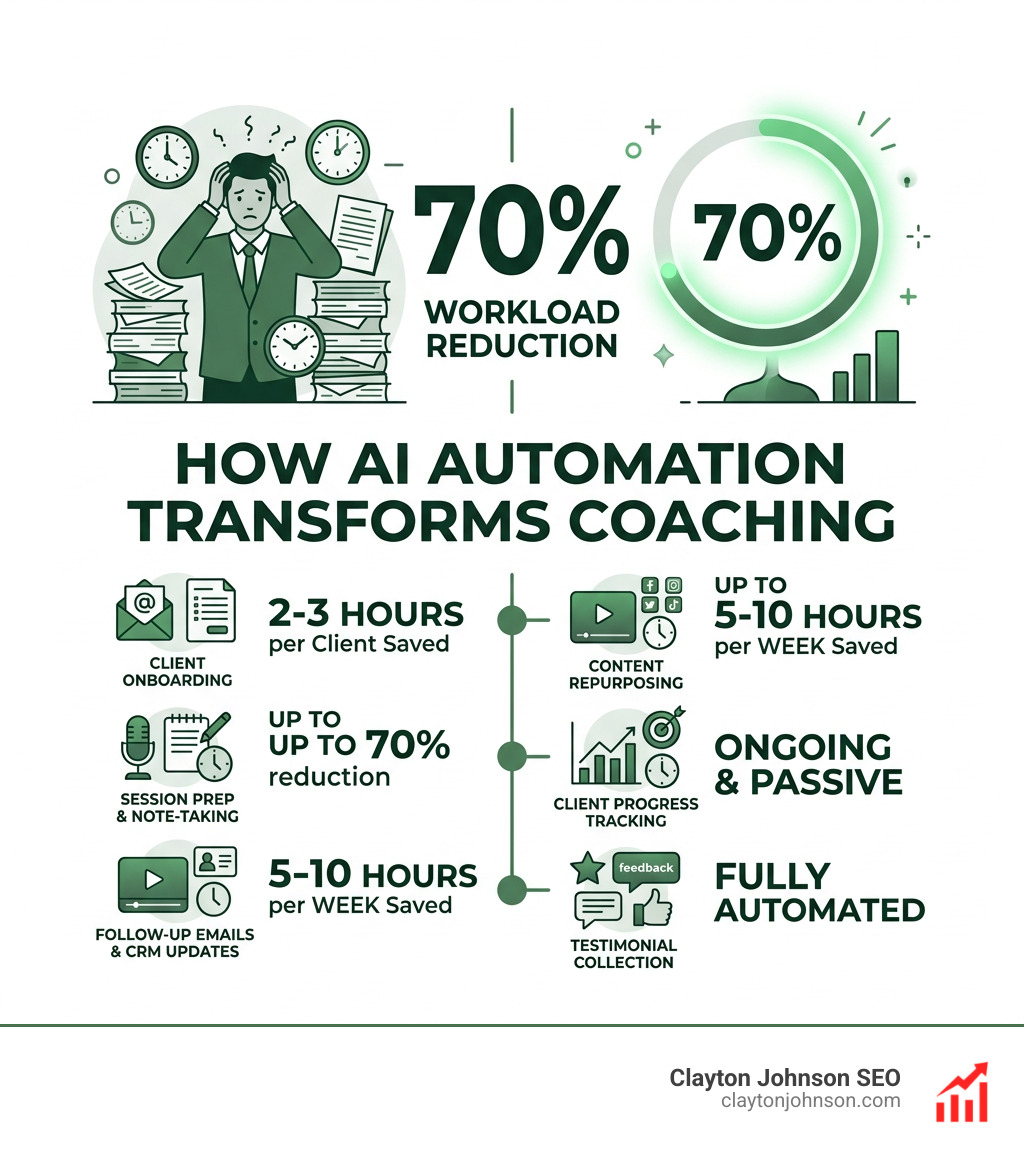
AI automation for coaches is the practice of using software tools to handle repetitive admin tasks — so you can spend more time actually coaching.
Here’s a quick breakdown of what it covers:
| What AI Automates | Time Saved |
|---|---|
| Client onboarding (welcome emails, intake forms) | 2-3 hours per client |
| Session prep and note-taking | Up to 70% reduction |
| Content repurposing from session recordings | 5-10 hours per week |
| Follow-up emails and CRM updates | 4+ hours per week |
| Client progress tracking and retention alerts | Ongoing, passive |
| Testimonial collection | Fully automated |
The bottom line: coaches who automate recover an average of 10 hours per week — without sacrificing the human connection that makes coaching work.
Research shows coaches spend up to 30% of their time on emails, scheduling, and session prep. That’s nearly a third of your working week on tasks that have nothing to do with helping clients get results. Over time, that kind of admin load doesn’t just slow growth — it causes burnout.
The good news? Most of it can be automated.
I’m Clayton Johnson, an SEO strategist and marketing automation expert who has spent nearly two decades helping business owners scale efficiently — including building AI-powered systems for coaches and consultants. My work sits at the intersection of search visibility and AI automation for coaches, which means I’ve seen which workflows move the needle and which ones are just hype. Let’s get into what actually works.
The Top 7 AI Automation for Coaches Workflows to Scale Your Business
The biggest lie in the coaching industry is that you need to work more hours to make more money. In reality, scaling is about removing yourself from the “busy work” so you can focus on high-leverage coaching. When we look at the biggest time-wasters, they usually fall into three buckets: scheduling, data entry, and manual follow-ups.
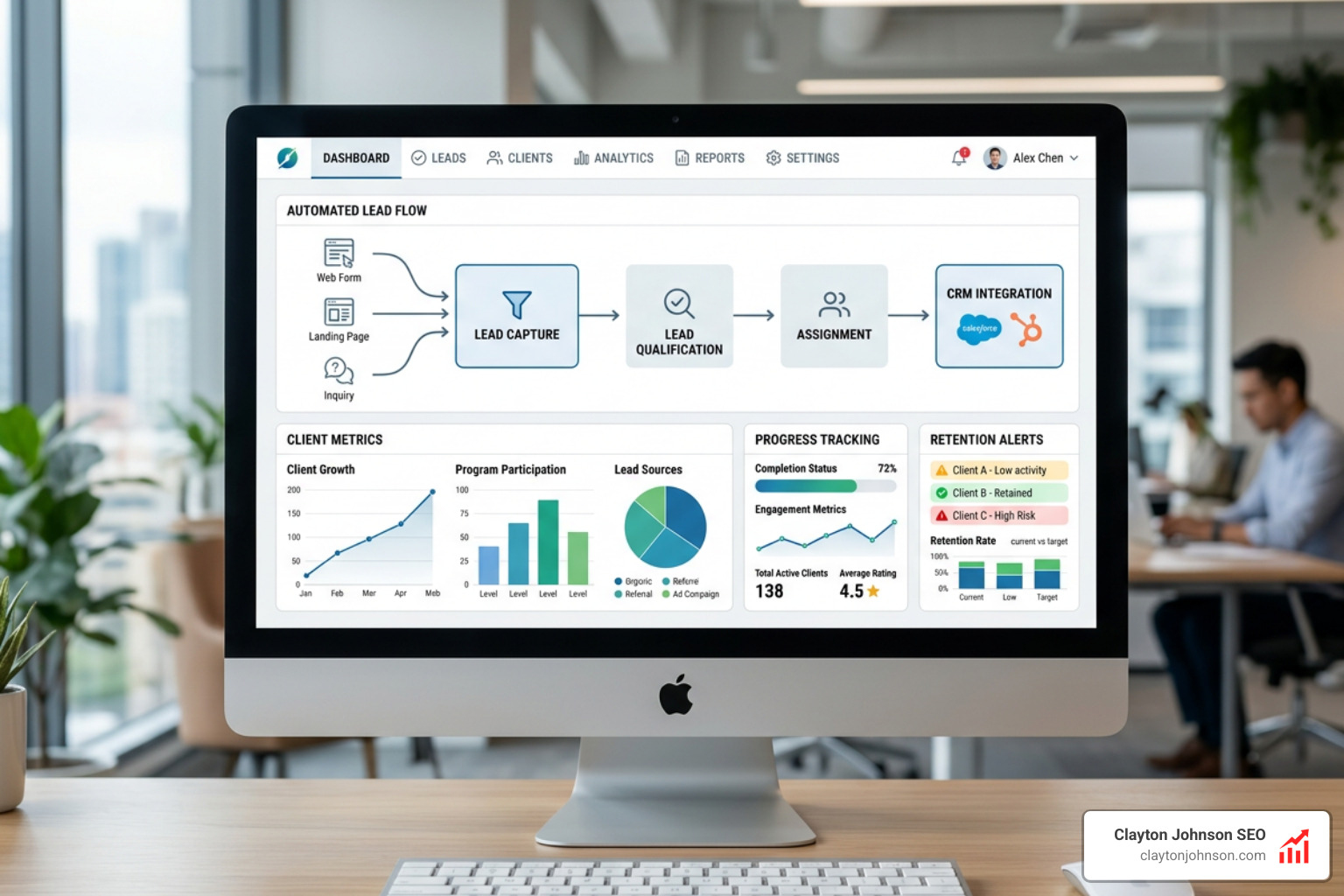
To fix this, we use “connectors” like Zapier or Make.com. These tools act as the glue between your favorite apps, allowing information to flow without you lifting a finger. For example, when a prospect fills out a form, AI can instantly qualify them, route the request to the right folder, and draft a personalized response.
The ROI here isn’t just theoretical. Statistics show that businesses utilizing these systems can save over 4 hours a week just on note-taking and CRM updates. Even better, automated email sequences generate 320% more revenue per email than non-automated campaigns, according to Campaign Monitor research. This is why learning how to win at implementing AI marketing systems is the ultimate competitive advantage.
1. Smart Client Onboarding and AI Automation for Coaches
The first impression is everything. If a client pays you and then waits 48 hours for a welcome email, the relationship is already on shaky ground. A smart onboarding system ensures that the moment a payment is processed, the machine starts working.
We recommend a workflow that connects Calendly, Typeform, and Google Drive.
- The Trigger: A client books their first session.
- The Action: An automated welcome sequence is sent, including an intake form.
- The AI Step: AI analyzes the intake form responses and summarizes the client’s biggest challenges into a “Cheat Sheet” for the coach.
- The Result: You save 2-3 hours per client and the client feels completely taken care of.
By implementing intelligent automation software, you eliminate the friction of manual document sharing and scheduling. This creates a “zero-wait” experience that prospects crave.
2. Automated Session Prep and Note-Taking
How many hours do you spend reviewing old notes before a call? Or worse, trying to remember what you promised a client three weeks ago? AI automation for coaches solves this through automated transcription and summarization.
Tools like Otter.ai or specialized coaching assistants can record your Zoom or Google Meet sessions, transcribe them in real-time, and then use a Large Language Model (LLM) to extract action items. One leadership coach reported a 70% reduction in session prep time by having an AI-generated dashboard that showed exactly where the last session left off.
Beyond just notes, you can watch AI call coaching in action to see how automated scoring improves performance. AI can detect the “sentiment” of the call—was the client frustrated? Excited? This data allows you to show up to the next session with a level of insight that manual note-taking simply can’t match.
3. Content Repurposing and Marketing AI Automation for Coaches
Marketing is often the first thing coaches neglect when they get busy. But if you stop marketing, your pipeline dries up. The solution is to turn your coaching sessions (with client permission) or your internal “brain dumps” into a content machine.
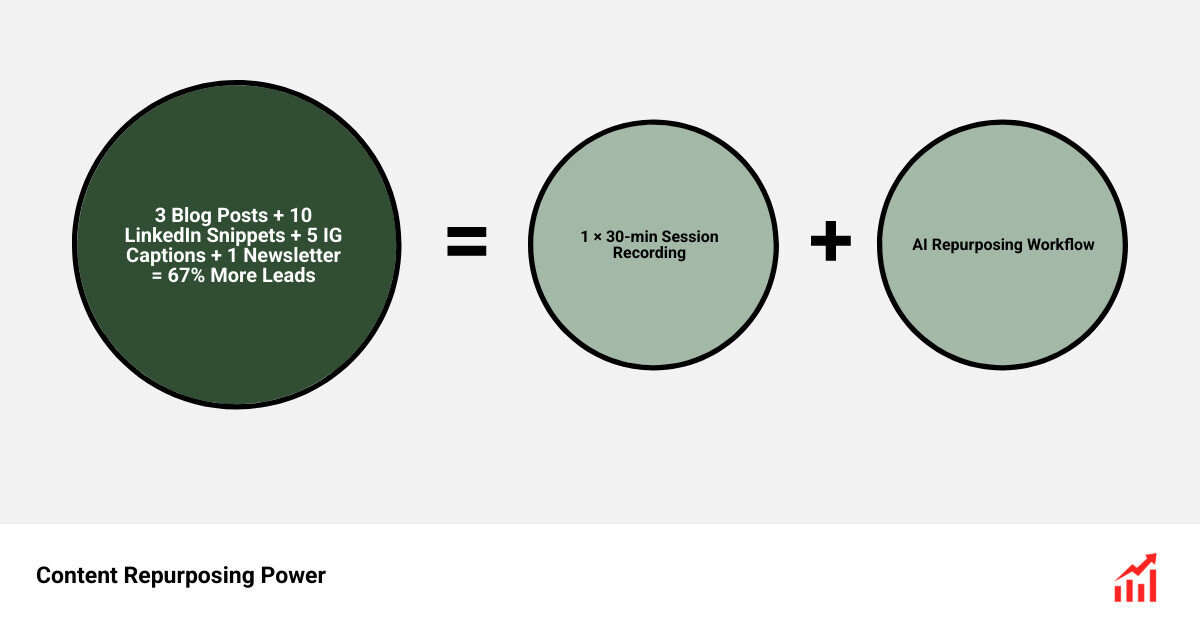
Imagine taking one 30-minute recording and turning it into:
- Three deeply researched blog posts.
- Ten LinkedIn snippets.
- Five Instagram captions.
- A weekly newsletter.
This isn’t a dream; you can turn a single blog post into 80+ pieces of content in less than 5 minutes using AI workflows. Research shows that businesses that consistently publish relevant content generate 67% more leads. By automating the “translation” of your spoken ideas into written thought leadership, you stay visible without spending your weekends writing.
4. Proactive Retention and Progress Tracking
The most expensive client to get is a new one. Keeping the ones you have is where the real profit lies. AI can act as an “early warning system” for client churn.
By centralizing your data in a tool like Airtable, you can set up automations that flag when a client:
- Misses two sessions in a row.
- Fails to fill out their weekly check-in.
- Expresses “low sentiment” in their messages.
Addressing these issues before a client “ghosts” you can boost retention by up to 40%. It allows you to be proactive rather than reactive. Instead of wondering why a client canceled, you’ll be reaching out with a personalized message the moment the data shows they are disengaged. For more on this, check out AI implementation best practices to ensure your tracking systems stay helpful, not creepy.
5. Testimonial Collection Pipelines
We know that strategically placed testimonials can boost conversions by 34%. Yet, most coaches forget to ask for them until they’re desperately looking for new clients.
A “Success Story Pipeline” automates this. You can set a trigger in your CRM so that when a client hits a specific milestone—say, 90 days in the program or completing a major goal—an automated email goes out asking for a quick Loom video or a written review.
The AI can then take that raw transcript, polish it into a punchy quote, and even draft a social media post celebrating the client’s win. This keeps a steady stream of social proof flowing into your marketing without you having to “chase” people down. It’s a key part of our non-robotic guide to implementing AI in business—using tech to highlight human success.
6. The AI Coach Clone and Niche Solutions
As you grow, you’ll eventually hit a ceiling: you only have 24 hours in a day. This is where “AI Clones” or niche-specific platforms come into play. An AI clone (like Coachvox) is trained on your specific methodology, your past content, and your unique voice. It can answer client questions at 3 AM, qualify leads on your website, and provide support when you’re on vacation.
For coaches in specific niches, there are already “out of the box” AI assistants designed for your unique data sets:
| Coaching Niche | Specialized AI Tool | Key Automation Feature |
|---|---|---|
| Endurance/Fitness | Athletica | Adaptive training plans based on real-time fatigue data. |
| Sports Performance | CoachSync | Automated athlete programming and load analysis. |
| Strength Training | CoachLogik | Raw metric-to-insight conversion for 40+ athletes. |
| Business Coaching | Coachvox | 24/7 lead qualification and methodology-based chat. |
These niche tools allow you to put AI agents to work for your marketing team and your service delivery simultaneously. They don’t replace you; they extend your reach.
Conclusion: Scaling Your Impact with Clayton Johnson SEO
The fear most coaches have is that AI automation for coaches will make their business feel cold and robotic. But the truth is the exact opposite. By automating the soul-crushing admin work, you actually free up the emotional energy required to be a great coach. You aren’t “losing your soul” to the machine; you’re using the machine to protect it.
When you stop copy-pasting data across 40 spreadsheets and start focusing on the human being in front of you, your results skyrocket. You’ll save 10+ hours a week, increase your revenue through better lead routing, and improve your life through better work-life balance.
At Clayton Johnson SEO, we specialize in building these durable systems. We don’t just look at keywords; we look at the entire architecture of your business—from how a prospect finds you on Google to how they are onboarded and retained through AI.
If you’re ready to stop drowning in admin and start building a scalable growth engine, we can help. Scale your business with expert coaching systems and let’s turn your fragmented marketing into a coherent, compounding asset.
