Long Tail SEO: Examples and Strategies for Niche Dominance

Why Most Searches Are Long Tail (And Why That Changes Everything)
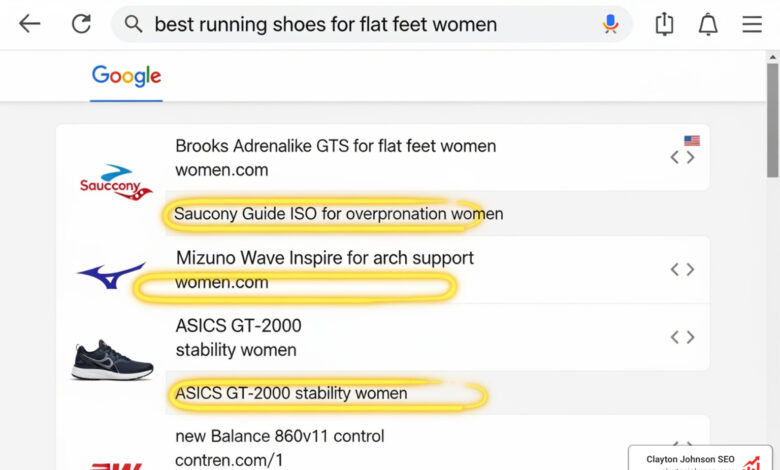
A long tail seo example looks something like this: instead of targeting “running shoes,” you target “best running shoes for flat feet women.” That one shift changes everything — less competition, more targeted traffic, and visitors who are ready to act.
Here are quick examples across common categories:
| Short-Tail (Head Term) | Long-Tail SEO Example |
|---|---|
| running shoes | best running shoes for flat feet women |
| CRM software | best CRM software for real estate agents |
| coffee shop | best organic coffee shop in downtown Seattle |
| hiking boots | lightweight waterproof hiking boots for winter |
| protein powder | best plant-based protein powder under $30 |
Long-tail keywords are phrases — usually three to five words — that are specific, low competition, and high intent. They target niche audiences instead of everyone.
Here’s why that matters for your business:
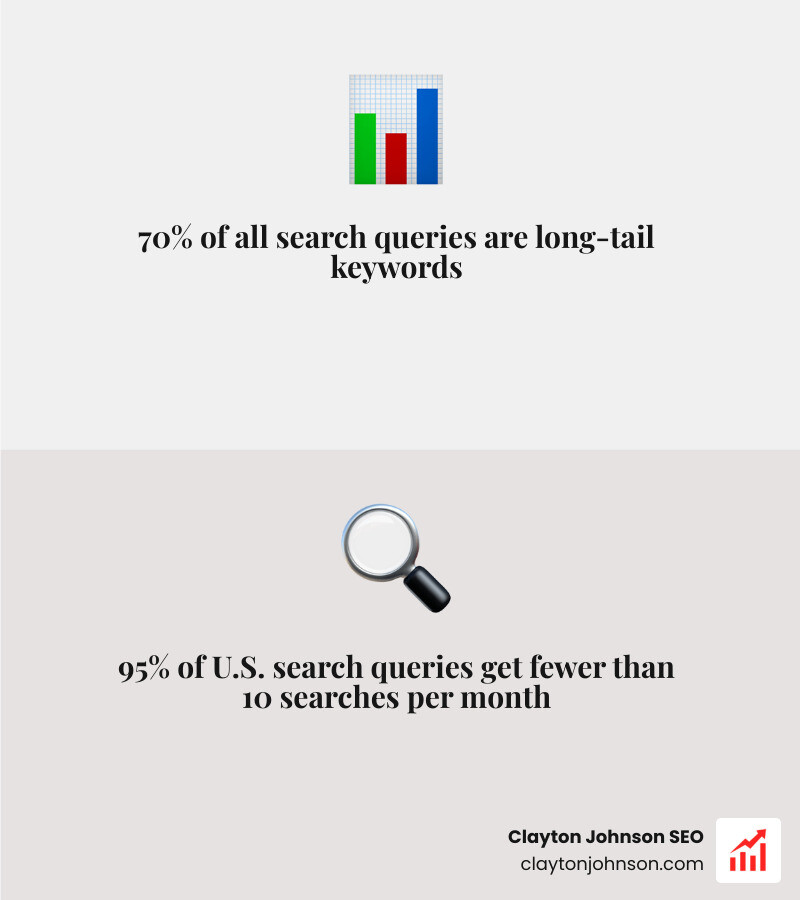
- Over 70% of all search queries are long-tail keywords
- They attract visitors who are closer to making a decision
- Smaller sites can rank for them without fighting industry giants
- They align naturally with voice search and AI-powered search results
If you’ve been pouring energy into broad keywords and watching bigger brands dominate the first page, long-tail SEO is the way out. It’s not about chasing volume — it’s about finding the right traffic.
What is a Long Tail SEO Example?
To understand a long tail seo example, we need to look at the search demand curve. Imagine a graph where the vertical axis is search volume and the horizontal axis is the number of keywords. On the far left, you have “Head Terms”—massive, one-word searches like “shoes” or “marketing.” These get millions of hits but are incredibly vague.
As you move to the right, the curve flattens out into a “long tail.” This is where the magic happens. While an individual long-tail keyword might only get 10 to 50 searches a month, there are billions of them. In fact, research shows that 95% of all search queries in the U.S. get fewer than 10 searches per month. Furthermore, roughly 70% of search queries are made using these specific phrases.
The Anatomy of a Long Tail Keyword
What makes a long tail seo example effective? It usually boils down to three attributes:
- Specificity: It describes exactly what the user wants (e.g., “organic cotton blue sofa” vs. “sofa”).
- Lower Competition: Giant retailers often ignore these low-volume terms, leaving the door open for you.
- High Conversion Potential: A person searching for “buy silver jewelry online” is much closer to pulling out their credit card than someone just searching for “jewelry.”
Head Term vs. Long Tail: The Comparison Table
| Attribute | Head Term (Short-Tail) | Long-Tail Keyword |
|---|---|---|
| Example | “SEO” | “SEO strategy for local law firms” |
| Search Volume | Very High | Low to Moderate |
| Competition | Extremely High | Low |
| Search Intent | Ambiguous (Researching) | Clear (Solving/Buying) |
| Conversion Rate | Low | High |
| Word Count | 1-2 words | 3+ words |
Real-World Long Tail SEO Example Across Industries
In our experience at Clayton Johnson SEO, we’ve seen that long-tail keywords are your secret weapon regardless of your niche. Let’s look at how this plays out in different sectors.
E-commerce
A broad term like “jacket” is a battlefield. However, an ecommerce long tail seo example like “men’s waterproof breathable hiking jacket” filters out people looking for denim jackets or winter parkas. You aren’t just getting traffic; you’re getting the right traffic.
SaaS & B2B
For a software company, “CRM” is nearly impossible to rank for. But “cloud-based CRM for non-profit fundraising” targets a specific pain point. B2B buyers often use complex, descriptive queries to find solutions that fit their exact business model. These “topical” long-tails allow smaller SaaS players to dominate a niche.
Local Business
Local SEO thrives on long-tail phrases. Instead of “dentist,” a clinic might target “emergency pediatric dentist in downtown Chicago.” By adding location and service modifiers, you capture users with immediate, high-intent needs.
A Practical Long Tail SEO Example for Content Planning
Success in SEO isn’t just about finding one keyword; it’s about the ultimate guide to keyword strategy and how you map those words to your user’s journey.
When planning content, we distinguish between two types of long-tail keywords:
- Supporting Long-Tail: These are variations of a main topic. For example, if your main post is about “how to bake a cake,” supporting keywords might be “how to bake a cake without eggs” or “easy chocolate cake recipe for beginners.”
- Topical Long-Tail: these are unique, standalone topics that deserve their own page because they address a very specific intent that isn’t covered by a broader “parent” topic.
By understanding your buyer personas, you can map these keywords to different stages of the funnel. A “beginner” persona might search for “what is SEO,” while a “ready-to-hire” persona might search for “best SEO agency for Shopify stores.” Learning how to target low volume keywords for high volume profits is about capturing those high-intent users who are often ignored by the “big guys.”
Mastering Long Tail SEO Strategy for Compounding Growth
At Clayton Johnson SEO, we don’t just “do SEO”—we build systems. A long-tail strategy shouldn’t be a random list of blog posts; it should be a structured ecosystem. This is where pillar pages and topic clusters explained for mere mortals comes into play.

The Cluster Method
Instead of trying to rank one page for 50 different keywords, you create a “Pillar Page” (a comprehensive guide on a broad topic) and surround it with “Cluster Content” (shorter articles targeting specific long-tail keywords). You then use internal linking to connect them. This tells search engines that you have deep topical authority.
On-Page Optimization Basics
Once you have your long tail seo example identified, you need to place it strategically:
- Title Tags & Meta Descriptions: Keep titles under 60 characters and descriptions under 160.
- Headers (H1, H2, H3): Use your long-tail phrase naturally in at least one subheading.
- URL Structure: Keep it clean.
/blog/best-running-shoes-flat-feetis better than/blog/p=12345. - Image Alt Text: Describe the image using a variation of your keyword.
How to Find High-Intent Long Tail SEO Examples
You don’t need a crystal ball to find these keywords; you just need the right tools. While we often use Ahrefs and SEMrush for deep data, some of the best insights come from free sources.
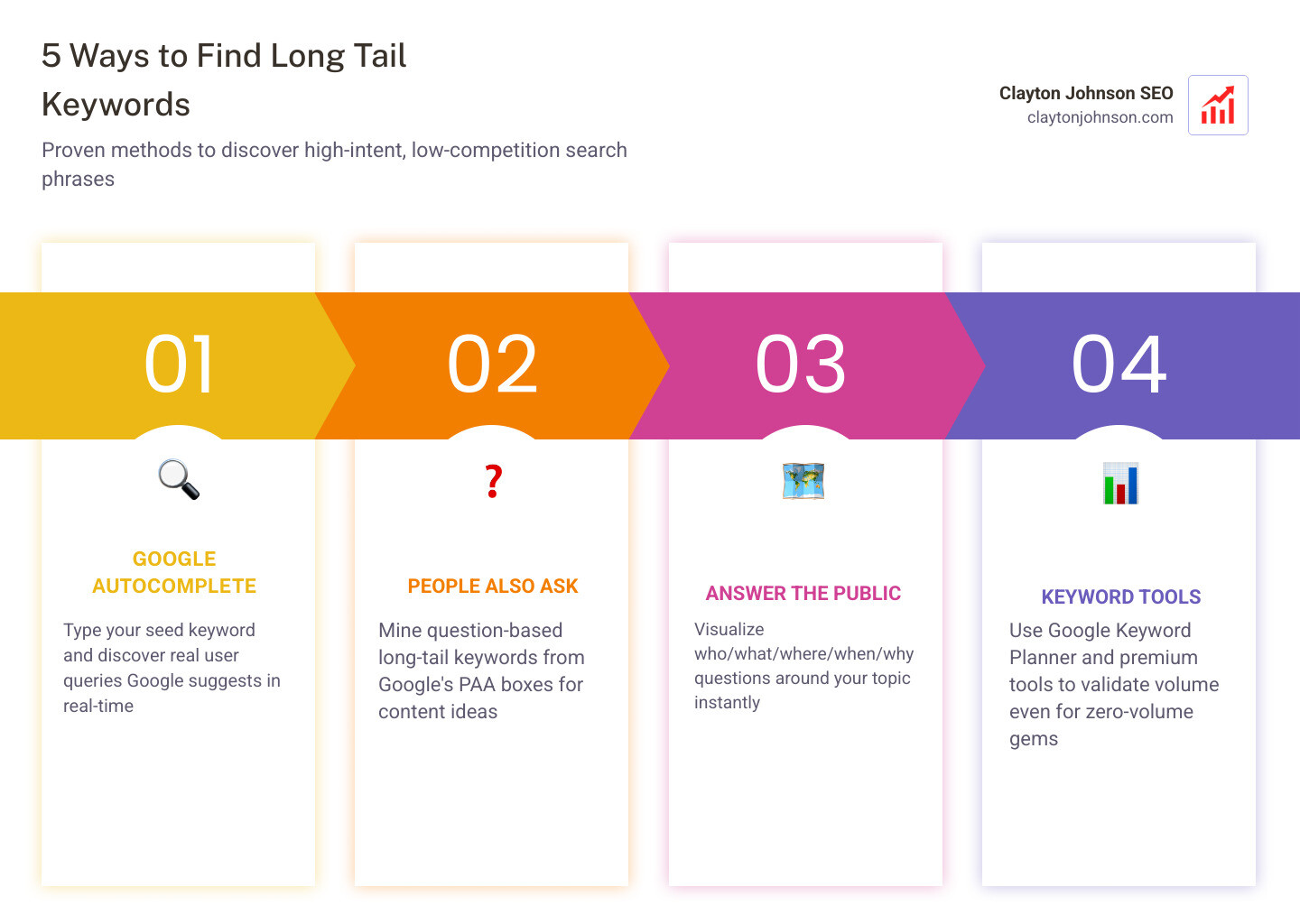
- Google Autocomplete: Start typing your main keyword into the search bar and see what Google suggests. These are real searches people are performing right now.
- People Also Ask (PAA): These question-based blocks are a goldmine for long-tail phrases. Each question can often be a standalone H2 or even a full blog post.
- Answer The Public: This tool Answer The Public visualizes the “who, what, where, when, and why” of any topic.
- Keyword Research Tools: Use Google Keyword Planner to find volume data, but even “zero volume” keywords in these tools can drive significant traffic.
- AI-Assisted Research: We believe finding keywords with AI is easier than you think. Tools like ChatGPT can help you brainstorm niche pain points and user intents that traditional tools might miss.
Optimizing for AI Overviews and Voice Search
The search landscape is shifting. Research indicates that a significant portion of AI Overview results handle multiple search intents simultaneously. This means that winning the AI search era with intent-based keyword research is no longer optional.
Search queries that trigger AI Overviews have grown in length and complexity. This trend perfectly aligns with long-tail strategies. People are talking to their devices like they talk to friends. Instead of typing “weather,” they ask, “Will I need an umbrella in Seattle this afternoon?”
To stay ahead, focus on natural language. Write content that answers questions directly. AI Overviews pull from a wide variety of unique websites for complex B2B queries—this is a massive opportunity for smaller, specialized sites to earn “citations” in the AI response, even if they aren’t the #1 organic result. The future of search with AI-powered keyword research is about precision, not just volume.
Measuring Success and Avoiding Common Pitfalls
How do you know if your long tail seo example is actually working? You have to look beyond the “big” numbers.
Tracking the Right Metrics
- Google Search Console: Look for “Impressions” on your specific long-tail queries. Even if clicks are low initially, rising impressions mean you’re becoming relevant.
- Google Analytics: Track the “Conversion Rate” of your long-tail landing pages. You’ll often find that while they get less traffic, the traffic they do get converts at a much higher rate.
- Rank Tracking: Use tools like Google Search Console or Ahrefs to monitor your position for specific niche phrases.
Common Mistakes to Avoid
- Keyword Stuffing: Don’t force the phrase “best organic coffee shop in downtown Seattle” into every sentence. Google is smart enough to understand synonyms and natural phrasing.
- Ignoring Intent: If someone searches “how to fix a leaky faucet,” they want a guide, not a product page for a new wrench. Match your content type to what the user is actually looking for.
- Chasing Volume Only: A keyword with 10 searches that results in a $5,000 sale is infinitely better than a keyword with 1,000 searches that results in nothing.
The Clayton Johnson SEO Philosophy: Clarity and Structure
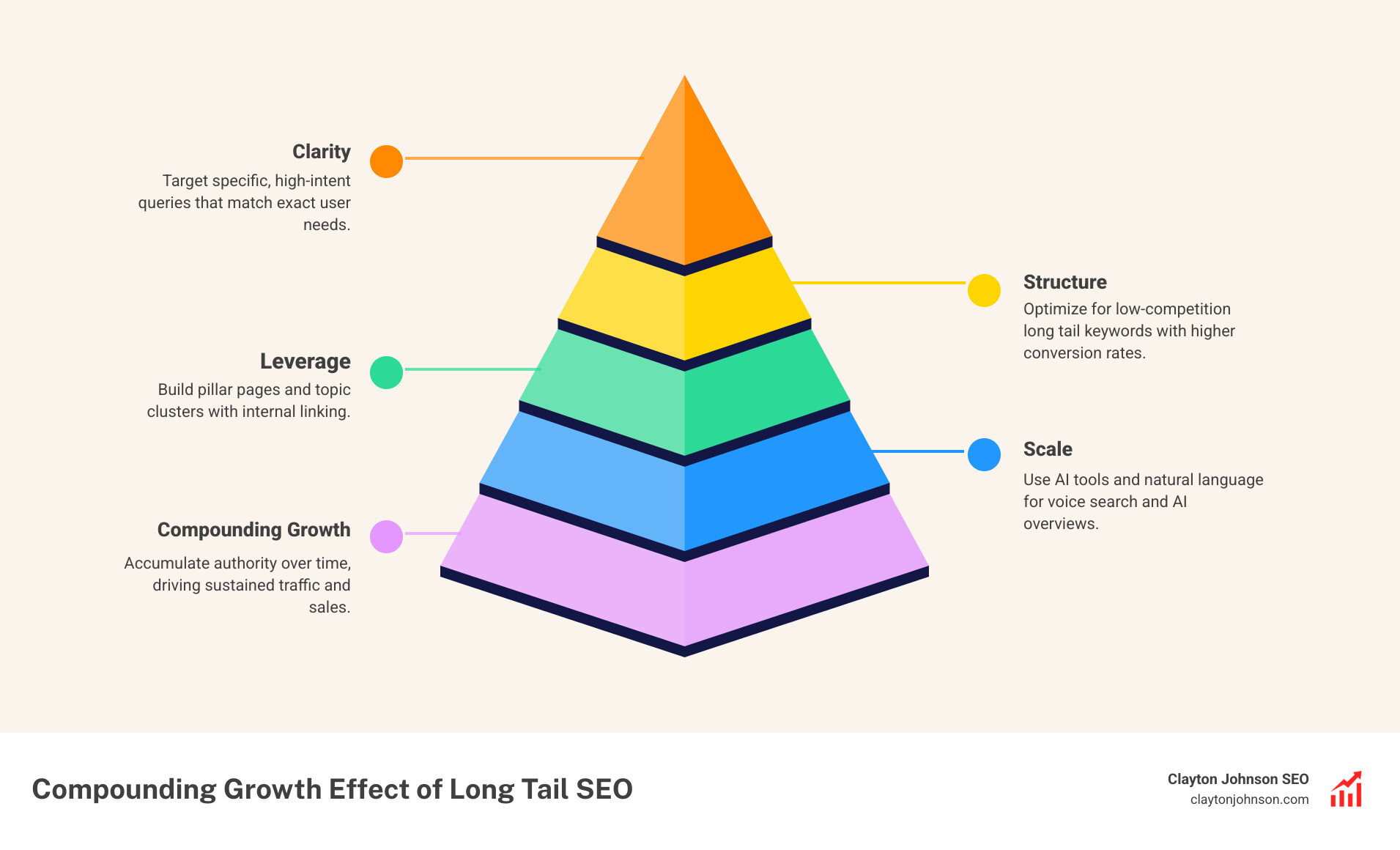
At the end of the day, long-tail SEO is about leverage. By building a structured content ecosystem based on search intent, you create a compounding growth engine. We focus on:
- Technical SEO: Ensuring your site architecture allows these long-tail pages to be found.
- AI-Augmented Workflows: Using tools to scale your content production without sacrificing quality.
- Measurable Outcomes: Focusing on business impact—sales and leads—rather than vanity metrics.
If you’re ready to stop fighting for scraps and start dominating your niche, it’s time to embrace the long tail. It’s the most durable way to build authority in an increasingly AI-driven world.
Final Thoughts: Mastering the Long Tail
Long-tail SEO isn’t just a “tactic”—it’s a fundamental shift in how we think about search. By focusing on the specific, conversational, and high-intent queries that make up the vast majority of the internet’s searches, you can bypass the giants and connect directly with your ideal customers.
Whether you are an e-commerce store, a local business, or a B2B SaaS provider, the path to growth is the same: Clarity → Structure → Leverage → Compounding Growth.
Start by identifying your first long tail seo example, build a high-quality piece of content around it, and watch as the right kind of traffic starts finding you. If you need help building these systems, we’re here to help you turn fragmented marketing into a coherent growth engine.