Scaling AI: A Strategic Framework for Modern Organizations

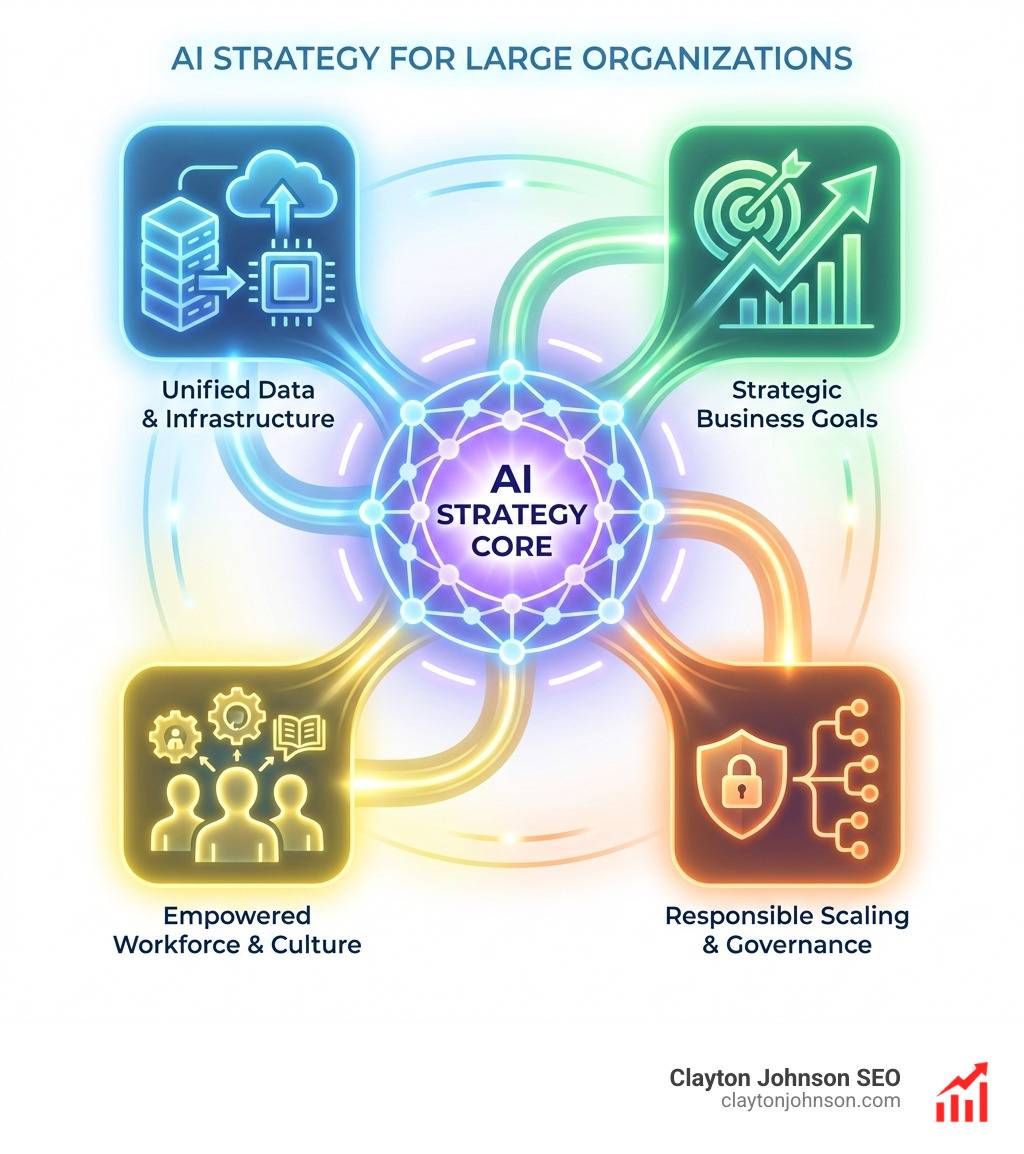
Why AI Strategy for Large Organizations Demands More Than Technology
AI strategy for large organizations is no longer about deploying chatbots or running isolated pilots—it’s about enterprise-wide transformation that delivers measurable ROI while navigating governance, culture, and architectural complexity. Here’s what actually works:
Key Components of Effective AI Strategy:
- Enterprise-wide alignment championed by C-suite with clear KPIs tied to business outcomes
- Data governance foundation including sovereignty, quality controls, and real-time compliance
- Strategic bets vs. table stakes — knowing when to build proprietary capabilities vs. buy platforms
- Agentic architecture enabling human-AI teams to operate at scale with autonomous workflows
- Dynamic iteration treating AI strategy as continuous reinvention, not a one-time plan
The numbers tell a stark story. More than 60% of organizations now have generative AI use cases in production—a 4X increase in just 12 months. Yet nearly 90% of organizations use AI regularly while less than 20% have scaled beyond pilots. The gap between experimentation and production value remains the defining challenge for large enterprises.
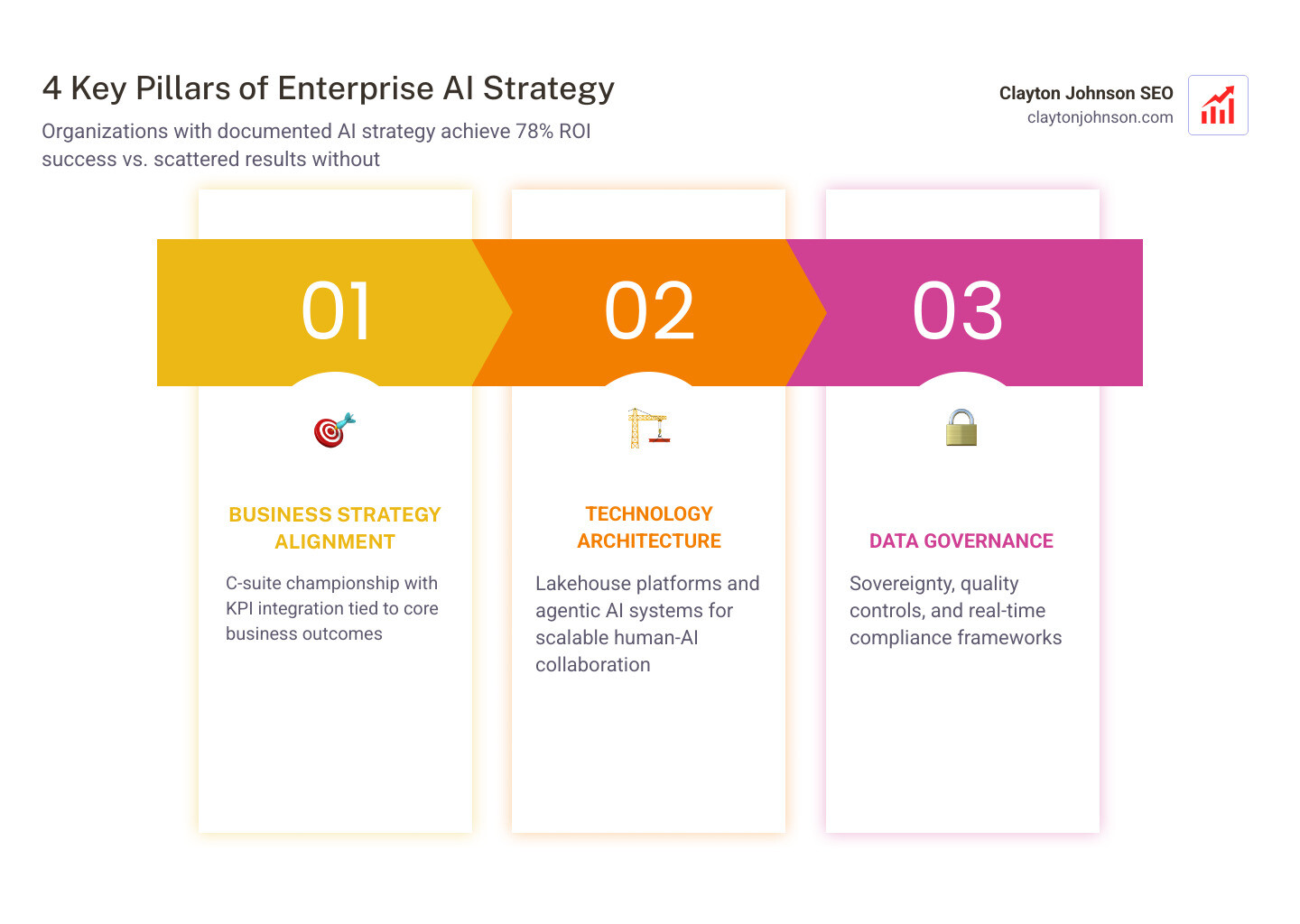
Organizations with a documented AI strategy see 78% already achieving ROI from generative AI, compared to scattered results among those without one. High performers—what Deloitte’s research calls “Transformers”—are three times more likely to have an enterprise-wide strategy and more than twice as likely to have leaders actively communicating an AI vision. They balance efficiency goals with growth objectives like new products and market expansion, while lower performers over-index on cost reduction alone.
The failure pattern is consistent. AI transformations stall when initiatives aren’t aligned with core business strategy, when data governance is weak, when cultural resistance isn’t addressed, or when efforts spread too thin across disconnected use cases. A global automotive manufacturer discovered this painfully when an AI-generated seat bracket design—40% lighter and 20% stronger—never reached production because their stamped-steel supply chain couldn’t manufacture the complex geometry. Innovation without operational integration is just expensive research.
The path forward requires rethinking operating models entirely. Organizations scaling AI successfully treat it as strategic fuel for their business north star, not as isolated technology projects. They establish lakehouse architectures that unify data warehouses and lakes, eliminating synchronization bottlenecks. They build agentic AI systems where small human teams supervise dozens of specialized AI agents handling end-to-end workflows. And critically, they balance build-versus-buy decisions by purchasing platforms for foundations while building only what provides true competitive advantage.
Canadian organizations face an additional strategic imperative: 91% now prioritize data sovereignty as AI usage expands, driven by geopolitical tensions and regulatory requirements. Data residency isn’t just a compliance checkbox—it’s becoming a strategic differentiator as proprietary data forms “walled gardens” beyond public internet training sets.
I’m Clayton Johnson, and I’ve spent years building scalable growth systems at the intersection of strategy, SEO, and AI-assisted workflows—helping organizations turn fragmented AI efforts into coherent AI strategy for large organizations that deliver compounding returns. The frameworks that follow draw from research across 2,000+ enterprises and dozens of executive interviews to give you an actionable roadmap.
Ai strategy for large organizations vocab to learn:
The Pillars of an Effective AI Strategy for Large Organizations
To build a strategy that doesn’t just sit in a slide deck, we must look at AI as “strategic fuel” rather than a standalone engine. According to a recent study on GenAI ROI, organizations that treat AI as a core business priority see a 4X increase in production use cases compared to those that treat it as a technical experiment.
The most successful organizations—the “Transformers”—start with their North Star. They don’t ask “What can AI do?” but rather “What are our core business goals, and how can AI accelerate them?” This distinction is vital. While “Starters” get bogged down in low-impact experiments, Transformers align their AI initiatives with enterprise-wide KPIs. This requires heavy C-suite championship; when the CEO acts as the “AI communicator-in-chief,” the organization moves faster and with more clarity. For those looking to dive deeper, we have more info about enterprise AI strategy available in our knowledge base.
Aligning Initiatives with Core Business Goals
We believe the strongest strategies begin without mentioning AI at all. They start with the business strategy and identify where friction exists. By integrating AI into the existing value-creation process, leaders can ensure that every dollar spent on technology moves the needle on growth. High-performing organizations shift from a cost-cutting mindset to a growth mindset, using AI to enter new markets or improve customer satisfaction. In this context, AI is the “fuel” that powers the strategic vehicle.
Why Most AI Transformations Fail
Most failures aren’t technical; they are systemic. Innovation stalls often occur when an AI breakthrough meets an immovable legacy object. We see this when a company develops a brilliant AI model that their existing supply chain or manufacturing systems simply cannot support. The General Motors seat bracket failure is the classic example: the AI designed a perfect part, but the factory was built for stamped steel, not complex AI geometries.

Architecting the Foundation: Data Governance and Sovereignty
You cannot scale AI on a shaky data foundation. Modern organizations are increasingly moving toward a lakehouse architecture, which unifies the best parts of data lakes and data warehouses. This architecture supports open standards, ensuring that you aren’t locked into a single vendor’s ecosystem.
For our partners in Canada, a new study on Canadian AI priorities highlights that 91% of businesses prioritize data sovereignty. With rising geopolitical pressures, keeping sensitive data within national borders is no longer optional—it’s a strategic necessity. This ties directly into compliance and risk management. If you are building for the long term, you need more info about responsible AI frameworks to guide your data handling.
Establishing Real-Time Governance and Responsible AI
Responsible AI isn’t just about ethics; it’s about reliability. By adopting frameworks like the NIST AI Risk Management Framework, organizations can establish guardrails that prevent bias and hallucinations before they reach production. Tools like the Responsible AI Dashboard allow teams to track data lineage and model performance in real-time, ensuring that the “black box” of AI remains transparent and auditable.
The Agentic Shift: Moving Beyond Simple Automation
The next frontier of ai strategy for large organizations is the “agentic organization.” We are moving away from simple RAG (Retrieval-Augmented Generation) systems toward an agentic AI mesh. In this paradigm, AI isn’t just a tool; it’s a coworker.
Imagine “human-AI squads” where two or three humans supervise fifty specialized AI agents. These agents don’t just answer questions; they execute end-to-end workflows, from M&A due diligence to supply chain optimization. This tool-coworker duality requires a fundamental redesign of the operating model. For a deeper dive, check out this inside look at AI agents.

Building the Next-Generation AI Strategy for Large Organizations
To thrive in the agentic era, organizations must flatten their networks. Real-time governance becomes the bottleneck if it remains centralized and slow. Instead, we advocate for agent-to-agent protocols that allow systems to communicate and integrate with near-zero marginal cost. By cultivating proprietary “data gardens,” companies can ensure their agents are learning from unique, high-value information that competitors can’t access on the public web.
Operationalizing Success: Build vs. Buy and ROI
A common pitfall in ai strategy for large organizations is trying to build everything from scratch. We recommend a structured approach based on the source of your competitive advantage.
| Model Type | Best For | Speed | Customization | Control |
|---|---|---|---|---|
| SaaS (Copilots) | General productivity, email, basic coding | Very High | Low | Low |
| PaaS (Foundry/RAG) | Custom customer service, internal knowledge bases | Medium | High | Medium |
| IaaS (Custom Training) | Proprietary R&D, highly regulated data | Low | Very High | Very High |
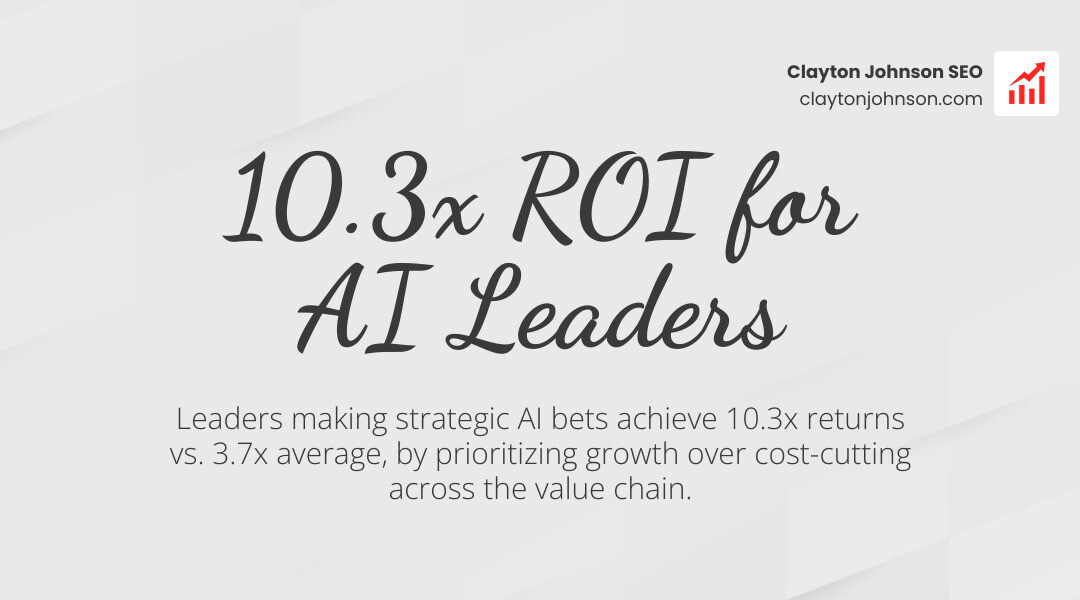
Research shows that for every dollar invested in generative AI, organizations realize an average ROI of 3.7x. However, top leaders—those who make “strategic bets” rather than just “table stakes” investments—are seeing returns as high as 10.3x. Learn more about why your brand needs an AI growth strategy right now.
Measuring Tangible ROI and Performance
ROI shouldn’t be a mystery. High performers focus on EBIT impact and adoption rates. By allocating capital to projects that spark growth rather than just cutting costs, organizations can drive continuous reinvention. McKinsey insights on AI in business functions suggest that 88% of organizations already use AI in at least one function, but the real winners are those who scale it across the entire value chain.
Cultivating an AI-Ready Workforce and Culture
Technology is only half the battle. The other half is people. To foster a culture of adoption, organizations must invest in EPOCH capabilities—human skills like empathy, problem-solving, and orchestration that complement AI’s shortcomings.
The C-suite vision must be clear: AI is not here to replace the workforce, but to augment it. Effective change management requires a structured approach, often following frameworks like Kotter’s 8-step process to move from chaos to controlled transformation.

A Crawl-Walk-Run Roadmap for AI Strategy for Large Organizations
We suggest using the MIT Center for Information Systems Research maturity model to assess your progress.
- Crawl: Experiment and build pilots. Focus on low-risk, high-visibility wins.
- Walk: Establish “AI ways of working.” Standardize your data stack and governance.
- Run: Become a “future-ready” organization. Deploy agentic workflows and proprietary data ecosystems.
This roadmap ensures you don’t over-extend before your foundations are ready. Future-proofing your strategy means iterating constantly as the technology evolves.
Frequently Asked Questions about Enterprise AI
Why do most large-scale AI pilots fail to reach production?
Most pilots fail because they lack business alignment or hit “innovation stalls” caused by legacy system incompatibility. Without a clear path to ROI and C-suite support, pilots often become “zombie projects” that never scale.
How should organizations balance data sovereignty with global AI scaling?
Large organizations should adopt a “regionalized” data strategy. Use global platforms for non-sensitive tasks, but maintain strict data residency and sovereignty for proprietary or regulated data, especially in jurisdictions like Canada.
What is the difference between a “Transformer” and a “Starter” organization?
“Transformers” have an enterprise-wide AI strategy, are 3X more likely to achieve high ROI, and focus on growth and value creation. “Starters” treat AI as a series of disconnected experiments and usually over-index on cost-cutting.
Conclusion
Scaling an ai strategy for large organizations is a marathon, not a sprint. It requires a delicate balance of bold ambition and rigorous governance. At Clayton Johnson SEO, we specialize in helping leaders navigate this complexity by building strategic frameworks that drive measurable growth. Whether you are diagnosing growth problems or building AI-assisted workflows, our goal is to help you achieve scalable impact.
Ready to take the next step? Explore our enterprise services or reach out to us in Minneapolis, Minnesota, to start your transformation journey. The era of the agentic enterprise is here—don’t just watch it happen, lead it.