Step-by-Step Guide to Local SEO for Acupuncturists


Why Most Acupuncture Clinics Are Invisible Online (And How to Fix It)
Local SEO for acupuncturists is the process of optimizing your online presence so nearby patients find your clinic first when they search Google for services like acupuncture, pain relief, or fertility support.
Here’s a quick summary of what it involves:
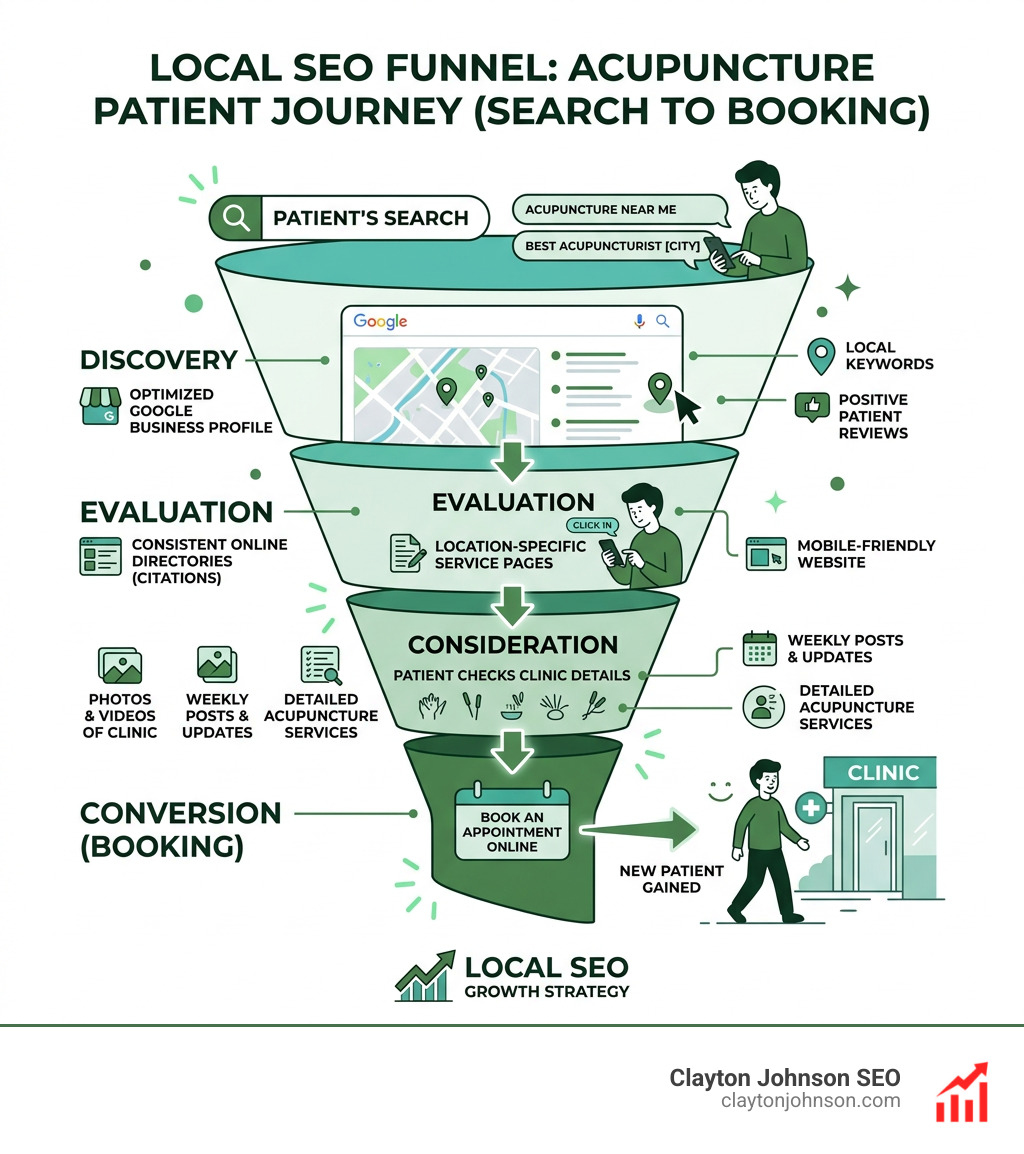
- Claim and optimize your Google Business Profile with accurate info, photos, and weekly posts
- Use high-intent local keywords like “acupuncture near me” or “acupuncture for back pain in Minneapolis”
- Build consistent citations (your name, address, and phone number) across online directories
- Generate patient reviews regularly and respond to every one
- Create location-specific service pages on your website
- Fix technical basics like mobile speed, SSL, and schema markup
The numbers are hard to ignore. 97% of people search online to find local businesses. And 77% of patients now use online searches to find healthcare providers. If your clinic isn’t showing up on the first page of Google — especially in the local map pack — you’re losing patients to competitors every single day.
The good news? Local SEO levels the playing field. Unlike big national health brands, you’re only competing with other clinics in your area. Many of them aren’t doing this well yet.
That means a focused, consistent local SEO strategy can move your clinic into the top Google results faster than you might expect — sometimes in as little as 30 days for the map pack, and within 3–6 months for broader organic growth.
This guide walks you through every step.
Why Local SEO for Acupuncturists is Your Best Growth Strategy
If you’ve ever felt like your clinic is the best-kept secret in town, you’re not alone. Many practitioners rely on word-of-mouth, but in the digital age, “word-of-mouth” happens on a smartphone screen. According to HubSpot: Local SEO Statistics, nearly 97% of people learn more about a local company online than anywhere else.
For an acupuncturist, local SEO isn’t just a marketing “extra”—it’s your primary growth engine. When someone wakes up with a stiff neck or is struggling with fertility, they don’t look for a flyer on a telephone pole. They search for “acupuncture near me.” This is what we call “high-intent traffic.” These searchers aren’t just browsing; they are ready to book an appointment.
By dominating the “Local Pack”—that box of three map listings at the top of Google—you gain an immediate competitive advantage. Most of your local competitors are likely still using outdated methods or have neglected their digital presence. Dominating this space builds instant patient trust. If Google recommends you as a top-three option, patients perceive you as a leader in your community. To understand the groundwork of how search engines work, check out our guide on SEO 101.
Optimizing Your Google Business Profile: The Digital Front Door
Think of your Google Business Profile (GBP) as your clinic’s digital front door. In many cases, patients will see your GBP before they ever click on your website. If this profile is messy, incomplete, or unverified, they’ll simply keep scrolling to the next needle-wielder.

Claiming and Verification
The first step is to visit Google Business Profile and see if a listing already exists for your clinic. If it does, claim it. If not, create one. Google will usually require verification via a postcard sent to your physical clinic address or a quick video verification. Don’t skip this; an unverified profile won’t show up in the Map Pack.
NAP Consistency
NAP stands for Name, Address, and Phone number. It sounds simple, but inconsistency is a major “ranking killer.” If your website says “Suite 200” but your Google profile says “Ste 2,” Google might get confused about your location’s legitimacy. Ensure your NAP is identical across your website, GBP, and all directories.
Engagement and Content
To truly optimize, you must move beyond the basics:
- Service Categories: Choose “Acupuncturist” as your primary category, but add secondary ones like “Pain Management Physician” or “Wellness Center” if applicable.
- Weekly Posts: Think of these as mini-blog posts. Share health tips, clinic updates, or “Mental Health Monday” insights. Regular updates signal to Google that your business is active.
- Geo-tagged Photos: Upload high-quality photos of your treatment rooms, your smiling staff, and even the exterior of your building. Using “geo-tagged” photos (images with location metadata) helps reinforce your local relevance.
- Business Description: Write a 100–200 word description that highlights your specialties (e.g., fertility, sports medicine) and ends with a clear call to action like “Book your first session today for 10% off.”
Mastering Content and Keywords for Your Practice
Targeting High-Intent Keywords for Local SEO for Acupuncturists
Keywords are the “pressure points” of your SEO strategy. You need to hit the right ones to get a reaction. For local SEO for acupuncturists, we categorize keywords into two buckets: Buying Intent and Research Intent.
| Keyword Type | Example | Intent |
|---|---|---|
| Buying Intent | “Acupuncturist in Minneapolis” | Ready to book now |
| Buying Intent | “Acupuncture for back pain near me” | Seeking immediate relief |
| Research Intent | “Does acupuncture hurt?” | Gathering information |
| Research Intent | “Benefits of cupping therapy” | Considering options |
While research keywords are great for blog posts, buying intent keywords should be the focus of your homepage and service pages. You can Get My Keywords (FREE) to discover the specific phrases your local audience is using. Don’t forget Traditional Chinese Medicine (TCM) specific terms—some patients search specifically for “dry needling,” “cupping,” or “herbal medicine.”
Creating Location-Specific Content and Service Pages
One common mistake we see is clinics putting all their services on one long page. Google prefers depth. If you offer fertility support, create a dedicated “Fertility Acupuncture in Minneapolis” page. This allows you to use local jargon and address the specific needs of your community.
When creating valuable content, aim for a “neighborly” tone. Instead of just listing clinical benefits, share anonymized patient success stories. For example: “How we helped a local marathon runner get back on the trail in Minneapolis.” This builds emotional resonance and local relevance simultaneously. Ensure you use internal linking to connect these pages back to your main booking page. If you need professional help crafting these strategies, explore our SEO services.
Building Authority with Citations, Reviews, and Technical SEO
Managing Patient Reviews and Local Citations
Reviews are perhaps the most powerful trust signal in healthcare. Research shows that over 72% of patients consider online reviews when choosing a provider. In local SEO for acupuncturists, reviews aren’t just “nice to have”—they are a ranking factor. Getting just 5–10 new positive reviews can significantly propel your clinic into the Map Pack.
- The Strategy: Ask patients for reviews after their 3rd or 4th session, when they’ve started feeling the results but the experience is still fresh. You can use QR codes in the lobby or follow-up emails.
- The Response: Always respond to reviews. A simple “Thank you, we’re so glad you’re feeling better!” shows prospective patients that you care. If you get a negative review, respond professionally and offer to take the conversation offline.
- Citations: These are mentions of your NAP on other websites like Yelp, Healthgrades, and Yellow Pages. Consistent citations act as “votes of confidence” for Google. For more on this, check out A local guide to building digital authority without losing your mind.
Technical Optimizations and Mobile Performance
You could have the best content in the world, but if your website takes ten seconds to load, patients will “bounce” back to the search results.
- Speed Matters: A website taking more than 3 seconds to load loses over 40% of its visitors. Use compressed image formats like WebP to keep things fast.
- Schema Markup: This is a bit of code that helps search engines understand your business type, hours, and location. Specifically, you want “LocalBusiness” structured data. It’s like giving Google a direct map to your data.
- Mobile-Friendliness: Over 60% of searches happen on mobile devices. If your site looks wonky on an iPhone, you’re losing patients.
- Security: Ensure your site has an SSL certificate (the “https” in your URL). Patients are sharing health concerns; they need to know your site is secure. For a refresher on these basics, see An absolute beginners guide to mastering core SEO.
Frequently Asked Questions about Local SEO for Acupuncturists
How long does it take to see results from local SEO?
This is the most common question we hear! Local SEO is a marathon, but the “sprints” can be rewarding.
- 30 Days: You can often see a boost in your Map Pack position within a month if you optimize your GBP and get a handful of new reviews.
- 3-6 Months: This is the typical timeframe for seeing significant organic growth and ranking for competitive keywords like “acupuncture Minneapolis.”
- The Variables: Your timeline depends on how competitive your market is. If you’re the only acupuncturist in a small town, you’ll rank almost instantly. In a city like Minneapolis, it takes more consistent effort.
What are the most common mistakes in local SEO for acupuncturists?
We see these “ranking killers” all the time:
- Inconsistent NAP: Having different addresses or phone numbers listed across the web.
- Ignoring Reviews: Letting negative reviews sit without a response or failing to ask for new ones.
- Keyword Stuffing: Writing for robots instead of humans. “We offer acupuncture city name acupuncture for back pain city name” looks terrible and gets penalized.
- Missing Photos: A profile with no photos looks like a “ghost clinic.”
- Duplicate Listings: Having two or three GBPs for the same location confuses Google and splits your ranking power.
Can I manage my clinic’s local SEO myself?
Yes, you certainly can! A solo practitioner can handle the basics: claiming the GBP, asking for reviews, and writing a few blog posts. However, as your clinic grows, the technical side (schema markup, backlink building, site speed) becomes a full-time job. Many practitioners start DIY and eventually transition to Best AI SEO services or professional agencies to scale their reach without losing time in the treatment room.
Conclusion
At Clayton Johnson SEO, we know that your passion is healing people, not staring at spreadsheets and keyword tools. However, in today’s market, local SEO for acupuncturists is the bridge between your expertise and the patients who desperately need it.
Investing in local SEO provides a long-term ROI that traditional advertising simply can’t match. While a Facebook ad stops working the second you stop paying, a well-optimized website and Google Business Profile are permanent digital assets that continue to bring in leads while you sleep.
By following this step-by-step guide—optimizing your profile, targeting the right keywords, and building local authority—you can ensure your clinic isn’t just a local secret, but a local landmark. Ready to take your practice to the next level? Start your growth with Minneapolis SEO and let’s get your calendar filled with patients who are looking for exactly what you offer.