Checklist for Social Media Management Brand Awareness Campaigns

Why Social Media Brand Awareness Campaigns Are Your Brand’s Best Growth Engine
Social media brand awareness campaigns are coordinated marketing efforts across one or more social platforms designed to make your brand more recognizable, memorable, and trusted by your target audience.
Here’s what a strong campaign typically includes:
- Clear goal — increase brand recall, reach new audiences, or shift perception
- Defined audience — built from real behavioral data, not assumptions
- Consistent creative — authentic brand voice across every post and platform
- Multi-format content — video, UGC, stories, challenges, and paid boosts
- Measurable KPIs — reach, impressions, share of voice, and sentiment
Over 300 million people in the U.S. use social media every single day. They’re spending more than two hours on these platforms — scrolling, sharing, and discovering brands. If your brand isn’t showing up in that feed consistently and memorably, a competitor’s brand is.
The good news? You don’t need a Super Bowl budget to win. CeraVe generated 15.4 billion impressions with a clever conspiracy campaign before their ad even aired. Duolingo got 500K likes and 120K shares from a single TikTok post. Visit Oslo drove a 26% jump in international arrivals with a reverse psychology video campaign.
The formula isn’t money. It’s strategy.
Most brands fail at social awareness campaigns not because they lack creativity — but because they lack structure. No clear goals. No audience research. No measurement framework. They post and hope.
This guide fixes that.
I’m Clayton Johnson, an SEO strategist and growth operator who has built scalable content architectures and AI-augmented marketing workflows across 50+ business models — including executing social media brand awareness campaigns that align with structured growth systems. Here, I’ll walk you through exactly how to build campaigns that compound over time, not just spike once.
Handy social media brand awareness campaigns terms:
The 3 Pillars of Successful Social Media Brand Awareness Campaigns
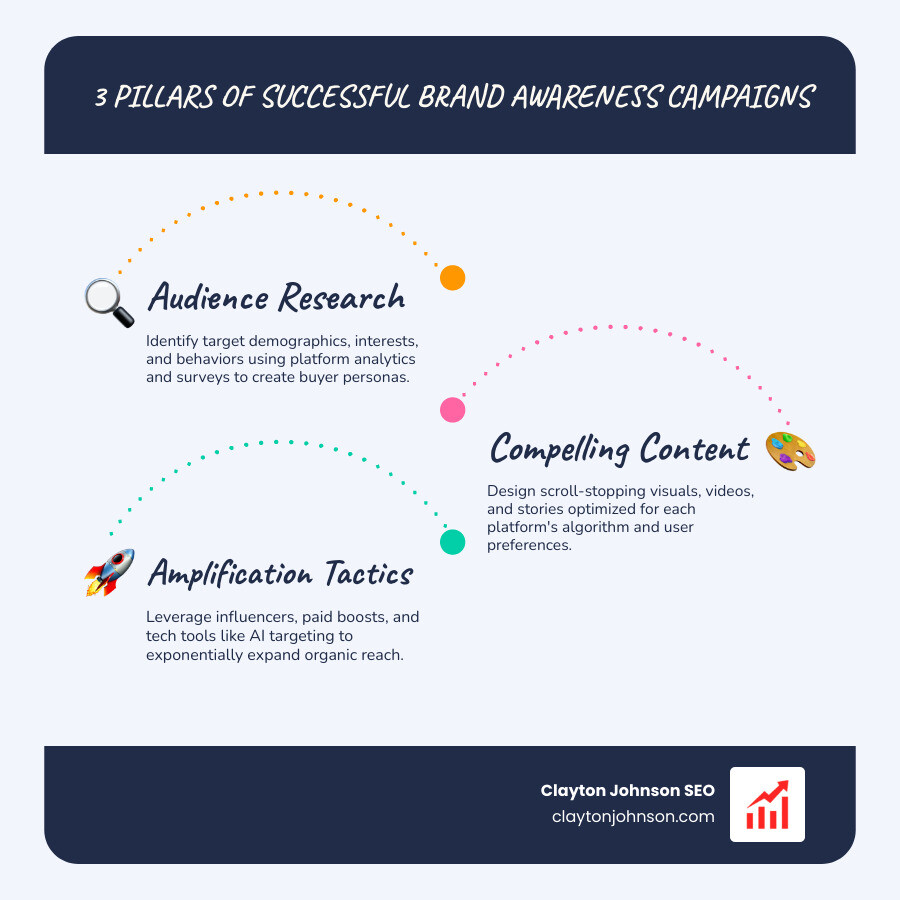
To move from a “wallflower” to the life of the digital party, your social media brand awareness campaigns must rest on three foundational pillars: Authenticity, Creativity, and Measurability. Without these, you’re just adding to the noise.
We’ve seen that unsuccessful campaigns often set multiple objectives without a well-designed execution strategy. To succeed, you need a structured brand voice that resonates across platforms. A prime example of this is Dove’s “Real Beauty” campaign, which challenged conventional beauty standards by featuring real women. It didn’t just show a product; it told a story that aligned with the audience’s values, creating deep emotional resonance.
Authenticity: True-to-Self Identity
People can spot a fake from a mile away. Authenticity is the number one thing consumers say they don’t see enough of from brands on social. Being authentic means being true-to-ideal (your values), true-to-fact (your claims), and true-to-self (your personality).
Take Patagonia’s “Don’t Buy This Jacket” campaign. By encouraging customers to repair or reuse existing clothing rather than buying new, they humanized their brand and built immense trust. It was a bold move that solidified their identity as a sustainability leader. When you lead with your values, you stop being a commodity and start being a community.
Creativity: Capturing Attention in the Feed
Creativity is the lifeblood of engagement. In a world of infinite scrolls, you need to be original, flexible, and perhaps a little bit daring. This often involves humor, satire, or unexpected twists.
Old Spice’s “The Man Your Man Could Smell Like” masterfully used humor to transform the brand’s perception. They took a “stuffy” legacy brand and made it viral by talking to a younger demographic in a language they enjoyed. Whether it’s through satire or orchestrated spectacle, creativity ensures your message sticks long after the user has scrolled past.
Strategic Planning: From Audience Signals to SMART Goals
Effective social media brand awareness campaigns don’t start with a post; they start with analytics and data. You need to listen before you speak. Social listening tools allow us to capture indirect mentions and understand the “why” behind audience behavior.
Before launching, we perform a competitive analysis to see where the gaps are. Are your competitors ignoring a specific platform? Is there a sentiment shift you can capitalize on? Use these signals to build a buyer persona that reflects real digital habits, not just demographic guesses.
Setting SMART Goals for Social Media Brand Awareness Campaigns
Vague goals like “get more followers” lead to vague results. Your goals must be:
- Specific: Increase brand mentions by 20%.
- Measurable: Track via share of voice and reach.
- Achievable: Based on your current baseline and budget.
- Realistic: Align with your overall business objectives.
- Time-sensitive: Achieve this within the next 90 days.
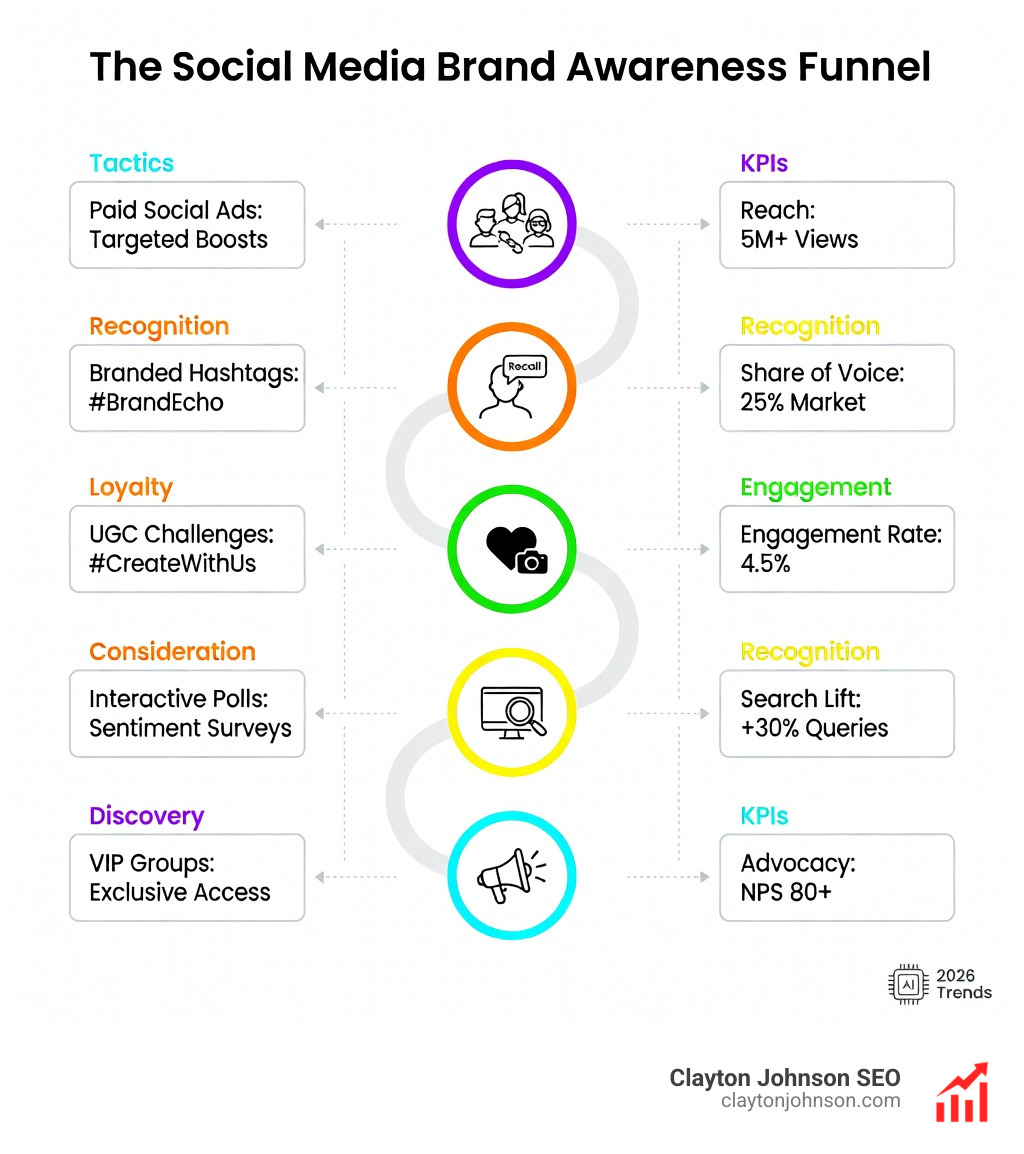
Common KPIs for awareness include reach, impressions, and brand search volume lift. If you aren’t tracking these, you aren’t running a campaign; you’re just posting.
Researching Your Digital Customer Journey
Not every piece of content needs to reach everyone. We focus on creating content specific to where the audience is in their journey. For awareness, this is “Top-of-Funnel.”
You need to understand the 17 most important social media metrics to gauge how users move from seeing a post to recognizing your brand name in a search engine. Platform selection is key here—don’t try to be everywhere. Choose the channels where your audience is already spending those two+ hours a day.
Content Formats That Stop the Scroll
The “scroll” is your biggest enemy. To beat it, you need formats that demand attention. Short-form video is currently the reigning champ, driving the highest engagement rates across all major platforms.
Leveraging Video in Social Media Brand Awareness Campaigns
YouTube has more than 2.5 billion users, and over one-third of consumers prefer video to any other branded content. Whether it’s TikTok, Reels, or YouTube, video allows for storytelling that static images simply can’t match.
The Dumb Ways to Die campaign is a textbook case. By using a catchy song and morbidly humorous animation, they reduced rail-related accidents by 30% and amassed over 180 million views. It worked because it was entertaining first and educational second.
The Power of User-Generated Content (UGC)
UGC is the ultimate social proof. It builds trust because it comes from real people, not a corporate marketing department. Apple’s #ShotOniPhone campaign has over 29 million posts on Instagram. It “shows” rather than “tells” the quality of the camera.
Similarly, the GoPro Awards encourage users to submit their best footage for a chance to be featured. This creates a self-sustaining cycle of high-quality content and community building. When your customers become your content creators, your brand awareness grows exponentially and authentically.
Amplifying Reach Through Influencers and Technology
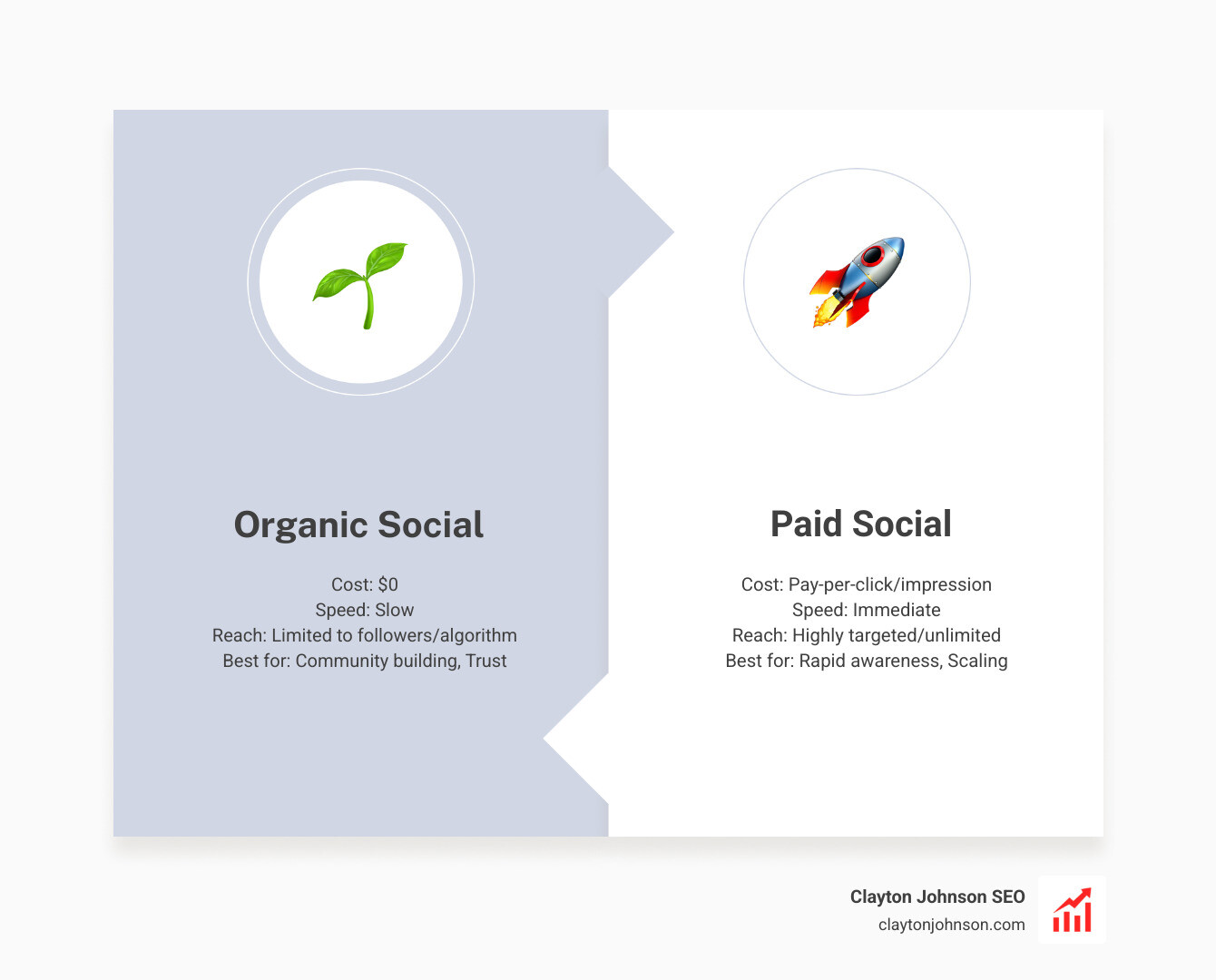
You don’t have to build an audience from scratch. Strategic partnerships allow you to tap into existing communities that already trust the creator.
Strategic Partnerships and Co-Marketing
The key to influencer marketing is finding a “best match” in values, not just follower count. Niche creators often have higher resonance than major celebrities.
CeraVe’s Michael Cera Conspiracy is a brilliant example of using an influencer (and an actor) to create pre-event intrigue. They generated 15.4 billion impressions by leaning into a weird, wonderful, and highly shareable story. We also see brands like Revolve dominating events like Coachella by hosting exclusive experiences that influencers can’t wait to share. This is conversion optimization at the awareness level—optimizing for the “click” of recognition.
Using AI and Social Listening Tools
Technology makes your workflows more efficient. AI can help with ideation, sentiment tracking, and even customer care. 73% of social media users expect a response within 24 hours; AI-augmented workflows ensure you meet that expectation without burning out your team.
However, use AI wisely. The Glasgow Willy Wonka experience lesson taught us that unchecked AI copy can lead to a nightmare for brand reputation. Use technology to enhance your human creativity, not replace it. Tools like social listening allow us to “hear” what customers want, so we can respond with campaigns that actually solve their problems.
Frequently Asked Questions about Brand Awareness
How do you measure the success of a brand awareness campaign?
We look at reach (how many people saw it), impressions (how many times they saw it), and share of voice (how much of the conversation you own compared to competitors). We also track brand search volume—if more people are Googling your brand name after a campaign, you’ve successfully moved the needle.
Which social media platform is best for brand awareness?
It depends on your audience. TikTok and Instagram are powerhouses for visual storytelling and viral challenges. YouTube is the king of long-form “show and tell.” LinkedIn is essential for B2B authority building. Always go where your data says your audience lives.
How long should an awareness campaign run?
Brand awareness isn’t a sprint; it’s a marathon. We recommend a sustained effort of at least three months, often broken into multiple phases (Tease, Launch, Sustain). You need time for your message to saturate the market and for the “snowball effect” to take hold.
Conclusion: Building Your Structured Growth Architecture
At Clayton Johnson, we believe that most companies don’t lack tactics—they lack structured growth architecture. Social media brand awareness campaigns are a vital part of that architecture, but they must be integrated into a larger system of SEO strategy, competitive positioning, and authority-building ecosystems.
We don’t just post content; we build infrastructure. Through Demandflow.ai, we combine actionable frameworks with taxonomy-driven SEO to ensure that when people discover you on social, they find a brand that is authoritative, consistent, and ready to convert.
Don’t let your brand stay a wallflower. By focusing on authenticity, leveraging the right technology, and sticking to a structured strategy, you can turn social media into your most powerful growth engine.
Ready to stop guessing and start growing?
Start your social media marketing strategy with us today and build the visibility your brand deserves.