Stop Blending In: A Guide to Developing and Establishing a Brand Positioning


Why Developing Brand Positioning Determines Who Wins in Your Market
Developing brand positioning is the strategic process of carving out a distinct, memorable space in your target customer’s mind — so they think of you when they need what you offer.
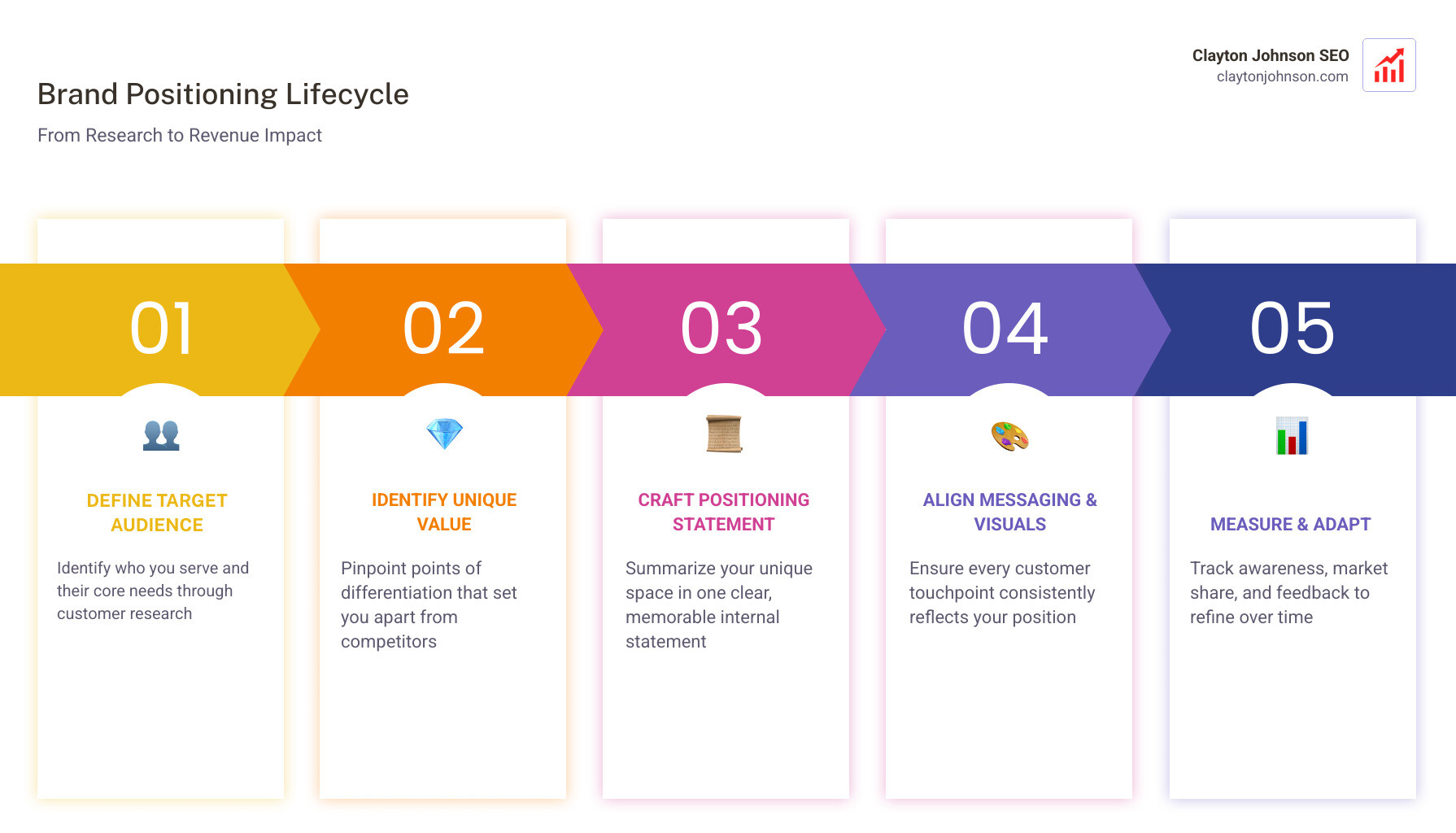
Here’s a quick breakdown of what it involves:
- Define your target audience – Know exactly who you’re serving and what they need
- Identify your unique value – Pinpoint what makes you different from every competitor
- Craft a positioning statement – Summarize your differentiation in one clear, internal statement
- Align your messaging and visuals – Make every touchpoint reflect that position consistently
- Measure and adapt – Track brand awareness, market share, and customer feedback over time
Think about the last time you walked down a grocery aisle. Dozens of similar products compete for your attention. The ones you reach for aren’t random — they’ve earned a spot in your mind through deliberate positioning.
The same dynamic plays out in every industry. Your potential clients are comparing options quickly, often before they ever contact you. If your brand doesn’t stand for something specific and clear, it blends into the background.
The stakes are real. Research shows that brands with strong positioning typically see revenue increases of 10%–20%. On the flip side, a product that’s high quality and competitively priced can still fail to gain traction — simply because no one understood who it was for or why it mattered.
Brand positioning isn’t just a logo or a tagline. It’s the underlying logic that shapes how customers perceive you versus every alternative. And it’s one of the few things in your business you have full control over.
Developing brand positioning word roundup:
The Strategic Framework for Developing Brand Positioning
When we talk about developing brand positioning, we aren’t just brainstorming catchy phrases. We are building a system. At Clayton Johnson SEO, we view positioning as the “operating system” for your marketing. Without it, your ads, content, and sales pitches are just noise.
To organize this chaos, we use a brand essence chart. Think of this as the DNA of your brand. It breaks down your identity into seven core components:
- Attributes: The physical or functional features of your product.
- Benefits: The “what’s in it for me” for the customer.
- Personality: How your brand would act if it were a person (e.g., “The rugged explorer” or “The witty tech expert”).
- Source of Authority: Why should they believe you? (Years in business, proprietary tech, or specific certifications).
- Implications for the Customer: How their life or business changes after using you.
- Emotional Impact: The feeling they get (security, excitement, status).
- Positioning Essence: The single “big idea” that ties it all together.
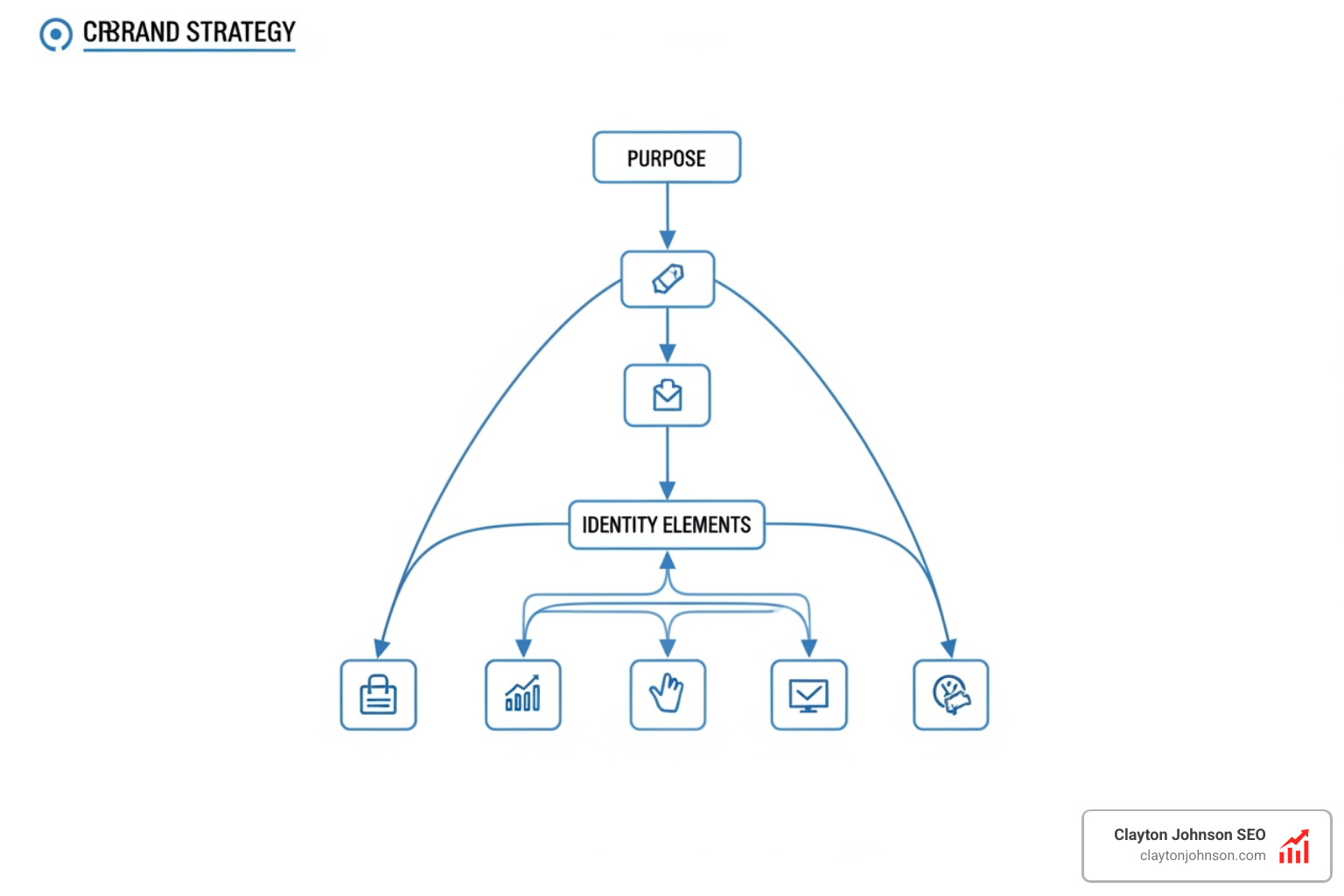
We often recommend a top-down approach. We start with that “big idea” and work our way down to message pillars and touchpoints. This ensures that whether someone sees a LinkedIn post or a product package, the vibe remains the same. If you want to dive deeper into the mechanics, check out the ultimate guide to market positioning models to see how different frameworks can help you visualize your path.
Market Positioning vs. Brand Positioning: What’s the Difference?
It is easy to use these terms interchangeably, but they serve different masters. Market positioning is about the “where” (your place in the competitive landscape), while brand positioning is about the “who” and “why” (the perception in the customer’s heart).
| Feature | Market Positioning | Brand Positioning |
|---|---|---|
| Focus | Competitive landscape and market share | Consumer perception and emotional connection |
| Goal | Occupying a specific niche or price point | Owning a “mental real estate” or association |
| Metric | Sales volume, category rank | Brand recall, loyalty, sentiment |
| Scope | External market dynamics | Internal identity and external messaging |
Defining Your Unique Value Proposition and Market Space
To stop blending in, we have to find your Unique Value Proposition (UVP). This is the intersection of what your customers desperately need and what you are uniquely qualified to provide.
In developing brand positioning, we look at two critical concepts:
- Points of Differentiation (PODs): These are the things that make you “better” or “different” in a way that actually matters to the buyer. Being the only company with a blue logo isn’t a POD. Being the only company that offers 24/7 human support in an industry of bots is.
- Points of Parity (POPs): These are the “table stakes.” They are the features you must have just to be considered a player in the game.
The magic happens when you identify “white space”—market gaps where customer needs are currently being ignored. We do this through systematic customer research. Don’t just look at demographics (age, location); look at psychographics (values, fears, aspirations). When you understand the “why” behind their buying habits, you can position your brand so competitors cry by solving a problem they didn’t even know they could complain about.
Choosing the Right Strategy for Developing Brand Positioning
There isn’t a one-size-fits-all strategy for developing brand positioning. Depending on your product and market, you might lean into one of these common types:
- Quality-Based Positioning: You are the “best” in terms of craftsmanship or performance. Luxury watch brands or high-end consulting firms often live here.
- Price-Based Strategy: You are the budget-friendly option. Think Dollar Shave Club, which disrupted the market by focusing on affordability and convenience for the “average Joe.”
- Innovation-Led: You are the first to do something revolutionary. Tesla didn’t just position itself as a car company; it positioned itself as a high-performance energy company with a futuristic outlook.
- Customer Service-Based: You win on the experience. Southwest Airlines built an entire empire around “heartfelt hospitality” and being the “friendly airline.”
- Value-Based: This is the “bang for your buck” strategy. It’s not necessarily the cheapest, but it offers the most utility for the price.
The 10-Step Process for Developing Brand Positioning
If you’re ready to roll up your sleeves, we suggest following this 10-step roadmap. This is how we take a fragmented brand and turn it into a growth engine.
- Audit Your Current Reality: How are you perceived right now? Be honest.
- Define Business Objectives: What are you trying to achieve? (Growth, retention, premium pricing?)
- Identify Target Clients: Narrow your focus. High-growth firms often grow faster by targeting a smaller, more defined group.
- Conduct Systematic Research: Research your target group at least quarterly. Firms that do this grow faster and are more profitable.
- Identify Your UVP: Find that white space.
- Develop Your Positioning Statement: Create your internal North Star.
- Build Your Messaging Architecture: Create headlines and proof points for different audiences.
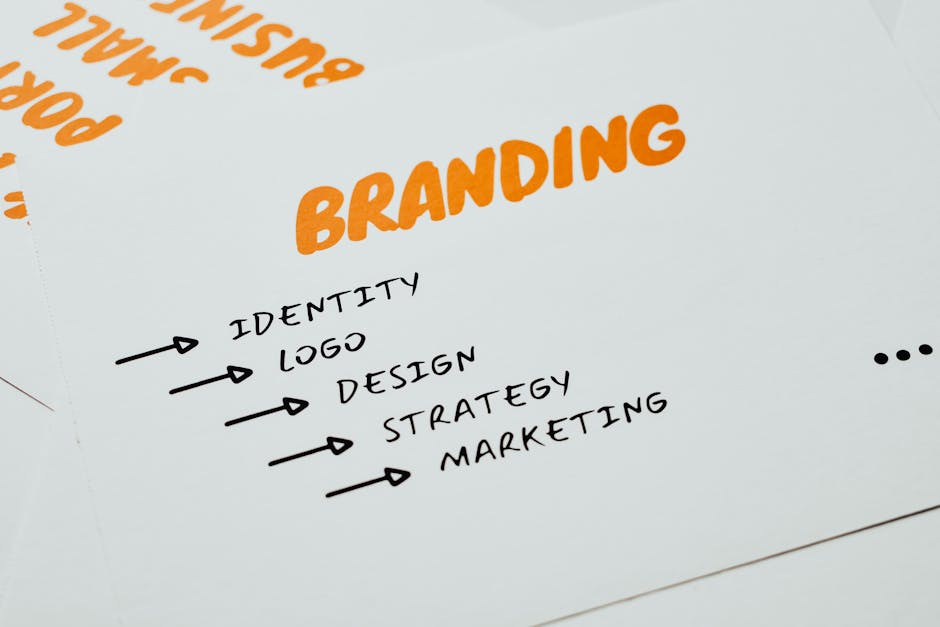
- Align Your Visual Identity: Ensure your logo, colors, and website match the “vibe” of your positioning. Check out this brand strategy guide for tips on keeping teams aligned.
- Build Your Marketing Toolkit: Develop the sales sheets, pitch decks, and content strategies that communicate your new position.
- Implement and Track: Launch it and start measuring.
Measuring Success and Avoiding Pitfalls in Brand Positioning
You’ve done the work, but how do you know it’s working? Success in developing brand positioning isn’t just a “feeling.” It shows up in the data.
We look for several key indicators:
- Brand Awareness Surveys: Are more people in your target market recognizing your name?
- Market Share: Are you taking a bigger piece of the pie from competitors?
- Customer Feedback: Is the language customers use to describe you matching your positioning statement?
- Revenue Impact: Strong positioning can lead to a 10%-20% revenue lift.
However, be wary of common pitfalls. The biggest mistake we see is copying competitors. If you try to be a “slightly better version” of the market leader, you’ve already lost. You need to be different, not just better. Another trap is having vague values. If your brand stands for “excellence” and “integrity,” you stand for nothing—everybody claims those. Be specific.
At Clayton Johnson SEO, we help you avoid these traps by building systems that bridge the gap between brand building and performance marketing. We don’t just want you to look good; we want your positioning to drive SEO services that actually convert.
Visualizing Your Space with Perceptual Mapping
One of the most powerful tools in our arsenal is the perceptual map. This is a simple visual that plots your brand and your competitors on a graph based on two attributes (e.g., Price vs. Quality or Performance vs. Cost).
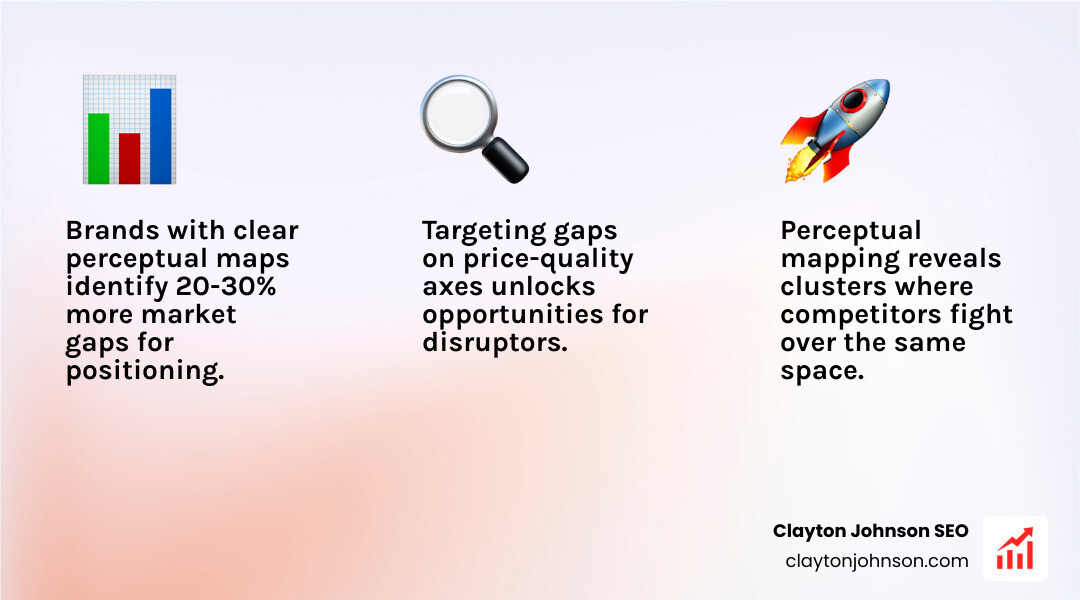
When you map out the competition, you’ll often see clusters of brands fighting over the same territory. The “gaps” on the map represent opportunities. If everyone is high-price/high-quality, is there room for a high-quality/mid-price disruptor? If you want to see exactly how to build one of these, read our guide on competitive positioning map demystified. To make your visuals pop during this process, you might even try Adobe Express today to help visualize your strategy.
Crafting a High-Impact Brand Positioning Statement
Your brand positioning statement is not your tagline. It’s an internal document that guides every decision you make. If a new marketing idea doesn’t align with this statement, you throw it out.
The classic formula we use is: “For [Target Market], [Brand Name] is the only [Frame of Reference] that [Unique Value Claim] because [Reason to Believe].”
- Target Market: Who are you talking to?
- Frame of Reference: What category do you play in?
- Unique Value Claim: What is your POD?
- Reason to Believe: What is your proof?
For example, a boutique SEO firm might say: “For mid-market SaaS founders, Clayton Johnson SEO is the only growth partner that builds durable content ecosystems rather than chasing temporary hacks, because our frameworks are backed by 50+ proven business models.”
Having this internal North Star ensures that your messaging remains consistent across all channels. For more academic rigor on this, Harvard Business School offers a great deep dive on how to craft the perfect brand positioning statement.
Real-World Examples: From Tesla to Apple
To truly master developing brand positioning, it helps to look at the giants who have done it right.
- Apple: They are the masters of the Golden Circle framework. They don’t start with what they make (computers); they start with why (challenging the status quo). This leads to incredible loyalty—only 11% of Apple users switch to Android.
- Nike: Their positioning isn’t about shoes; it’s about empowerment and victory. Their namesake is the Greek Goddess of Victory, and every ad reinforces the “Just Do It” mentality.
- Trader Joe’s: They’ve carved out a niche as the “national chain of neighborhood grocery stores.” They offer a tight-knit, fun experience that feels personal compared to the clinical feel of a giant supermarket.
- Ben & Jerry’s: They are a values-driven brand that positions itself through social and environmental justice. People don’t just buy the ice cream; they buy the mission.
- Coca-Cola: They own “happiness.” Through campaigns like “Share a Coke” and their iconic holiday polar bears, they’ve moved beyond being a beverage to being a symbol of togetherness.
Developing a strong brand position is a marathon, not a sprint. It requires constant reevaluation as the market shifts. But when you get it right, you stop competing on price and start competing on meaning. And in a noisy world, meaning is the only thing that lasts.