Stop Blending In and Start Positioning Like April Dunford


Why Most B2B Products Fail to Stand Out (And What to Do About It)
April Dunford positioning strategies give founders and marketing leaders a repeatable framework to make their product’s value obvious to the right buyers. Here is a quick summary:
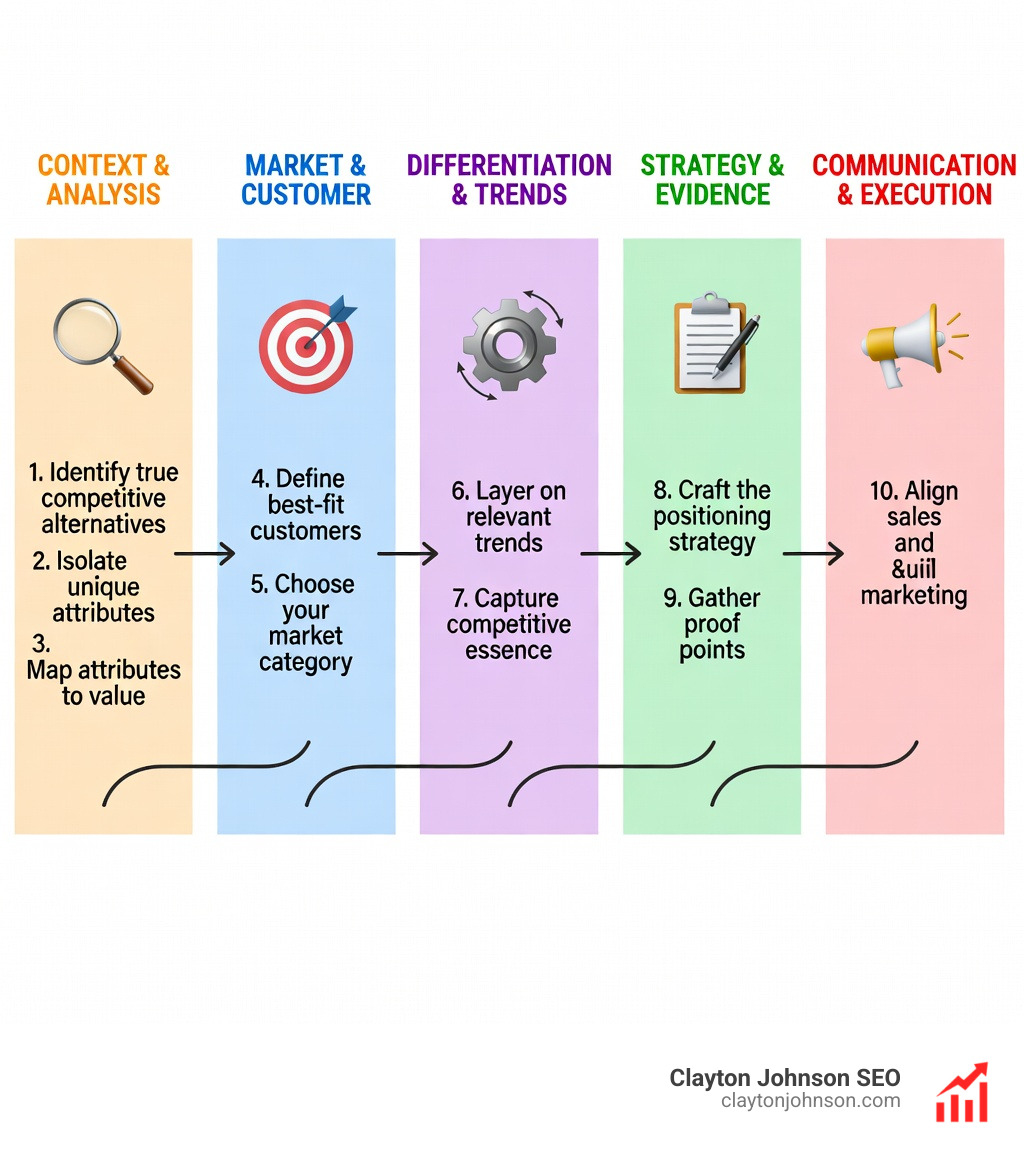
- Identify true competitive alternatives – what customers would actually do without your product
- Isolate unique attributes – features or capabilities no competitor has
- Map attributes to value – translate features into outcomes customers care about
- Define best-fit customers – who cares most about that specific value
- Choose your market category – the frame of reference that puts your strengths front and center
- Layer on relevant trends – optional context that makes your timing feel urgent
Put a dozen senior marketers in a room and ask them to define positioning. You will likely get a dozen different answers. That is not a hypothetical — it is a real problem. Most teams confuse positioning with messaging, taglines, or branding. They are not the same thing. Positioning is the strategic foundation that everything else is built on.
When positioning is weak, the symptoms show up fast. Prospects ask “what exactly does this do?” on sales calls. Deals stall. Teams revert to pitching features instead of value. Growth becomes expensive and unpredictable.
April Dunford has spent over two decades fixing this problem hands-on with more than 200 companies — from early-stage startups to global technology enterprises. Her framework is not theoretical. It is a battle-tested process that has driven measurable outcomes, including one repositioning that took a company from under $2M to nearly $80M in revenue in 18 months.
I’m Clayton Johnson, an SEO and growth strategist who has applied April Dunford positioning strategies across competitive B2B markets to build structured growth systems that compound over time. In this guide, I will walk you through every component of the framework so you can apply it to your own product.
What is Product Positioning? (Defining the April Dunford Way)
April Dunford defines positioning as the act of defining how your product is a leader at delivering something that a well-defined set of customers cares a lot about. It is not a tagline. It is not a brand story. It is the “context” you provide so that your customers can understand why they should care about your product.
Think about the opening scene of the movie Apocalypse Now. The movie starts with palm trees, smoke, and intense music. Before a single word of dialogue is spoken, you know exactly where you are: a war zone. This is context-setting.
In B2B tech, your market category acts as that opening scene. If you tell a customer you are a “CRM,” they immediately assume you have a contact database, a way to track deals, and that you compete with Salesforce. If you tell them you are a “Customer Messaging Platform,” their assumptions change instantly. Positioning is about managing those assumptions by providing the right frame of reference.
In her book Obviously Awesome, April points out that many companies fall into the trap of “default positioning.” They stick with the category they started in, even if the product has evolved into something else entirely. This leads to what she calls a franken-statement of gobbledygook that confuses everyone.
True positioning is the input to your messaging and branding. You cannot write a great homepage or design a beautiful logo until you know exactly who you are competing against and what makes you uniquely valuable. April’s essay Everything You Know About Positioning Is Wrong highlights that most people treat positioning as a “fill-in-the-blanks” exercise, but it is actually a rigorous process of discovery.
Why April Dunford positioning strategies matter for B2B Tech
The B2B market is noisier than ever. Buyers are risk-averse and overwhelmed by choice. In fact, research shows that up to 40% of B2B deals end in “no decision.” This means the customer didn’t choose a competitor; they chose to do nothing because they couldn’t figure out why your solution was worth the risk of change.
Effective April Dunford positioning strategies solve this by reducing sales friction. When your positioning is tight, your “best-fit” customers understand your value immediately. They don’t need a three-month trial to see if the product works for them; the context you’ve provided makes the value obvious.
For companies in Minneapolis or anywhere else looking to scale, understanding market positioning models is the difference between being a commodity and being a market leader.
The Five Core Components of the April Dunford Framework
April’s framework breaks positioning down into five interdependent pieces. You cannot change one without affecting the others.
| Component | Definition |
|---|---|
| Competitive Alternatives | What customers would use if you didn’t exist. |
| Unique Attributes | The features or capabilities you have that the alternatives don’t. |
| Value | The specific benefit those unique attributes provide to the customer. |
| Target Market Characteristics | The traits of the customers who care most about that value. |
| Market Category | The context you use to make your value obvious. |
These components follow a specific workflow. You start with the alternatives and work your way down. If you don’t know who you’re competing against, you can’t know what makes you unique. If you don’t know what makes you unique, you can’t define your value.
To get this right, you need to be visualizing your competitive edge clearly. It is not enough to have a “better” product; you must have a “different” product for a specific group of people.
Identifying True Competitive Alternatives and Status Quo
One of the biggest mistakes companies make is listing “phantom competitors”—companies they theoretically compete with but never actually lose deals to.
In the April Dunford framework, a “true competitive alternative” is what a customer would actually do if your product didn’t exist. Often, the biggest competitor isn’t another startup; it’s the status quo. This includes:
- Manual processes (hiring an intern to do it).
- Spreadsheets (the “Excel” of it all).
- Do nothing (continuing to suffer with the current problem).
If you are a project management tool, your real competition might be a whiteboard and sticky notes. If you don’t acknowledge that, your positioning will be weak. You must understand how to think about competitive pressure from the customer’s perspective, not just the Gartner Magic Quadrant.

Isolating Unique Attributes and Differentiated Value
Once you know what the customer is currently doing, you can list your unique attributes. These are the “cool features” that your alternatives lack. But here is the catch: customers don’t buy features; they buy value.
An attribute is “we have a 256-bit encryption.” The value is “your data is safe from hackers.” April suggests mapping every unique attribute to a “value theme.” If you have five features that all help with speed, your value theme is “Efficiency.”
This helps you formulate an unfair advantage strategy by focusing on the outcomes that matter to the buyer. You are looking for the “so what?” behind every feature.
A Step-by-Step Guide to April Dunford Positioning Strategies
Developing strong positioning isn’t a solo job for the marketing manager. It requires a “positioning team” including the CEO, and heads of Sales, Product, and Customer Success.
Here is the 10-step methodology April outlines in Obviously Awesome:
- Understand the customers who love your product: Look at your happiest, highest-paying customers.
- Form a positioning team: Get the right people in the room.
- Align your vocabulary: Make sure everyone defines “positioning” the same way.
- List your true competitive alternatives: What would those happy customers use if you weren’t around?
- Isolate your unique attributes: What do you have that the alternatives don’t?
- Map attributes to value themes: Group your features into 2-3 main pillars of value.
- Determine who cares a lot: Define the characteristics of the companies that desperately need that value.
- Choose a market frame of reference: Pick a category that makes your value obvious.
- Layer on a trend (optional): Add a “why now” element like AI or Remote Work.
- Capture your positioning: Document it in a way that can be shared across the company.
Choosing the Right Market Category and Frame of Reference
The market category is the most powerful tool in your positioning arsenal. It tells the customer what “kind” of thing you are. April identifies three main ways to position yourself in a market:
- Head-to-Head: You are in an existing category (like CRM) and you are claiming to be better than the leader. This is hard and expensive.
- Big Fish Small Pond (Sub-segmentation): You are a CRM, but specifically for dental offices. You win because you are tailored to their unique needs.
- New Game (Category Creation): You are claiming to be something entirely new. This is the riskiest strategy because you have to spend a lot of money educating the market on why the category even needs to exist.
Most successful startups find their footing in the art of being different and better within a sub-segment before trying to take on the whole market.
Avoiding Common Pitfalls in April Dunford positioning strategies
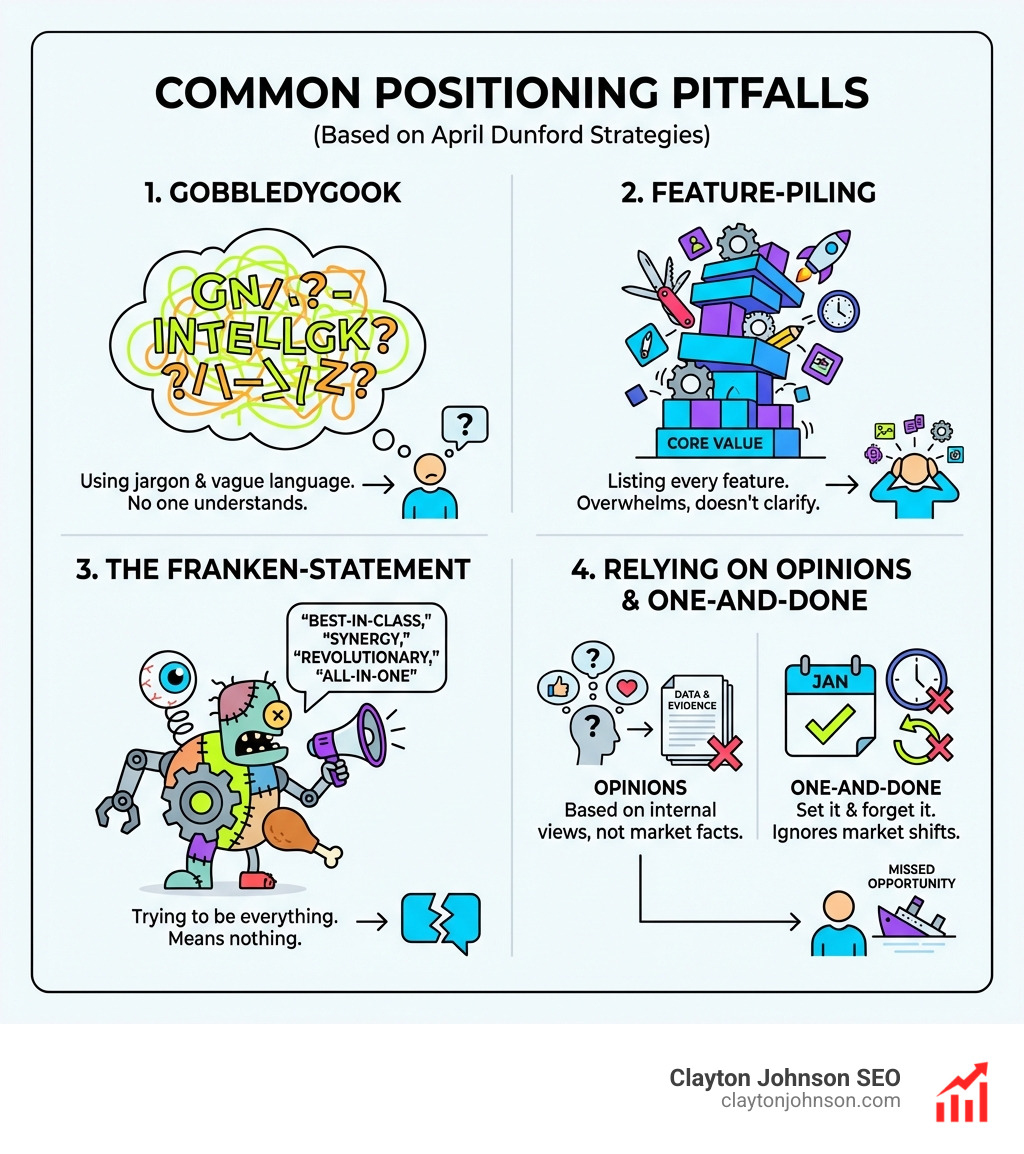
Even with a framework, it’s easy to get off track. We see many companies fall into these traps:
- The “Franken-statement”: Trying to be everything to everyone and ending up with a positioning statement that is 50 words long and means nothing.
- Relying on Opinions: Positioning should be based on evidence from sales calls and customer data, not just what the CEO thinks sounds “cool.”
- The One-and-Done Mentality: Markets change. Competitors launch new features. You should review your positioning every six months to ensure it still holds up.
April’s article Everything You Know About Positioning Is Wrong is a great reminder that positioning is a process, not a destination.
Implementation: Turning Strategy into Sales and Growth
Positioning is useless if it stays in a Google Doc. To make it work, you have to bake it into your daily operations.
The first step is creating a messaging document. This takes your positioning and translates it into the actual words you will use on your website, in your ads, and in your sales decks.
Next, you must align the sales pitch. If your marketing says you are an “Analytics Tool” but your sales team is pitching you as a “Business Intelligence Platform,” you have a problem. Every customer touchpoint should reinforce the same frame of reference.
This requires stop guessing with competitive intelligence and starting to use your positioning as a filter for everything you do—including what features you decide to build next.
Testing and Iterating Your Positioning Thesis
In the early stages, your positioning is a thesis, not a fact. You need to test it in the wild.
- Listen to sales calls: Do prospects “get it” in the first five minutes? Or do they spend the whole call asking clarifying questions?
- Watch your conversion rates: If you change your homepage headline to reflect your new positioning, do sign-ups go up or down?
- Look for patterns: Are you suddenly winning deals in a specific industry? That might be a sign you’ve found a “Big Fish Small Pond” opportunity.
For ongoing inspiration and deep dives into these tactics, we highly recommend April Dunford’s Podcast, where she breaks down real-world positioning challenges.
Real-World Success: Companies Transformed by Deliberate Positioning
The impact of April Dunford positioning strategies is best seen through those who have used them to win.
- The CRM for Investment Banks: A company was struggling to compete against Salesforce. By repositioning as a “Relationship Modeling Tool for Investment Banks,” they stopped being a “worse CRM” and became the “only solution” for their niche. They grew from $2M to $80M in 18 months and were eventually acquired for over a billion dollars.
- The Embeddable Database: A product was failing as a “Microsoft Access Killer.” After talking to customers, April realized people were using it for mobile devices. They repositioned it as an “Embeddable Database for Mobile Devices,” which led to a massive acquisition and hundreds of millions in revenue.
- Help Scout: April helped Help Scout move away from being just another help desk tool. By focusing on their philosophy of human-centric customer service, they differentiated themselves from “bot-heavy” competitors.
- Postman: The team at Postman used these exercises to clarify their identity as a platform for the entire API lifecycle, rather than just a testing tool.

Frequently Asked Questions about April Dunford Positioning
What is the difference between positioning and messaging?
Positioning is the strategy; messaging is the expression of that strategy. Positioning defines the “what, who, and why” in the background. Messaging is the actual copy on your website or the script for your sales demo. You can’t have good messaging without a solid positioning foundation.
When should a startup fix its positioning?
You should look at your positioning if you have symptoms of a problem: long sales cycles, customers who don’t understand your value, or losing deals to inferior competitors. However, very early-stage startups should remain flexible. Your first few customers will often tell you what your positioning should be.
Is category creation always the best strategy?
Actually, it’s usually the hardest. Only a small percentage of successful companies (about 7% of those that go public) created a new category. The other 93% found an underserved niche in an existing category. It is much easier to say, “We are like X, but for Y,” than to explain a brand-new concept from scratch.
Conclusion
Positioning is the most powerful lever you have for driving compounding growth. When you stop trying to blend in and start positioning like April Dunford, you stop fighting for attention and start attracting the customers who value you most.
At Clayton Johnson, we believe that clarity leads to structure, and structure leads to leverage. Whether you are building a new startup or looking to revitalize a legacy product, the framework is the same: find your unique value, find the people who care about it, and put it in a context that makes it obvious.
We are building Demandflow.ai to provide founders with the structured growth architecture they need to succeed. Our platform combines actionable strategic frameworks with competitive positioning models to help you win your market.
If you want to learn from the best, check out our guide on the greatest marketers of all time and see how the legends of the industry used these same principles to build empires.