Stop Using Boring SEO Tactics with These Modern On-Page Checklists


The Google Leak Framework for Modern On-Page SEO Checklists
Modern on-page SEO checklists have changed dramatically — and if you’re still working from an outdated list of tips, you’re optimizing for a search engine that no longer exists.
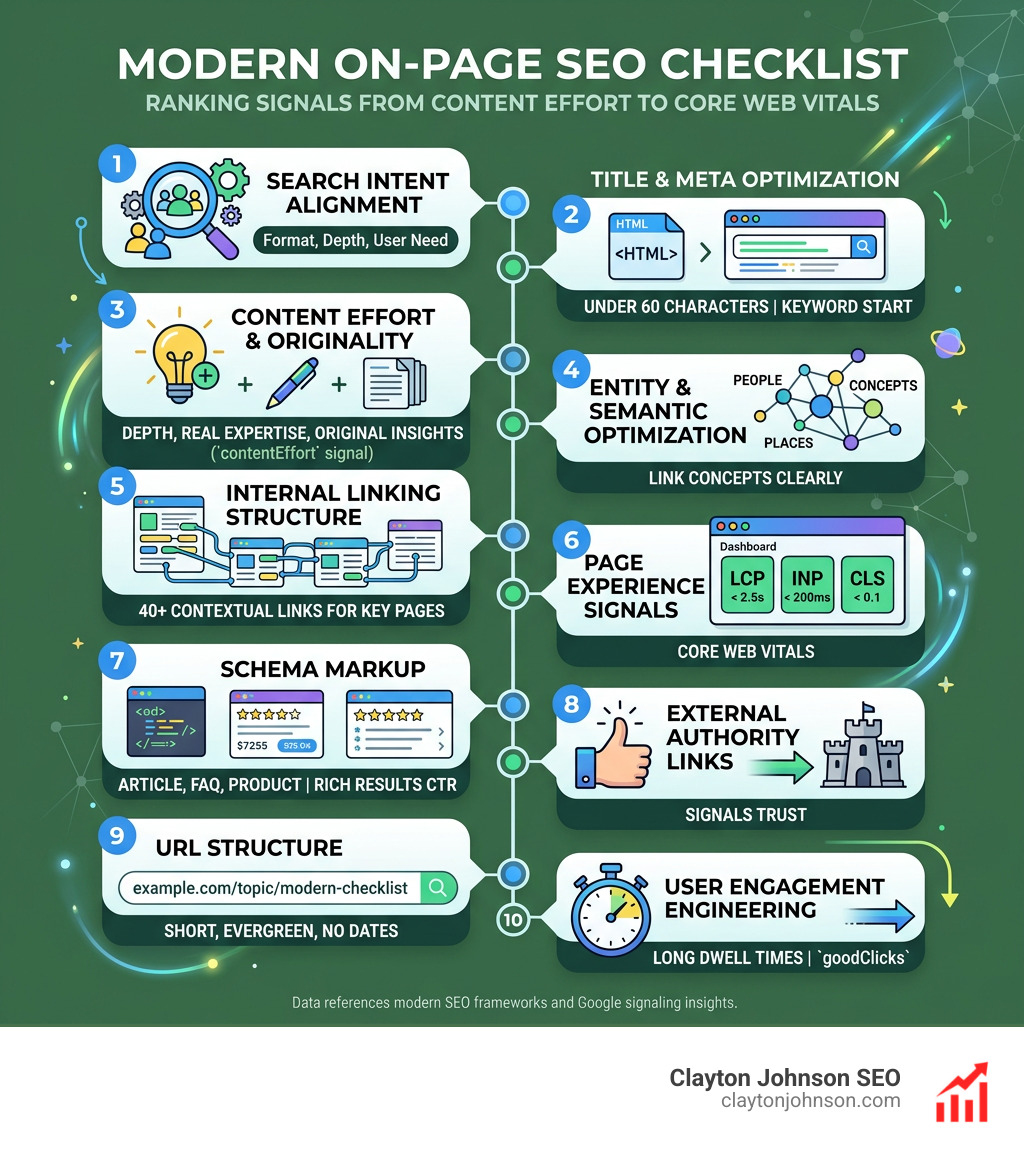
Here’s what a modern on-page SEO checklist actually covers today:
- Search intent alignment – Match content format and depth to what top-ranking pages show
- Title tag and meta optimization – Under 60 characters, primary keyword near the start
- Content effort and originality – Depth, real expertise, and original insight (not recycled content)
- Entity and semantic optimization – Reference real people, places, and concepts clearly
- Internal linking structure – 40+ contextual links for important pages
- Page experience signals – Core Web Vitals: LCP under 2.5s, INP under 200ms, CLS under 0.1
- Schema markup – FAQ, Article, and Product schema for rich result CTR boosts
- External links to authority sources – Signals trust and improves rankings
- URL structure – Short, evergreen, no dates embedded in slugs
- User engagement engineering – Structure pages to earn long dwell times and good clicks
Most guides focus on the basics. But ranking today means understanding why those basics work — and what new signals Google is actually using to evaluate your pages.
The Google Content Warehouse API leak gave the SEO community an unprecedented look inside Google’s ranking systems. Across more than 2,500 pages and 14,000 attributes, it confirmed things many suspected and revealed things almost no one expected. Signals like contentEffort, siteAuthority, documentHistory, and goodClicks aren’t theories anymore — they’re documented parts of how Google scores your pages.
This changes how you should build your checklist.
I’m Clayton Johnson, an SEO strategist who has spent nearly two decades building scalable search frameworks — and applying modern on-page SEO checklists is one of the highest-leverage activities I use with clients to drive compounding organic growth. Let’s get into exactly what works right now.
When we talk about modern on-page SEO checklists, we have to start with the “CompositeDoc.” According to the Google Content Warehouse leak, this is the master file Google keeps for every URL. It isn’t just a collection of keywords; it’s a massive data object that holds every signal associated with your page.
To rank in a world of AI search and sophisticated algorithms, we have to understand the pipeline. Google doesn’t just look at your page once. It passes through a series of evaluation gates:
- Mustang: This is the primary engine. It handles initial scoring and ranking. It’s looking for the foundational stuff—the “Topicality” (T*) of your content.
- NavBoost: This is where things get interesting. NavBoost re-ranks the results based on user behavior data. It looks at a rolling window of 13 months of click data to see if people actually like what they found.
- Twiddlers: These are the final “re-ranking” functions. They apply boosts or demotions for things like freshness, quality, or site-level authority.
The leak confirmed two massive top-level signals: Q (site-level quality) and P (popularity). If your site has a high siteAuthority score, every new page you publish gets a “halo effect.” This is why a new post on a major news site can outrank a masterpiece on a brand-new blog.

Engineering for Good Clicks and User Engagement
One of the most profound revelations from the leak was the confirmation of goodClicks. Google isn’t just counting hits; it’s measuring satisfaction. A “good click” is one where the user stays on the page, interacts with the content, and doesn’t immediately bounce back to the search results (pogo-sticking).
We also learned about chromeInTotal. Yes, Google uses data from the Chrome browser to see how users interact with your site. This makes engagement metrics a non-negotiable part of our modern on-page SEO checklists.
To engineer for these signals, we focus on:
- Dwell Time: Creating content so engaging that users stick around.
- Rich Results: Using schema to get those eye-catching snippets. Research from Milestone Research shows that rich results achieve a 58% CTR compared to 41% for standard results. Even better, FAQ schema can reach an 87% CTR.
- Search Intent: If you don’t match what the user wants, you’ll never get a “good click.” You can dive deeper into this in The Ultimate Guide to Mastering Search Intent Targeting.
Optimizing Content Effort and Originality in Modern On-Page SEO Checklists
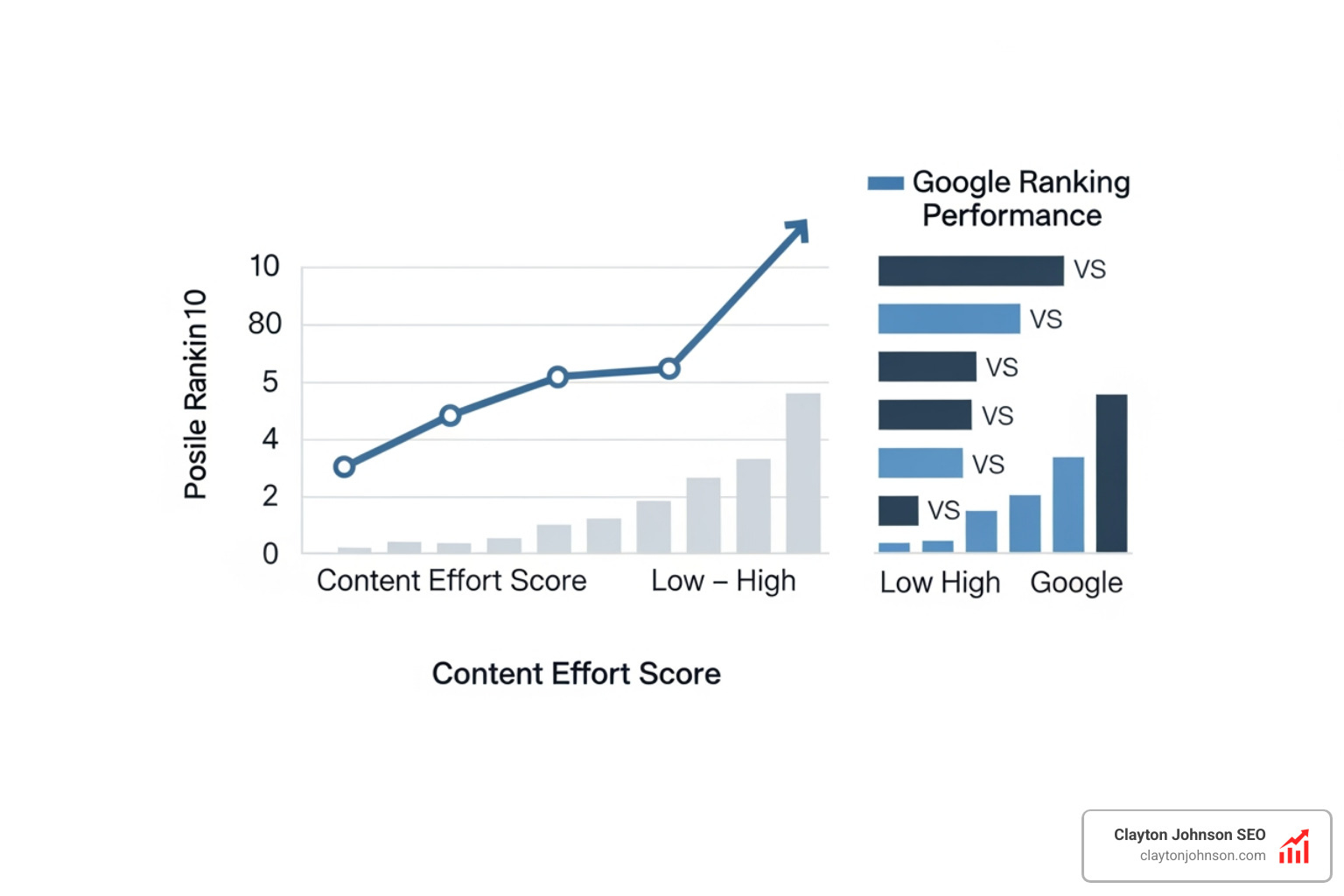
Google has a specific attribute called contentEffort. This is an LLM-based estimation of how much work a human actually put into the page. If your content looks like a generic AI rewrite of the top 10 results, your effort score will be low.
We also have to watch the OriginalContentScore. This score (ranging from 0 to 512) rewards pages that bring something new to the table. In a world of “me-too” content, originality is a massive ranking factor.
One “old school” tactic that the leak confirmed as highly effective is linking out to authority sources. A controlled experiment by Reboot Online found that 100% of sites with outgoing links to authoritative sources ranked higher than those without. It signals that you’ve done your research and are part of a trustworthy web of information.
To stay ahead, we use AI-augmented marketing workflows to find content gaps and ensure our “effort” is visible to the algorithm.
Technical Signals: Entities, Regions, and Temporal Trust
Modern SEO is moving away from simple keyword strings toward “Entities.” The webrefEntities attribute shows that Google maps your content to real-world people, places, and concepts in its Knowledge Graph.
Another key technical signal is pageregions. Google understands the difference between your main body content, your sidebar, and your footer. It gives much more weight to keywords and links found in the main body.
Then there is “Temporal Trust.” The leak confirmed attributes like hostAge and documentHistory.
- The Sandbox is real: New sites face a “probationary” period where they are demoted until they prove their value over time.
- URL History: Every time you change a URL, you risk losing the
documentHistoryassociated with it. This is why we advocate for short, evergreen URL structures. - Syntactic Dates: Google parses dates in your URL strings (
syntacticDate). If your URL says “best-laptops-previous-model” but your content says “current-model,” you’ve created a signal conflict that can hurt your rankings.
Internal linking is the “glue” that holds these signals together. A study by Zyppy found that pages with 40-44 internal links received 4x more clicks than pages with only a few. You can master this with The Ultimate Guide to Internal Linking Strategy.
| Signal Type | Mustang (Initial) | NavBoost (User Data) |
|---|---|---|
| Topicality | High (Keywords/Entities) | Medium (Click Relevance) |
| Authority | PageRank / siteAuthority | High (Brand Recognition) |
| User Behavior | Low (Predicted) | Very High (Actual Clicks) |
| Freshness | SemanticDate | NavBoost Logs |
Executing Your Modern On-Page SEO Checklists for Compounding Growth
Strategy is nothing without execution. When we apply modern on-page SEO checklists, we have to tailor them to the specific “job” the page is doing. A blog post has a different goal than a SaaS product page.
- Blog Posts: Focus on information density and
contentEffort. Research shows that content over 3,000 words receives 77.2% more backlinks. However, the “sweet spot” for traffic often sits between 2,100 and 2,400 words. - Service Pages: These need to establish E-E-A-T (Experience, Expertise, Authoritativeness, Trustworthiness) immediately. Use clear author bios and link to case studies.
- SaaS/Ecommerce: Here, technical signals like
clutterScore(avoiding too many pop-ups) andproductSchemaare king.
To build a sustainable growth engine, you need a coherent SEO content strategy that connects these pages into a topical cluster.

A Step-by-Step Modern On-Page SEO Checklist for High Performance
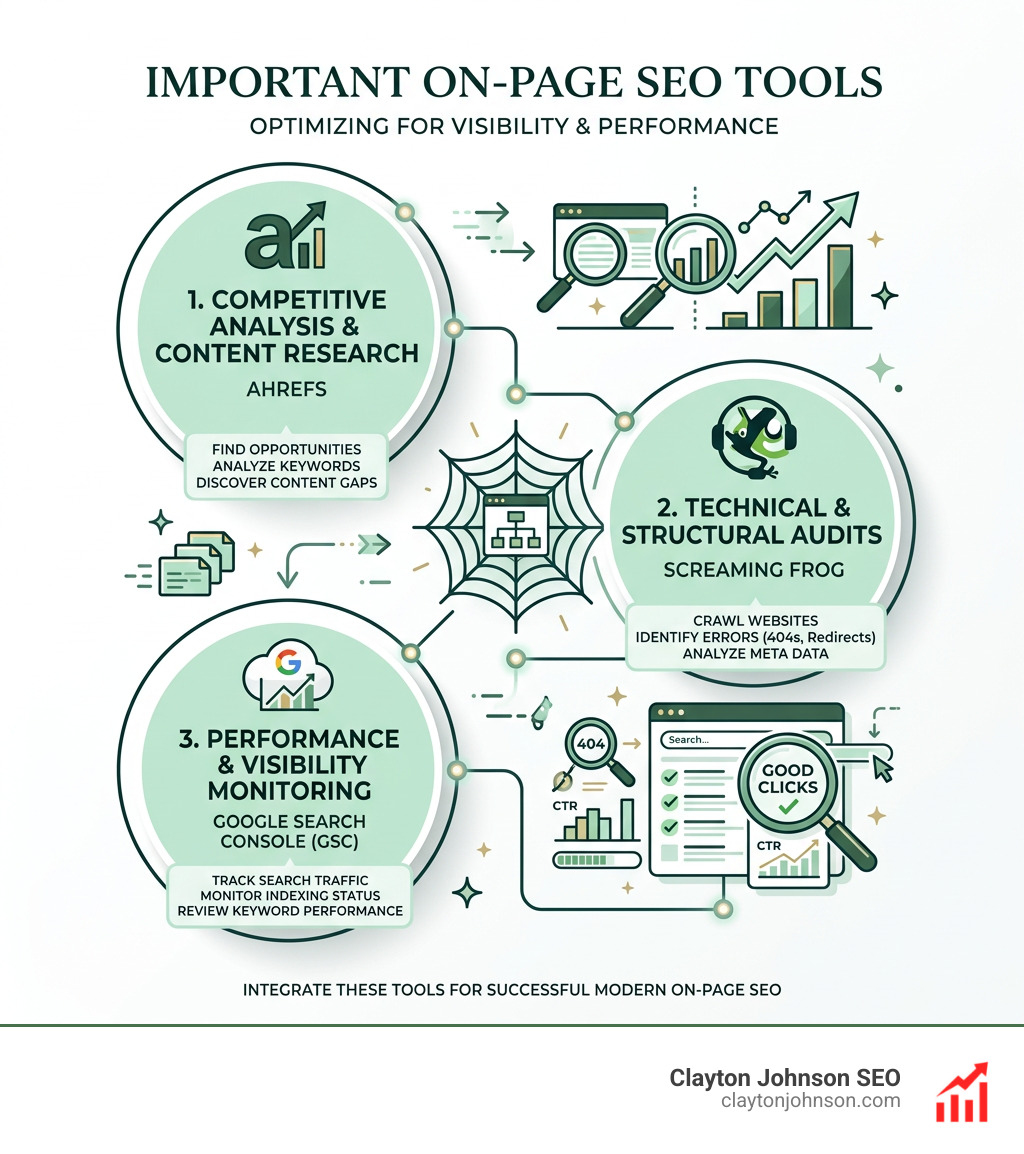
Now, let’s turn these insights into an actionable checklist. We use tools like Screaming Frog for crawling, Ahrefs for competitive analysis, and Google Search Console to monitor our “good clicks.”
1. The Foundation: Intent and Entities
- [ ] Validate Search Intent: Is the user looking to buy, learn, or find a specific site?
- [ ] Identify Main Entities: Use specific names, places, and technical terms to help Google map your content.
- [ ] Answer Immediately: Place the most important information in the first 100 words (the “inverted pyramid” style).
2. Content Quality (The “Effort” Layer)
- [ ] Original Research: Add a unique stat, a custom visual, or a fresh interview.
- [ ] Semantic Coverage: Don’t just repeat one keyword; cover all the related sub-topics.
- [ ] External Authority: Link to 2-3 high-quality, non-competing sources.
3. Technical and Structural Signals
- [ ] Title Tag: Keep it under 60 characters. Ahrefs found that Google rewrites titles 33.4% of the time, especially if they are too long.
- [ ] Header Hierarchy: Use one H1, and use H2s and H3s to create a machine-readable map of your content.
- [ ] Evergreen URLs: Remove dates and volatile keywords from the slug.
- [ ] Image Optimization: Compress images (WebP format is best) and add descriptive alt text.
4. User Experience and Engagement
- [ ] Core Web Vitals: Aim for a PageSpeed Insights score of 90+. Speed is a measurable ranking factor; a 0.1-second improvement can increase conversions by 8.4%.
- [ ] Mobile-First Design: Over 60% of searches are on mobile. Test your layout on a real phone.
- [ ] Internal Linking: Ensure the page is linked from at least 5-10 other relevant pages on your site.
5. Advanced Schema and Data
- [ ] JSON-LD Schema: Implement FAQ, Article, or Review schema to claim more SERP real estate.
- [ ] Crawl Depth: Keep important pages within 3 clicks of the homepage.
For a deeper dive into how we use technology to scale this process, check out our guide on AI-driven SEO audits.
Final Expert Advice: Avoid the “Boring” Pitfalls
The biggest mistake we see in modern on-page SEO checklists is the “set it and forget it” mentality. SEO is a compounding game. HubSpot found that 76% of their monthly views and 92% of their leads came from old posts. By simply updating historical content, they increased organic views by 106%.
Don’t fall into the trap of keyword stuffing or ignoring the user experience. The leak proved that Google’s “Twiddlers” can easily demote sites with high clutterScore or repetitive text.
Instead, focus on clarity, structure, and leverage. Build a site that users love to visit and that Google’s AI can easily parse. When you combine technical depth with high-effort content, you create a growth engine that doesn’t just rank—it dominates.
If you’re ready to stop guessing and start building a durable search system, we’re here to help you translate these complex models into measurable business impact. Clarity leads to structure, and structure leads to compounding growth.