Brian Dean’s Best Backlink Methods for SEO

Why Brian Dean Backlink Methods Still Define Modern Link Building
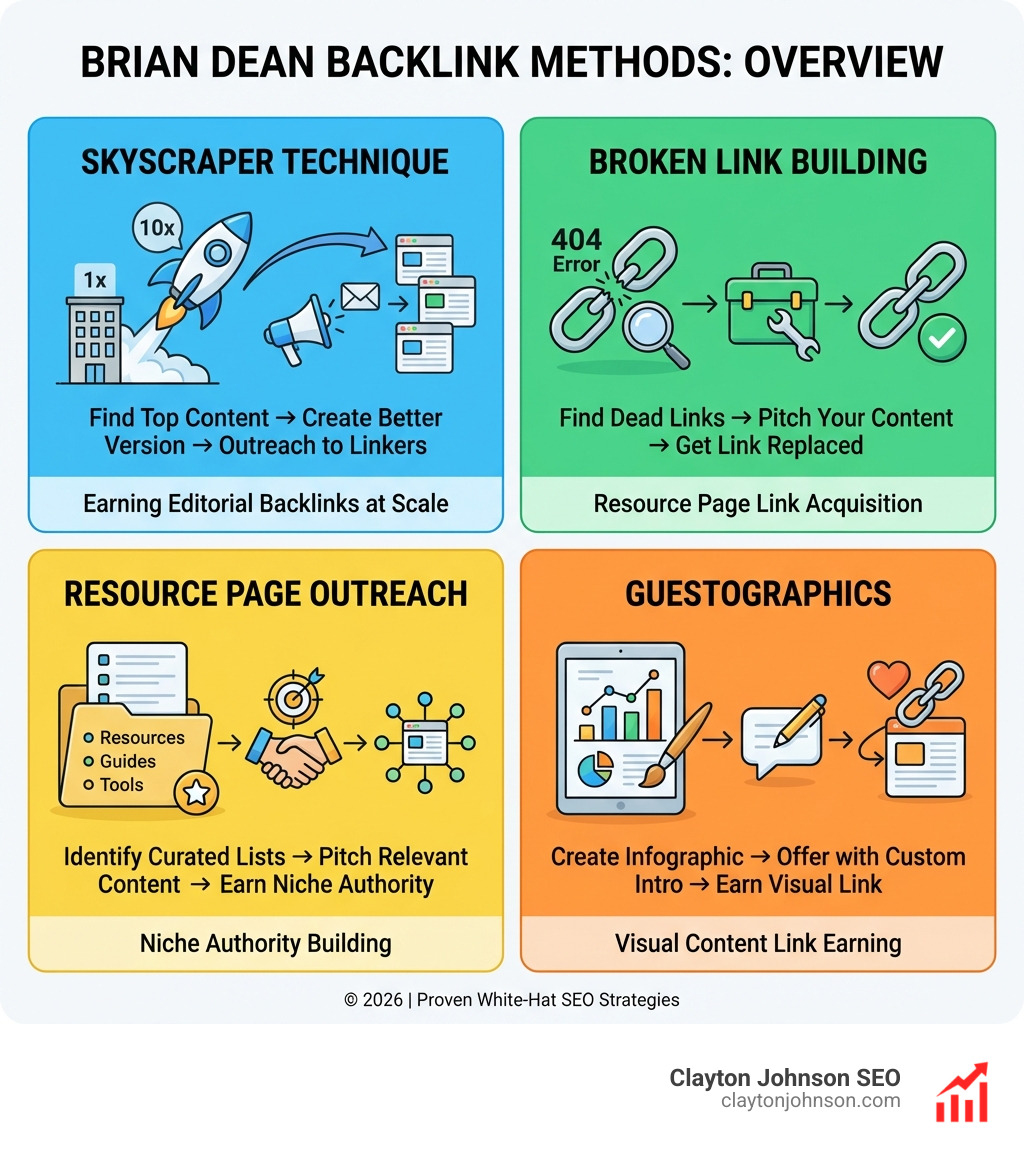
Brian Dean backlink methods are a set of proven, white-hat SEO strategies designed to earn high-quality editorial links through superior content and targeted outreach. Here is a quick overview:
| Method | What It Is | Best For |
|---|---|---|
| Skyscraper Technique | Find top content, make it better, outreach to linkers | Earning editorial backlinks at scale |
| Broken Link Building | Find dead links, pitch your content as a replacement | Resource page link acquisition |
| Resource Page Outreach | Pitch relevant content to curated link pages | Niche authority building |
| Guestographic Method | Promote infographics with custom intros to bloggers | Visual content link earning |
| Reverse Engineering | Analyze competitor backlinks and replicate wins | Competitive link gap closing |
These methods share one core principle: earn links by offering genuine value, not by gaming the system.
Most link building advice falls into one of two traps. It is either too vague (“just create great content”) or too risky (private blog networks, paid links, spammy directories). Brian Dean’s approach cuts through both problems with repeatable, structured frameworks that hold up under algorithm scrutiny.
The results speak for themselves. A single podcast guide built using these methods attracted links from over 118 different websites and ranks at the top of Google for its target keyword. A water conservation infographic earned links from more than 800 domains. These are not accidents — they are the outcome of a systematic process.
Google’s own ranking data reinforces why this matters. According to Moz research, 18 of the 19 strongest ranking signals are backlink-related. Links are not a secondary SEO factor. They are the architecture that determines whether your content ranks or disappears.
I’m Clayton Johnson, an SEO strategist who has spent years building scalable link acquisition systems using structured frameworks — including the Brian Dean backlink methods covered in this guide. My work focuses on turning fragmented outreach efforts into compounding authority engines that drive measurable rankings and revenue.
Let’s break down exactly how each method works and how to implement it.
The Skyscraper Technique: A Proven Framework for Brian Dean Backlink Methods
The Skyscraper Technique, developed by Brian Dean of Backlinko, is perhaps the most famous link building framework in the world. Its name comes from a simple observation: humans are naturally attracted to the tallest, most impressive building in the skyline. In content, we want to be that tallest building.
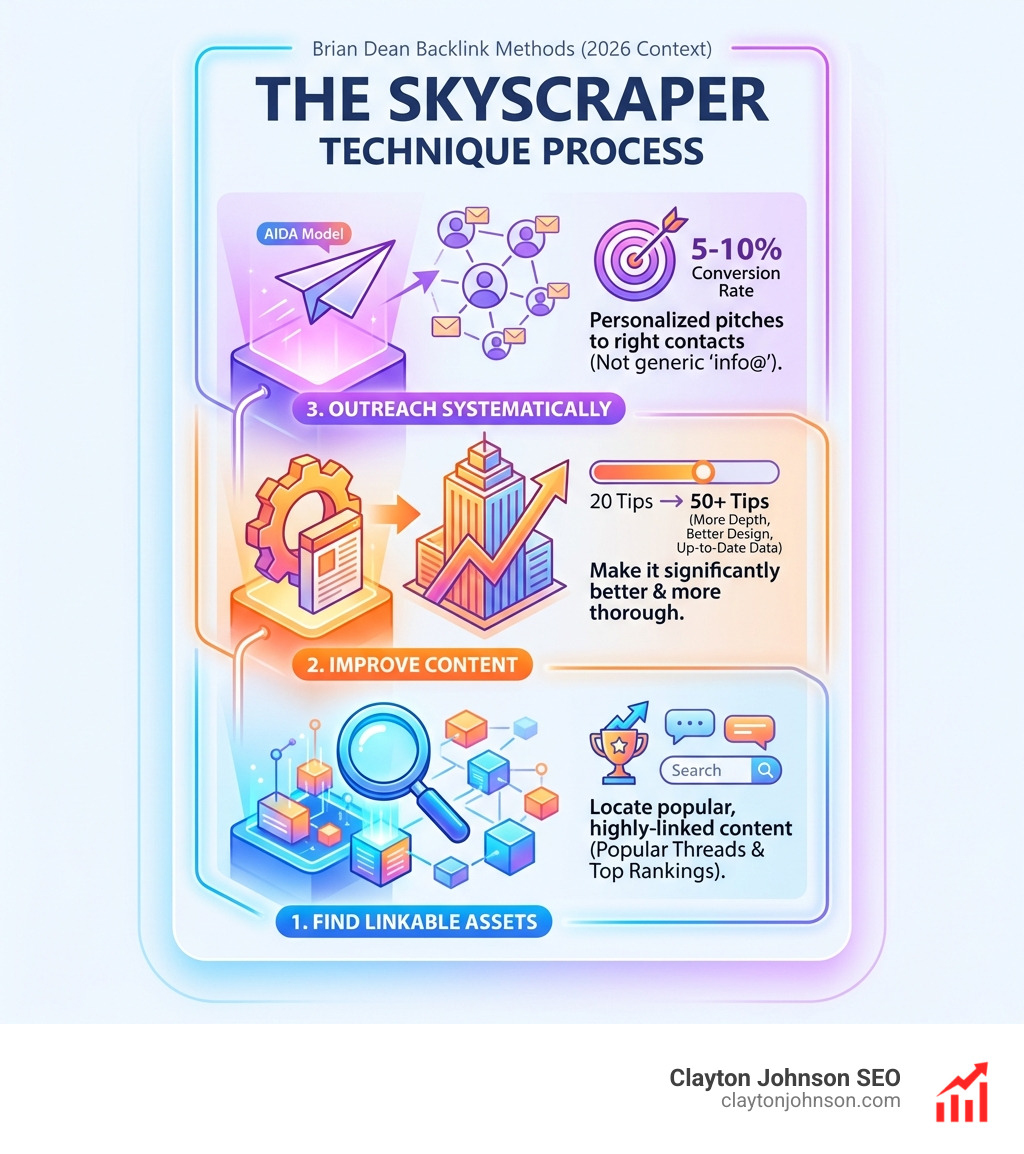
The logic is simple: instead of guessing what people might link to, we find content that has already proven its ability to attract links. Then, we build something objectively better. Finally, we reach out to the very people who linked to the original content and show them our superior version.
This is a fundamental part of How to Build an Authority Site That Dominates the SERPs. Unlike “shotgun” outreach where you email everyone with a pulse, the Skyscraper Technique is a “sniper” approach. You are only contacting people who have already demonstrated an interest in your specific topic.
If you want to dig into the original framework, Brian Dean’s canonical breakdown is here: Skyscraper Technique.
| Feature | Traditional Outreach | Skyscraper Technique |
|---|---|---|
| Target Selection | Broad, often irrelevant | Laser-targeted based on existing links |
| Content Quality | Variable | Guaranteed to be “best-in-class” |
| Success Rate | Often < 1% | Approximately 10% conversion rate |
| Scalability | Difficult without spamming | Highly scalable through systematic research |
Finding Linkable Assets with Brian Dean backlink methods
The first step is finding “linkable assets”-content that has already generated a massive amount of “link juice.” We don’t want to reinvent the wheel; we want to improve it.
We start by using tools like BuzzSumo or Ahrefs to find the most shared and linked-to content in our niche. But we don’t stop there. We also look at:
- Reddit and Quora: We search for popular threads with hundreds of upvotes. If a topic is generating massive engagement on these platforms, it is a proven topic.
- Google’s First Page: If a page is ranking in the top three for a competitive keyword, it almost certainly has a strong backlink profile.
- Forums: Industry-specific forums (like Cheftalk for the culinary world) often have “sticky” threads that represent evergreen pain points.
Once we find a piece of content with a lot of links, we look for ways to make it better. Can we make it longer? More up-to-date? Better designed? More thorough? If the original has 20 tips, we provide 50. If the original was written years ago, we provide fresh data.
Outreach Success for Brian Dean backlink methods
The magic happens in the outreach. We aren’t just saying, “Hey, look at my post.” We are providing a service to the webmaster.
We use the AIDA model (Attention, Interest, Desire, Action) to craft our personalized pitches. A typical pitch might look like this:
“Hi [Name], I was reading your post about [Topic] and noticed you linked to [Competitor’s Page]. That’s a great resource, but I actually just put together a more comprehensive version that includes [New Data/Visuals]. Thought your readers might find it useful! Keep up the great work.”
To find the right contact information, we use tools like Hunter.io or VoilaNorbert. The goal is to reach the actual content creator or editor, not a generic “info@” address. When done correctly, this systematic outreach can achieve a 5-10% conversion rate, which is massive in cold SEO outreach.
Creating “Wow Content” and Linkable Assets
If the Skyscraper Technique is the engine, “Wow Content” is the fuel. You cannot earn world-class links with mediocre blog posts. Brian Dean emphasizes that your linkable asset must be so good that people feel a social obligation to share it.
This often means going deep—very deep. Research shows that the average word count of a top 10 Google result is over 2,000 words. Furthermore, articles over 3,000 words get significantly more social shares across Facebook, LinkedIn, and Twitter. This is a core component of a robust SEO Strategy for Enterprises.
“Wow Content” isn’t just about length, though. It’s about E-E-A-T (Experience, Expertise, Authoritativeness, and Trustworthiness). We achieve this through:
- Original Research: Conducting our own surveys or data analysis.
- Case Studies: Showing real-world results with “crunchy” stats (e.g., “How we increased conversions by 785%”).
- Ultimate Guides: Becoming the definitive source for a specific “medium-tail” keyword.
Content Design and Length for SEO
Design is the first thing a user sees, and it creates an immediate “trust signal.” In fact, a study on health websites found that 94% of users distrusted sites purely because of poor design, even if the content was accurate.
To make our content link-worthy, we focus on:
- Readability: Using 15-17px font sizes and 1-2 sentence paragraphs.
- Custom Banners: Moving away from generic stock photos and using custom-designed section headers.
- Visual Assets: Including charts, graphs, and “Share Triggers” that make complex data easy to digest.
When content looks professional, it feels authoritative. When it feels authoritative, other experts are much more likely to cite it as a source.
The Power of Original Data
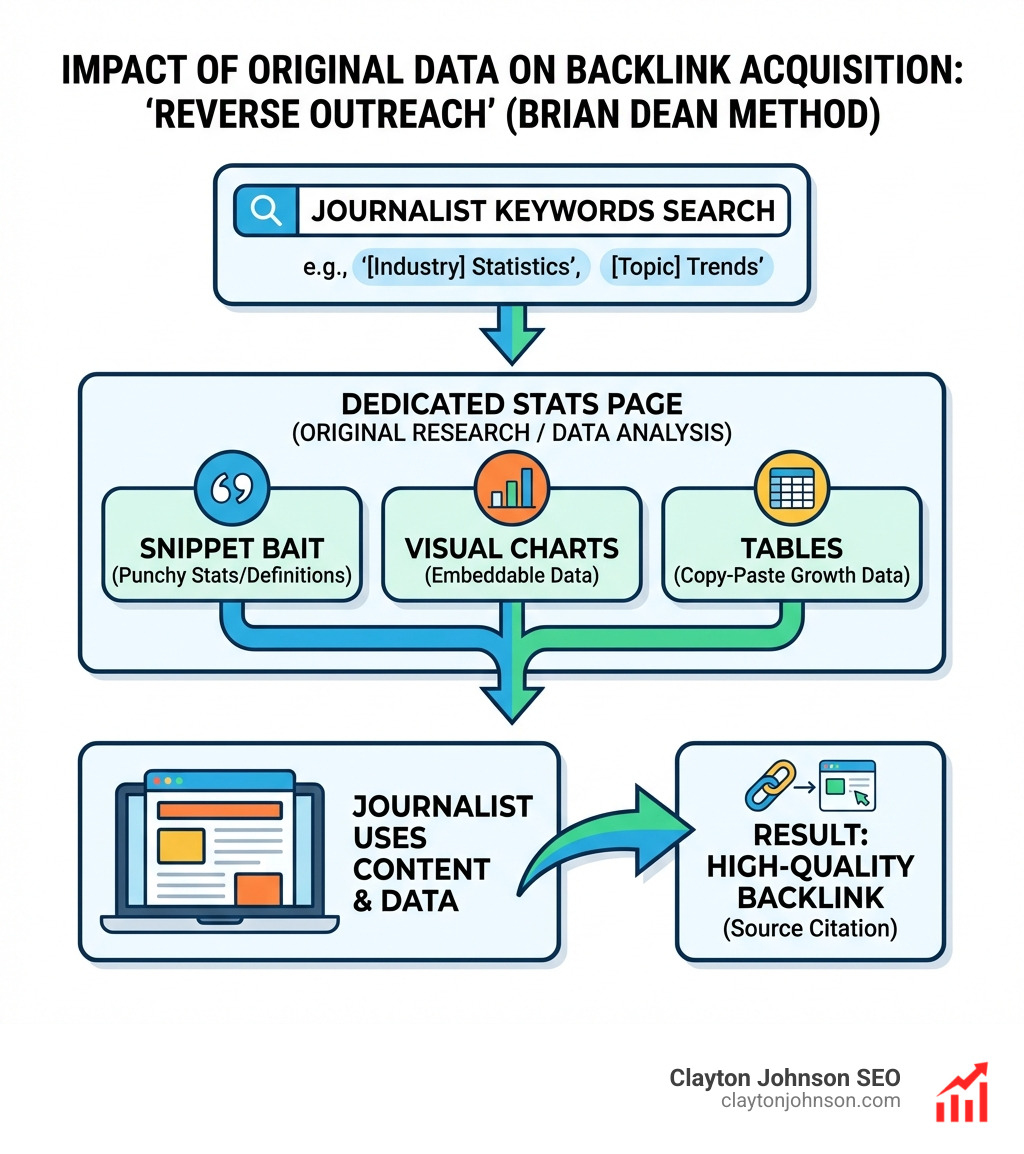
One of the most effective Brian Dean backlink methods is what he calls “Reverse Outreach.” Instead of us reaching out to bloggers, we create content that journalists are already looking for.
Journalists and reporters are constantly searching for “journalist keywords”—terms like “[Industry] statistics” or “[Topic] trends.” By creating a dedicated stats page, we position ourselves as the primary source for their articles.
We source data from places like Statista, Google News, or even S-1 filings, and then we organize it into a “crunchy” stats page. This includes:
- Snippet Bait: Short, punchy definitions or stats that Google can easily pull into a Featured Snippet.
- Visual Charts: Making our data embeddable so others can use our images (and link back to us as the source).
- Tables: Organizing growth data into clean tables that journalists can copy and paste.
Advanced Outreach: Broken Links, Resource Pages, and Guestographics
Beyond the Skyscraper Technique, Brian Dean has popularized several other high-conversion outreach strategies. These methods focus on different types of “link prospects” to ensure a diversified and natural backlink profile.
Broken Link Building
This is the “win-win-win” of SEO. You find a dead link (404 error) on a high-authority site, notify the webmaster that they have a broken link (which hurts their SEO), and suggest your relevant content as a replacement. We use tools like the Check My Links Chrome extension to find these opportunities in seconds. It’s effective because you are helping the webmaster fix their site while simultaneously securing a high-quality editorial link.
Resource Page Pitching
Resource pages are curated lists of the best tools or articles in a specific niche. Because these pages exist solely to link out to great content, the webmasters are usually very open to suggestions. By using search operators like “keyword + inurl:resources,” we can find hundreds of these targets. The pitch is simple: “I noticed you have a great list of resources for [Topic]. I recently published a guide on [Sub-topic] that might be a good addition.”
The Guestographic Method
We all know infographics are great, but just publishing one isn’t enough. The Guestographic method involves reaching out to bloggers in your niche and offering them your infographic to use in a post. The “twist” is that you also offer to write a unique, 200-300 word introduction for them. This removes the barrier of work for the blogger—they get a great visual and free content, and you get a contextual backlink.
Identifying High-Quality Link Opportunities
To find these opportunities at scale, we use reverse engineering. By plugging a competitor’s URL into Semrush or Ahrefs, we can see every single site that links to them. We then filter for white-hat opportunities—editorial links, resource pages, and mentions in “Best of” roundups.
We also set up Ahrefs Alerts or use Google Alerts to track unlinked brand mentions. If someone mentions our brand or a unique strategy we’ve coined (like the “Trademark Technique”) without linking, we send a friendly nudge to ask for the attribution. This is often the easiest link you’ll ever earn.
For those looking to scale these efforts, you can find More info about SEO services that specialize in these high-touch outreach frameworks.
Avoiding Low-Quality Tactics
In Brian Dean backlink methods, quality always beats quantity. One link from a high-authority, relevant site (like a major industry publication) is worth more than 1,000 links from spammy directories.
We strictly avoid:
- PBNs (Private Blog Networks): These are risky, footprint-heavy networks that can lead to manual Google penalties.
- Spammy Directories: If anyone can get a link there, the link is worthless.
- Over-Optimized Anchor Text: We aim for anchor text diversity. A natural profile should have a mix of brand names, URLs, and organic phrases, with only about 20-25% being exact-match keywords.
Following the Penguin algorithm updates, Google has become incredibly good at spotting manipulative link patterns. Our focus is always on building brand authority through legitimate editorial placements.
Frequently Asked Questions about Brian Dean Backlink Methods
What is the Skyscraper Technique?
The Skyscraper Technique is a 3-step link building framework: 1) Find content that has already earned a lot of links. 2) Create a superior version of that content (more depth, better design, updated data). 3) Reach out to the people who linked to the original and ask them to link to your improved version instead.
How does broken link building work?
Broken link building involves finding dead links (404 errors) on other websites using tools like Check My Links. Once found, you reach out to the site owner to let them know about the broken link and suggest a relevant page on your own site as a replacement. It provides value to the webmaster by helping them fix their user experience.
Why does Brian Dean prioritize editorial links over PBNs?
Editorial links are “earned” through merit and are placed naturally within the body of a piece of content. PBNs (Private Blog Networks) are “owned” or “bought” links that violate Google’s Webmaster Guidelines. While PBNs might provide a short-term boost, they carry a high risk of permanent de-indexing. Editorial links provide long-term, sustainable authority.
Conclusion
Mastering Brian Dean backlink methods isn’t about finding a “secret hack”—it’s about adopting a structured growth architecture. Whether you are using the Skyscraper Technique to dominate the SERPs or Reverse Outreach to attract journalists, the goal is to build a high-authority ecosystem that grows more powerful over time.
Building links is hard work, but with the right system, it becomes a predictable path to growth. Start by finding your first “linkable asset” today and see the difference a structured approach can make.