The Definitive Guide to AI Search Optimization Strategies

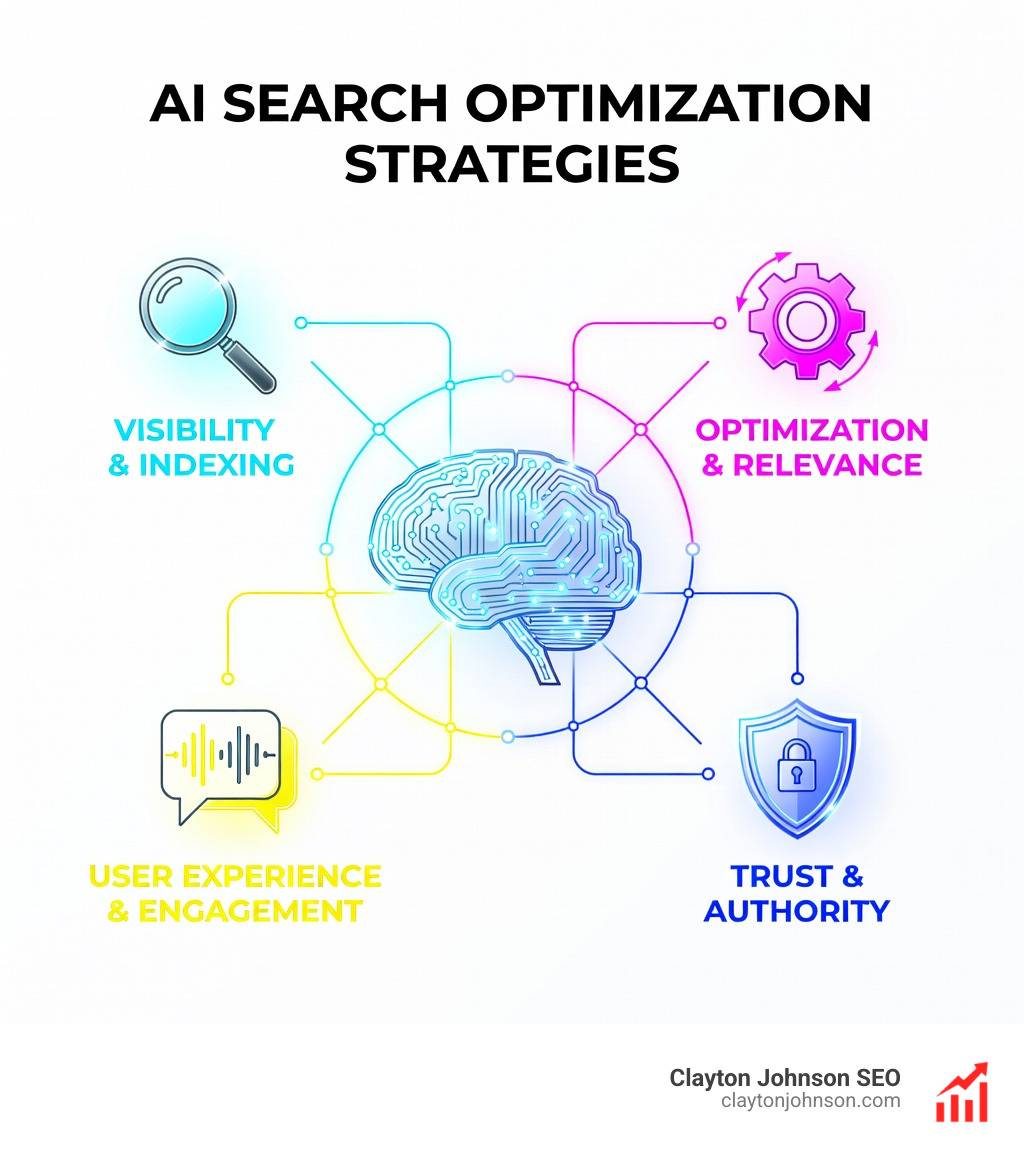
Why AI Search Optimization Strategies Define the Next Era of Visibility
AI search optimization strategies are the methods marketers and founders use to make their content visible, citable, and trustworthy inside AI-generated search answers — not just traditional search results pages.
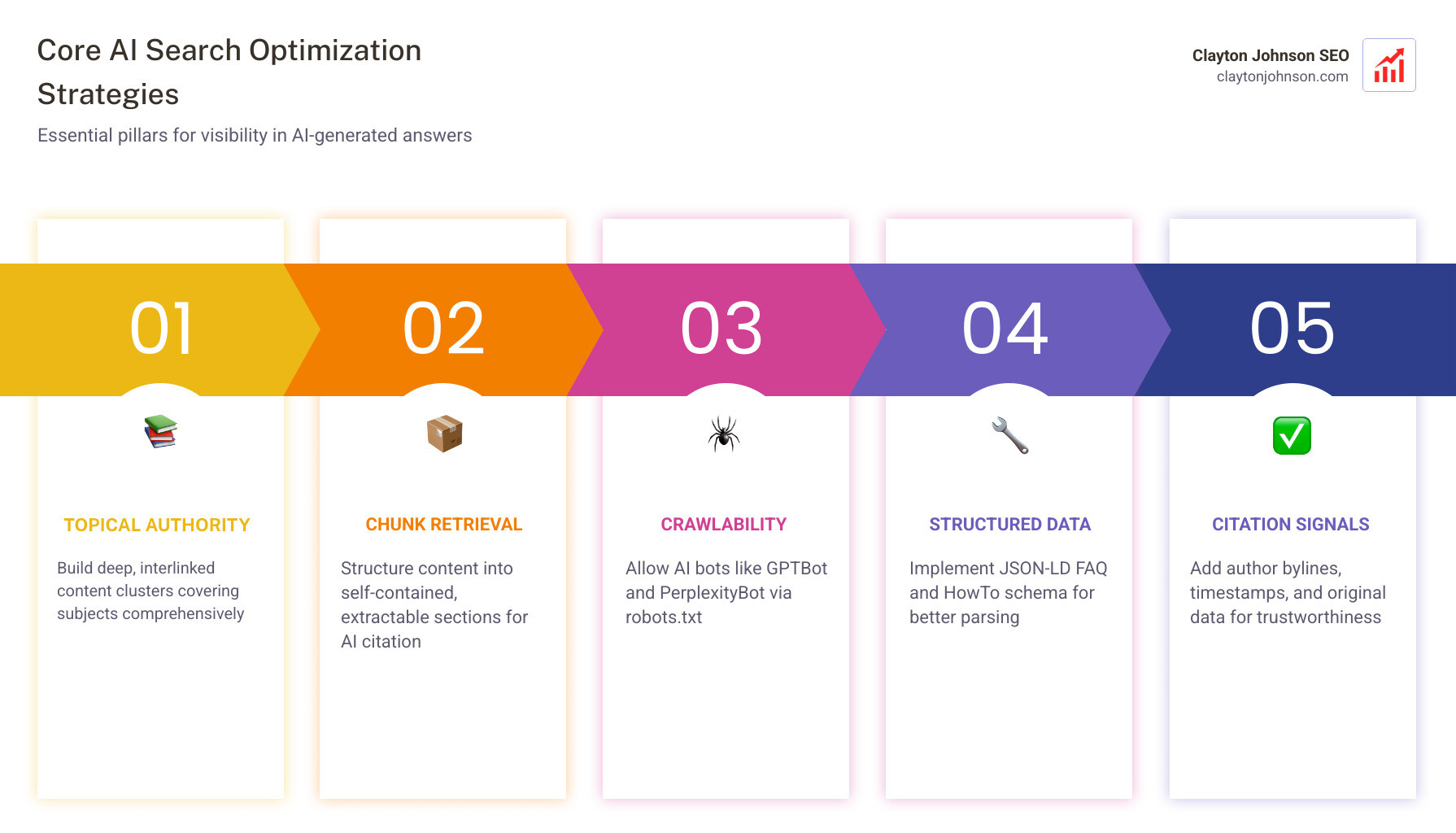
Here is a quick breakdown of the core strategies:
- Build topical authority — Cover your subject deeply across interlinked content clusters
- Structure content for chunk retrieval — Write self-contained sections AI can extract and cite
- Optimize for crawlability — Allow AI bots like GPTBot and PerplexityBot in your robots.txt
- Use structured data — Implement FAQ and HowTo schema in JSON-LD format
- Create citation-worthy assets — Add author bylines, timestamps, and original data
- Monitor AI referrals — Track brand mentions, sentiment, and AI-driven traffic separately from organic
Search has fundamentally shifted. Google processes roughly 8.5 billion searches every day — and a growing share of those now end with an AI-generated answer, not a click to your website. Currently, AI Overviews appear on about 18% of all Google searches, and only 8% of those sessions result in any website visit at all. That is less than half the click-through rate of a standard search result.
For founders and marketing leaders, this is not a future provide. It is happening right now.
The old playbook — rank for keywords, earn clicks, convert traffic — is losing ground fast. AI systems like Google’s AI Overviews, ChatGPT, and Perplexity do not rank pages the way traditional search engines do. They retrieve content in pieces, synthesize it into answers, and cite sources they judge as authoritative. If your content is not structured for that process, it will not appear — regardless of how well it ranks.
This guide exists to close that gap.
I’m Clayton Johnson, an SEO strategist and growth architect who has spent years building scalable content systems and AI-augmented marketing workflows — including hands-on work developing AI search optimization strategies for founders and marketing leaders navigating this exact shift. If you are ready to move from reactive SEO to a structured, compounding growth engine, this guide gives you the architecture to do it.
The Evolution of Search: From Keywords to AI-Driven Discovery
Search is no longer just a list of blue links; it is a conversation. Historically, SEO 101 was about matching keywords to a user’s query. If you had the right words in your title tag, you won. Today, search engines have evolved into “answer engines.”
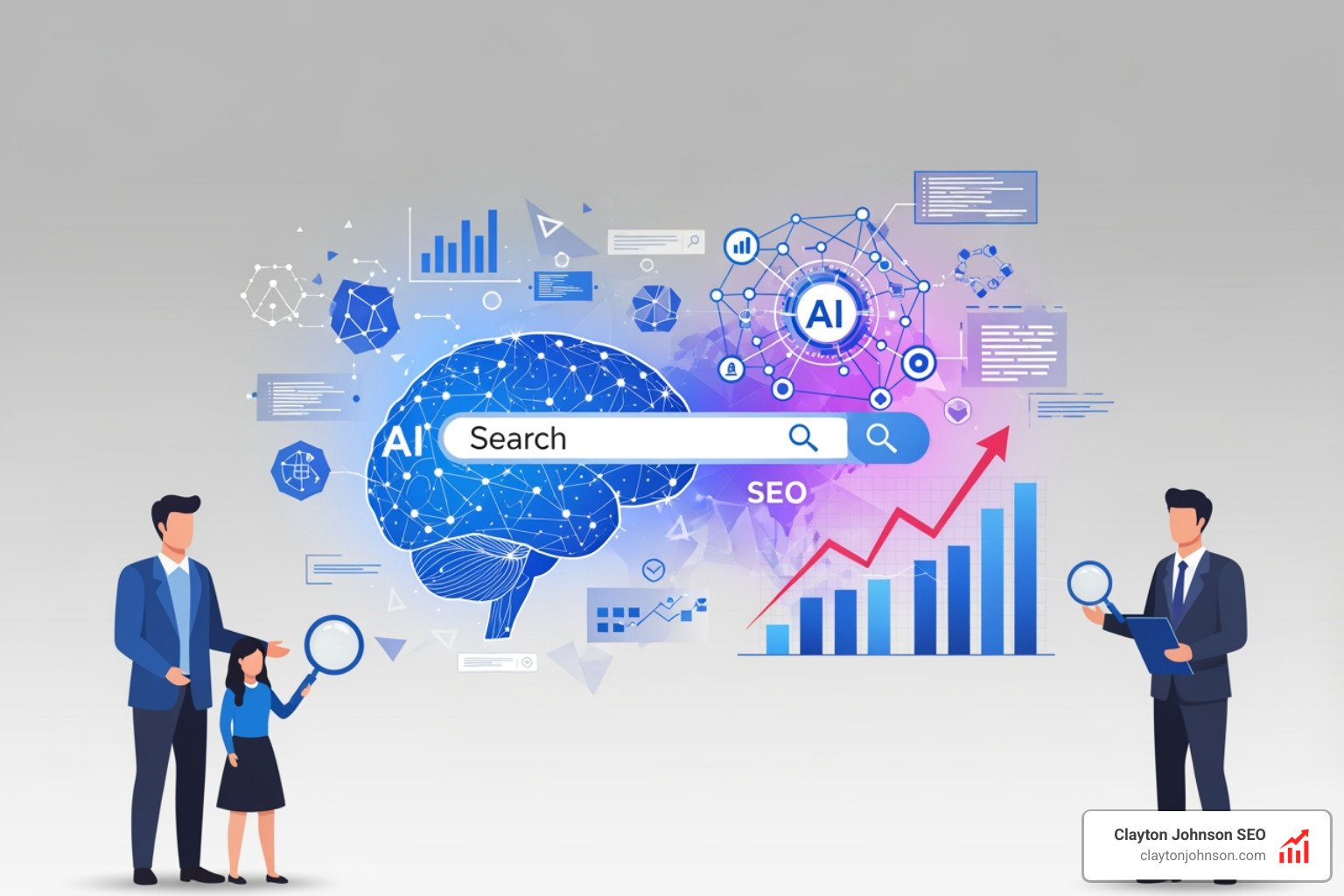
Google’s Search Generative Experience (SGE) and AI Overviews use Large Language Models (LLMs) to understand the intent behind a query rather than just the words. This shift allows for:
- Personalization: Search results are now tailored to your specific behavior and past queries.
- Predictive Analytics: AI can forecast what you might want to know next, surfacing information before you even ask.
- Conversational Discovery: Tools like ChatGPT and Perplexity allow users to ask complex, multi-turn questions that traditional search engines used to struggle with.
While Google still commands roughly 92% of the global search market, the way users interact with that market is changing. We are moving from a world where “Googling” is a verb for finding a website to one where it is a verb for getting an immediate, AI-synthesized answer.
Core AI Search Optimization Strategies for Modern Visibility
To win in this new environment, we must focus on ai search optimization strategies that prioritize “citability” over mere “rankability.” This requires a shift toward The Ultimate Guide to Generative Engine Optimization and Search Techniques—a framework that treats content as a modular resource for AI models.
One of the most powerful concepts here is Query Fan-Out. Unlike traditional search, which matches a single query to a single page, AI search breaks a complex question into several sub-queries (the fan-out), retrieves information from multiple sources, and then stitches them together. If your content only answers part of the puzzle, you need to ensure that part is the most authoritative “chunk” available.
Implementing AI Search Optimization Strategies for E-E-A-T
Experience, Expertise, Authoritativeness, and Trustworthiness (E-E-A-T) are more critical than ever. AI models are programmed to favor sources that demonstrate clear provenance. To improve your chances of appearing in an AI Overview, we recommend these Ranking in the AI Overview: A Practical Guide tactics:
- Author Bylines: Clearly state who wrote the content. AI systems look for recognized entities (people and organizations) to verify the reliability of a claim.
- Timestamps: Freshness is a major signal. Regularly update your content and ensure “last updated” dates are clearly visible to crawlers.
- Source Citations: Ironically, to be cited by AI, you should cite others. Linking to reputable external data proves your content is grounded in fact, not just fluff.
Real-world data shows that platforms like Wikipedia, YouTube, and Reddit drive about 15% of all citations in Google AI Overviews. This tells us that AI trusts community-vetted and highly structured information.
Advanced AI Search Optimization Strategies for Chunk Retrieval
AI models do not read your 3,000-word blog post from top to bottom. They retrieve “chunks”—small, semantically rich sections of text.
To optimize for chunk retrieval, follow these best practices:
- One Idea Per Section: Use H2 and H3 headings to define clear, self-contained topics.
- Semantic Density: Ensure each paragraph contains enough context to be understood on its own.
- Chunk Overlap: Maintain a 10-30% overlap in context between sections to help the AI maintain the “thread” of your argument.
- Concise Summaries: Start your sections with a direct answer to a likely question.
By treating your content as modular units, you make it easier for RAG (Retrieval-Augmented Generation) systems to pull your brand into the final answer.
Technical Architecture: Crawlability and Schema for LLMs
If the AI can’t see you, it can’t cite you. Technical SEO remains the foundation of all ai search optimization strategies. You must explicitly allow AI bots to access your site.
In your robots.txt file, ensure you are not blocking these key agents:
- GPTBot (OpenAI)
- Google-Extended (Google’s AI training bot)
- PerplexityBot (Perplexity AI)
- ClaudeBot (Anthropic)
Beyond crawlability, you need to provide a “machine-readable” map of your content. This is where schema.org comes in. Using JSON-LD format, you can label your content so the AI doesn’t have to guess what it is.
For those just starting, check out An Absolute Beginner’s Guide to Mastering Core SEO to get your technical house in order. Specifically, implement FAQ Schema and Organization Schema. This helps AI systems disambiguate your brand and recognize you as a canonical entity in your niche.
Content Engineering: Building Citation-Worthy Assets
The rise of the “zero-click search” is a major challenge. When a user gets their answer directly on the search page, they don’t click through to your site. This is The Future of Search: Navigating the Zero-Click AI Revolution—a world where being the source is more important than being the destination.
To remain relevant, you must build content that is so authoritative that the AI must cite it. This includes:
- Original Research: Conduct surveys and publish the data. AI loves facts and figures.
- Semantic Clarity: Avoid industry jargon that obscures meaning. Use clear, direct language that maps to how people actually ask questions.
- Answer Synthesis: Structure your pages to provide a “TL;DR” at the top. This increases the likelihood of your site being used as the primary summary source.
For businesses focused on investment attraction or FDI (Foreign Direct Investment), having your region or service cited as a top-tier choice in an AI-generated comparison is worth more than a thousand traditional clicks.
Measuring Success in the Era of Generative Answers
Traditional metrics like “keyword rankings” are becoming less useful. If you rank #1 but the AI Overview takes up the whole screen, your “rank” doesn’t pay the bills.

We need to evolve our measurement stack. Instead of just looking at Search Console, we should track:
- AI Referrals: Monitor traffic coming from
chatgpt.com,perplexity.ai, and other AI tools. - Brand Mentions: How often is your brand named in AI-generated answers?
- Sentiment Analysis: When the AI mentions you, is the tone positive or negative?
- Citation Share: What percentage of the citations in your niche belong to you?
| Metric | Traditional SEO | AI Search Optimization |
|---|---|---|
| Primary Goal | Clicks to Website | Citations & Mentions |
| Key Tool | Google Search Console | AI Analytics/GA4 AI Channels |
| Content Unit | The Web Page | The Content Chunk |
| User Intent | Keyword Matching | Task Completion |
For a deeper dive into these metrics, see The Future of Search with AI-Powered Keyword Research.
Frequently Asked Questions about AI Search Optimization Strategies
Will SEO still exist in 10 years?
Yes, but it won’t look like it does today. SEO is evolving into GEO (Generative Engine Optimization). We will move away from “optimizing for search engines” and toward “optimizing for discovery engines.” As long as people have questions, businesses will need strategies to be the ones providing the answers.
How do I optimize for zero-click searches?
You optimize by becoming the “Featured Snippet” or the “AI Overview” source. This involves using structured data, lists, and direct Q&A formats. While you may get fewer clicks, your brand awareness and authority will grow, leading to more direct, high-intent traffic later in the buyer journey.
What are the most common AI SEO mistakes?
The biggest mistake is blocking AI crawlers out of fear of “content theft.” If you aren’t in the index, you don’t exist in the conversation. Other mistakes include creating “walls of text” that are hard for AI to parse and failing to use schema markup to define your data.
Conclusion
The shift to AI search can feel overwhelming, but it is actually an opportunity for those who prioritize structure over noise. At Demandflow.ai, we believe that most companies don’t lack tactics — they lack structured growth architecture.
By implementing these ai search optimization strategies, you aren’t just chasing the latest algorithm update; you are building a durable, compounding asset. You are moving from a world of “hope-based marketing” to one of “leveraged growth infrastructure.”
Clarity leads to structure. Structure leads to leverage. Leverage leads to compounding growth.
If you’re ready to stop guessing and start building a search presence that survives and thrives in the age of AI, we’re here to help. Explore more info about AI Search services and let’s build your growth engine together.