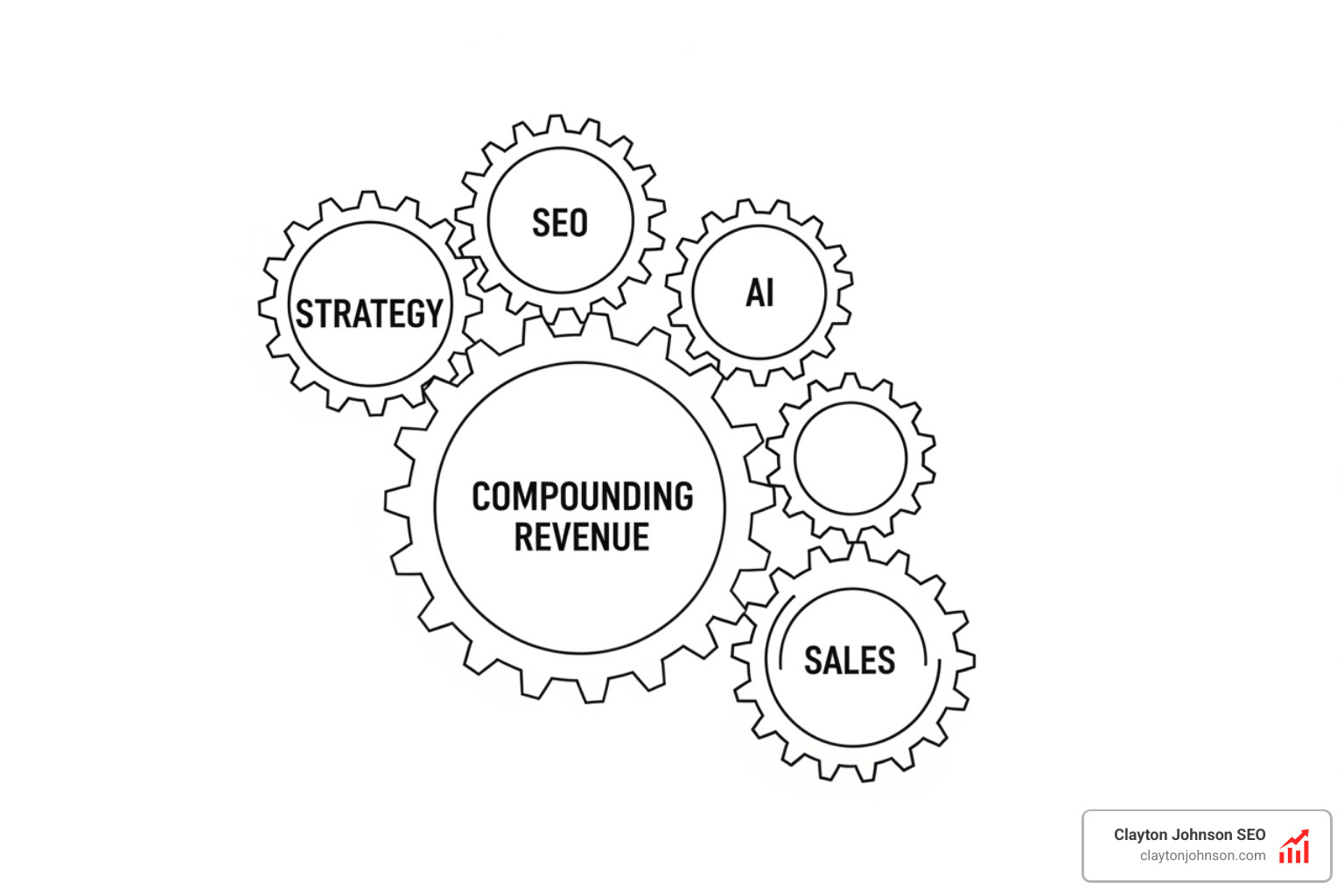
The Executive Guide to Compounding Growth Architecture

Why Growth Architecture Is the Missing Layer in Your Revenue Strategy
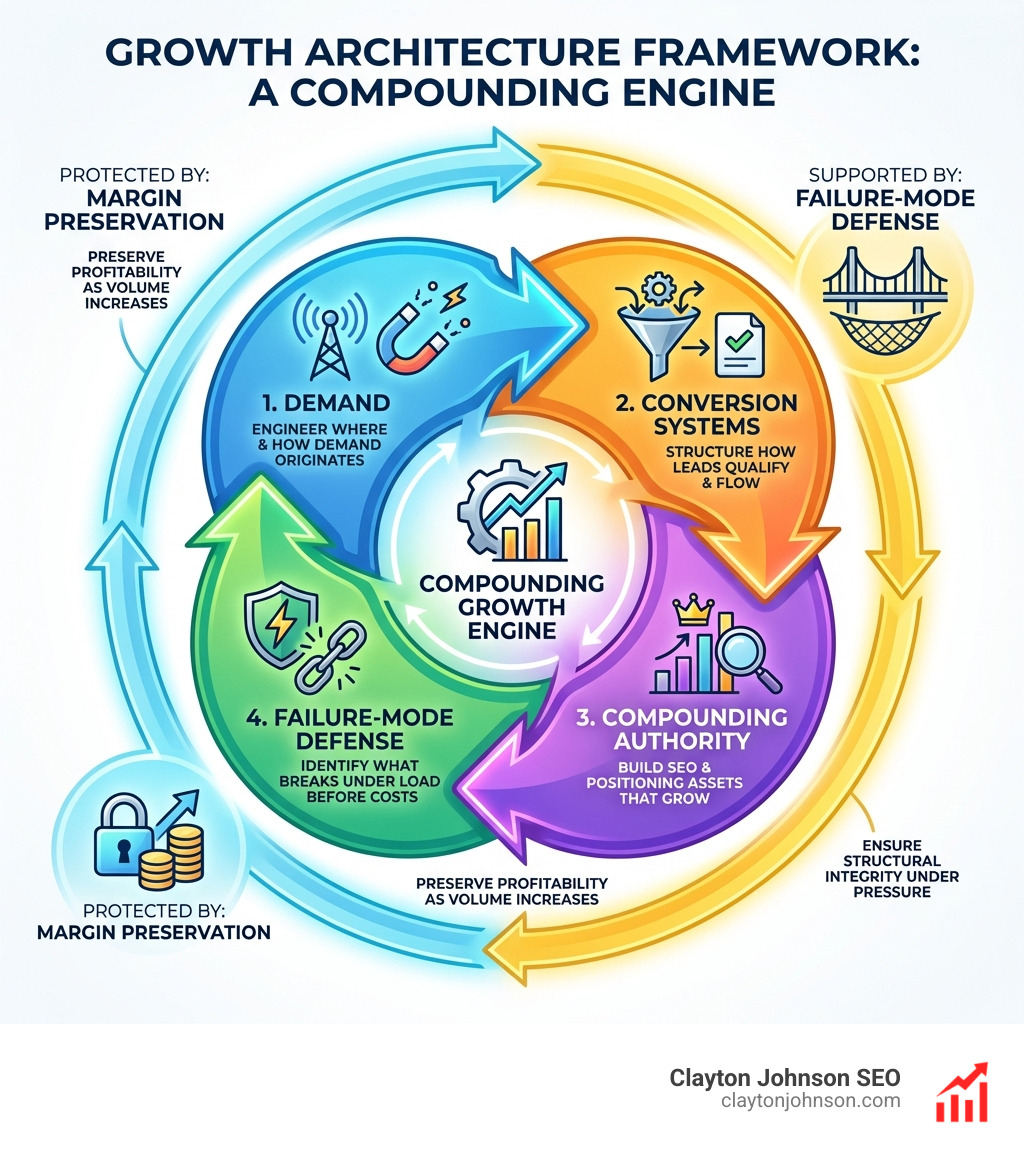
Growth architecture for companies is the discipline of designing revenue systems that are structured, scalable, and built to survive real-world pressure — not just generate short-term results.
Here’s what it covers at a glance:
- Demand creation — engineering where and how demand originates
- Conversion systems — structuring how leads qualify and flow through your pipeline
- Compounding authority — building SEO and positioning assets that grow over time
- Failure-mode defense — identifying what breaks under load before it costs you
- Margin protection — preserving profitability as volume and complexity increase
Most companies don’t have a growth architecture. They have a collection of tactics — ads, content, outreach — running in parallel without a unifying structure. At small scale, that feels inefficient. At enterprise scale, it becomes dangerous.
Research consistently shows that revenue growth drives between 32% and 56% of total shareholder return, depending on the time horizon. Yet more than one-third of companies still deliver below-median shareholder returns despite growing faster than inflation. The problem isn’t effort. It’s structure.
The companies that sustain growth — the ones that compound rather than spike — invest in integrated systems, not individual campaigns. A study of over 2,000 publicly traded companies found that “growth champions,” those who consistently outperformed peers year after year, earned valuations of 4.2 times revenue compared to just 1.7 times for lower-performing peers. The differentiator wasn’t a better ad budget. It was a better-designed growth system.
I’m Clayton Johnson, an SEO strategist and growth operator with over a decade of experience building scalable demand systems for founders and marketing leaders — and growth architecture for companies is the core framework I use to turn fragmented marketing efforts into compounding revenue engines. In the sections ahead, we’ll break down exactly how this system works, what it replaces, and how to implement it.
Simple guide to growth architecture for companies terms:
The Fundamentals of Growth Architecture for Companies
When we talk about growth architecture for companies, we aren’t just talking about a fancy synonym for marketing. If marketing is the paint and the furniture, growth architecture is the blueprint, the foundation, and the load-bearing walls. It is the structural discipline that ensures your revenue engine doesn’t collapse the moment you step on the gas.
At its core, growth architecture is about analyzing and designing the business processes, functions, and structures that lead to revenue. It bridges the gap between a high-level business strategy and the daily execution of your sales and marketing teams. While traditional business architecture focuses on general operations, growth architecture is laser-focused on the mechanics of expansion.
Marketing vs. Growth Architecture: A Comparison
To understand why this distinction matters, we have to look at how most organizations approach growth. Usually, it’s a series of “bets” or “initiatives.” We try a new ad channel, we hire a new sales rep, or we launch a blog. These are tactics. Growth architecture is the system that makes those tactics work together.
| Feature | Traditional Marketing | Growth Architecture |
|---|---|---|
| Primary Goal | Lead volume and brand awareness | Predictable, compounding revenue |
| Focus | Campaigns and channels | Systems and infrastructure |
| Time Horizon | Monthly or quarterly | Multi-year compounding |
| Measurement | Clicks, impressions, MQLs | System integrity, margin, LTV |
| Scalability | Linear (more spend = more leads) | Exponential (leverage and automation) |
| Outcome | Episodic spikes | Survivable, defensible growth |
The Role of Business and Enterprise Architecture
For organizations at enterprise scale, growth architecture often intersects with broader disciplines like those promoted by the Business Architecture Guild. Business architecture provides the blueprint for how an organization operates, identifying capabilities and value streams.
However, growth architecture adds a layer of “revenue forensics.” It asks: Where does the money actually come from, and what structural friction is preventing it from doubling? In many companies, structural misalignment turns small inefficiencies into massive, expensive roadblocks as the company scales. Growth architecture identifies these “failure modes” before they become catastrophic.
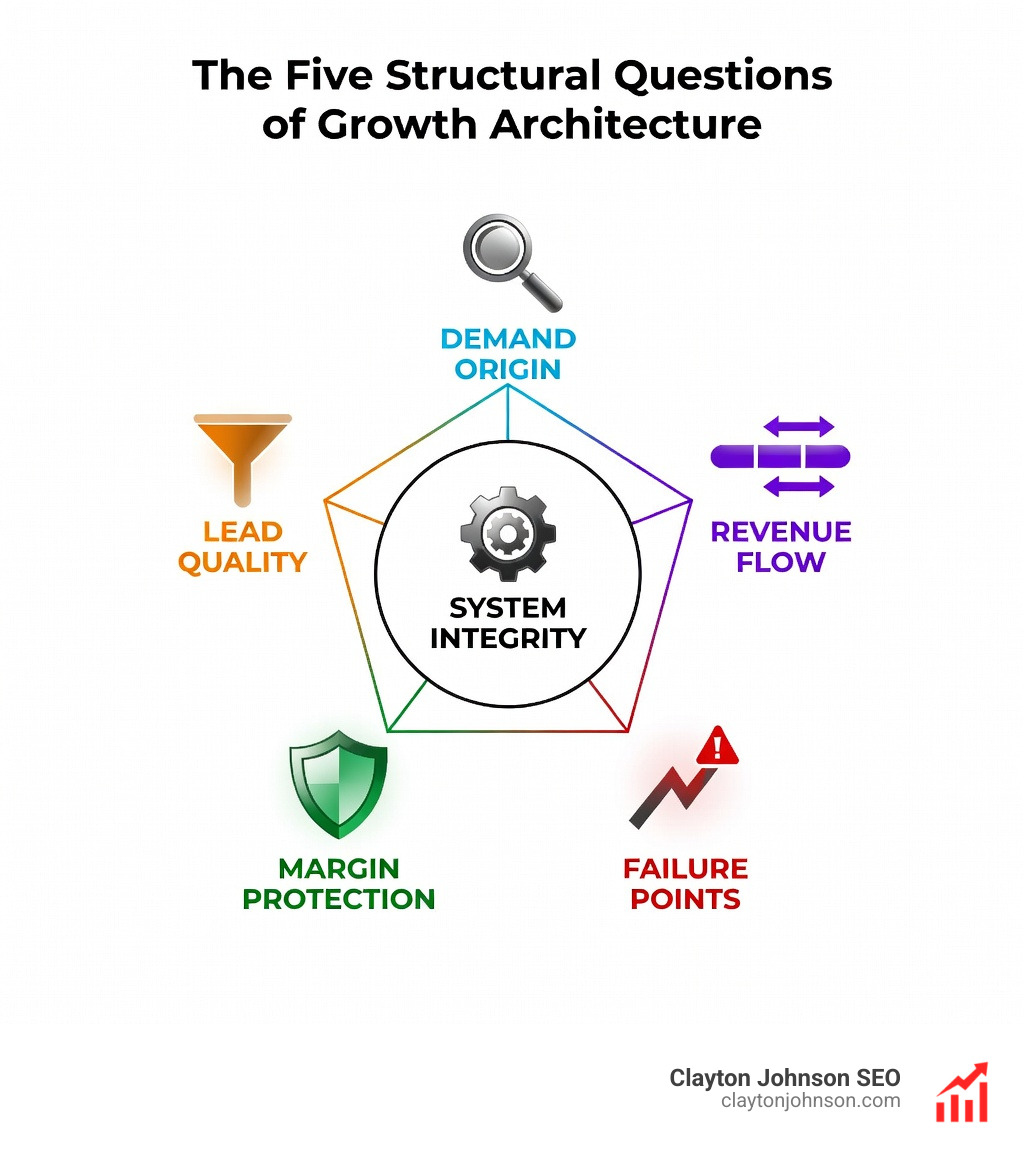
The Five Structural Questions of Growth Architecture
Before we spend a single dollar on scaling, we must answer five core questions. These questions aren’t about your “vibe” or your brand colors; they are about the physics of your revenue system. According to research on how to Create a System to Grow Consistently, the highest-performing organizations invest in integrated capabilities rather than just chasing the next shiny object.
1. Where does demand actually originate?
Most leaders think demand starts with an ad click. It doesn’t. Demand starts with a problem in the mind of your customer. Growth architecture maps the “demand origin” — whether it’s search intent, social proof, or outbound pressure — and ensures we aren’t just capturing demand, but engineering it.
2. What determines lead quality vs. lead volume?
If we double our lead volume but our sales team stays the same size, our “lead-to-close” ratio usually plummets. Why? Because the system wasn’t designed for quality at scale. We must architect the “intake” process to filter for high-intent signals automatically.
3. How does revenue flow through the organization?
We use revenue forensics to map the path from the first touchpoint to the final signature. We look for “leaky buckets” where prospects drop out because of slow response times, poor handoffs between marketing and sales, or confusing pricing structures.
4. What breaks under load?
This is the “stress test” of growth architecture for companies. If we 10X our traffic tomorrow, does our website crash? Does our sales team quit? Does our customer success team get buried? We model these failure points early so we can build “survivable” systems.
5. What protects margin, attribution, and positioning over time?
Growth is a treadmill if it doesn’t lead to higher margins. We architect systems that build “authority assets” (like proprietary data or dominant SEO positions) that lower our customer acquisition cost (CAC) over time. This creates “leverage” — where revenue grows faster than expenses.
The Operating Sequence: From Revenue Forensics to Defensible Systems
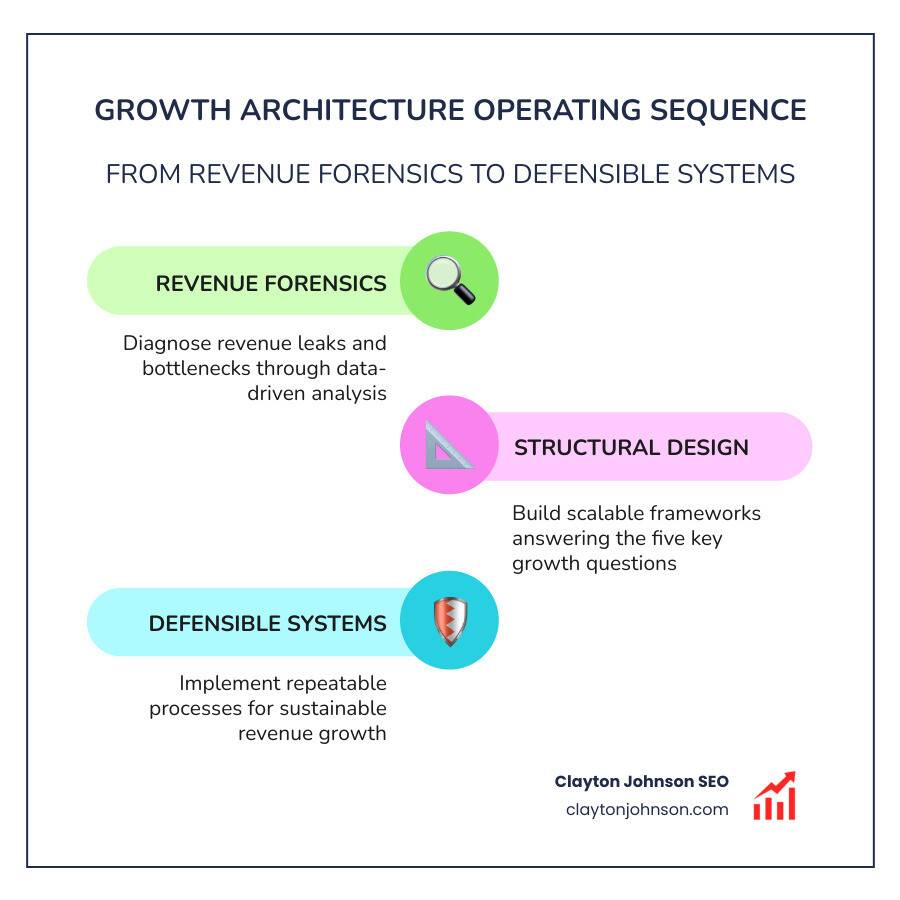
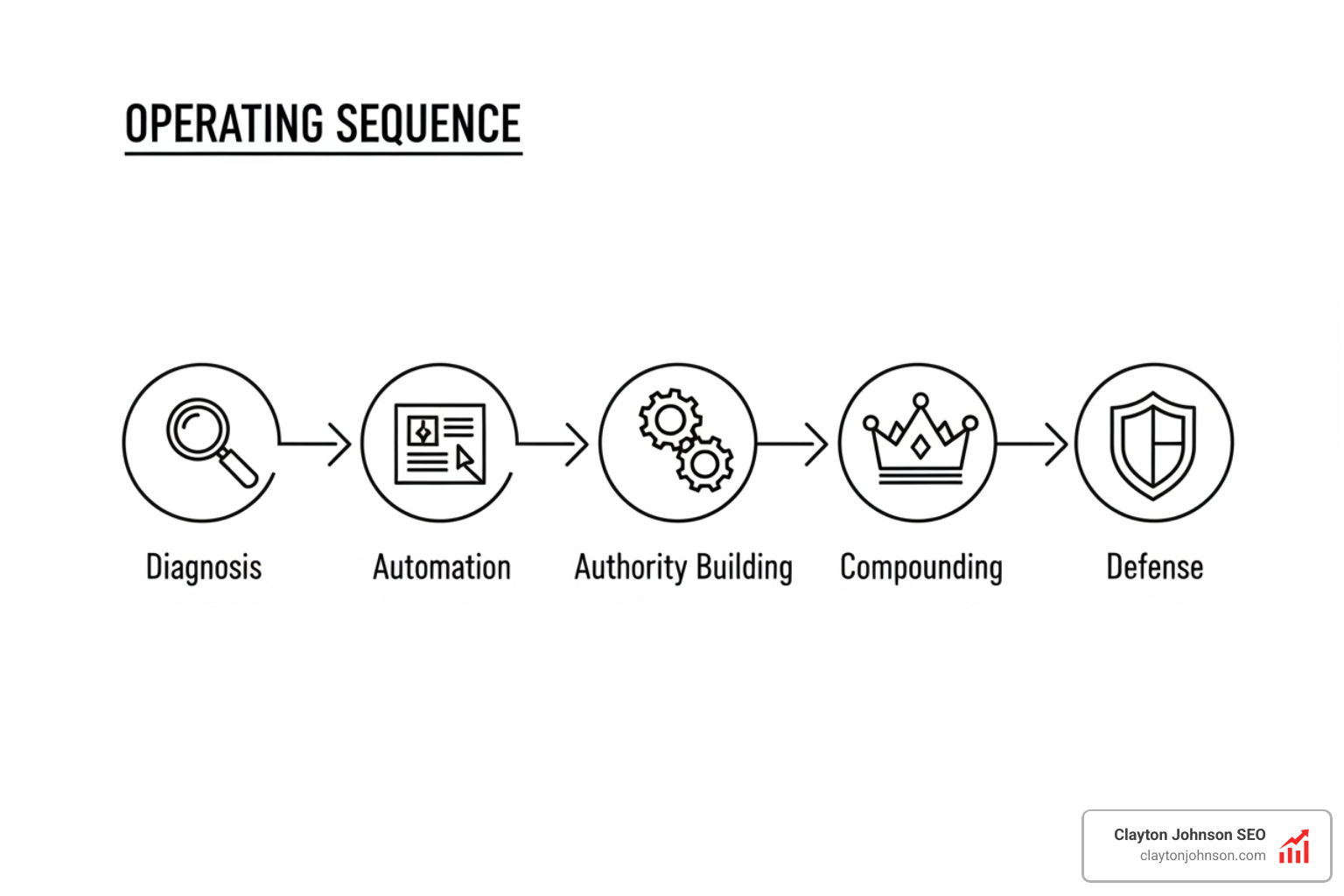
Implementing growth architecture for companies isn’t a one-time project; it’s a sequence. You can’t automate a mess, and you shouldn’t scale a broken system. We follow a non-negotiable methodology to ensure every layer of the architecture is sound.
Implementing Growth Architecture for Companies: The Operating Sequence
- Diagnosis & Revenue Forensics: We start by looking at the data. We find out where the “truth” is. Often, what a founder thinks is driving growth isn’t actually what shows up in the revenue forensics.
- System Design: We map out the new blueprint. This includes your data taxonomy, your lead routing, and your “authority ecosystem.”
- Automation & RevOps: Once the design is solid, we build the machine. This isn’t just about software; it’s about creating workflows that reduce “latency” (the time it takes for a lead to move through the funnel).
- Authority Building: We engineer defensible search authority. We want your company to own the “intellectual real estate” in your industry.
- Compounding & Defense: Finally, we build the “moat.” This involves setting up systems that protect your margins and ensure your growth is defensible against competitors and market volatility.
For those looking to stay ahead of the curve, we also look at how AI search services are changing the way authority is built. In a world of “zero-click search,” your architecture must account for how users consume information without ever leaving the search results page.
Scaling Growth Architecture for Companies in the Age of AI
We are currently witnessing a massive shift in how growth is executed. According to McKinsey, the economic potential of generative AI could add trillions of dollars in value to the global economy, specifically in marketing and sales.
In our framework at Demandflow.ai, we use AI-augmented marketing workflows to handle the heavy lifting of execution. This allows us to maintain a “taxonomy-driven SEO” system that organizes content into a logical, authoritative structure that both humans and AI algorithms can understand. By using AI to enhance our competitive positioning, we can move faster than “tactic-stacking” competitors who are still manually writing every single meta description.
Why Enterprise Growth Strategies Fail Without Proper Architecture
Most growth strategies don’t fail because of a lack of ideas. They fail because of “structural misalignment.” When a company tries to scale a “fragile” system, the cracks start to show.
Tactic Stacking vs. System Building
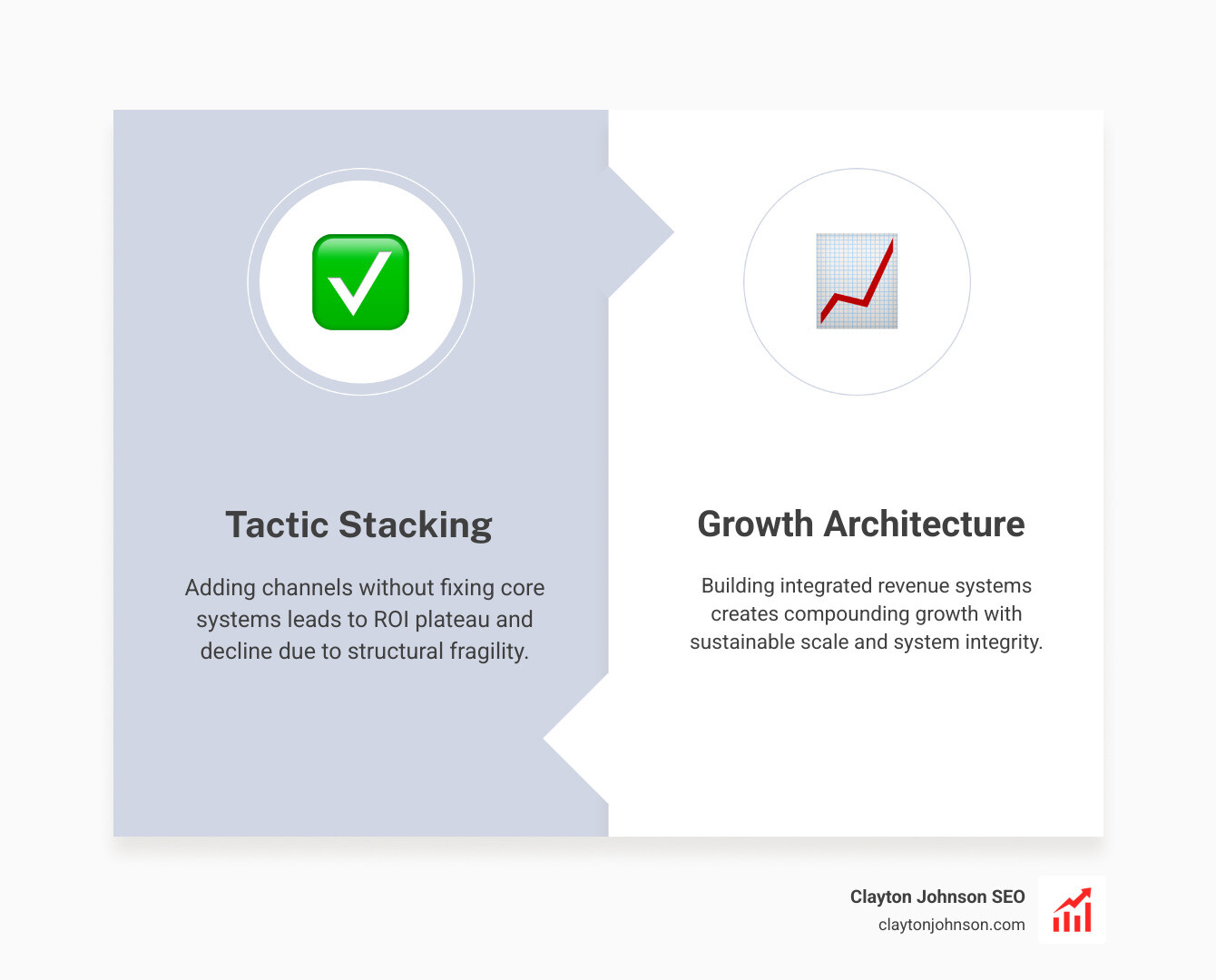
The most common mistake we see is “tactic stacking.” This is when a company keeps adding new tools and channels — a LinkedIn ad here, a TikTok strategy there — without fixing the underlying plumbing. It’s like trying to build a skyscraper by just stacking bricks without any mortar or steel beams. Eventually, the whole thing topples over under its own weight.
The Six Starting-Point Archetypes
Research from BCG identifies six archetypes for revenue growth based on a company’s starting point (industry growth vs. market share). Understanding which archetype you fall into is a critical part of your growth architecture diagnosis.
- Stars: Gaining share in fast-growth industries. They must invest heavily in sales and marketing (30% more than others) to maintain momentum.
- Underdogs: Losing share in fast-growth industries. They often need aggressive M&A (spending 45% more than average) to catch up.
- Incumbents: Losing share to upstarts in fast industries. They focus on fixing the core and using their scale for reach.
- Tacticians: Gaining share in slow-growth industries. They use bold M&A outside their core to find new life.
- Expanders: Gaining share in slow industries but with low shareholder return. They need to strengthen core performance before expanding.
- Challenged: Losing share in slow industries. They must pivot via R&D (spending 18% more) to find new frontiers.
Only 57% of “growth champions” actually outperformed the market. About 17% of companies that grew quickly actually destroyed value because their growth wasn’t “survivable” — it was too expensive or too chaotic.
Scale Fragility
At small scale ($1M–$5M), structural issues just feel like “hustle.” You can brute-force your way through a broken lead-routing system. But at enterprise scale ($30M+), those same issues become dangerous. They lead to “scale fragility,” where every new dollar of revenue costs more than the last, and the organization becomes increasingly volatile.
Frequently Asked Questions about Growth Architecture
What is the difference between growth architecture and GTM frameworks?
Go-to-Market (GTM) frameworks like the “Bowtie” are excellent for aligning sales, marketing, and customer success around a customer lifecycle. However, growth architecture for companies goes deeper. It includes the technical “plumbing” — the data taxonomy, the AI-augmented workflows, and the defensible SEO infrastructure — that makes the GTM framework actually function at scale. GTM is the strategy; growth architecture is the machine that runs it.
Who is growth architecture designed for?
While the principles apply to everyone, we find the most impact with:
- Founder-led companies ($5M–$30M): Transitioning from “founder-led chaos” to a professionalized revenue system.
- B2B Enterprises: Dealing with long sales cycles and complex attribution.
- Law Firms: Managing high-volume intake where lead quality and case-value risk are paramount.
- PE-Backed Operators: Who need a defensible, predictable growth engine to hit their exit targets.
Why is growth architecture delivered as advisory services?
You can’t buy growth architecture “off the shelf.” It requires executive-level authority to bridge the silos between marketing, sales, and IT. Most agencies are “project-based” — they do the tasks you tell them to do. A growth architect acts as a fractional executive, designing the system and ensuring it is implemented correctly across the entire organization. We aren’t just here to run ads; we are here to engineer the engine.
Conclusion
The path to sustainable, compounding revenue isn’t found in a new hack or a viral trend. It is found in the discipline of growth architecture for companies. By moving from “tactic stacking” to “system building,” you create a revenue engine that doesn’t just grow — it compounds.
At Clayton Johnson SEO and through our platform, Demandflow.ai, we help leaders find clarity. We believe that Clarity → Structure → Leverage → Compounding Growth. We don’t just provide content marketing; we provide structured growth infrastructure.
Whether you are a Minneapolis-based founder or an enterprise marketing leader, the question remains: Is your growth built on a foundation of sand, or is it architected to survive the pressure of scale?
If you’re ready to stop firefighting and start building a defensible revenue system, it’s time to look at your architecture.
Schedule a growth architecture consultation with our team today to start your diagnosis and build your compounding engine.