Why SEO for Fiduciary Wealth Firms Is Your Highest-ROI Growth Channel
SEO for fiduciary wealth firms is the practice of optimizing your online presence so that high-net-worth prospects find your firm — not your competitors — when they search for trusted financial guidance.
Here’s a quick answer to what that looks like in practice:
| SEO Component | What It Does for Your Firm |
|---|---|
| Keyword targeting | Matches your pages to what prospects actually search |
| Local SEO | Puts your firm in front of nearby high-net-worth clients |
| E-E-A-T signals | Proves your expertise and builds trust with Google |
| Technical SEO | Ensures your site loads fast and ranks reliably |
| Content strategy | Answers client questions and draws qualified traffic |
| AI optimization | Gets your firm cited in ChatGPT and Google AI answers |
Most fiduciary firms grow through referrals. That works — until it doesn’t.
Referrals slow down. Markets shift. And your next ideal client is already on Google right now, searching for a fiduciary advisor they can trust.
The firms that show up on page one capture that attention. The ones that don’t, stay invisible.
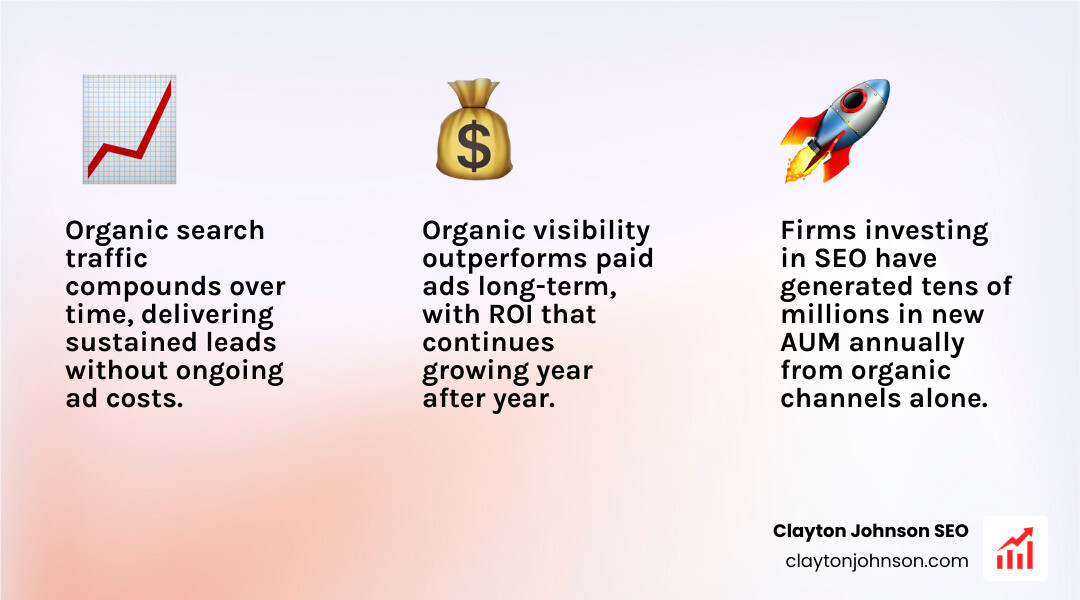
Here’s what makes this channel different from running ads: organic search compounds. Every article, every optimized service page, every backlink you earn keeps working for you month after month — without an ongoing ad spend. One real-world example shows just how powerful this can be: a wealth firm that invested in SEO over several years generated tens of millions in new AUM annually from organic traffic alone, with a return on investment that dwarfed almost any other marketing channel.
That kind of growth doesn’t happen overnight. But it does happen — consistently — for firms willing to build it the right way.
This guide walks you through exactly how to do that.
Core Components of SEO for fiduciary wealth firms
When we talk about SEO for fiduciary wealth firms, we aren’t just talking about “getting more traffic.” We are talking about building a digital fortress of trust. In the financial world, Google classifies your website as “Your Money, Your Life” (YMYL). This means the stakes are higher; Google applies stricter standards to your content because it directly impacts a person’s financial well-being.
To rank, we must satisfy the four pillars of E-E-A-T: Experience, Expertise, Authoritativeness, and Trustworthiness. This isn’t just a buzzword; it’s the framework Google uses to determine if you’re a legitimate fiduciary or just a flashy landing page.
The Technical Foundation
Before you write a single blog post, your website’s plumbing must be perfect. If your site takes five seconds to load on a mobile device, a high-net-worth individual (HNWI) will bounce before they even see your credentials. We recommend using tools like Google’s Lighthouse to check your “Core Web Vitals.”
Key technical “must-haves” include:
- HTTPS Security: Non-negotiable for financial firms.
- Mobile Optimization: Over 70% of online interactions now happen on mobile.
- Clean Site Architecture: A logical hierarchy that helps search engines index your pages. For a deep dive into the basics, check out our Beginners Guide to Wealth Manager SEO.
Content Architecture
We don’t just “post blogs.” We build content ecosystems. This involves creating “Pillar Pages” (broad topics like Retirement Planning) and “Cluster Content” (specific articles like “401(k) Rollover Strategies for Physicians”). This structure signals to Google that you have depth in your niche. For more on the fundamentals, Google’s Search Engine Optimization (SEO) Starter Guide is an excellent resource for understanding how search engines view your site.
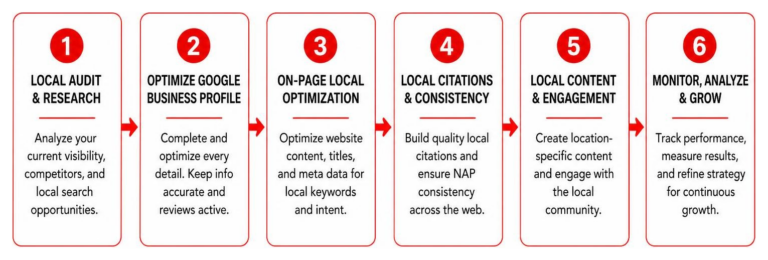
Mastering Local SEO for fiduciary wealth firms
For most fiduciary firms, the “gold mine” is the local map pack. When a prospect searches for “fiduciary financial advisor near me,” they aren’t looking for a local expert they can meet for coffee.
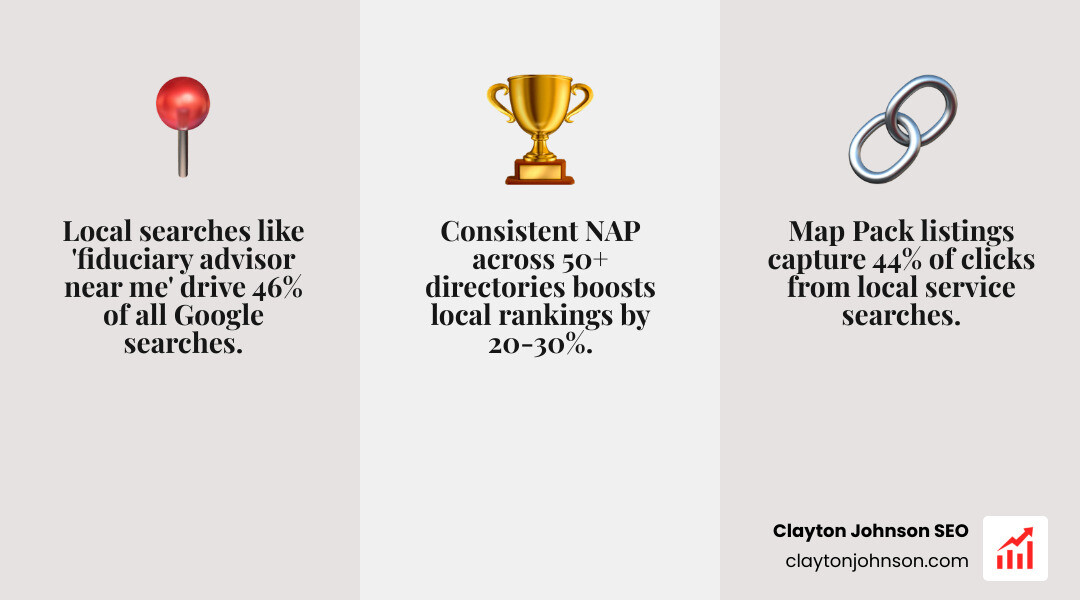
Google Business Profile (GBP) is your most important asset. You must claim and verify your profile through Google Authority. A complete profile includes your firm’s correct name, address, and phone number (NAP), but also your specific service categories, office hours, and high-quality photos of your team. Don’t forget to do the same with Bing Authority to capture the portion of the market using Microsoft’s ecosystem.
NAP Consistency and Citations Your firm’s information must be identical across the web. If your address is “Suite 200” on Google but “Ste. 200” on Yelp, it creates “data friction” that can hurt your rankings. We focus on building local citations in directories like the Chamber of Commerce, BBB, and industry-specific networks like NAPFA or the CFP Board. For a strategic look at local growth, see our A Guide to Growing Your Wealth Management Client Base.
Keyword Research and Content Strategy for fiduciary wealth firms
The biggest mistake we see firms make is chasing “vanity keywords.” Ranking #1 for “financial advisor” is nearly impossible and often useless because the intent is too broad. Instead, we target long-tail keywords with high intent.
Intent Mapping: The Secret Sauce We categorize keywords into three buckets:
- Informational: “What is a fiduciary?” (Top of funnel)
- Investigative: “Fee-only vs. commission-based advisors.” (Middle of funnel)
- Transactional: “Best fiduciary wealth firm in [City Name].” (Bottom of funnel)
By using tools like Keysearch, Google’s Keyword Planner, or Ahrefs Keyword Generator, we identify terms like “estate planning for business owners” or “tax-efficient withdrawal strategies.” These terms have lower search volume but much higher conversion rates.
Thought Leadership 64% of buyers say thought leadership is more trustworthy than marketing materials. We encourage our clients to write about the specific problems their “Ideal Client Avatar” faces. If you serve corporate executives, write about NQDC plans or ISO exercises. This is how you demystify the process, as we explain in SEO Strategies for Wealth Managers Demystified.
Building Authority Through E-E-A-T and Backlinks
In the eyes of a search engine, a backlink is a vote of confidence. However, not all votes are equal. One link from the Wall Street Journal or a local Business Journal is worth more than 1,000 links from random blogs.
Credential Signaling To boost your E-E-A-T, your site must prominently display your professional designations. Link your bio to the CFP Board or the CFA Institute. This tells Google, “This person is a verified expert.”
Quality Over Quantity We focus on “earned” media. This includes:
- Guesting on financial podcasts.
- Contributing quotes to industry publications.
- Partnering with local CPAs or Estate Attorneys for co-authored content.
Building this authority is what makes your SEO “pay dividends” over the long run, a concept we explore in How to Rank Higher and Make Your Wealth Manager SEO Pay Dividends.
Optimizing for AI Search and LLM Visibility
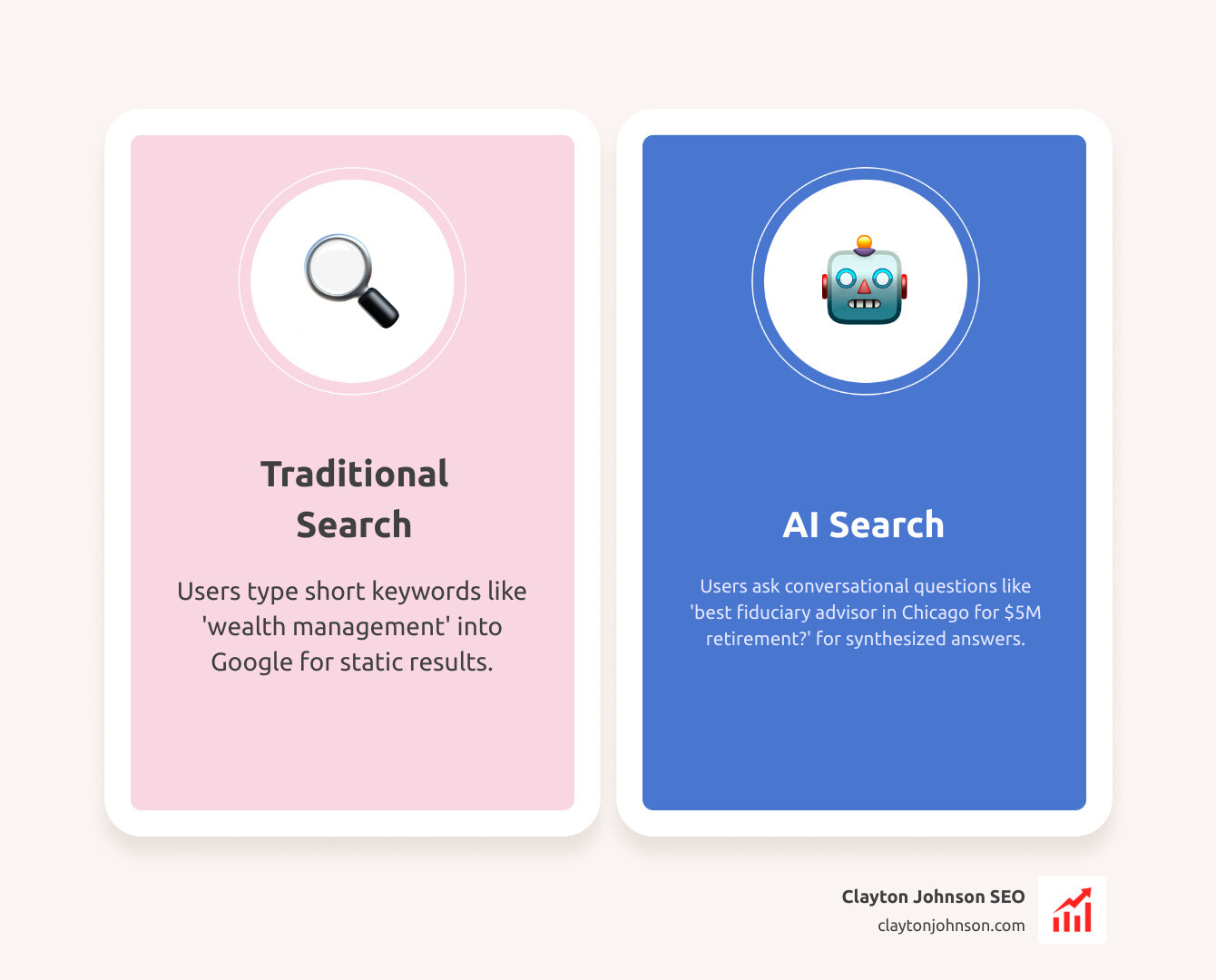
The world of search is changing. With the rise of ChatGPT and Google’s AI Overviews, people are asking conversational questions.
Instead of typing “wealth management,” they ask: “Who is the best fiduciary advisor in Chicago for someone retiring with $5M?”
To show up in these AI answers, your firm needs to be “citable.” This means:
- Structured Data (Schema Markup): Using code to tell search engines exactly what your services are, who your advisors are, and where you’re located.
- FAQ Sections: Answering specific questions directly and concisely.
- Entity-Based SEO: Ensuring your firm is mentioned consistently across the web so AI models recognize you as a “trusted entity” in the wealth management space.
We specialize in these advanced financial-services/wealth-managers/ strategies to ensure you stay ahead of the curve.
Implementing a Scalable Growth System for Your Firm
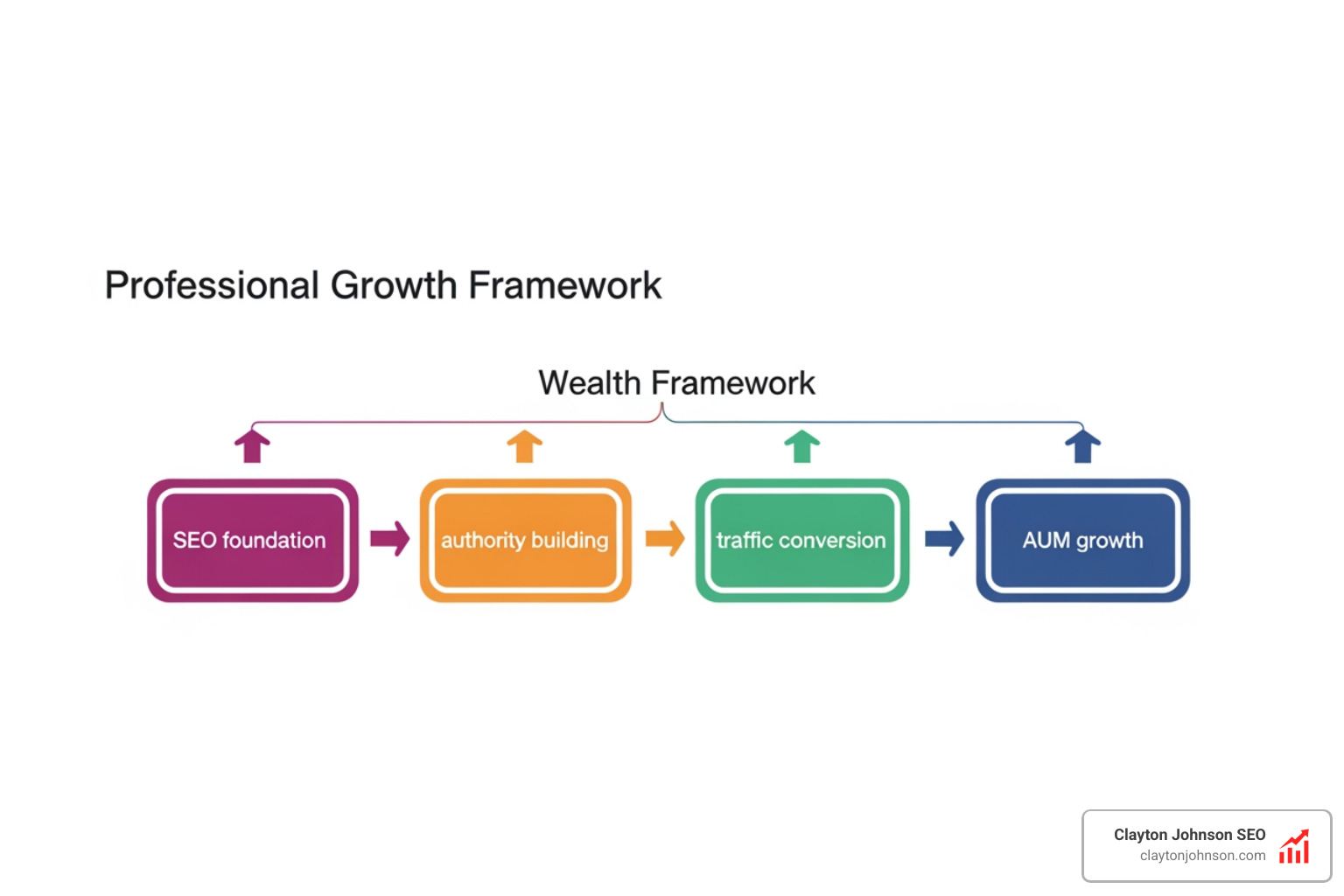
SEO is not a “set it and forget it” tactic. It is a compounding system. At Clayton Johnson SEO, we don’t just look for “clicks”; we look for AUM growth. We turn fragmented marketing into a coherent growth engine.
Converting Organic Traffic into High-Net-Worth Leads
Traffic is a vanity metric; conversions are a sanity metric. If 5,000 people visit your site but nobody books a call, your SEO has failed. We implement “Conversion Rate Optimization” (CRO) to turn visitors into leads.
- Lead Magnets: Offer a “Retirement Readiness Checklist” or a “Tax Strategy Guide” in exchange for an email address.
- Clear CTAs: Don’t just say “Contact Us.” Use “Schedule Your 15-Minute Introductory Call.”
- Scheduling Integration: Use tools like Calendly to remove friction.
- Lead Filtering: Use short forms to ensure you’re talking to prospects who meet your minimum AUM requirements.
For a step-by-step on this, see our Beginners Guide to Financial Advisor Lead Generation. You can also explore our full range of SEO Services or Schedule Your SEO Consultation to see how we can build this for you.
Measuring Success and Avoiding Common SEO Pitfalls
How do you know if it’s working? We track the metrics that actually matter.
- Organic Sessions: Are more people finding you through search?
- Keyword Rankings: Are you moving up for high-intent terms?
- Conversion Rate: What percentage of visitors are booking calls?
- Cost Per Lead: How does the investment in SEO compare to paid ads over 12 months?
We use Google Analytics Set Up and Search Console Set Up to monitor site health and performance daily.
Common Pitfalls to Avoid:
- Patience Deficit: SEO takes 6–12 months to show meaningful ROI. Don’t quit in month three.
- Compliance Ignorance: Ensure all content is reviewed for SEC/FINRA compliance. Avoid promissory language or “guaranteed” returns.
- Keyword Stuffing: Writing for robots instead of humans. If a human finds your content unreadable, Google will eventually penalize you.
Conclusion
The digital landscape for fiduciary wealth firms is more competitive than ever, but the opportunity has never been greater. By focusing on SEO for fiduciary wealth firms, you are building a durable asset that generates leads while you sleep.
It’s about clarity, structure, and leverage. When you build a system that aligns your expertise with the way people actually search, growth becomes inevitable. Whether you’re a solo RIA or a multi-office wealth firm, the path to visibility starts with a single, optimized step.
Ready to dominate your local market and attract the high-net-worth clients you deserve? Let’s build your growth engine. Explore our specialized financial-services/ section to learn more about our industry-specific approach.