The Mind-Reader’s Guide to SEO Buyer Intent Profiling


Why an SEO Audience Intent Audit Is the Missing Link in Your Strategy
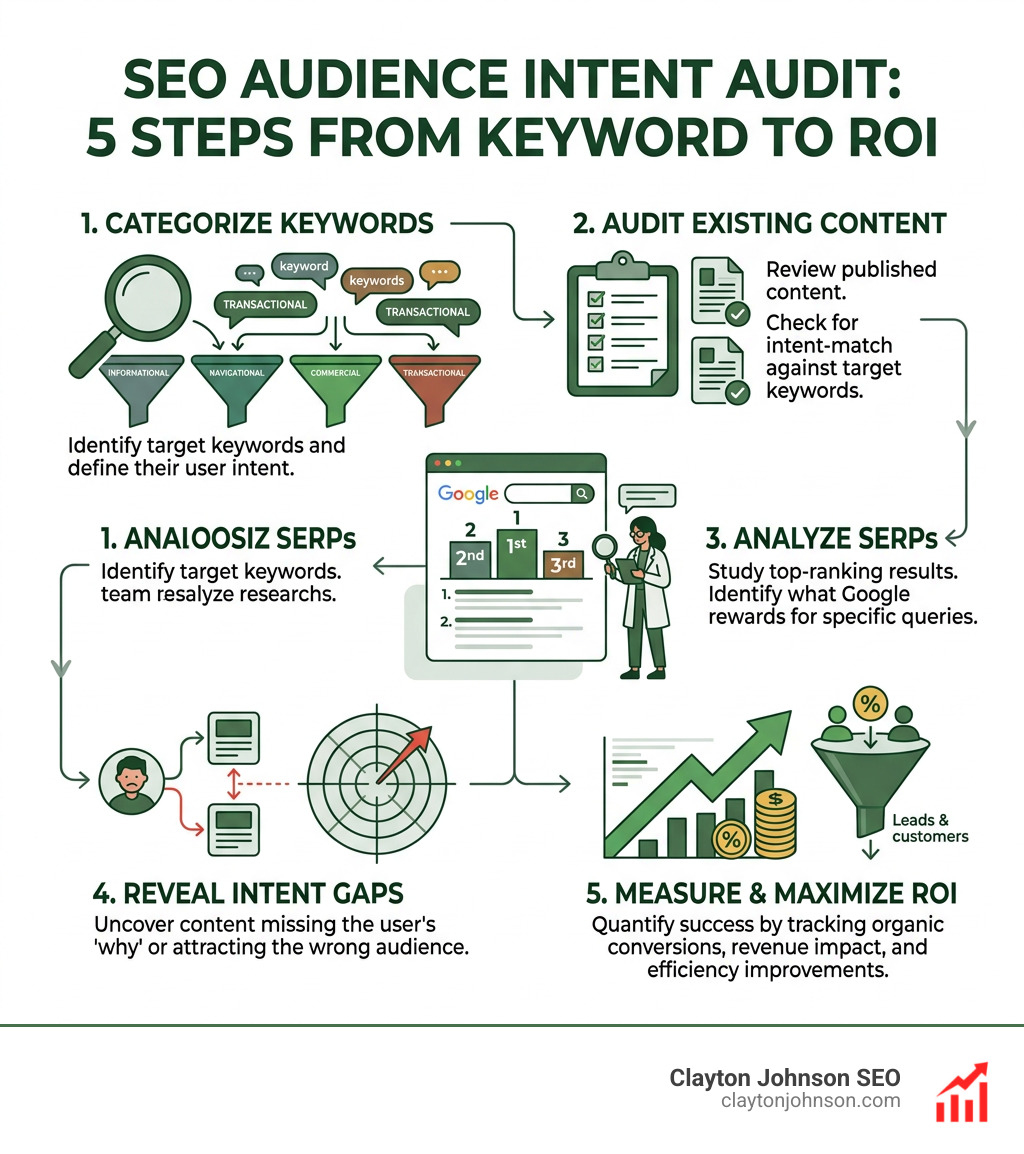
An SEO audience intent audit is a structured process of analyzing your target keywords, existing content, and search result pages to determine whether your site matches what your audience actually wants when they search.
Here’s what it covers at a glance:
- Identify search intent types – Categorize your target keywords as informational, navigational, commercial, or transactional
- Audit existing content – Check whether each page matches the dominant intent for its target keyword
- Analyze SERPs – Study top-ranking results to confirm what Google rewards for each query
- Find intent gaps – Spot pages that attract the wrong audience or fail to convert
- Prioritize fixes – Rank content updates by revenue impact and ease of implementation
Most SEO problems are not technical. When a page ranks poorly or fails to convert, the real issue is usually a mismatch between what you published and what the searcher actually wanted.
Google’s algorithm is built to read intent. If your content doesn’t match the “why” behind a search, it won’t rank — no matter how many keywords you’ve included.
The stakes are real. Research shows that 100 visits from high-intent commercial keywords can deliver a stronger return than 1,000 visits from general informational queries. Attracting the wrong traffic isn’t just a vanity metric problem — it’s a revenue problem.
“The game has changed. It’s no longer enough to drop the right keywords or follow a one-size-fits-all template.”
That shift is exactly what makes intent auditing so powerful — and so underused.
I’m Clayton Johnson, founder of Clayton Johnson SEO, and I’ve spent nearly two decades building scalable SEO frameworks that are grounded in search intent alignment, including using AI to cluster Search Console data and surface SEO audience intent audit opportunities that traditional keyword tools routinely miss. In this guide, I’ll walk you through the exact process we use to align content with audience intent and turn organic traffic into qualified leads.
Executing a Comprehensive SEO Audience Intent Audit
To master the SEO audience intent audit, we have to look past the “what” (the keyword) and obsess over the “why” (the trigger). Why did this person open a browser at 2:00 PM? Were they frustrated by a broken software feature, or were they just curious about how a DNA kit works?
In modern SEO, search engines act as a “fixed-action pattern” touchpoint. When a trigger occurs—like a manager realizing their team is disorganized—it actuates search behavior. Our job is to reverse-engineer those triggers. This requires a deep dive into Search Quality Evaluator Guidelines, specifically section 12.7, which Google uses to train human raters on identifying if a page actually meets a user’s needs.
A successful audit begins by identifying content gaps. These gaps often appear because businesses write from their own frame of reference rather than the customer’s. If you only talk about your product features but your audience is searching for “how to save money on cloud hosting,” you have an intent mismatch. We recommend a full content audit to ensure your library isn’t just a collection of digital brochures, but a system of answers.
Decoding the Four Pillars of Search Intent
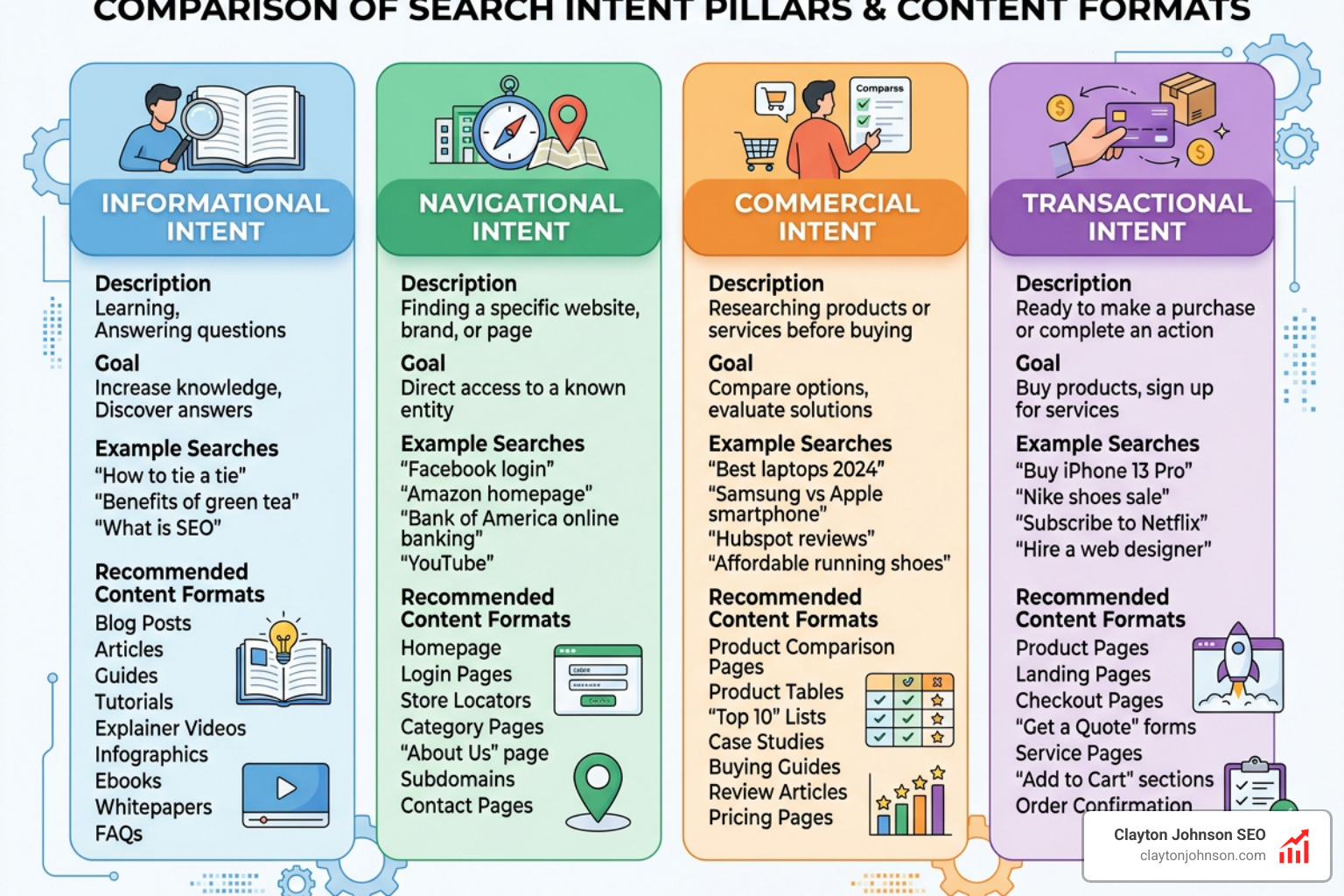
Before we can fix our content, we must understand the four primary buckets Google uses to classify the human psyche. While some queries are “fractured” (meaning they have multiple possible intents), most fall into one of these pillars:
- Informational Intent: The “Know” queries. Users want knowledge. This makes up roughly 80% of all web searches. They use modifiers like “how to,” “why,” and “guide.”
- Navigational Intent: The “Go” queries. The user wants to reach a specific destination, like a login page or a brand’s homepage.
- Commercial Investigation: The “Compare” queries. Users know they want to buy, but they are still weighing options. They search for “best,” “vs,” or “reviews.”
- Transactional Intent: The “Do” queries. The credit card is on the desk. They use words like “buy,” “price,” or “download.”
Step-by-Step Framework for an SEO Audience Intent Audit
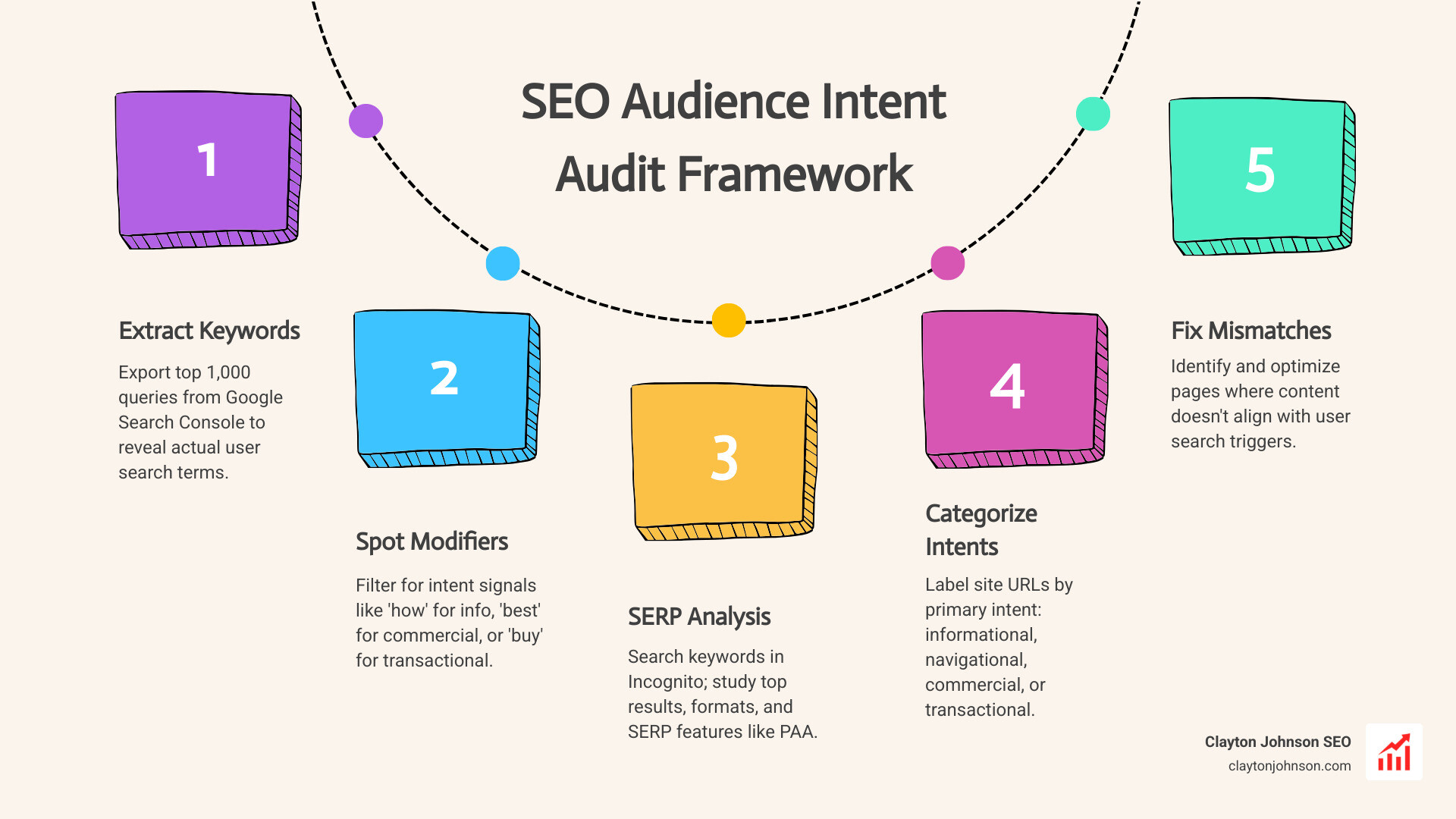
Executing an SEO audience intent audit isn’t about guessing; it’s about data-driven detective work. We use a repeatable framework to ensure no keyword is left behind.
- Step 1: Extract Your Keyword Data. Export your top 1,000 queries from Google Search Console. This shows you what people actually used to find you, not just what you thought they would use.
- Step 2: Identify Intent Modifiers. Use automated tools or manual filtering to spot modifiers. “How” signals info; “Best” signals commercial.
- Step 3: Perform Manual SERP Analysis. Take your most important keywords and search them in Incognito mode. What does the first page look like? If it’s all videos, you shouldn’t be trying to rank with a 3,000-word text article.
- Step 4: Categorize and Map. Label each URL on your site with its primary intent.
- Step 5: Identify Mismatches. If a page targeting a transactional keyword (“buy safety gloves”) is actually a long blog post about the history of rubber, you have a problem.
Analyzing SERP Features and Micro-Intents
Google’s Search Engine Results Pages (SERPs) are the ultimate cheat sheet. They tell you exactly what the algorithm thinks the user wants. If you see a “People Also Ask” (PAA) box, Google is signaling that the intent is complex and requires follow-up answers.
We look for “Micro-Intents”—the subtle nuances within a category. For example, a search for “web development” might be dominated by “Beginner’s Guides.” If you write a technical piece for senior architects, you’ll likely fail to rank for that broad term because the micro-intent is “educational/entry-level.” Mastering these nuances is the key to mastering search intent targeting.
Optimizing Strategy and Measuring Audit Success
Once the audit is complete, the real work begins: optimization. This isn’t just about changing a few meta tags; it’s about restructuring the page to satisfy the user as quickly as possible. If the intent is informational, put the answer at the top. If it’s transactional, make the “Buy” button impossible to miss.
We often use tools like the Screaming Frog SEO Spider to analyze site structure and ensure that our most important intent-aligned pages aren’t buried deep in the architecture. A well-structured site guides the user from a “how-to” blog post to a “best-of” comparison, and finally to a product page. This is the essence of AI-driven SEO audits—using technology to map out the most efficient conversion paths.
Mapping Intent to the Buyer’s Journey
A common mistake we see is businesses focusing only on the “Bottom of the Funnel” (BOFU). They want the “buy now” traffic. However, by ignoring informational and commercial queries, they miss out on 90% of their potential audience.
- Awareness (TOFU): The user has a problem but doesn’t know the solution. Intent: Informational.
- Consideration (MOFU): The user is comparing solutions. Intent: Commercial Investigation.
- Decision (BOFU): The user is ready to pull the trigger. Intent: Transactional.
By building content clusters—groups of related topics that all ladder up to a primary intent—you establish topical authority. This is how you win the search era—by being the most helpful resource at every single stage of the journey.
Scaling Your SEO Audience Intent Audit with AI and Tools
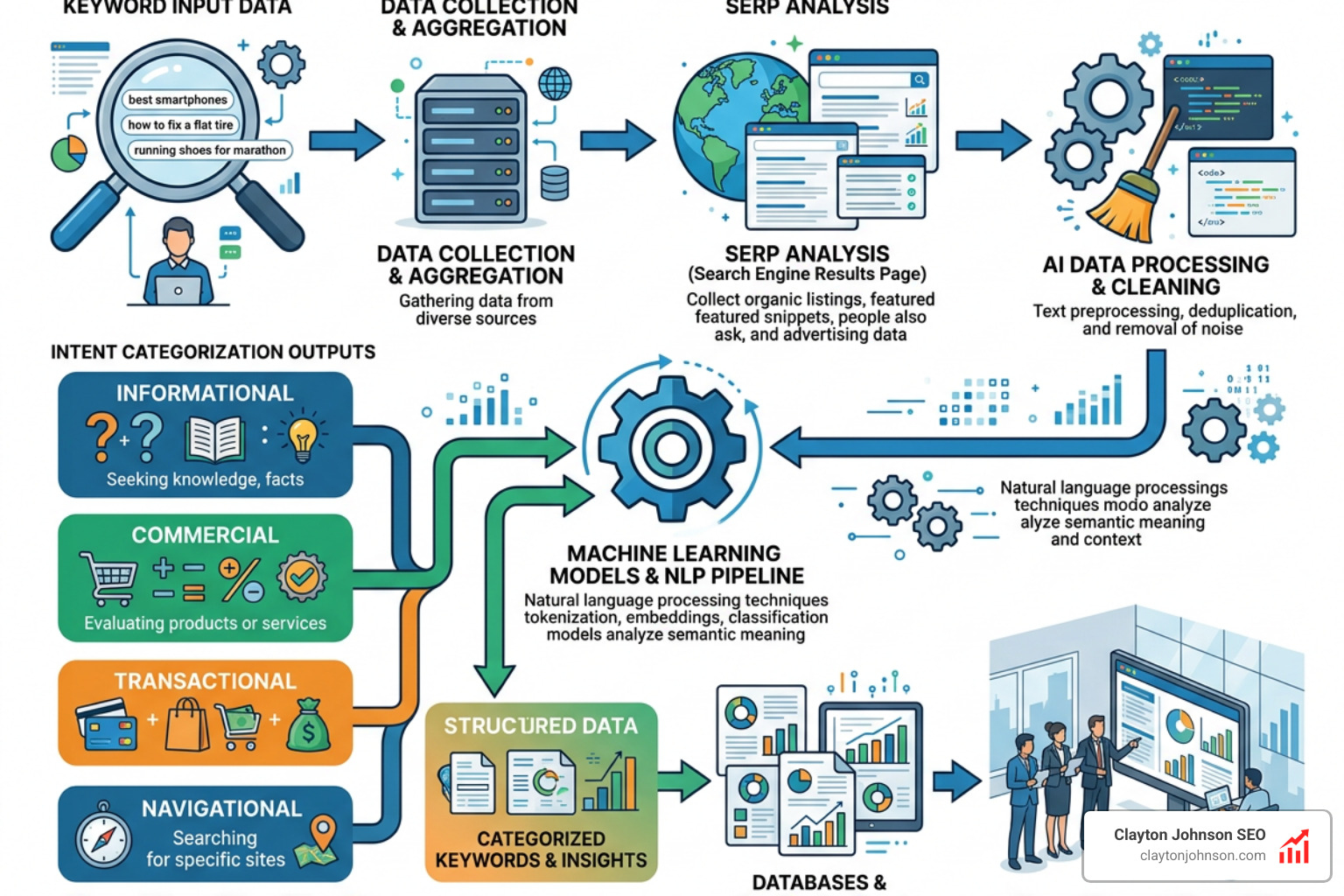
For enterprise sites with tens of thousands of keywords, manual analysis is impossible. This is where we leverage AI workflows. We can train models to categorize thousands of keywords in seconds based on SERP features and query language.
Using the Screaming Frog SEO Spider in conjunction with custom AI prompts allows us to spot intent shifts at scale. For instance, during global events, the intent for “face masks” famously shifted from “costumes” to “medical supplies” almost overnight. AI helps us catch these shifts before the competition does.
Measuring ROI and Refining the Intent Roadmap
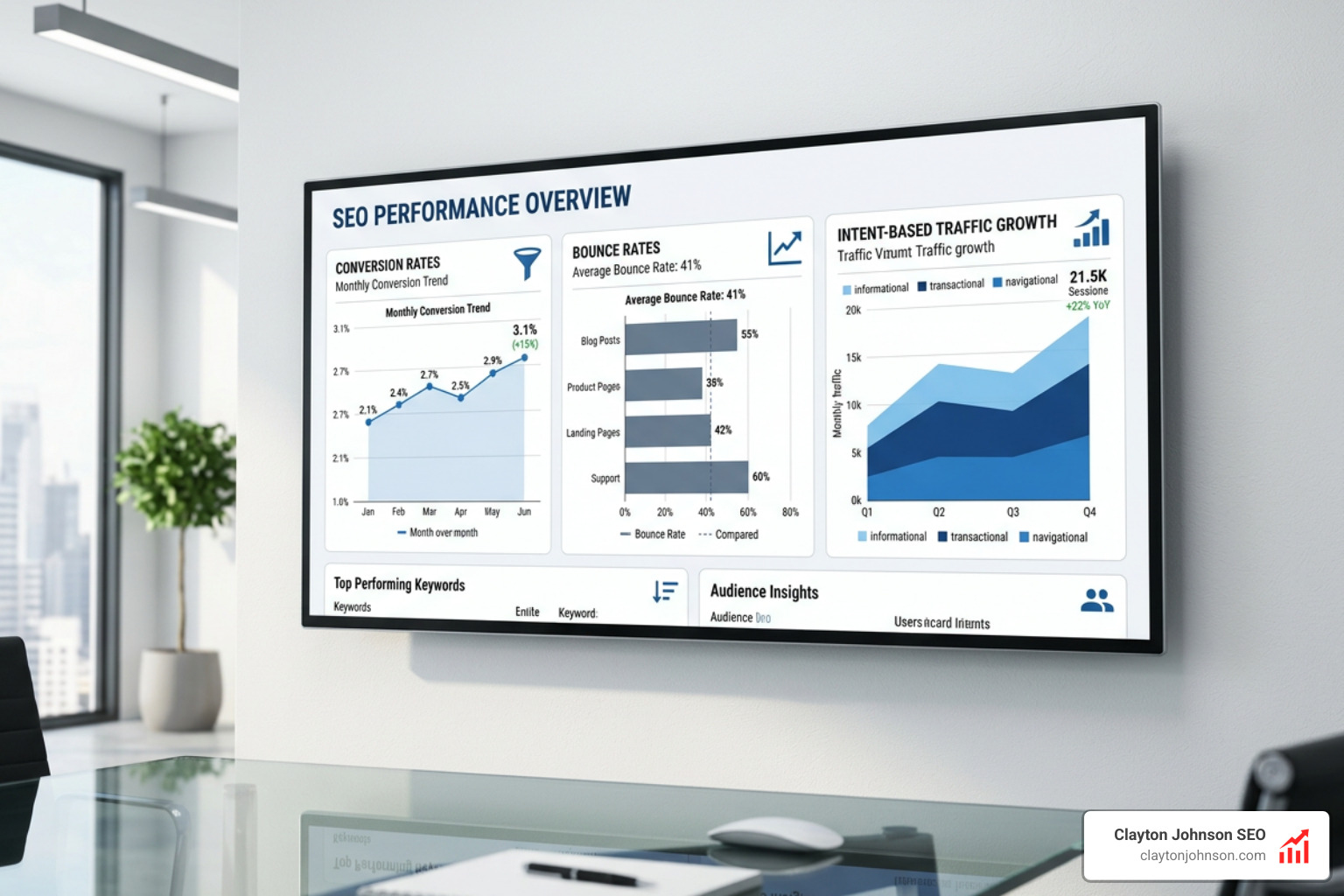
How do we know if our SEO audience intent audit worked? We look at more than just rankings. We track:
- Conversion Rate: Are people actually doing what we want them to do?
- Bounce Rate: If this is high on an informational page, it might mean we didn’t answer the question quickly enough.
- Dwell Time: Are users sticking around to read our expert insights?
At Clayton Johnson SEO, we believe that traffic is a vanity metric; revenue is a sanity metric. If your audit leads to a 10% drop in traffic but a 50% increase in leads, that is a massive win. It means you’ve successfully pruned the “looky-loos” and attracted the “ready-to-buys.”
Ready to stop chasing keywords and start capturing customers? Our SEO services are designed to build the durable systems—taxonomy, architecture, and intent alignment—that drive compounding growth.
Common Pitfalls in Intent Auditing (And How to Avoid Them)
Even the best SEOs can get tripped up by intent. One major pitfall is an over-reliance on keyword tools. A tool might classify “best CRM” as informational, but if the SERP is full of comparison tables and affiliate links, the intent is actually commercial. Always verify with your own eyes.
Another mistake is ignoring “Information Gain.” In the age of AI-generated content, simply repeating what everyone else said won’t cut it. You need to provide unique data, personal experience, or a contrarian perspective that an LLM can’t replicate. This is how you satisfy the most demanding intent of all: the search for truth.
The Future of Intent: AI and Semantic Search
As search engines evolve with technologies like MUM (Multitask Unified Model), they are becoming better at understanding complex, conversational queries. We are moving away from “matching text strings” and toward “solving human problems.”
The future of the SEO audience intent audit lies in predicting what the user will ask next. If someone searches for “how to start a vegetable garden,” they will eventually need to know about “the best soil for tomatoes.” If your content ecosystem anticipates and provides that next step, you don’t just win a click—you win a customer for life.
By following this guide, you aren’t just optimizing for an algorithm; you’re optimizing for people. And in SEO, that is the only strategy that truly compounds over time. Clarity leads to structure, structure leads to leverage, and leverage leads to the kind of growth that changes businesses. Let’s get to work.