The Multi-Model Guide to Winning at AI Search

Why AI Search Requires a Fundamental Shift in Content Strategy
Optimize for Gemini AI by structuring content for semantic extraction, establishing entity authority through schema markup, and building E-E-A-T signals that AI models can parse and cite with confidence. The rise of AI-driven search engines represents more than an incremental change—it’s a complete restructuring of how users discover information and how search systems evaluate authority.
Quick Answer: How to Optimize for Gemini AI
- Structure content with question-based headers and place concise 40-60 word answers immediately below each H2
- Implement schema markup (Article, FAQ, HowTo) using JSON-LD format
- Build E-E-A-T signals through author bios, external citations, and first-person expertise
- Create topic clusters with pillar pages exceeding 2,000 words
- Optimize for multimodality by integrating YouTube content and Google Business Profile
- Ensure technical accessibility for AI crawlers through proper robots.txt configuration
ChatGPT reached hundreds of millions of weekly users while AI-driven searches are projected to reduce traditional search volume significantly. For B2B websites specifically, this shift has already caused meaningful drops in SEO-driven traffic. The counterintuitive insight: traffic from AI systems often delivers visitors who are materially more valuable, with higher conversion rates compared to traditional organic search.
Google AI Overviews—powered by Gemini—now appear in a large share of informational search queries and frequently cite sources from the first page of organic results. This creates both opportunity and urgency: websites that structure content for AI extractability gain disproportionate visibility, while those optimizing solely for traditional ranking signals can become invisible in answer-engine results.
The fundamental shift isn’t from SEO to something else—it’s from rankable content to extractable content. AI systems don’t browse. They scan for structure, semantic signals, and clear labels that enable confident citation. Content with concrete numbers is more likely to be cited by language models. AI-optimized pages can rank higher and increase user engagement.
I’m Clayton Johnson, an SEO and growth strategist who has helped enterprise clients navigate the transition from ranking optimization to AI visibility infrastructure, specifically developing frameworks to optimize for Gemini AI across technical implementation, content architecture, and entity authority modeling. This guide synthesizes that work into actionable strategies you can implement immediately.
Understanding How to Optimize for Gemini AI
To truly optimize for gemini ai, we must first understand that Gemini isn’t just a chatbot; it is a multimodal ecosystem deeply integrated into the Google Knowledge Graph. Unlike traditional search engines that index keywords, Gemini functions as an “answer engine” that synthesizes information from across Google’s properties, including YouTube, Google Maps, and the core search index.
Gemini uses a “mixture-of-experts” (MoE) architecture. This means when you ask a question, the model activates specific sub-networks that are “experts” in that topic. For us as content creators, this means our content must be undeniably authoritative in its specific niche. If our content is vague or tries to cover too much unrelated ground, Gemini’s “experts” won’t find it reliable enough to cite.
Furthermore, Gemini excels at multimodal processing. It doesn’t just “read” your text; it understands your images, processes your video transcripts, and checks your local business data. This is why a siloed approach to SEO no longer works. You need a structured SEO content marketing strategy that treats every piece of media as a potential data point for the AI.
How Gemini Processes Content Differently
Traditional search engines rely heavily on backlinks and keyword density to determine relevance. Gemini, however, utilizes Semantic Analysis and Retrieval-Augmented Generation (RAG).
When a user enters a query, Gemini doesn’t just look for those words. It fanned the query out into dozens of variants to understand the intent. It then uses RAG to pull “chunks” of information from the web—often from pages that don’t even rank in the top 3—to stitch together a comprehensive answer.
We also need to practice Entity-first SEO. In Gemini’s eyes, your brand, your products, and your authors are “entities” in the Knowledge Graph. By mentioning specific brands, partners, and technical terms clearly, we help Google identify exactly who we are and what we know. This is further supported by Gemini’s massive context window, which allows it to process and remember thousands of words of context, making long-form, pillar content more valuable than ever.
The Importance of Citations in Gemini AI Overviews
One of the most common myths is that AI search will kill all website traffic. While it’s true that click-through rates (CTR) can drop by ~34.5% for simple queries, the traffic that does come through is significantly higher in intent.
According to an Ahrefs study on AI Overview citations, 76% of cited pages rank in Google’s top 10. However, about 14.4% of citations come from pages outside the top 100. This is a game-changer! It means if your content is the most “extractable” and authoritative, you can be cited by Gemini AI even if you haven’t yet built the backlink profile of a legacy giant.
Core Strategies to Optimize for Gemini AI
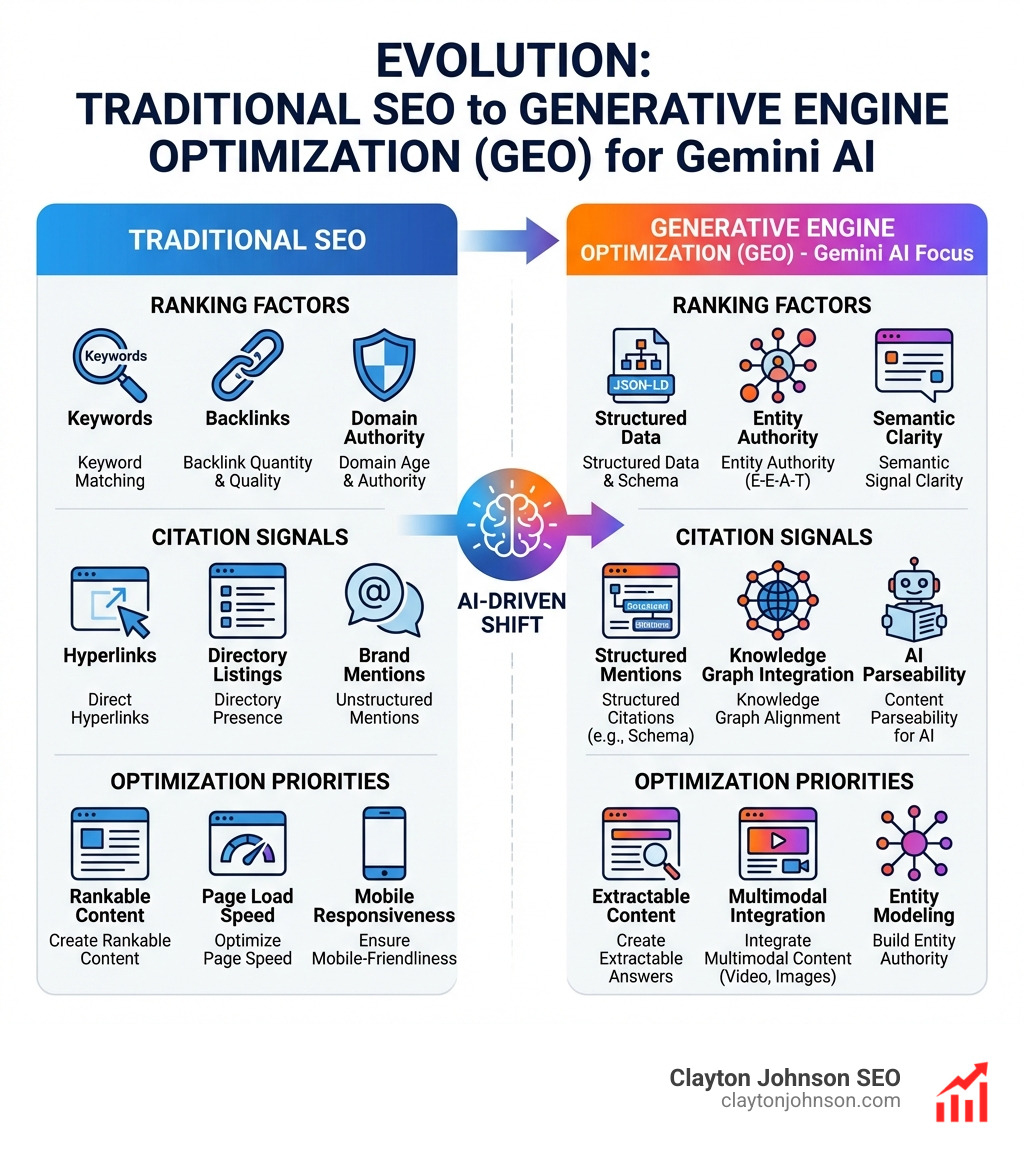
Optimization today is about moving from “Search Engine Optimization” to “Generative Engine Optimization” (GEO). We aren’t just trying to rank; we are trying to be the source the AI trusts.
| Feature | Traditional SEO | Gemini AI (GEO) |
|---|---|---|
| Primary Goal | Rank #1 for a keyword | Become the primary cited source |
| Content Unit | The entire page | Semantic “chunks” and summaries |
| Key Metric | Keyword position | AI Visibility & Share of Voice |
| Structure | Keyword-optimized headings | Question-based headers (Natural Language) |
| Authority | Backlinks | E-E-A-T & Entity mentions |
Structuring Content for AI Extractability
If we want to optimize for gemini ai, we have to think less like writers and more like formatters. AI models love structure. We use a clear H2/H3 hierarchy where the headers themselves are natural language questions.
For example, instead of a header that says “Gemini SEO Tips,” we use “How do I optimize my blog for Gemini AI?” Immediately following that header, we provide a concise summary of 40-60 words. This “Bottom Line Up Front” (BLUF) approach makes it incredibly easy for Gemini to “extract” our answer for an AI Overview.
Formatting Best Practices for AI:
- Use Bulleted Lists: AI models scan for lists to create “How-To” steps.
- Include Concrete Numbers: Statistics and data points increase citation probability by 30-40%.
- Short Paragraphs: Keep them under 3 sentences to prevent the AI from losing the context.
- Tables: Gemini loves structured data for “versus” or comparison queries.
Establishing E-E-A-T for Gemini AI Visibility
Experience, Expertise, Authoritativeness, and Trustworthiness (E-E-A-T) are the bedrock of Gemini optimization. Because AI models are prone to “hallucinations,” they are programmed to prioritize sources that show real-world signals of accuracy.
We establish this by including detailed author bios with credentials and links to professional profiles. We don’t just state facts; we link to original research and primary sources. If we are writing a guide, we include a “Methodology” section or mention first-person experience (e.g., “In our 10 years of implementing SEO in Minneapolis…”).
Following Google’s guidance on helpful content is no longer a suggestion—it is a requirement for AI visibility.
Technical and Multimodal Optimization for Gemini
Technical SEO in the AI era is about making sure nothing stands between the AI crawler and your data.

Leveraging the Google Ecosystem and Multimodality
Gemini is uniquely “Google.” It has a massive advantage over ChatGPT because it can pull from the Google Business Profile and YouTube.
To optimize for gemini ai effectively, we must:
- Embed YouTube Videos: Gemini uses video transcripts as training signals. Content with a relevant video is more likely to be seen as “comprehensive.”
- Update Google Business Profiles: For local queries in Minnesota, Gemini relies heavily on your GBP reviews and photos.
- Use Multimodal Schema: Don’t just use Article schema. Use
ImageObjectandVideoObjectto tell Gemini exactly what your media represents.
If you’re feeling overwhelmed by the technical requirements, working with an expert SEO consultant can help you build the “structured growth architecture” needed to automate these signals.
Technical Requirements for AI Crawlers
Your robots.txt file is your first line of defense. Ensure you aren’t accidentally blocking GPTBot, PerplexityBot, or Google’s specific AI crawlers.
Beyond crawling, speed is a ranking factor for AI. Perplexity, for instance, favors sites with a Time to First Byte (TTFB) under 200ms. We recommend using plain HTML (Server-Side Rendering or Static Site Generation) over JavaScript-heavy frameworks. If an AI crawler has to execute complex JS to see your content, it might just move on to a simpler source.
Building Authority with Topic Clusters and Pillar Content
AI models don’t just look at one page; they look at your entire site’s “Topical Authority.” This is where topic clusters come in.
Instead of writing ten random blog posts, we build one massive Pillar Page (2,000+ words) that covers a broad topic in depth. We then surround it with 5-7 “Cluster Content” pieces that link back to the pillar using exact-match anchor text. This creates a “web of authority” that Gemini recognizes. When Gemini sees that you have written extensively and accurately about a topic from multiple angles, it identifies you as an “Entity” of authority in that space.

Frequently Asked Questions about Gemini AI Optimization
How is optimizing for Gemini different from traditional SEO?
Traditional SEO is often about “tricking” an algorithm with keywords and backlinks. Gemini optimization is about semantics and extractability. While SEO targets SERP rankings, Gemini optimization (GEO) targets being the cited answer in a conversational interface. Keywords are replaced by intent, and backlinks are supplemented by citations and entity authority.
How long does it take to see results from Gemini optimization?
You can see initial improvements in AI visibility within a few weeks of updating your structure (especially headers and schema). However, building the “Topical Authority” required for consistent Gemini citations typically takes 3 to 6 months. This is a compounding game—the more you optimize, the more the AI trusts you.
Does Gemini require special schema markup?
No. There is no “Gemini-only” schema. According to Google’s structured data guide, you should use standard Schema.org vocabulary. JSON-LD is the preferred format. Focus on FAQPage, HowTo, Article, and Organization markup to provide the clearest context.
Conclusion
The shift to AI search is not a threat; it’s an opportunity for those who value clarity and structure. At Demandflow.ai, we believe that most companies don’t lack tactics—they lack the structured growth architecture to win in this new era.
By following the strategies in this guide—optimizing for multimodality, structuring for extractability, and building unshakable E-E-A-T—you aren’t just surviving the AI shift; you are leading it. If you’re ready to move beyond basic content marketing and build a system for compounding growth, let’s work together. We help founders and marketing leaders in Minneapolis and beyond build the infrastructure that AI models love to cite.