The Secret Sauce for Local SEO Success

Why Local SEO for Service Businesses Changes Everything
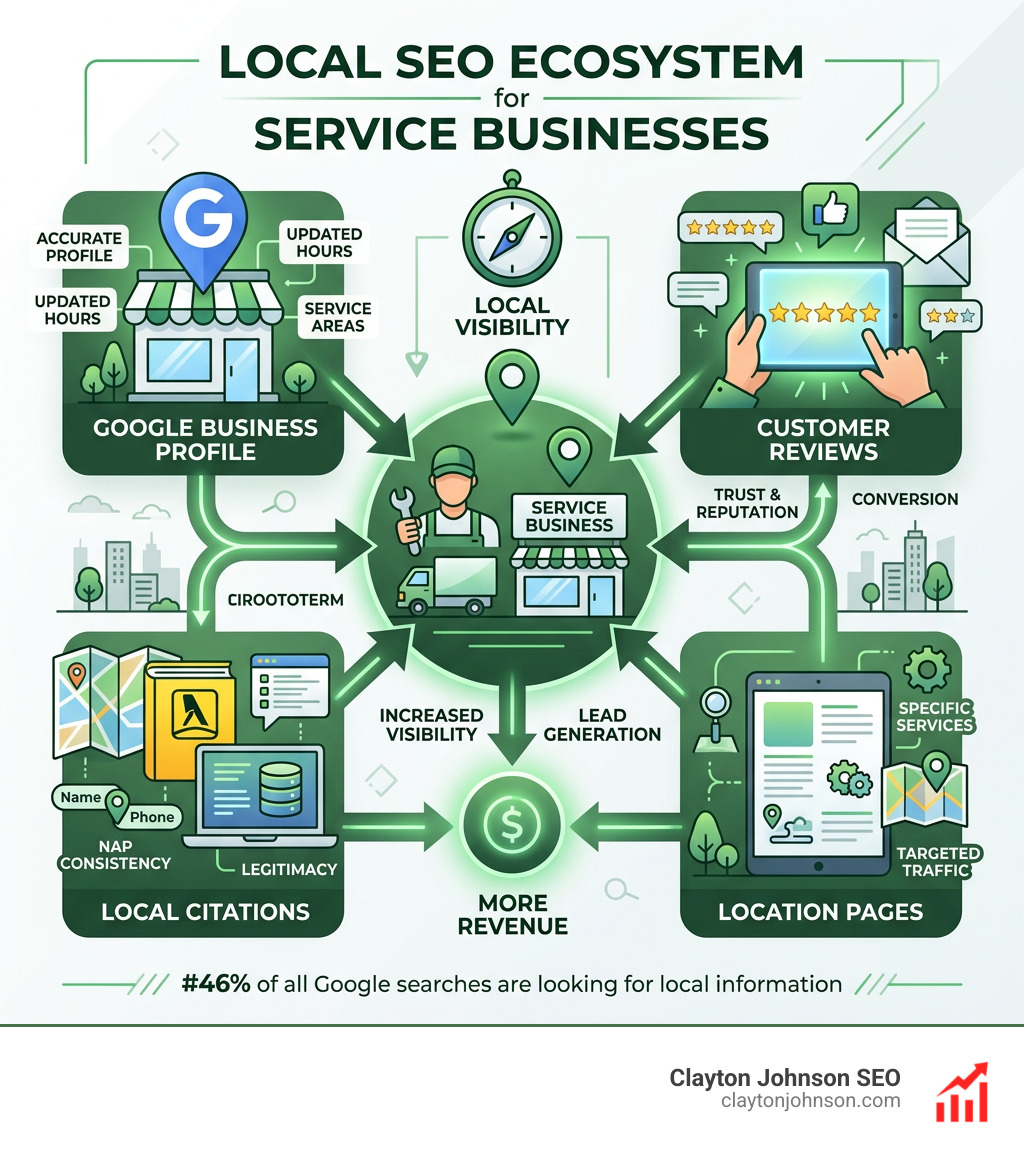
Local SEO for service businesses is the practice of optimizing your online presence so nearby customers find you — not your competitors — when they search for the services you offer.
Here’s a quick breakdown of what it involves:
| What It Covers | Why It Matters |
|---|---|
| Google Business Profile setup | Shows your business in Maps and local search results |
| NAP consistency (Name, Address, Phone) | Builds trust with Google and customers |
| Online reviews and reputation | Directly influences rankings and conversions |
| Location-specific service pages | Captures high-intent searches in your area |
| Local citations and directories | Confirms your business is legitimate and findable |
| On-page SEO and schema markup | Helps Google understand what you do and where |
Over 46% of all Google searches are looking for local information. Yet most service businesses either skip these steps entirely or set things up wrong from the start — and wonder why the phone isn’t ringing.
If you run a plumbing company, landscaping business, HVAC service, or any other business where you go to the customer, this guide is built for you. The rules are different when you don’t have a storefront. And the opportunity is bigger than most business owners realize.
I’m Clayton Johnson, an SEO strategist with nearly two decades of experience helping service businesses dominate local search — including building scalable local SEO for service businesses frameworks that drive consistent, qualified leads. Let’s walk through exactly how it works.
Mastering Local SEO for service businesses
To win at local search, we have to move beyond just “having a website.” For a service provider, your digital presence acts as a 24/7 salesperson. If that salesperson is invisible or provides conflicting information, you lose the lead before they even pick up the phone.
According to Wikipedia, local search involves using specialized engines that allow users to submit geographically constrained searches against a database of local business listings. This means when a homeowner’s pipe bursts at 2 a.m., they aren’t looking for a national plumbing franchise’s blog; they are looking for the closest, most reputable professional who can show up now.
Winning this “near me” battle requires a deep dive into SEO 101 fundamentals, specifically tailored for the local algorithm. Google doesn’t rank businesses by accident. It uses a sophisticated calculation based on three pillars: Relevance, Distance, and Prominence.
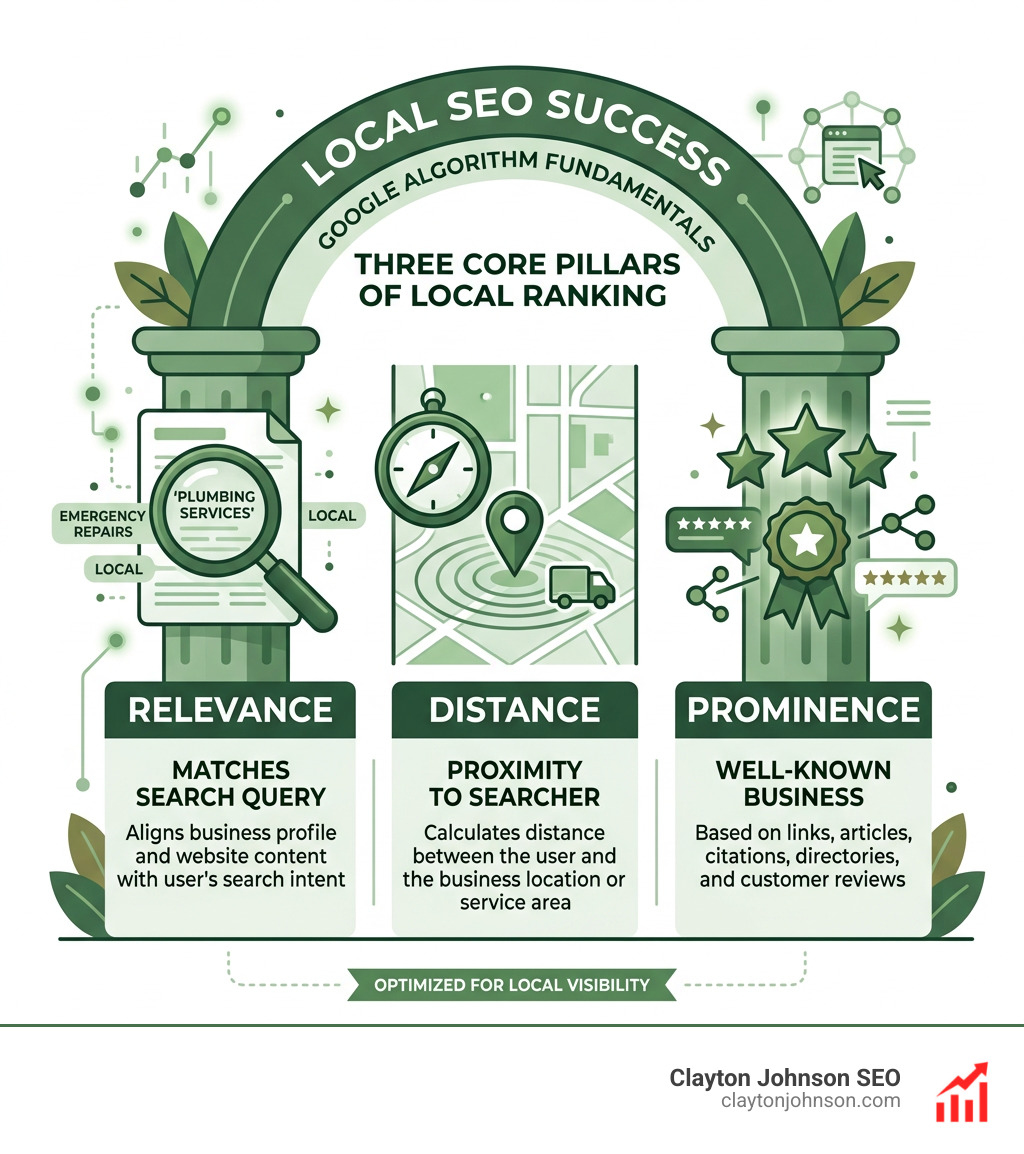
- Relevance: How well does your business profile and website match what the user is searching for?
- Distance: How far is your business (or your service area) from the person searching?
- Prominence: How well-known is your business? This is based on information Google has from across the web, like links, articles, directories, and—most importantly—reviews.
For more detail on these factors, you can explore the Moz Local Search Ranking Factors Survey, which highlights that category selection and review signals are among the top drivers of visibility.
Google Business Profile and the Service-Area Business (SAB) Model
One of the biggest points of confusion for professionals is the difference between a brick-and-mortar shop and a Service-Area Business (SAB). If you are a plumber, locksmith, or pest control expert, you likely work out of your home or a warehouse that isn’t open to the public.
| Feature | Storefront Business | Service-Area Business (SAB) |
|---|---|---|
| Customer Interaction | Customers visit your location | You visit the customer’s location |
| Address Visibility | Must be shown on Google Maps | Should be hidden (Service area defined) |
| Primary Goal | Drive foot traffic | Drive phone calls and bookings |
| Examples | Coffee shops, Dental clinics | Plumbers, Electricians, Landscapers |
When setting up your Google Business Profile, it is vital to follow Google’s guidelines on adding or editing your service area. If you don’t have a physical storefront where customers are greeted, you must toggle the “hide address” option. Instead of a pin on a map, Google will show a shaded area representing where you work. You can define this by up to 20 cities or zip codes, typically within a two-hour driving radius of your base.
To maximize this profile, we recommend:
- Choosing Precise Categories: Don’t just pick “Contractor.” If you do roofing, choose “Roofing Contractor.” This accounts for a significant portion of your ranking power.
- Using Google Posts: Think of these as “mini-ads” that appear in your profile. Share seasonal tips, recent job photos, or special offers.
- Leveraging Q&A: Don’t wait for customers to ask questions. Pre-seed your Q&A section with common queries like “Do you offer emergency 24/7 service?” or “Are you licensed and insured?”
- Local Services Ads (LSAs): For many SABs, LSAs (the “Google Guaranteed” checkmark) are a powerful companion to organic local SEO for service businesses. They sit at the very top of the search results and operate on a pay-per-lead basis.
The Core Ranking Factors: Relevance, Distance, and Prominence
As we look toward the future of search, including AI-driven results and voice search, the “Prominence” factor is becoming even more critical. Google’s AI doesn’t just look for keywords; it looks for “entities” it can trust.
When someone asks their smart speaker, “Who is the best electrician near me?”, Google scans for the business with the highest star rating, the most consistent contact info, and the most relevant service pages. This is why building brand authority is no longer optional.
Ranking outside your immediate home office area is a common challenge for SABs. Since you don’t have a physical “pin” in every city you serve, you must rely on Relevance and Prominence. This is achieved by creating dedicated location pages on your website and generating reviews from customers in those specific outlying areas.

Scaling Your Local Authority and Systems
Once the foundation of your Google Business Profile is set, we need to turn our attention to the “ecosystem” surrounding your business. Google doesn’t just look at its own platform; it “crawls” the entire web to see if other reputable sources verify that you are who you say you are.
This is where building digital authority becomes the differentiator. We want to create a “bulletproof” infrastructure that signals to search engines that your business is the most legitimate option in the region.
Building a Bulletproof Local SEO for service businesses Infrastructure
The cornerstone of this infrastructure is NAP Consistency. NAP stands for Name, Address, and Phone number. It sounds simple, but inconsistencies are the silent killer of local SEO for service businesses. If your business is listed as “Main Street Plumbing” on Yelp but “Main St. Plumbing, LLC” on Google, search algorithms may view these as two different entities, diluting your ranking power.
To build a solid local footprint, you should focus on:
- Core Directories: Ensure you are listed accurately on Bing Places, Yelp, and Apple Business Connect.
- Industry-Specific Citations: For service businesses, sites like Angi, Thumbtack, and the Manta Business Directory are high-authority signals.
- Local Organizations: Being listed on your local Chamber of Commerce website is one of the strongest local backlinks you can earn.
- Technical Speed and Mobile Optimization: Over 88% of local searches on mobile result in a call or visit within 24 hours. If your site takes longer than three seconds to load, that customer is clicking the next result.
- Structured Data (Schema): Implementing LocalBusiness schema tells Google exactly what services you offer, your hours, and your service area in a language the “robots” understand perfectly.
Content Strategy: Local Keywords and Location-Specific Pages
Many service business owners make the mistake of having one “Services” page that lists everything they do. From a local SEO for service businesses perspective, this is a missed opportunity.
To rank for specific terms, you need a dedicated page for each core service in each primary location. For example, instead of one page, you might have:
yourwebsite.com/plumbing-repair-minneapolisyourwebsite.com/drain-cleaning-minneapolisyourwebsite.com/emergency-plumber-st-paul
Each of these pages should include “Geo-modifiers”—words that anchor the service to a specific place. This includes mentioning local landmarks, neighborhoods, and even local weather conditions that affect your service (like “frozen pipe repair” in Minnesota). For more on how this works in a specific market, check out our guide on Minneapolis SEO.
A common question is: Should I have one site with location pages or multiple sites for different cities? In almost every case, one site with well-structured location pages is better. It allows you to consolidate your “Domain Authority” into one powerful asset rather than spreading your efforts thin across multiple weak websites.
Reputation Management and Review Acquisition Systems
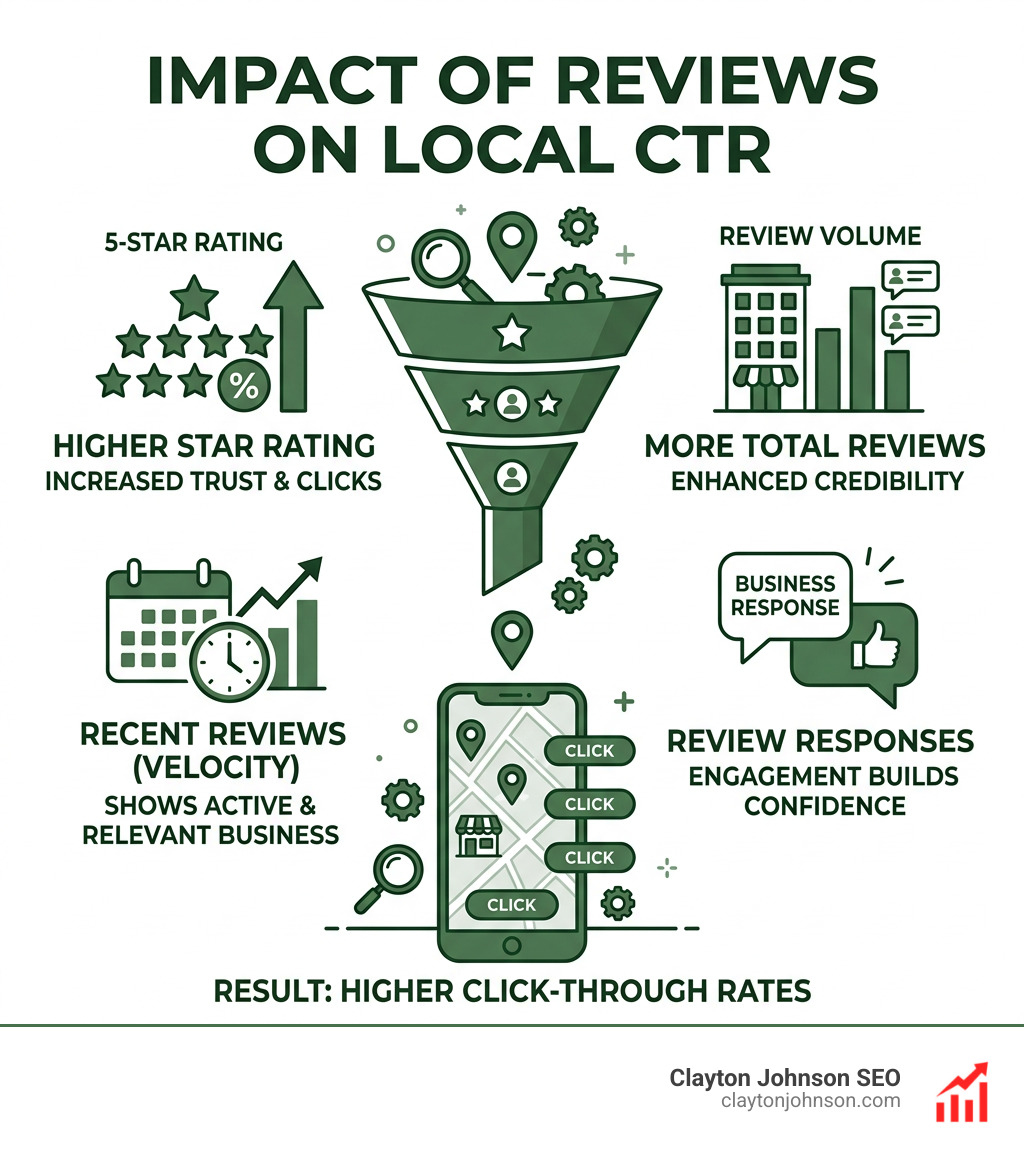
Reviews are the lifeblood of local search. Data shows that businesses in the top three “Local Pack” spots average hundreds of reviews with high star ratings. But it’s not just about the total number; it’s about Review Velocity (how often you get new reviews) and Response Discipline.
97% of consumers who read reviews also read the business’s responses. If you aren’t responding, you’re ignoring your customers in public.
How to build a review acquisition system:
- Ask Immediately: The best time to ask for a review is within two hours of completing the job, while the “wow” factor is high.
- Use SMS: Texting a direct link to your Google review page has a much higher conversion rate than email.
- Train Your Techs: Your team in the field should be the ones asking. A personal request from the person who fixed the problem is incredibly powerful.
- Respond to Everything: Thank the happy customers. For the unhappy ones, respond professionally, take the conversation offline, and show potential leads that you care about making things right.
Measuring Success and Avoiding Common Local SEO for service businesses Pitfalls
You cannot manage what you do not measure. To track your local SEO for service businesses success, you should look beyond just “where do I rank today?” Rankings fluctuate based on where the person is standing when they search. Instead, focus on these KPIs:
- Google Business Profile Insights: Track how many people clicked to call, requested directions, or visited your website from your profile.
- Google Search Console: Monitor which local keywords are driving impressions and clicks to your site.
- Conversion Tracking: Use call tracking numbers to see exactly how many leads are coming from your SEO efforts versus paid ads.
Common Pitfalls to Avoid:
- Keyword Stuffing your Business Name: Adding “Best Plumber Minneapolis” to your business name when it’s just “Main Street Plumbing” can get your profile suspended.
- Using Stock Photos: Google (and customers) prefer real photos. Upload pictures of your branded trucks, your team in uniform, and real before-and-after work.
- Neglecting Your Website: Your GBP might get you the “click,” but your website gets you the “call.” Ensure your phone number is prominent and you have a clear call-to-action (CTA).
At Clayton Johnson SEO, we focus on building these durable systems so your growth compounds over time. Whether you are looking for SEO for roofing companies or plumbing SEO strategies, the goal is the same: Clarity, Structure, and Leverage.
If you’re ready to stop chasing “hacks” and start building a lead-generation engine, it’s time to scale your growth with Clayton Johnson.
Your 30-Day Local SEO Action Plan:
- Days 1-7: Claim and verify your Google Business Profile. Fill out every section, hide your address if you’re an SAB, and choose your categories carefully.
- Days 8-14: Standardize your NAP. Create a master document and ensure your info matches across Yelp, Bing, and your website.
- Days 15-21: Launch your first three location-specific service pages. Focus on high-intent keywords.
- Days 22-30: Implement a review request system. Reach out to your last 10 happy customers and ask for a review.
Local SEO isn’t a one-time task; it’s an operational habit. Start today, and within a few months, you’ll be the business that everyone finds first.