The Solo Founder’s Guide to AI Content Agency Setup


Why the Solo Founder Can Now Build a Full-Service Agency
Setup AI content agency operations, and you can run a profitable full-service content business without hiring a single employee. Here’s what you need:
Core Components to Setup AI Content Agency Infrastructure:
- AI Tech Stack – ChatGPT/Claude for drafting, Jasper for brand voice, automation platforms like Zapier
- Service Architecture – Productized packages with unit-based pricing ($1,500-$15,000/month)
- Quality Systems – Human-in-the-loop workflows maintaining 80% AI efficiency, 20% strategic oversight
- Client Acquisition – Niche specialization, LinkedIn outreach, diagnostic-led sales
Expected Outcomes:
- 60-80% profit margins vs. 15-25% traditional agency margins
- 5-8 clients managed by one operator
- 75% workload reduction per client through intelligent automation
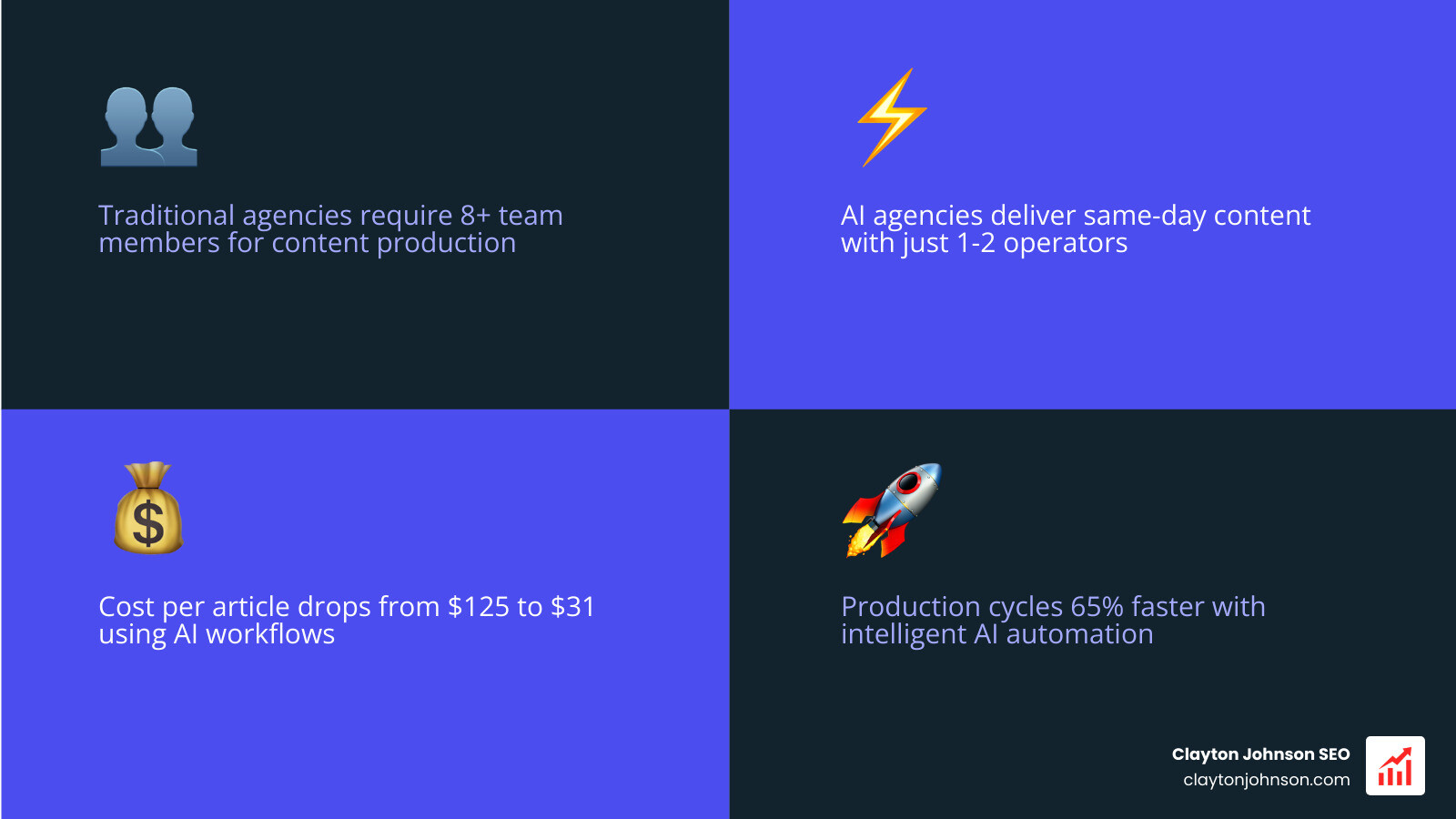
The old agency model is collapsing. Traditional agencies that ignore AI are standing on the same precarious cliff edge as early design firms that refused digital software. Meanwhile, AI-powered agencies are capturing clients 24/7, delivering 3x more qualified leads from the same traffic, and slashing production timelines from days to minutes.
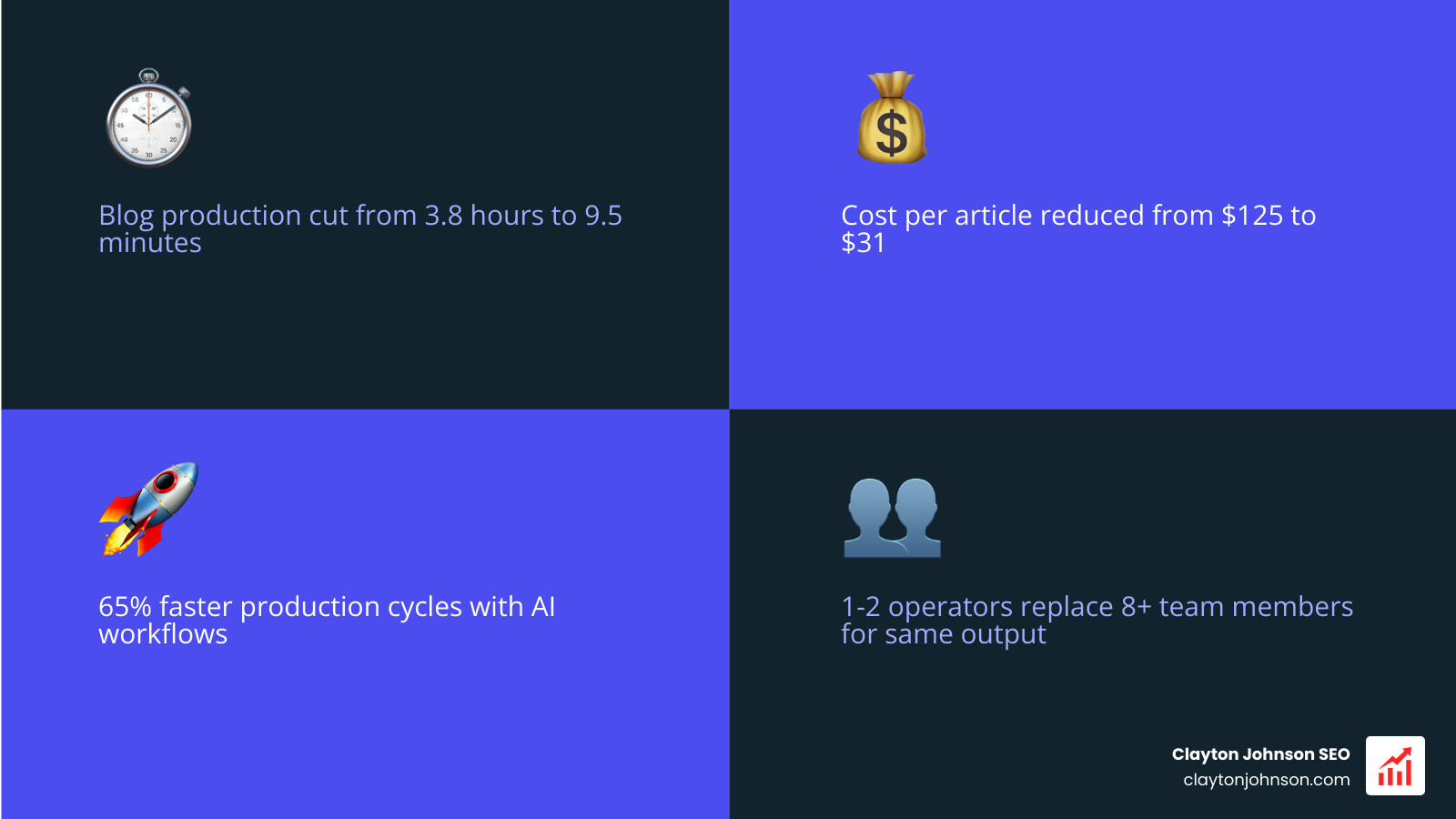
The global AI market is projected to reach $1.3 trillion, and agencies adopting structured AI workflows report cutting blog production times from 3.8 hours to just 9.5 minutes while maintaining consistent brand voice. In recent years, generative AI use by U.S. federal agencies jumped from 32 to 282 distinct applications.
This isn’t about replacing human expertise. It’s about building structured growth infrastructure where AI handles execution and humans drive strategy. One-person agencies are now managing enterprise-level workloads that previously required teams of 10+.
But most founders approach this wrong. They treat AI as a writing assistant instead of an operational engine. They chase tools instead of building systems. They automate tactics instead of architecting workflows.
I’m Clayton Johnson, and I’ve helped agencies transition from fragmented AI experiments to cohesive execution systems that scale predictably. Throughout this guide, I’ll show you exactly how to setup AI content agency operations that deliver enterprise-level results without enterprise-level overhead.
Explore more about Setup AI content agency:
- AI Content Systems
- AI content system setup
Why You Must Setup AI Content Agency Infrastructure Now
If you’re waiting for the “AI hype” to die down, you’re missing the largest structural shift in the history of professional services. We aren’t just looking at a new tool; we are looking at intelligence amplification.
The math is simple: traditional agencies are weighed down by high headcounts and linear scaling. To make more money, they have to hire more people. This eats into margins and creates a “bottleneck culture.” When you setup AI content agency infrastructure, you decouple your revenue from your hours worked.
The global AI market is expected to reach over $1.3 trillion because businesses are desperate for efficiency. They don’t want to pay for an account manager’s five hours of manual reporting per week-they want the insights that lead to growth. AI tools can already slash that admin time by over 50%.
Think of it like the transition from drafting tables to CAD software in the past. The architects who refused to learn the software didn’t just work slower; they became obsolete. Today, how AI empowers any business is the central question for every CEO in Minneapolis and beyond. By offering SEO content marketing services that leverage this speed, you position yourself as a high-value partner rather than a commodity vendor.
The Three-Tiered Tech Stack for Your Agency
Building an agency stack isn’t about collecting every shiny new app on Product Hunt. It’s about creating a cohesive ecosystem where data flows seamlessly from one stage to the next. We recommend a tiered approach to conversion optimization and production.
Essential Tools to Setup AI Content Agency Operations
The foundational layer is your “brain.” You need a primary Large Language Model (LLM) that understands nuance.
- ChatGPT-4 & Claude 3: These are your workhorses for drafting and research.
- Jasper: Essential for agencies because it allows you to bake in brand voices and style guides, ensuring your output doesn’t sound like a generic robot.
- Google Gemini: As platforms integrate Google Gemini for agencies, it becomes a powerful co-pilot for unearthing deep client insights and automating tedious data analysis.
The secret sauce here is prompt engineering. You aren’t just “talking” to the AI; you’re programming it with context. A well-structured prompt library is the most valuable intellectual property your agency will own.
Advanced Automation and Agentic Workflows
Once you have your “brain,” you need “limbs”-tools that actually do things.
- Zapier & Make: These connect your LLMs to your CMS, email, and project management tools. For example, major AI initiatives show that platforms are moving toward autonomous optimization. You can use Zapier to trigger a content update the moment a keyword drops in rank.
- Voiceflow: This allows you to build “AI agents”-specialized bots that can handle lead triaging, client onboarding, or even initial content research 24/7.
By using best AI tools for content creators, you build a system that works while you sleep, capturing leads and preparing drafts before you even open your laptop in the morning.
Building a Scalable AI Content Workflow

Scaling an agency usually means more stress. But when you setup AI content agency workflows correctly, scaling simply means increasing the “volume” on your existing systems. We follow the 80/20 rule: AI handles 80% of the heavy lifting (research, drafting, formatting), while humans provide the 20% that matters (strategy, storytelling, and fact-checking).
This isn’t just theory; it’s a model being adopted at the highest levels. Federal AI adoption is accelerating because even the government realizes that manual information processing is a losing game. As an SEO consultant, your job shifts from “writer” to “editor-in-chief.”
Step-by-Step Phases to Setup AI Content Agency Delivery
- Ideation & Clustering: Use AI to analyze search intent and cluster keywords into topical authority maps.
- The Structured Brief: Never ask an AI to “write a blog post.” Instead, give it a data-rich brief containing the target persona, internal links, and competitive gaps.
- Drafting: Use Copy.ai for personalization to ensure the content speaks directly to the reader’s pain points.
- Optimization: Run the draft through SEO validators to ensure it hits all technical benchmarks.
- Distribution: Automate the repurposing of one long-form article into 10 social media snippets and an email newsletter.
The Reporter Model and Quality Assurance
One of the biggest hurdles is maintaining a client’s specific brand voice. We solve this using the Reporter Model. Instead of asking a Subject Matter Expert (SME) to write a 2,000-word article (which they will never do), you interview them for 15 minutes.
You then feed that transcript into your AI. The result? Content that contains high-level, unique insights that no generic AI could ever hallucinate.
However, you must implement “review gates.” With a significant portion of workers admitting they’ve uploaded sensitive info to public AI, data privacy is non-negotiable. Ensure your tech stack is GDPR and CCPA compliant and use style validators to catch factual errors or “hallucinations” before the client ever sees a draft.
Niche Selection and Client Acquisition Strategies

The biggest mistake new founders make is trying to be a “General AI Agency.” When everyone has access to ChatGPT, generalists are a dime a dozen. Success comes from a well-defined business niche.
If you specialize in “AI Content for Minneapolis Real Estate” or “SaaS Growth Infrastructure,” you can build reusable prompt libraries and workflows that make you 10x faster than a generalist.
Our Client Acquisition Framework:
- Intentional Networking: Don’t just post on LinkedIn; engage in intentional networking with professionals who are struggling to integrate AI into their specific workflows.
- Productized Packages: Stop selling “hours.” Sell units. “4 High-Authority Articles + Social Repurposing” for a flat monthly fee. This makes the buying decision easy for the client.
- Value-Based Pricing: If your content drives a 41–50% increase in advertising effectiveness, you shouldn’t be charging by the word. You should be charging based on the revenue growth you generate.
Frequently Asked Questions about AI Content Agencies
How do I ensure AI content matches a client’s unique brand voice?
The key is “grounding” the AI. We don’t start with a prompt; we start with a Knowledge Base. Upload 5-10 pieces of the client’s best past content, their Voice of Customer (VOC) data, and their specific “do not use” word list. This allows tools like Jasper or specialized GPTs to mimic the tone, cadence, and vocabulary of the brand with startling accuracy.
Will AI-generated content be penalized by search engines?
No. Google has explicitly stated they reward high-quality, helpful content regardless of how it is produced. They care about E-E-A-T (Experience, Expertise, Authoritativeness, and Trustworthiness). As long as your “human-in-the-loop” workflow ensures factual accuracy and unique insights (like those from the Reporter Model), your content will rank. The penalty isn’t for “AI content”—it’s for “low-effort content.”
What is the best pricing model for an AI content agency?
We recommend Unit-Based or Value-Based Pricing. Since AI makes you significantly faster, an hourly rate actually punishes you for being efficient. By selling productized packages (e.g., $3,000/month for a specific set of deliverables), you capture the “efficiency dividend” created by your AI stack.
Conclusion
The transition to an AI-augmented world isn’t coming; it’s here. But tools alone won’t save your agency. You need structured growth architecture.
At Demandflow, we believe that clarity leads to structure, and structure leads to leverage. When you setup AI content agency systems, you aren’t just making content—you’re building a compounding growth engine. You move from being a “vendor” to being the “infrastructure” that powers your client’s business.
The opportunity for solo founders in Minneapolis and across the country is unprecedented. You can now deliver the same output as a 20-person agency with a fraction of the stress and 4x the profit.
Ready to stop chasing tactics and start building systems? Work with me to architect your agency’s future.