How to Architect Your Content for Maximum SEO Impact

Why Most Sites Are Leaving Rankings on the Table
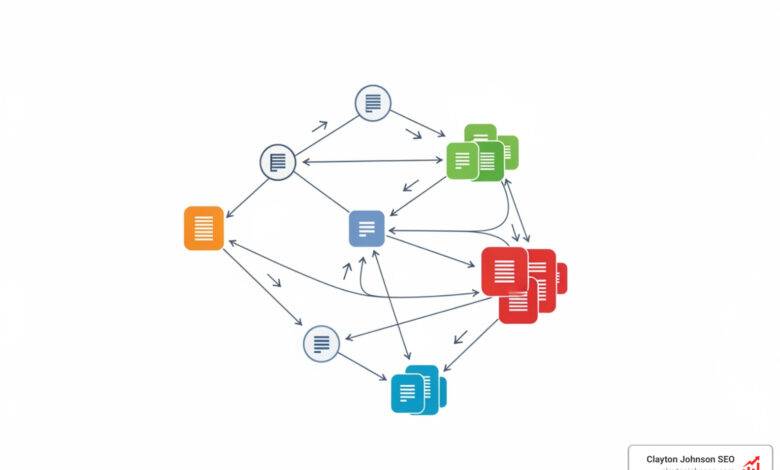
A strategic internal linking framework is a documented system that controls how every page on your site connects to every other page — determining which pages receive the most link equity, what anchor text patterns are used, how topic clusters are structured, and how the whole system is maintained as your site grows.
Here is what a strategic internal linking framework controls:
| Element | What It Does |
|---|---|
| Link equity flow | Directs PageRank from strong pages to high-priority targets |
| Crawl depth | Keeps important pages within 3 clicks of the homepage |
| Topical authority | Groups related content into clusters Google recognizes as expertise |
| Anchor text rules | Balances exact match (25-35%), partial match (30-40%), and natural context (20-30%) |
| Priority tiers | Tier 1 pages get 15+ inbound links; Tier 2 get 8-15; Tier 3 get 3-8 |
Most sites do not have this. They have internal links — scattered, inconsistent, added whenever a writer remembered. That is not a strategy. That is maintenance.
The difference matters. Sites with deliberate linking hierarchies rank an average of 3.2 positions higher for commercial terms compared to sites with flat, unstructured linking. Pages with zero internal links pointing to them are essentially invisible to search engines — crawled rarely, ranked never.
The problem is not that site owners ignore internal linking. It is that most treat it as a housekeeping task rather than what it actually is: site architecture. Your internal links are the roads that tell Google which neighborhoods matter most. Without intentional design, link equity flows wherever the path of least resistance takes it — often straight past your most valuable commercial pages.
I’m Clayton Johnson, an SEO strategist with nearly two decades of experience building scalable search frameworks, and one of the most consistent wins I’ve seen across client sites comes from implementing a strategic internal linking framework — often producing measurable ranking lifts without publishing a single new page.

Engineering a strategic internal linking framework
When we sit down to design a site’s link architecture, we aren’t just looking for “related posts.” We are building an engineering blueprint. This blueprint is usually based on the “Pyramid Model.” In this model, authority flows from the top down and is reinforced from the bottom up.
At the very top sits your homepage. It typically holds the most external link equity because it’s the primary target for backlinks. From there, authority should flow into your Pillar Pages (your high-level topic hubs), then down into Cluster Pages, and finally into supporting blog posts.
However, a strategic internal linking framework isn’t just a one-way street. For the architecture to hold, we must implement “upward” and “horizontal” linking. Every supporting post should link back up to its parent pillar page, and related cluster pages should link to each other. This creates a “web” of relevance that tells search engines exactly what the site is about.
Google explains how search works and the importance of following links, noting that some pages are discovered because Google has already crawled them, while others are found by following a link from a known page to a new one. If your links are a mess, Google’s discovery process becomes inefficient.
As sites grow, maintaining this manually becomes a nightmare. Linkbot executes your linking rules automatically across WordPress, Shopify, and headless CMS platforms. Start your free trial →. This allows us to focus on the high-level strategic frameworks for business growth while the software handles the repetitive execution.

Identifying cornerstone targets and link equity tiers
Not all pages are created equal. If we treat a “Contact Us” page the same as a $5,000 service page, we are wasting PageRank. To fix this, we categorize every URL into link equity priority tiers:
- Tier 1 (Cornerstone Content): These are your most important commercial pages. They should receive 15+ internal links from across your entire content archive.
- Tier 2 (Pillar Pages): These are high-level educational hubs. They should receive 8–15 internal links from cluster and supporting posts.
- Tier 3 (Supporting Content): Standard blog posts or detailed articles. These should have 3–8 contextual links pointing to them.
John Mueller on how Google ranks important pages based on distance from homepage has suggested that pages linked directly from the homepage are generally seen as more critical. By tiering our pages, we ensure that our “Cornerstones” are never more than two or three clicks away from our highest-authority URLs.
Identifying these targets requires looking at both business priority and current performance. We use AI-enhanced SEO systems to analyze which pages are currently getting the most impressions in Search Console and then map them to our commercial goals. If a page has a high conversion rate but low internal link counts, it’s a prime candidate for a Tier 1 upgrade.
Optimizing anchor text within the strategic internal linking framework
One of the biggest mistakes we see is “anchor text laziness.” Using “click here” or “read more” provides zero semantic signal to Google. On the other hand, over-optimizing with 100% exact-match keywords can look manipulative.
A healthy strategic internal linking framework follows a specific distribution ratio:
- 25–35% Exact Match: Using the primary keyword you want the target page to rank for.
- 30–40% Partial Match: Using variations or long-tail versions of the keyword.
- 20–30% Natural Context: Using descriptive sentences or “branded” anchors.
Google link analysis methods and anchor text features indicate that the words surrounding a link also provide context. We don’t just drop a link; we weave it into a relevant paragraph. This is especially important for SEO services for consultants and agencies where topical depth is a major ranking factor.
By varying our anchors, we avoid keyword cannibalization. If two pages are fighting for the same term, we use different anchor text strategies to signal to Google which page is the definitive “pillar” for that specific keyword.
Auditing for crawl depth and orphan pages
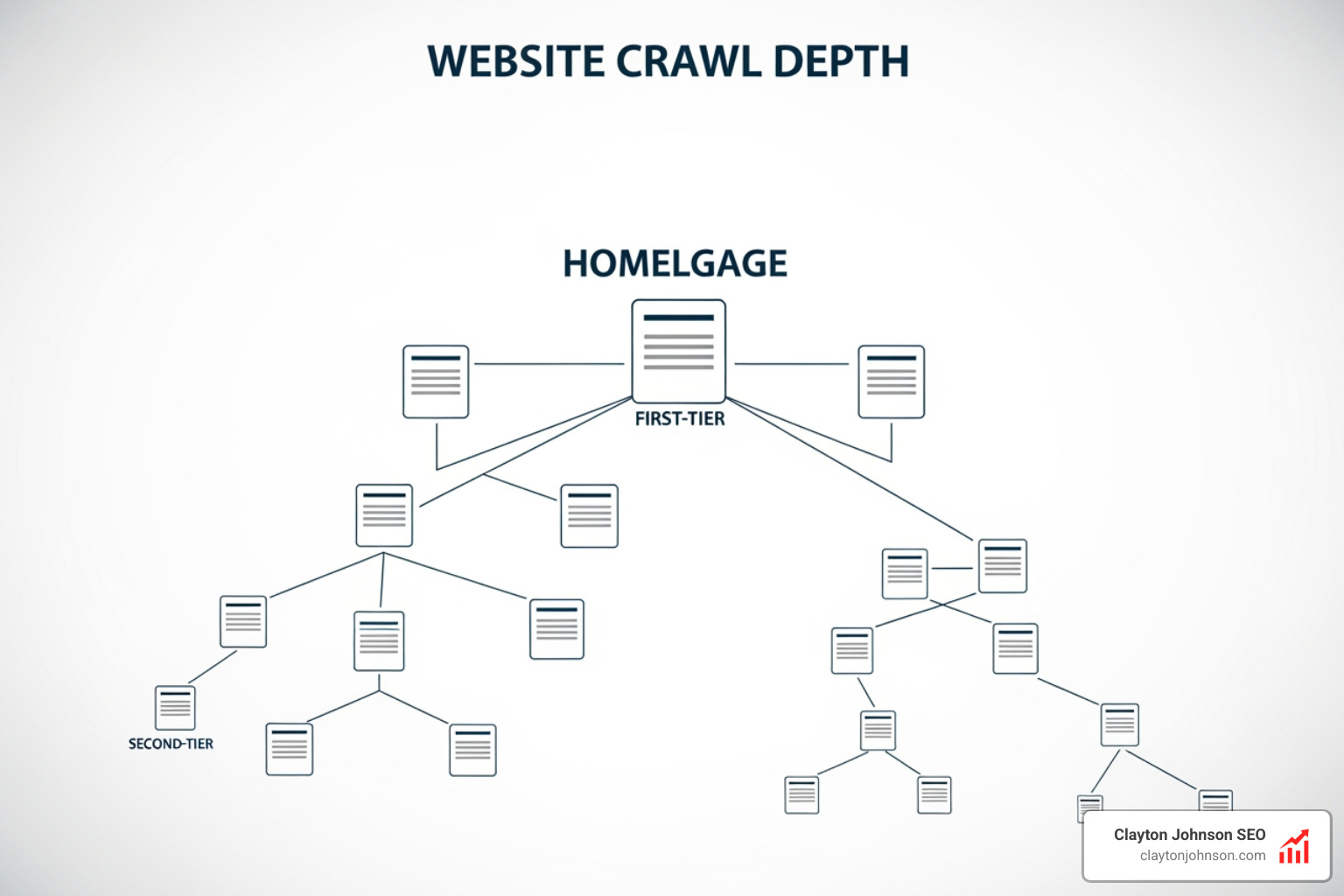
If a page exists on your site but no other page links to it, it is an “orphan.” Search engines might find it via your sitemap, but they will rarely index it or give it any ranking power. Similarly, if a page is buried 6 clicks deep, Googlebot will likely “lose sleep” over it and stop crawling before it gets there.
Our target crawl depth is 3 or fewer clicks for all important pages.
To find these issues, we use tools like the Screaming Frog SEO Spider for site navigation simulation. It mimics how Googlebot moves through your site. We also rely on SE Ranking for identifying orphaned and broken links.
Common audit red flags include:
- Broken Internal Links (404s): These are “leaks” where PageRank goes to die. Research shows 42.5% of websites have these.
- Redirect Chains: When a link goes through multiple 301 redirects before reaching the destination, losing equity at every step.
- HTTPS to HTTP links: Links that trigger security warnings or unnecessary redirects.
Scaling and maintaining your taxonomy-driven architecture
Manual internal linking works when you have 20 pages. It becomes difficult at 50 pages and completely unsustainable past 75 to 100 posts. At this scale, you can no longer remember every opportunity to link a new post to an old cornerstone.
This is where we switch from a “tactical” approach to a “systemic” one. We move from adding links to encoding rules. Linkbot is the only tool that lets you encode your linking strategy into rules that then run automatically across your site.. For example, we can set a rule that says: “Every time the phrase ‘retirement planning’ appears in a blog post, link it to our strategic SEO for financial services pillar page, but only if that post doesn’t already have 3 links to that page.”
Implementing topic clusters and hub-and-spoke models
The “Hub-and-Spoke” model is the gold standard for building topical authority. We designate a “Hub” (the pillar page) and connect it to several “Spokes” (cluster pages).
- The Hub: A broad, high-volume keyword page (e.g., “The Ultimate Guide to AI Marketing”).
- The Spokes: Specific, long-tail articles (e.g., “How to use AI for email subject lines”).
The strategy requires a bidirectional flow. The Hub links to all Spokes. All Spokes link back to the Hub. This creates a “silo” of content. Google sees this dense cluster of related information and concludes that your site is an authority on the topic. Google Webmaster Guidelines on ensuring all pages are reachable emphasize that every page should be findable from at least one other page. In a hub-and-spoke model, every page is findable from many.
Automating the strategic internal linking framework
Automation is often feared in SEO because of “spammy” plugins from a decade ago. But modern automation isn’t about random keyword matching; it’s about executing your specific strategy at scale.
When we use a tool like Linkbot, we are creating growth systems for founders that handle the heavy lifting. The automation engine analyzes your full content library, identifies topically relevant opportunities, and places links based on the priority tiers we’ve established. It even handles your archive retroactively. If you publish a new cornerstone page today, the system can go back through 500 old blog posts and find perfect places to link to that new page.
This is critical for e-commerce and SaaS sites where content volume can reach thousands of URLs. Without automation, your oldest (and often most authoritative) content remains disconnected from your newest (and most relevant) pages.

Measuring success and quarterly strategy iteration
A strategic internal linking framework is not a “set it and forget it” project. We measure success using several key metrics:
- Google Search Console Impressions: This is often the leading indicator. When you improve internal linking, you usually see an uptick in impressions for the target pages within 6–12 weeks.
- Crawl Frequency: Using Google Search Console for tracking top linked pages, we check if Google is visiting our cornerstone targets more often.
- Average Position: We look for the 3.2-position jump we mentioned earlier.
- Bounce Rate and Dwell Time: Better internal links guide users to more content, keeping them on the site longer.
We recommend a monthly “Quick Audit” to fix broken links and a “Quarterly Strategy Review” to re-evaluate our cornerstone targets. As your business goals shift—perhaps you launch a new service or pivot to a new niche—your internal linking must shift to support those new priorities.
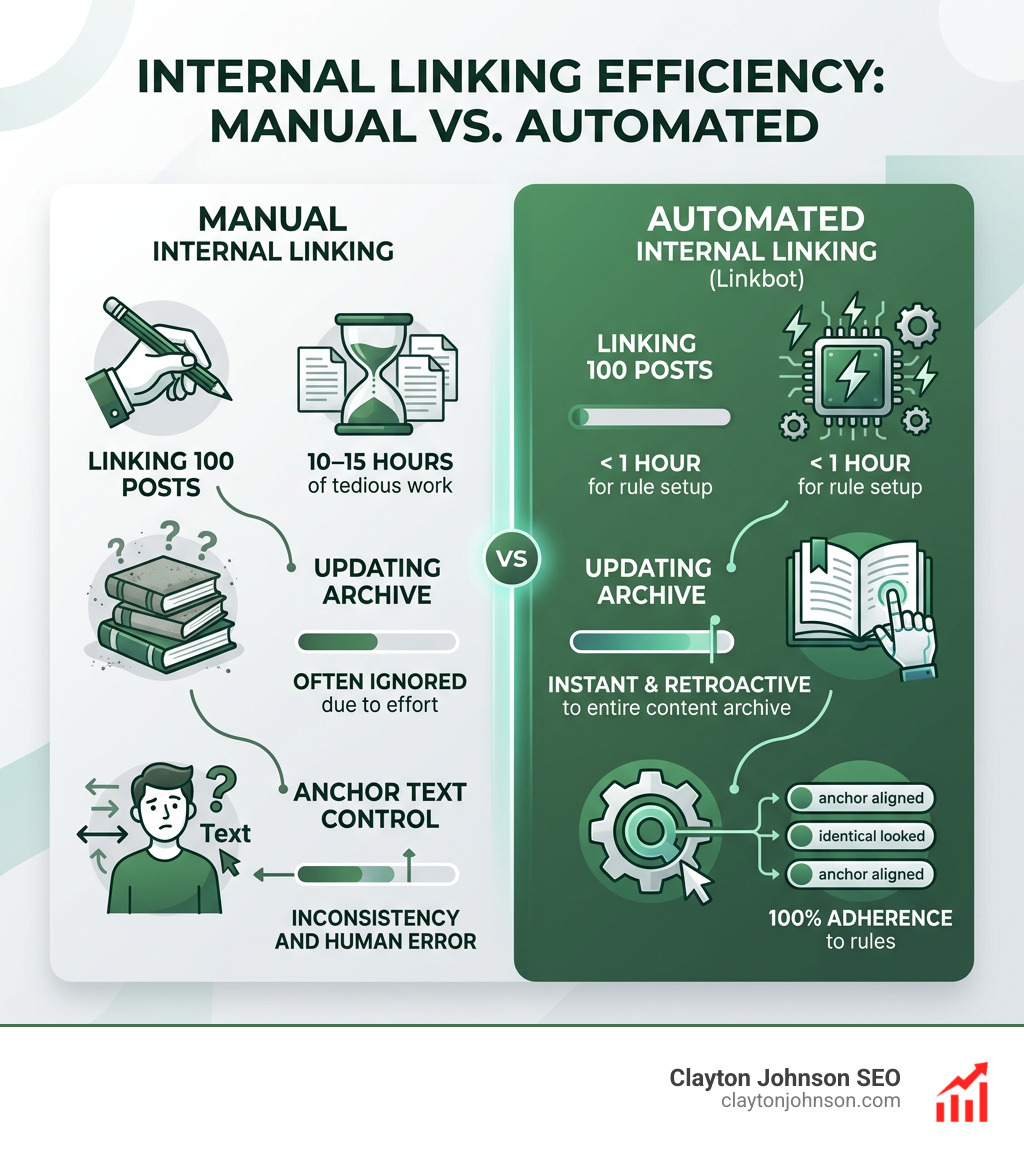
| Task | Manual Approach | Automated Approach (Linkbot) |
|---|---|---|
| Linking 100 posts | 10–15 hours of manual editing | < 1 hour (Rule setup) |
| Updating Archive | Often ignored (Too much work) | Instant & Retroactive |
| Anchor Text Control | Human error/Inconsistency | 100% adherence to rules |
| Orphan Page Fixes | Requires manual crawl & edit | Automatic identification & linking |
| Scalability | Breaks at 75+ pages | Unlimited scale |
Summary of the Framework
Building a strategic internal linking framework is one of the highest-ROI activities in technical SEO. It doesn’t require expensive backlink campaigns or a massive content budget. It simply requires a better way of organizing what you already have.
By mapping your architecture into a pyramid, identifying your cornerstone targets, and using smart automation to maintain those relationships, you turn a collection of isolated pages into a coherent growth engine.
Remember the philosophy: Clarity → Structure → Leverage → Compounding Growth.
If you’re ready to stop guessing and start engineering your site’s authority, start by auditing your crawl depth. If your best pages are more than three clicks away, you’re not just hiding them from your users—you’re hiding them from the world’s most powerful search engine.