The Ultimate B2B SaaS SEO Strategy Playbook


Building a High-Conversion B2B SaaS SEO Strategy
A b2b saas SEO strategy is a structured plan to grow organic search traffic, attract qualified buyers, and convert them into paying customers — without relying on paid ads alone.
Here is what a winning B2B SaaS SEO strategy looks like:
- Define your ICP and buyer journey — Know exactly who you are targeting and what they search at each stage
- Do full-funnel keyword research — Target educational (TOFU), evaluative (MOFU), and transactional (BOFU) keywords
- Build topic clusters — Create pillar pages with supporting content to establish topical authority
- Fix technical SEO — Fast site speed, clean URLs, schema markup, and proper indexing
- Publish ICP-aligned content — Solve real buyer problems, not just stuff pages with keywords
- Build backlinks and internal links — Earn authority through guest posts, digital PR, and smart internal linking
- Track revenue metrics — Measure organic conversions, LTV:CAC ratio, and non-branded traffic growth
- Refresh and iterate — Update underperforming content regularly to sustain rankings
Most SaaS companies make the same mistake: they chase high-volume keywords that attract the wrong audience. Or they publish a lot of content that never converts.
The reality is that organic search is the highest-ROI growth channel for B2B SaaS — if you do it right. It compounds over time, reduces customer acquisition costs (CAC), and attracts buyers who are already looking for a solution like yours. One study found that non-branded search traffic can grow from 25,000 to over 500,000 monthly visitors with the right strategy in place. That kind of growth does not happen by accident.
But getting there requires more than publishing blog posts. It demands a system — one that connects technical foundations, buyer-aligned content, and authority building into a single engine.
I’m Clayton Johnson, an SEO strategist with nearly two decades of experience building scalable b2b saas seo strategy frameworks that drive measurable pipeline growth — and this playbook is built on what I know actually works.
Building a high-conversion b2b saas seo strategy isn’t about casting the widest net possible; it’s about fishing where the hungry fish are. In enterprise software, a single qualified lead can be worth tens of thousands of dollars in Lifetime Value (LTV). Therefore, our strategy must prioritize quality and intent over raw traffic numbers.
The most successful SaaS companies treat their website like a 24/7 salesperson. This salesperson needs to be able to talk to a distracted CEO, an analytical IT manager, and a frustrated end-user—all at the same time. To do this, we must align our content with the specific stages of the B2B buyer journey.
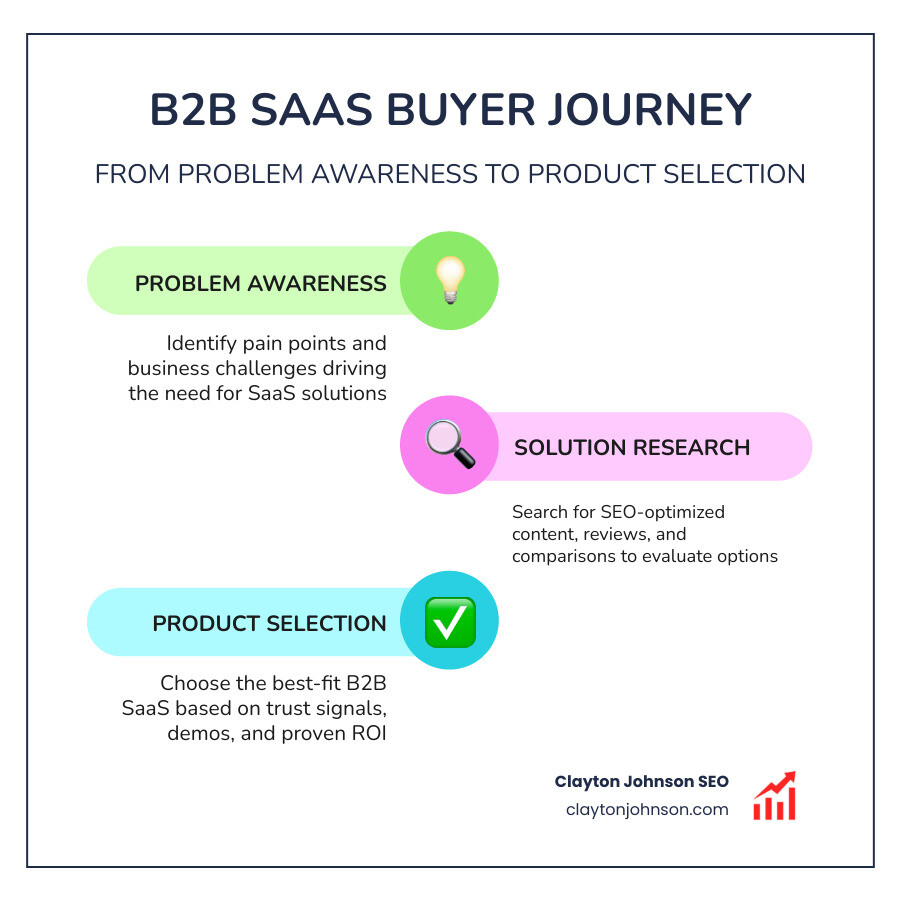
Mapping the B2B SaaS SEO Strategy to the Buyer Journey
The B2B buying process is rarely linear. It often involves up to 15 touchpoints and multiple stakeholders before a demo is even booked. We use the Jobs-To-Be-Done (JTBD) framework to understand the “struggle” our customers are facing. What “job” are they hiring your software to do?
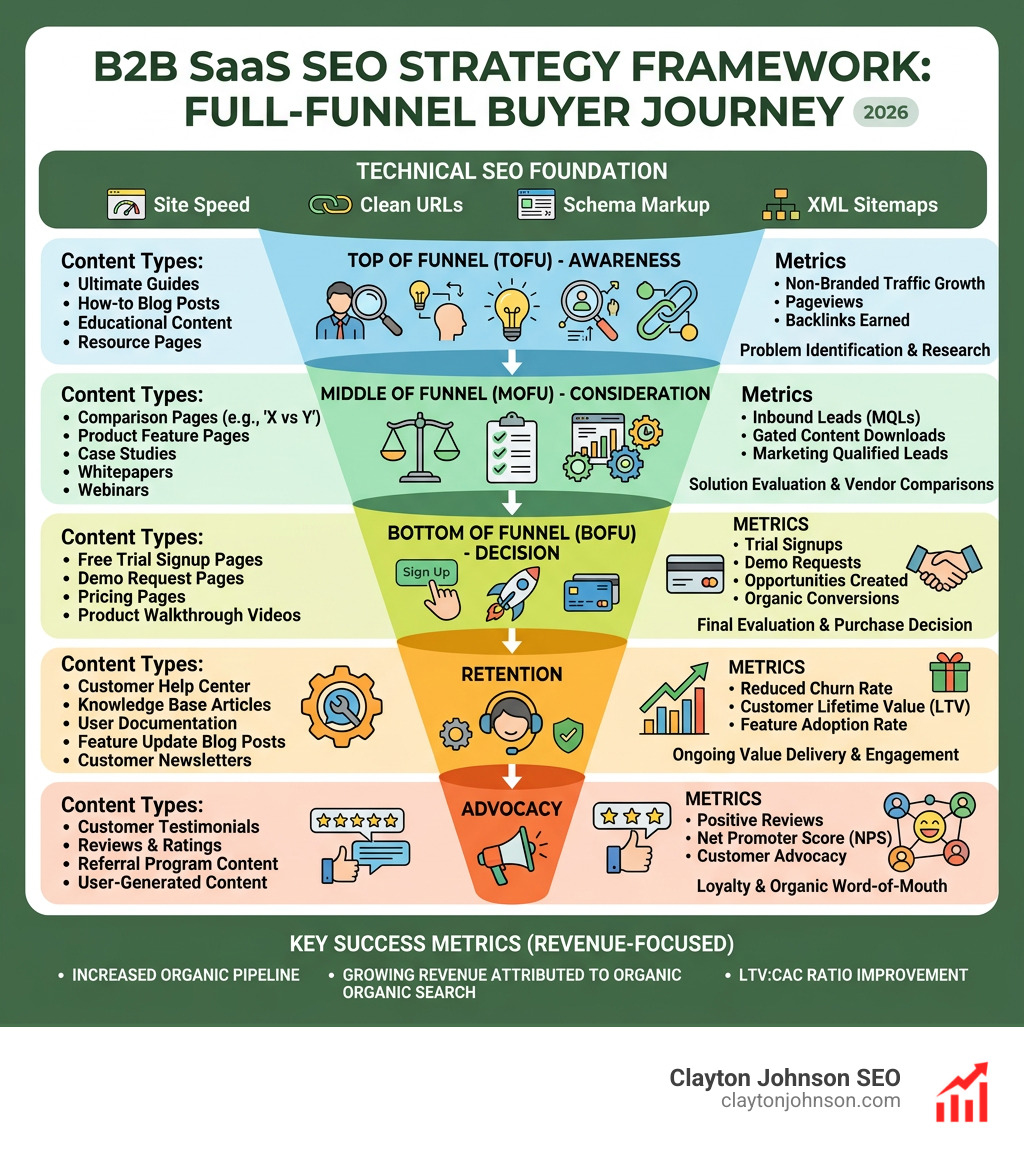
We break this journey into three distinct phases:
- Top of Funnel (TOFU) – Awareness: The buyer realizes they have a problem but doesn’t know the solution. They search for educational terms like “how to reduce churn” or “improving team productivity.”
- Middle of Funnel (MOFU) – Consideration: The buyer is evaluating categories of solutions. They look for “best project management tools” or “automation software reviews.”
- Bottom of Funnel (BOFU) – Decision: The buyer is ready to buy and is comparing specific vendors. They search for “[Your Brand] vs [Competitor]” or “[Competitor] alternatives.”
According to scientific research on the B2B buying journey, buyers spend a significant portion of their time researching independently online. If you aren’t visible during this research phase, you simply don’t exist to them. For those looking to dive deeper into how these frameworks integrate with broader business goals, you can find more info about strategic frameworks here.
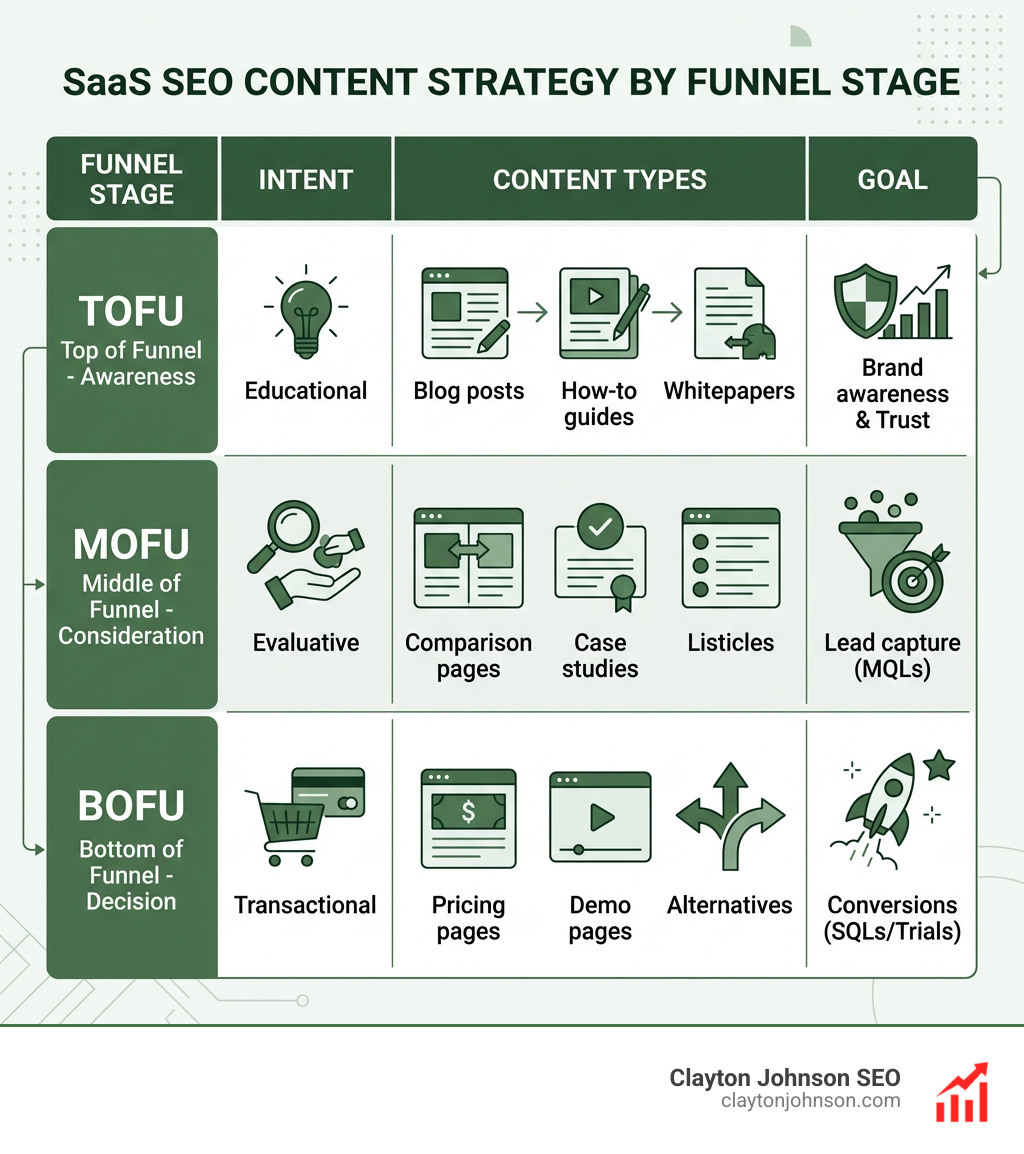
| Funnel Stage | Intent | Content Types | Goal |
|---|---|---|---|
| TOFU | Educational | Blog posts, How-to guides, Whitepapers | Brand awareness & Trust |
| MOFU | Evaluative | Comparison pages, Case studies, Listicles | Lead capture (MQLs) |
| BOFU | Transactional | Pricing pages, Demo pages, Alternatives | Conversions (SQLs/Trials) |
Keyword Research for B2B SaaS SEO Strategy Success
A common mistake in a b2b saas seo strategy is obsessing over search volume. In B2B, a keyword with only 50 searches a month might be worth $100k in revenue if those 50 searchers are VPs of Engineering at Fortune 500 companies.
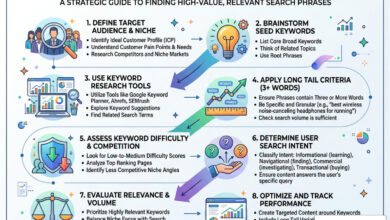
We focus on three primary keyword categories:
- High-Intent Keywords: These are “money” keywords. They include terms like “software,” “platform,” “tool,” or “solution.”
- Long-Tail Keywords: These are specific phrases like “cloud-based accounting software for healthcare providers.” They have lower competition and much higher conversion rates.
- Competitor Alternatives: People search for alternatives when they are unhappy with their current provider. This is the perfect time to show up.
To execute this, we leverage the Semrush keyword research toolkit to find what competitors are ranking for and where the gaps lie. Additionally, the Ahrefs site explorer is invaluable for uncovering the exact “backdoor” keywords that drive trials for your biggest rivals. Don’t just look at tools, though—listen to your sales calls. Tools like Gong or Chorus can reveal the exact language your customers use to describe their pain points.
Technical Foundations and Content Architecture
You can have the best content in the world, but if your site takes 10 seconds to load on a mobile device, Google will bury you. Technical SEO is the “engine” of your SaaS growth.
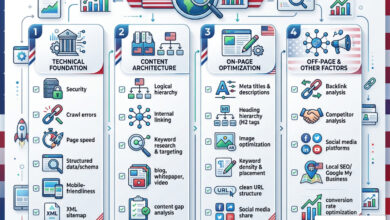
Critical technical elements include:
- Core Web Vitals: Google uses these metrics to measure user experience. This includes Largest Contentful Paint (loading), First Input Delay (interactivity), and Cumulative Layout Shift (visual stability). You can read the scientific research on Core Web Vitals to understand the technical benchmarks.
- Schema Markup: This is code that helps search engines understand your data. For SaaS, using
SoftwareApplicationandFAQPageschema can help you win rich snippets in search results, which can increase click-through rates significantly. - Sitemaps and Indexing: Ensure your XML sitemap is clean and submitted to Google Search Console. SaaS sites often waste “crawl budget” on duplicate user dashboards or old documentation—use your robots.txt file to keep Google focused on your high-value marketing pages.
We often recommend Webflow for SaaS companies because it offers a “Ferrari-level” performance and built-in SEO controls that traditional CMS platforms lack. As AI continues to change how search works, your technical architecture must support AI-augmented workflows. Check out our AI SEO services for more information on staying ahead of the curve.
Executing and Scaling Your Organic Growth Engine
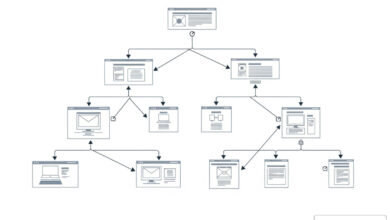
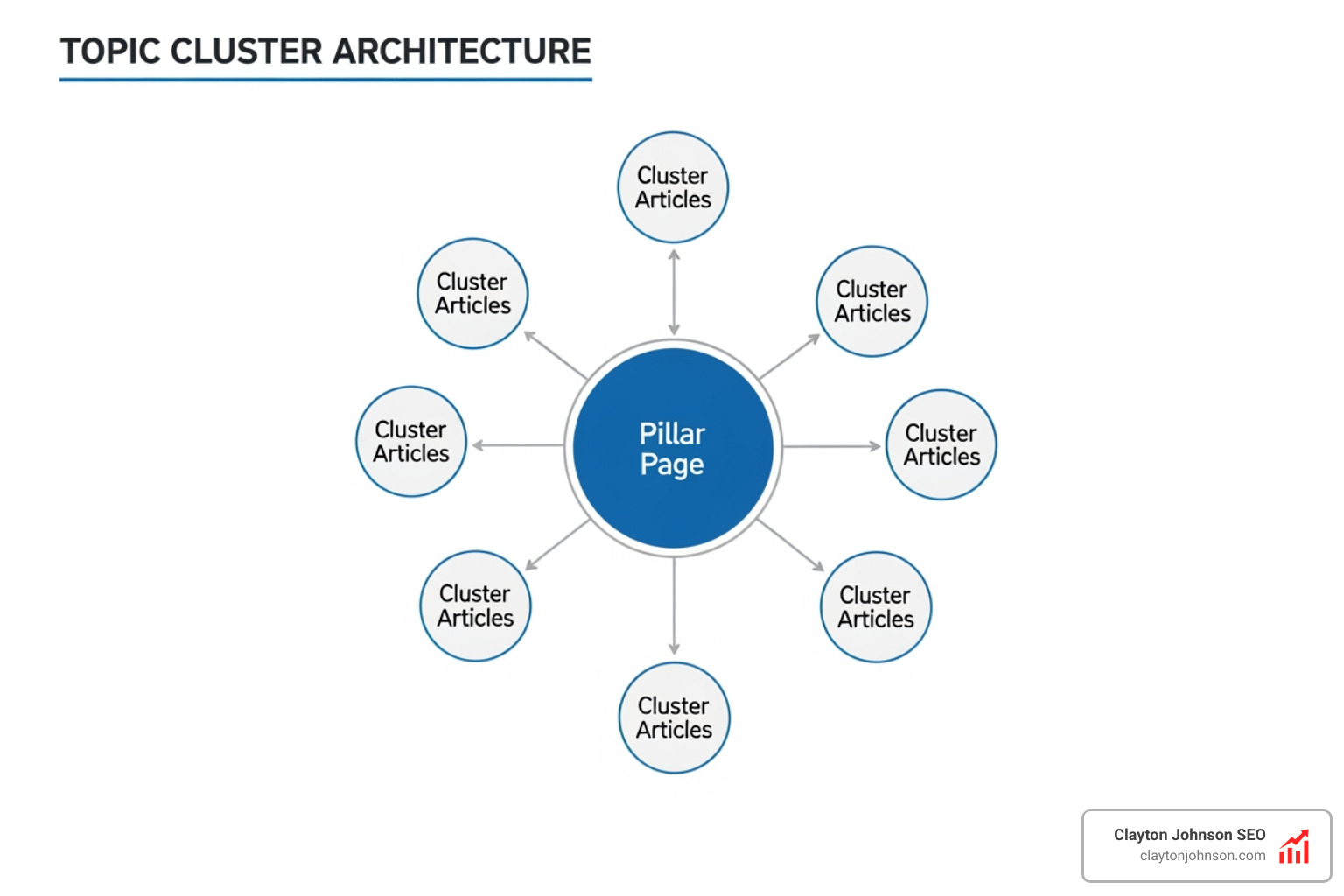
Once the foundation is set, it’s time to scale. Scaling a b2b saas seo strategy requires moving from individual “random acts of content” to a structured ecosystem. We use a “Topic Cluster” architecture to signal to Google that we are an authority on a specific subject.
Imagine your content is a neighborhood. Instead of having scattered houses (random blog posts), you want a planned community with clear street signs and a central town square (the pillar page).
Customer-Led Content and Topic Clusters
The “Old Way” of SEO was writing for search engines. The “New Way” is Customer-Led SEO. This means using the Audience-Topic-Keywords (ATK) framework. We start with the audience’s pain points, group them into topics, and then find the keywords.
- Pillar Pages: These are comprehensive guides on a broad topic (e.g., “The Ultimate Guide to Remote Team Management”).
- Cluster Content: These are smaller, more specific articles that link back to the pillar (e.g., “Best Video Tools for Remote Teams,” “How to Run a Remote Standup”).
This internal linking structure passes “authority” from your high-performing pages to your new ones. It tells Google, “We don’t just have one article about this; we have a whole library of expertise.” For a deeper dive into how to choose these topics, explore our more info about keyword strategy resources.
Link Building and Authority Systems
Links are the “oil” that keeps your SEO engine running. However, over half of the content online has zero backlinks. In B2B SaaS, you don’t need thousands of spammy links; you need a few high-authority mentions from industry-relevant sites.
Our proven tactics include:
- Digital PR and Linkable Assets: Create original research, data reports, or free tools (like an ROI calculator). People love to link to statistics and useful tools.
- Guest Posting: Write high-quality articles for reputable tech and business publications. This builds both authority and referral traffic.
- Passive Link Acquisition: When you rank #1 for a “What is…” term, journalists and bloggers will naturally link to you as a reference.
We focus on building growth systems that make link building a byproduct of great marketing, rather than a separate, painful chore. Avoid the “link farms”—Google’s algorithms are now sophisticated enough to ignore or even penalize low-quality, purchased links.
Measuring Success and Iterating for Revenue
If you are only tracking “organic traffic,” you are missing the point. You can’t pay your employees in “clicks.” We focus on metrics that align with business growth:
- Organic Conversions: How many trials or demos came from search?
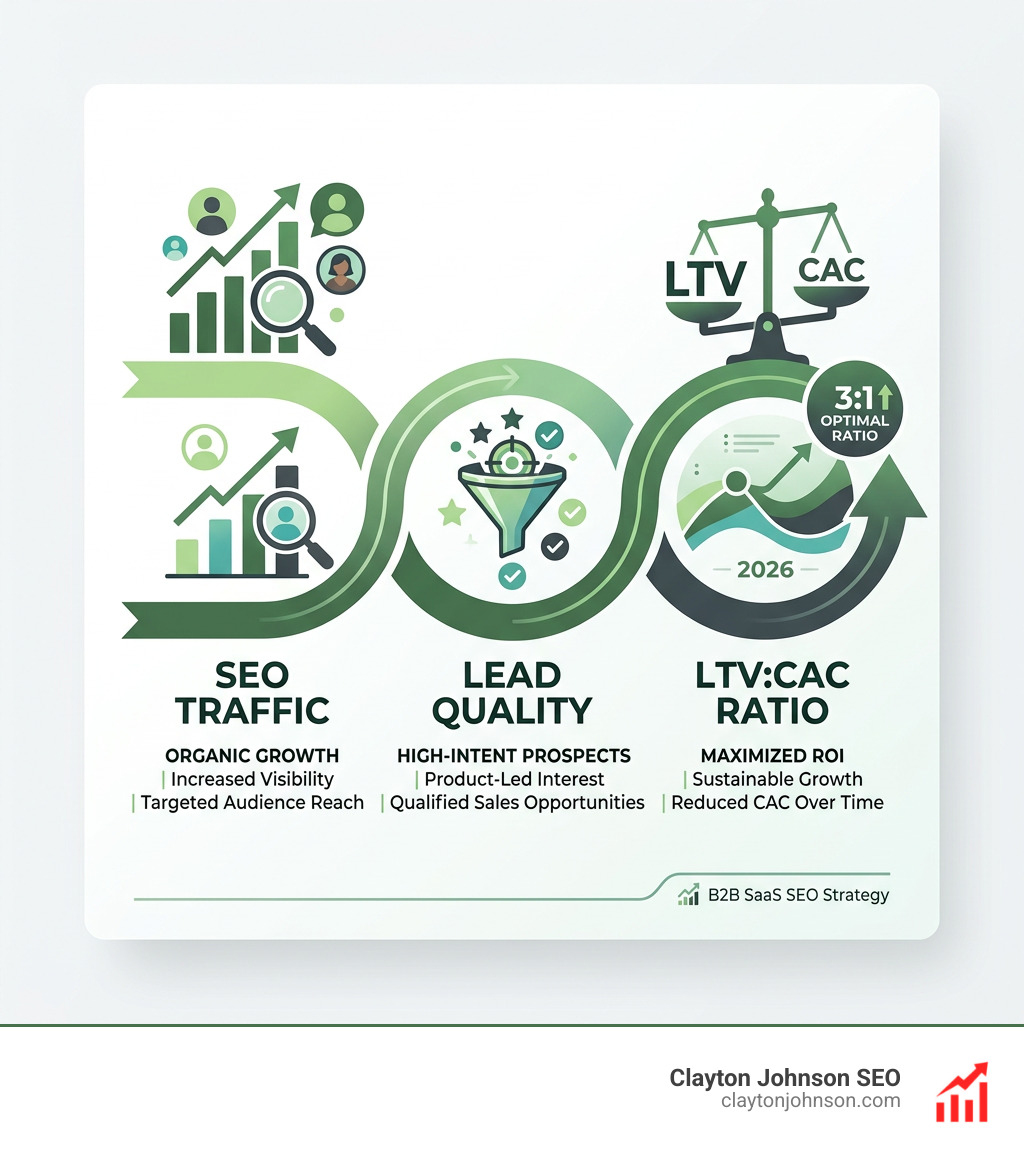
- LTV:CAC Ratio: For SaaS, the optimal ratio is 3:1. SEO is the best way to lower your Customer Acquisition Cost (CAC) over time.
- Non-Branded Traffic Growth: This shows you are reaching new prospects who didn’t already know your name.
- Trial-to-Paid Conversion: Are the leads you’re getting from SEO actually turning into revenue?
At Clayton Johnson SEO, we believe in “Clarity → Structure → Leverage.” We don’t just want you to rank; we want you to dominate your category. Our AI marketing systems are designed to help you iterate faster, using data to decide which content to refresh and which new topics to tackle.
The 90-Day SEO Action Plan
If you want to see results, follow this technical audit and execution list:
- Audit (Week 1-2): Use Screaming Frog to find broken links, 404s, and duplicate content. Check your site speed on pagespeed.web.dev.
- Quick Wins (Week 3-4): Optimize your existing BOFU pages. Add FAQs and better CTAs to your pricing and “vs” pages.
- Content Foundation (Month 2): Launch your first topic cluster. Publish one pillar page and four cluster articles.
- Authority Building (Month 3): Start your outreach for guest posts and promote your first data-backed “linkable asset.”
By following this strategy, you are not just reacting to search algorithm changes. You are building a durable, compounding organic growth engine that can support pipeline and revenue for years to come. Ready to turn your website into a high-performing sales asset? Let’s build your system.