Guide to AI for Cruise Planning and Travel Consulting


Why AI for Cruise Planners Is Changing Everything
AI for cruise planners is transforming how travel advisors find cruises, manage bookings, and serve clients — faster and with far less manual work.
Here’s a quick look at what AI tools now do for cruise planners:
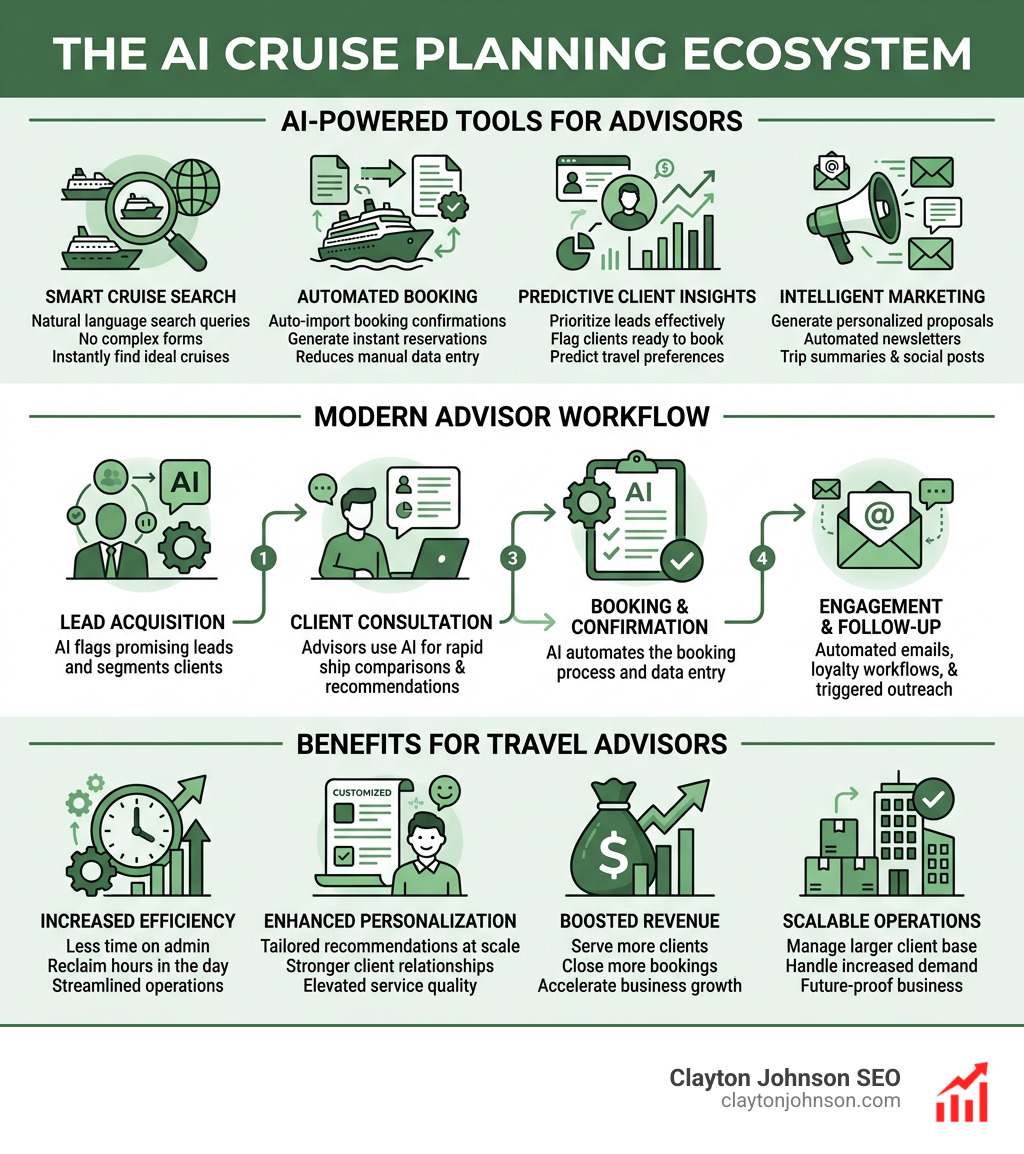
- Search cruises using plain language instead of complex filter forms
- Auto-import booking confirmations and generate reservations instantly
- Prioritize leads and flag clients who are ready to book
- Generate marketing content like proposals, newsletters, and trip summaries
- Predict travel trends to make proactive recommendations
- Automate follow-ups with triggered emails and loyalty workflows
The cruise industry is massive. It serves tens of millions of passengers every year and generates tens of billions in annual revenue. First-time cruisers continue to grow, which means more travelers who need guidance.
And yet, most cruise planning tools have barely changed in over a decade.
That’s where AI comes in. Franchise networks like Cruise Planners are embedding AI directly into their booking platforms. Independent platforms like CruiseVoices and 360Cruising are building AI tools that handle everything from ship comparisons to full itinerary planning in minutes.
For travel advisors, this isn’t a threat. It’s a massive opportunity. The advisors who learn to use these tools now will serve more clients, close more bookings, and build stronger businesses — without burning out.
This guide breaks down exactly how.
How AI for Cruise Planners is Revolutionizing the Travel Industry
The traditional image of a travel advisor buried under a mountain of brochures and complex spreadsheets is fading. In its place is a tech-savvy professional powered by ai for cruise planners. This shift isn’t just about “using a computer”—it’s about leveraging machine learning and natural language processing (NLP) to handle the heavy lifting of data analysis.
Efficiency is the primary driver here. By automating manual tasks like data entry and reservation tracking, advisors can reclaim hours of their day. Instead of manually typing in every detail from a PDF confirmation, AI tools can “read” the document and populate the CRM automatically. This allows for personalization at scale, where an advisor can send tailored recommendations to hundreds of clients without losing that personal touch.
Furthermore, predictive analysis allows advisors to move from being reactive to proactive. By analyzing travel trends and historical booking patterns, AI can suggest the perfect time for a client to book their next Mediterranean voyage before the client even realizes they want to go. According to ASTA consumer research on why travelers choose travel advisors, travelers value clear communication and expert guidance. AI provides the data backbone that makes this expert guidance possible.
As we discuss in our look at Why AI Marketing Intelligence Platforms Are the Future of Growth, the goal is to turn fragmented data into a coherent growth engine.
| Feature | Manual Planning | AI-Augmented Planning |
|---|---|---|
| Search Method | Rigid filters (date, port, price) | Natural language (“Find me a balcony under $1200”) |
| Data Entry | Manual typing from emails | Automated AI confirmation import |
| Client Insight | Based on memory/notes | Predictive lead scoring and trend analysis |
| Marketing | Generic templates | AI-generated, personalized storytelling |
| Speed | Hours of research | Minutes with AI concierge tools |
Inside the Cruise Planners AI Ecosystem: CP Maxx and Beyond
For those in the franchise world, Cruise Planners has set a high bar with its proprietary platform, CP Maxx. This isn’t just a CRM; it’s a central command center that has been migrated to the cloud for maximum speed and scalability. By integrating ai for cruise planners directly into the workflow, they’ve removed the friction that usually slows down a home-based business.
One of the most impressive additions is the AI Confirmation Import Tool. Imagine receiving a confirmation email from a supplier and, instead of spending ten minutes logging the details, you simply “import” it. The AI extracts the pricing, cabin category, and commission data, generating a reservation in CP Maxx instantly.
Then there is Trip Summary 3.0. This tool allows advisors to bundle multiple itineraries into a single, beautiful mobile-friendly presentation for the client. With drag-and-drop functionality and the ability to include flights via “Find A Flight” (powered by Google Flights), it turns a complex set of options into a clear, bookable journey. The roadmap for this ecosystem includes a Reservation Intelligence Engine, which will use AI to suggest add-ons like shore excursions or transfers based on a client’s specific booking patterns.
Leveraging Maxx Intelligence as an AI for Cruise Planners
Maxx Intelligence is the “brain” inside the CP Maxx system. It’s designed to help advisors work smarter, not harder. One of its key functions is content generation. Writing a compelling newsletter or a vacation proposal can be time-consuming, but with AI, an advisor can generate a “client story” that highlights the best features of a ship like the Wonder of the Seas in seconds.
We often emphasize How to Build AI Marketing Workflows That Actually Work, and Maxx Intelligence is a prime example of this in action. It doesn’t just “chat”; it prioritizes leads. By using predictive lead scoring, the system can flag which clients are most likely to book a specific promotion, allowing the advisor to focus their energy where it counts. This is marketing automation that feels personal rather than robotic.
Streamlining Workflows with AI for Cruise Planners Tools
Beyond the core CRM, several specialized tools complement the ai for cruise planners experience:
- CruiseWatcher: This tool acts as an automated “sentinel,” monitoring cruise deals and price drops. When a price changes or a new promotion hits, the advisor is notified, allowing them to provide proactive service to their clients.
- LivePlanner: This allows for real-time collaboration. An advisor can “walk” a client through different cabin options or itineraries on their screen, making the planning process an interactive event.
- CP Genie: Think of this as an internal search engine for the advisor. It helps them quickly find supplier promotions, training materials, and destination insights without leaving the platform.
- Loyalty Loop: This automated marketing system ensures that clients are contacted at the right time—whether it’s a “welcome home” email or a reminder to book their next trip to maintain their loyalty status.
Competitive Advantages of AI-Powered Franchise Models
There is a significant divide between independent advisors and those within a tech-forward franchise. Independent advisors often have to stitch together five or six different software subscriptions—a CRM, an email marketing tool, a search engine, and a spreadsheet. This leads to “data silos” where information is trapped in different places.
Franchises like Cruise Planners provide a proprietary, all-in-one technology suite from day one. This centralized approach is a core part of an Enterprise AI Strategy 101. It provides scalability that a small business could never achieve on its own.
Advisors also benefit from specialized training like CP Genie Learning. They aren’t just given the tools; they are taught how to use them to become “tech-savvy professionals.” This includes specialist certifications that help them stand out in a crowded market.
The biggest advantage? Cost. Most of these AI tools are included in the franchise fees, meaning advisors don’t have to pay extra for “AI add-ons” or separate subscriptions. This lowers the barrier to entry and allows new advisors to compete with industry veterans immediately.
Emerging AI Platforms and the Future of Cruise Booking
While franchises offer robust internal tools, the broader market is seeing a surge in consumer-facing and independent AI platforms. CruiseVoices.com is a prime example of this “new wave.” It features an AI cruise concierge that can plan an entire trip—including flights, hotels, and excursions—through a single natural language conversation.
Other platforms like 360Cruising provide specialized AI advisors. Unlike generic chatbots that might give you outdated info, these are trained on current fleet data and loyalty program nuances. They can answer hyper-specific questions like, “Which ship has the best kids’ club for a 5-year-old?” or “Compare the balcony sizes on these two ships.”
As we look toward The Ultimate Guide to Digital Marketing AI, we see a future where AI support is 24/7 and multilingual. Tools like PierPlanner are already promising to save travelers many hours of research by delivering personalized, day-by-day itineraries quickly. This level of speed is becoming the new standard.
Frequently Asked Questions about AI for Cruise Planners
Will AI replace travel advisors in the cruise industry?
Absolutely not. If anything, it makes the human advisor more valuable. While AI is great at sorting through 30,000 cruise itineraries in a second, it cannot replicate the human experience of having actually sailed on a ship.
AI doesn’t know the “vibe” of a dining room or how to handle a complex flight cancellation during a storm. Travelers still crave the reassurance of a human expert. AI is simply the “super-assistant” that handles the boring, repetitive tasks so the advisor can focus on relationship building and complex problem-solving.
What is the AI Confirmation Import Tool?
This is a game-changer for efficiency. It is a tool that allows advisors to take a confirmation email from a cruise line or supplier and “read” it into their CRM system. The AI identifies key fields—booking numbers, passenger names, sail dates, cabin categories, and pricing. It then automatically creates the reservation record, tracks the commission, and updates the client’s itinerary. This eliminates manual data entry errors and saves hours of administrative work.
How does AI Cruise Search work for new advisors?
For a new advisor, the sheer number of cruise options can be overwhelming. Traditional search engines require you to know exactly which filters to click. AI for cruise planners changes this by allowing natural language queries.
An advisor can type (or speak): “Show me seven-night Caribbean cruises in July under $1,500 with a balcony.” The AI understands the intent and pulls the results instantly. This acts as a “training shortcut,” allowing new advisors to provide expert-level recommendations from their very first day.
Conclusion
The integration of ai for cruise planners is no longer a futuristic concept—it is the current reality of the travel industry. From the robust, proprietary ecosystems like CP Maxx to independent AI concierges like CruiseVoices, these tools are designed to empower, not replace.
At Clayton Johnson SEO, we believe in the power of clarity and structure. By building durable systems and AI-augmented workflows, travel businesses can turn fragmented efforts into compounding growth. Whether you are a franchise owner or an independent operator, the goal remains the same: use technology to provide better service, faster results, and more personalized experiences.
If you’re looking to build a scalable traffic system or implement a structured growth framework for your travel business, our SEO Services can help you navigate this digital transformation. The “robot” won’t take your job, but the advisor who knows how to use the robot just might. It’s time to embrace the leverage that AI provides.