The Ultimate Guide to How PESTLE Impacts Modern Markets

Why Strategic Leaders Turn to PESTLE for Market Intelligence
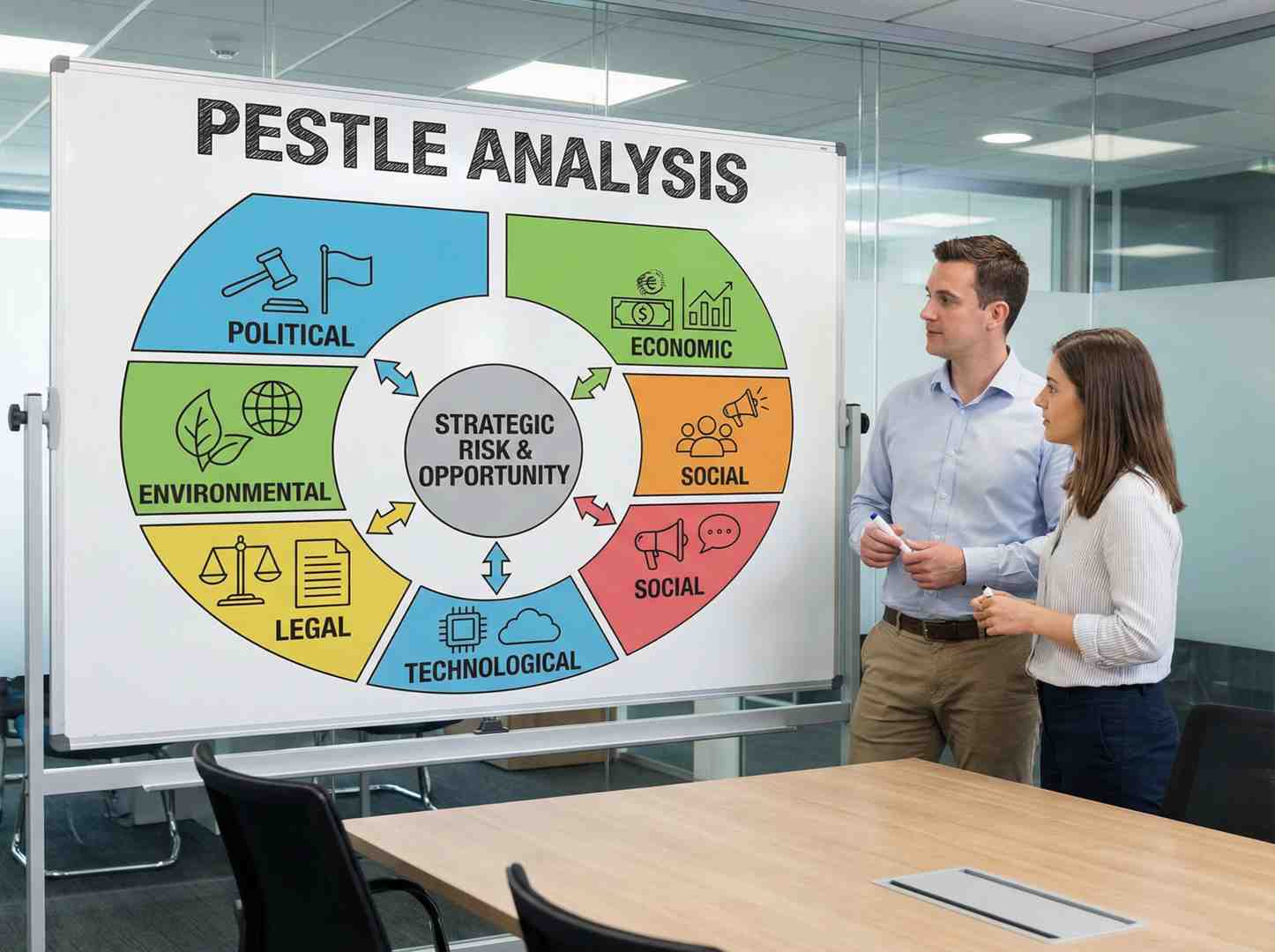
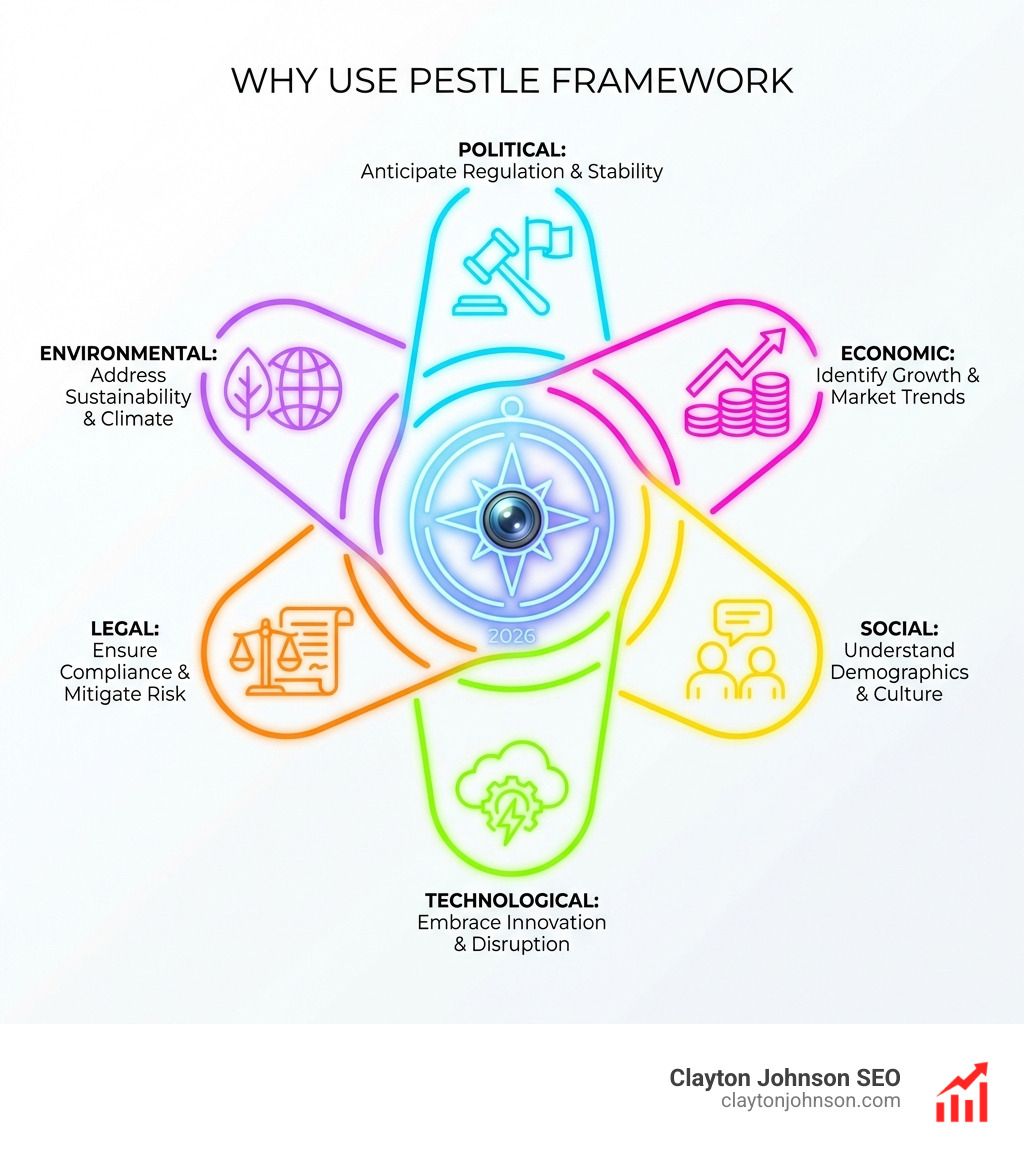
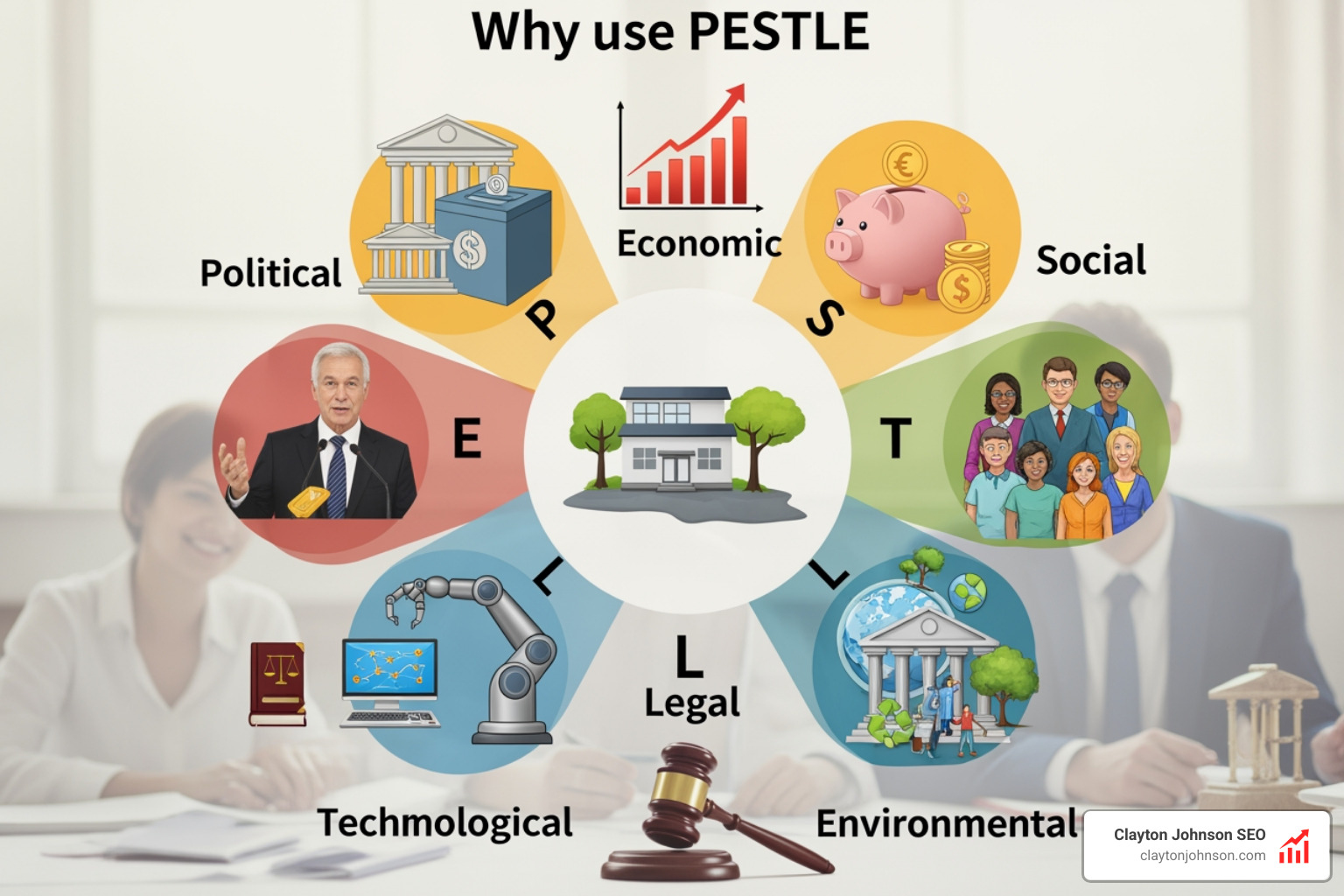
Why use PESTLE framework? Organizations use PESTLE to systematically identify and evaluate external macro-environmental forces—Political, Economic, Social, Technological, Legal, and Environmental—that could impact strategic decisions, operations, and long-term competitiveness. The framework provides advance warning of emerging threats and opportunities, enabling proactive planning rather than reactive firefighting.
Key reasons to use PESTLE:
- Competitive Advantage – Organizations that monitor macro-environmental changes can differentiate from competitors and respond faster to market shifts
- Risk Mitigation – Identifies regulatory, economic, and technological threats before they impact operations
- Strategic Context – Provides the external analysis foundation needed for effective SWOT assessments and strategic planning
- Opportunity Discovery – Reveals emerging trends in technology, policy, and consumer behavior that create growth opportunities
- Informed Decision-Making – Replaces assumptions with structured environmental scanning across multiple domains
PESTLE analysis emerged from Francis Aguilar’s 1967 work on environmental scanning and has evolved into a core strategic diagnostic tool. The framework is particularly valuable because it forces consideration of the wider context beyond immediate competitive dynamics—from government policy shifts and economic volatility to technological disruption and sustainability mandates.
The six pillars work together to create a comprehensive external audit. Political factors examine government policies, trade regulations, and political stability. Economic factors assess inflation, interest rates, exchange rates, and consumer spending power. Social factors analyze demographics, lifestyle trends, and cultural shifts. Technological factors track innovation, automation, and digital transformation. Environmental factors evaluate climate impact, resource scarcity, and CSR expectations. Legal factors monitor regulatory changes, employment law, and compliance requirements.
Organizations across industries use PESTLE before major strategic initiatives—market entry decisions, product launches, mergers and acquisitions, and annual planning cycles. The analysis should be repeated regularly, with best practices suggesting reviews every six months in stable industries and as frequently as every few months in rapidly evolving sectors like artificial intelligence.
I’m Clayton Johnson, and I’ve helped enterprise marketing leaders navigate external market volatility by applying why use PESTLE framework principles to diagnose visibility compression in AI-driven search environments and build resilient growth architectures. The structured approach PESTLE provides creates clarity when external forces feel chaotic.
Why Use PESTLE Framework for Strategic Planning?
When we talk about building a business in Minneapolis or anywhere else in the modern market, we often get caught up in our own “internal” world—our team, our product, our coffee machine. But no business is an island. We operate within a massive, swirling ocean of external forces. This is exactly why use PESTLE framework is so critical: it stops us from being blindsided by waves we didn’t see coming.
The primary purpose of conducting a PESTLE analysis is to provide a “diagnostic” view of the world outside your office walls. It’s about PESTEL – what is it and how to apply it to your business strategy so that you aren’t just reacting to the news—you are anticipating it.
Strategic planning without a PESTLE analysis is like trying to build a house without checking the weather forecast or the local zoning laws. You might build a beautiful deck, but if a hurricane is coming or the city is about to rezone your street as a highway, your hard work is at risk. By identifying these factors early, we can engage in proactive planning, ensuring that our SEO content marketing services and broader business goals are aligned with where the world is actually going.
Gaining a Competitive Advantage with PESTLE
Organizations that successfully monitor and respond to changes in the macro-environment can differentiate themselves from the competition. Think about it: if you know that a new trade restriction is coming six months before your competitor does, you can pivot your supply chain while they are still scratching their heads.
By scanning the business environment, we gain the ability to forecast trends. This isn’t about having a crystal ball; it’s about strategic positioning. When we understand the “mega-trends”—like the shift toward remote work or the rise of AI—we can position our brand as a leader rather than a follower. This differentiation is what creates a material competitive advantage.
Why Use PESTLE Framework in Risk Management
Risk management isn’t just about insurance policies; it’s about awareness. External threats often come from places we aren’t looking. For example, in industries like construction or tech, the PESTLE Technique – A Tool to Identify External Risks in Construction Projects helps teams spot regulatory shifts or economic volatility that could stall a multi-million dollar project.
If inflation is rising and disposable income is dropping, your high-end luxury product might need a “mid-tier” alternative to survive the season. Without the PESTLE framework, you might just wonder why your sales are dipping. With it, you have a roadmap to mitigate that risk before it hits your bottom line.
Breaking Down the Six Pillars of Macro-Environmental Analysis
To truly understand why use PESTLE framework, we have to look at the individual pillars. Each one represents a different lens through which we can view our business environment. It’s a bit like a health check-up for the world around you.
When we are researching and gathering evidence for each pillar, we want to look for specific insights. We don’t just want a list of facts; we want to know the “likelihood” of an event happening and the “impact” it will have on our specific business.
Political and Legal Factors: Navigating Regulation
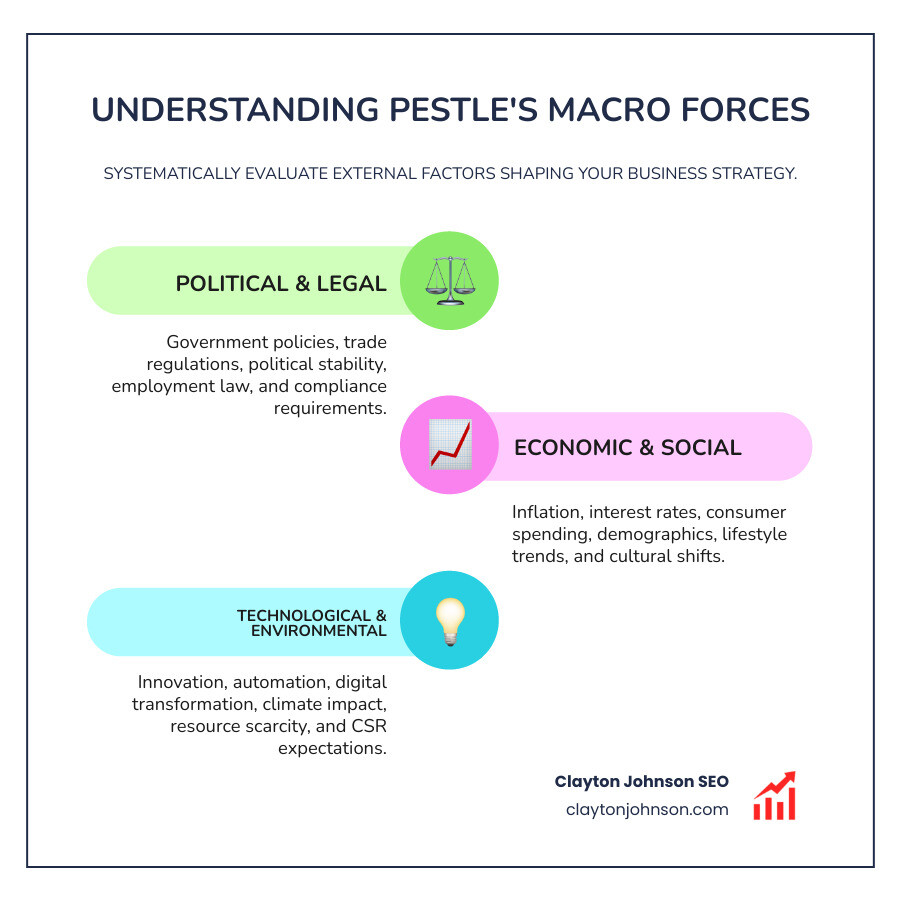
Political and Legal factors are often grouped together, but they represent different things. Political factors are led by government policy—think about tax implications, trade restrictions, or political stability. Legal factors are the “must-dos”—the mandatory compliance requirements like employment law, health and safety, and consumer protections.
For example, a PESTLE approach for assessment of coastal zone management practice in India shows how government policy directly dictates how businesses can operate in sensitive areas. In the US, especially in hubs like Minneapolis, we keep a close eye on changes in labor laws or tax rebates that can either hurt our margins or provide a much-needed boost.
Economic and Social Factors: Understanding the Market
The Economic pillar is all about the “money” environment. We’re looking at inflation rates, interest rates, and the general economic growth of the regions where our target market resides. If interest rates are high, consumer spending usually drops.
Social factors, on the other hand, look at the “people” environment. What are the current lifestyle trends? Are people moving toward more sustainable living? Is the population aging? Understanding these demographics helps us fine-tune our messaging. If the social trend is shifting toward “work-life balance,” our marketing should reflect that value.
Why Use PESTLE Framework for Technological and Environmental Shifts
Technology moves fast—exponentially fast. In sectors like AI, strategic reviews using PESTLE might be needed every couple of months. We look at automation, R&D spending, and disruptive technologies that could render our current systems obsolete. As the saying goes, “adapt or die” is a reality in the tech landscape.
Environmental factors have also moved from the “nice to have” category to the “essential” category. With the rise of Corporate Social Responsibility (CSR), things like carbon footprints and ethical sourcing are central to business strategy. A PESTLE Analysis of Biofuels Energy Industry in Europe highlights how environmental mandates can create entire industries overnight.
How to Conduct an Effective PESTLE Analysis
Now that we know the “what,” let’s talk about the “how.” Conducting a PESTLE analysis isn’t just a solo mission for the CEO. It should be a collaborative, cross-functional effort.
| Framework | Components | Primary Focus |
|---|---|---|
| PEST | Political, Economic, Social, Technological | Core macro forces |
| PESTLE | PEST + Legal, Environmental | Regulatory & Sustainability focus |
| STEEPLE | PESTLE + Ethical | Moral & Values-based focus |
To start, we recommend gathering a diverse team. You want the person in sales, the person in HR, and the person in tech all in one room. They each see a different slice of the external world. You might even consider developing your skills with a CIM Diploma in Professional Marketing to master these strategic audits.
The steps are straightforward but require discipline:
- Brainstorm: List all the external pressures you can think of.
- Classify: Categorize them into the six PESTLE pillars.
- Research: Gather data to back up your hunches.
- Score: Evaluate each item for ‘likelihood’ and ‘impact’.
- Refine: Narrow the list down to the most critical, actionable points.
Integrating PESTLE with SWOT Analysis
One of the most powerful reasons why use PESTLE framework is that it provides the “meat” for your SWOT analysis. A PEST analysis focuses entirely on the external macro-environment. Once you have identified these external opportunities and threats, you can bring them into your SWOT (Strengths, Weaknesses, Opportunities, Threats) to see how your internal strengths can capitalize on them.
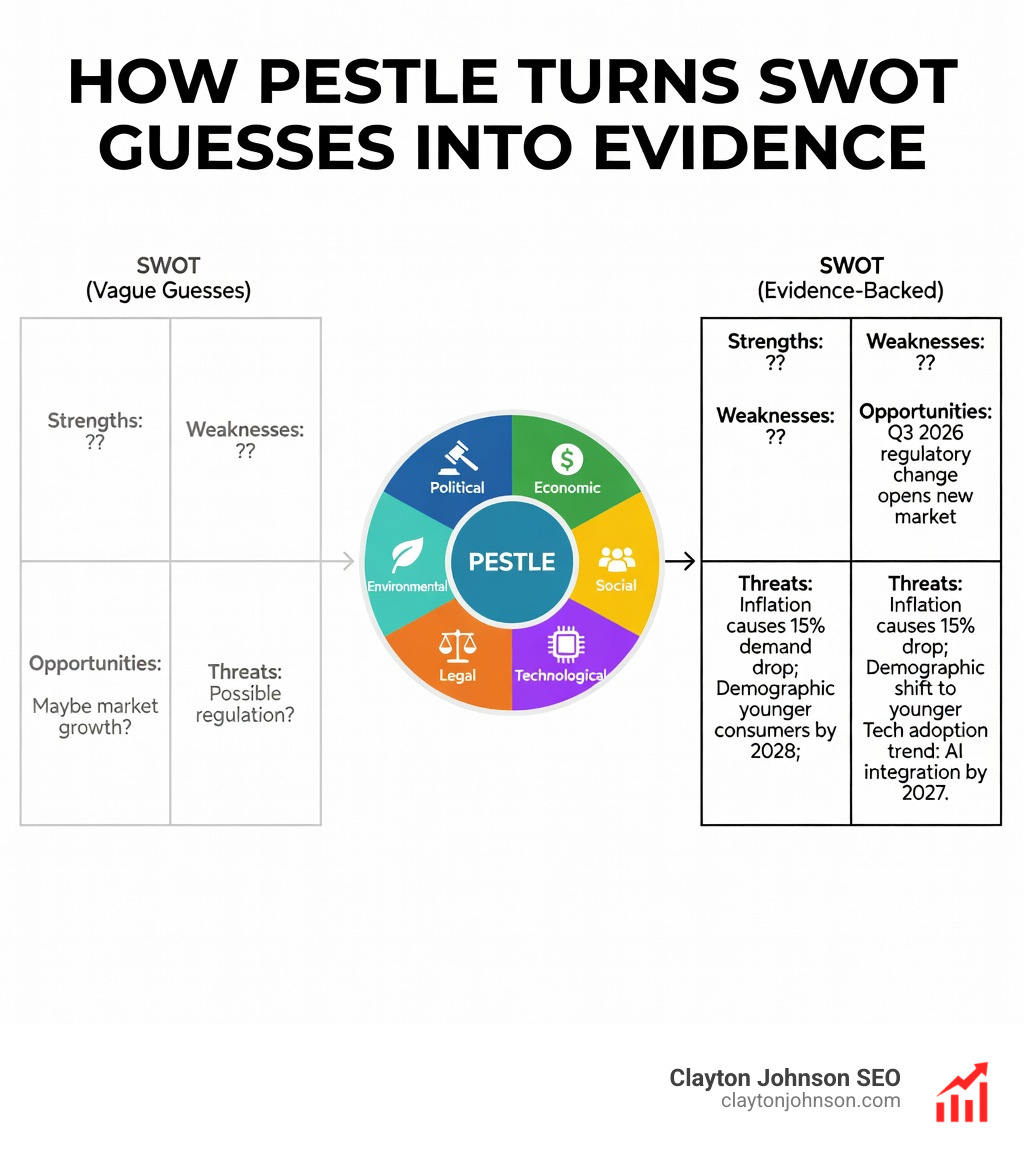
Without PESTLE, the Opportunities and Threats in your SWOT are often educated guesses. With PESTLE, they become evidence-backed inputs pulled from real macro signals. You move from “I think the market is changing” to “Multiple indicators show customers are shifting to mobile-first buying, and that changes our channel and product priorities.”
Frequency and Maintenance of the Framework
How often should you do this? A PESTEL analysis should generally be repeated every six months. However, if you are in a high-speed industry like AI or biotechnology, you might need a “sense check” every two months.
To keep it current, we recommend setting up news alerts for industry-specific keywords and engaging with industry networks. If you’re feeling overwhelmed by the process, you can always get in touch with our team for guidance on how to build this into your growth architecture.
Limitations and Best Practices for Modern Organizations
While we love the PESTLE framework, we have to be honest about its limitations. Its biggest weakness is its external focus bias. It doesn’t tell you anything about what’s happening inside your company. It also doesn’t provide solutions—it only identifies the issues.
Another challenge is “paralysis by analysis.” It’s easy to get lost in the data. To avoid this, focus on the factors that have the highest likelihood and the biggest impact.
Best Practices for Modern Teams:
- Use AI-Augmented Workflows: Leverage AI to summarize news reports and identify emerging trends. (But be careful with proprietary data!)
- Avoid Solution Mode: During the brainstorming phase, just identify the trends. Don’t try to solve them yet.
- Look for Non-Obvious Factors: Real threats often lie in the details, not the headlines.
- Build Consensus: Ensure the management team agrees on which forces are the most critical to address.
A strategic analysis of barriers and solutions to development of sustainable buildings shows that even when the path forward is clear, internal and external consensus is required to actually move the needle.
Frequently Asked Questions about PESTLE
How often should a PESTLE analysis be updated?
For most businesses, every six months is the “sweet spot.” This allows you to catch shifts in government policy or economic trends without spending all your time in meetings. However, if a major event happens (like a sudden change in interest rates), do an immediate update.
What is the difference between PEST and PESTLE?
PEST is the original model, focusing on Political, Economic, Social, and Technological factors. PESTLE adds Legal and Environmental factors. Where sustainability and compliance are huge, PESTLE is generally the better choice.
Who should be involved in the PESTLE process?
Ideally, a cross-functional team. You need perspectives from finance, HR, marketing, and operations. Front-line staff often spot emerging threats that senior management might miss, so don’t be afraid to include them!
Conclusion
Understanding why use PESTLE framework is the first step toward moving away from “tactical firefighting” and toward “structured growth architecture.” At Clayton Johnson, we believe that clarity leads to structure, and structure leads to compounding growth.
We don’t just provide content; we build authority-building ecosystems and competitive positioning models that take the external world into account. By using frameworks like PESTLE, we help founders and marketing leaders build a growth operating system that is resilient to external shocks and ready to capitalize on new opportunities.
If you are ready to stop leading in the dark and start building a measurable growth model that accounts for the macro-environment, let’s talk.
Work with me to build your structured growth architecture today.