The Ultimate Guide to SEO Marketing Success


What Is an SEO Marketing Strategy (and Why It Determines Your Online Growth)
A strong seo marketing strategy is the difference between a website that quietly collects dust and one that consistently attracts qualified leads. Here is a quick overview of what it involves:
- Define your goals – Set clear business outcomes (leads, revenue, visibility)
- Research keywords – Find what your audience actually searches for
- Optimize on-page elements – Content, headings, metadata, and internal links
- Build authority – Earn backlinks and trust signals from reputable sources
- Fix technical foundations – Site speed, mobile experience, crawlability, and security
- Track and improve – Monitor rankings, traffic, and conversions regularly
This framework drives compounding organic growth – traffic that builds over time without paying for every click.
Google processes over 8.5 billion searches every day. The businesses showing up in those results are not there by accident. They have a plan. They understand how search engines decide what to rank, and they build their content and site structure around that understanding.
Meanwhile, businesses without a clear SEO plan keep pouring money into paid ads that stop the moment the budget runs out – while their competitors quietly compound organic traffic month after month.
Organic search drives 53% of all website traffic. And inbound leads from SEO cost 61% less than outbound leads. The numbers are hard to ignore.
I’m Clayton Johnson, an SEO strategist with nearly two decades of experience building scalable seo marketing strategies for businesses that want sustainable visibility and qualified demand – not just rankings. In this guide, I’ll walk you through every layer of a modern SEO strategy, from foundational pillars to AI-powered workflows that give you a compounding edge.

Core Pillars of a Modern seo marketing strategy
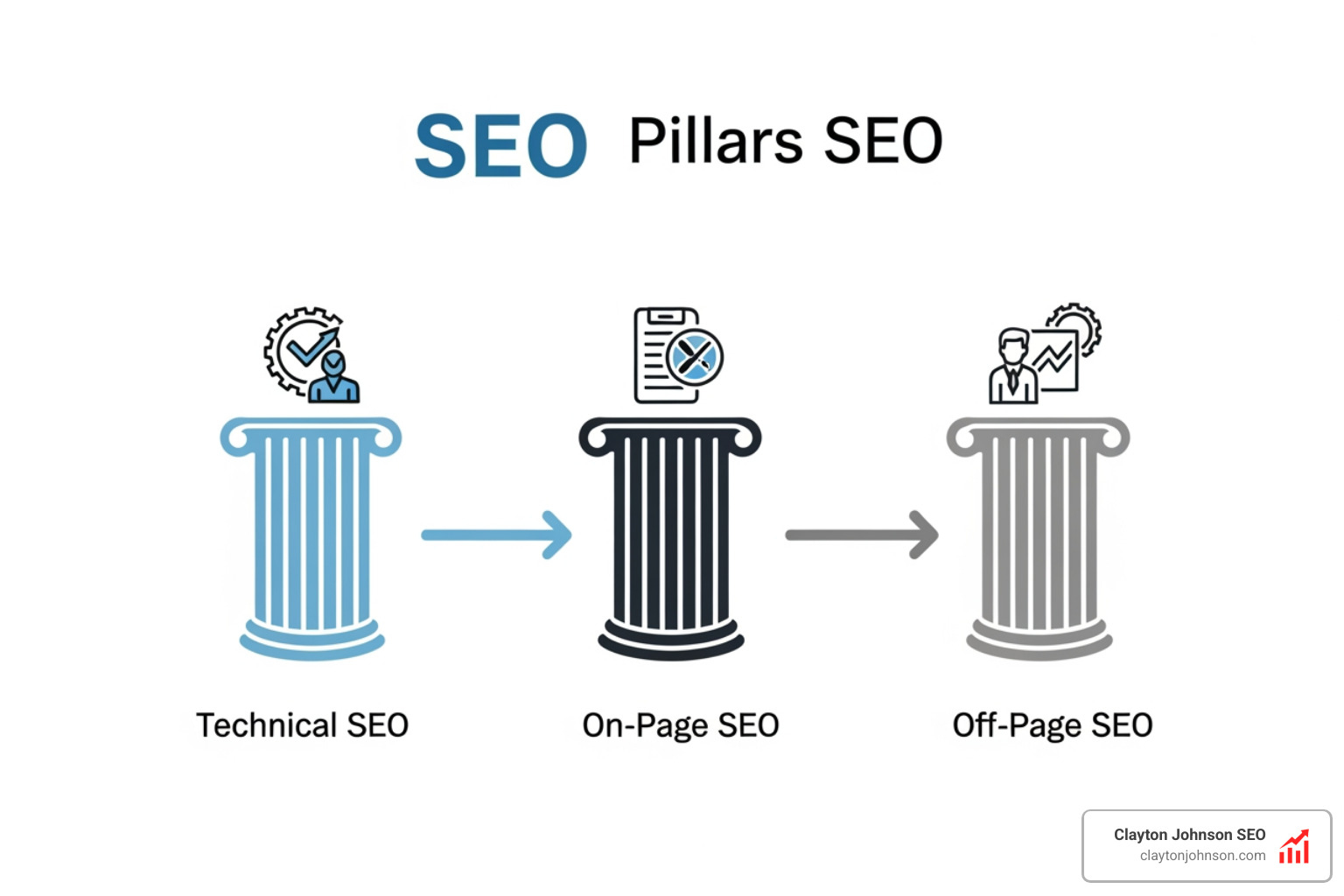
To build a strategy that doesn’t crumble with the next algorithm update, we have to understand the three fundamental pillars of search: Technical SEO, On-Page SEO, and Off-Page SEO. Think of these as the foundation, the framing, and the reputation of your digital house.
Before a user ever sees your content, search engines must perform three critical tasks:
- Crawling: Discovery bots follow links across the web to find your pages.
- Indexing: The search engine parses your content and stores it in a massive database.
- Ranking: Algorithms evaluate hundreds of signals to decide which page best answers a user’s query.
SEM vs SEO: The Long Game vs. The Quick Fix
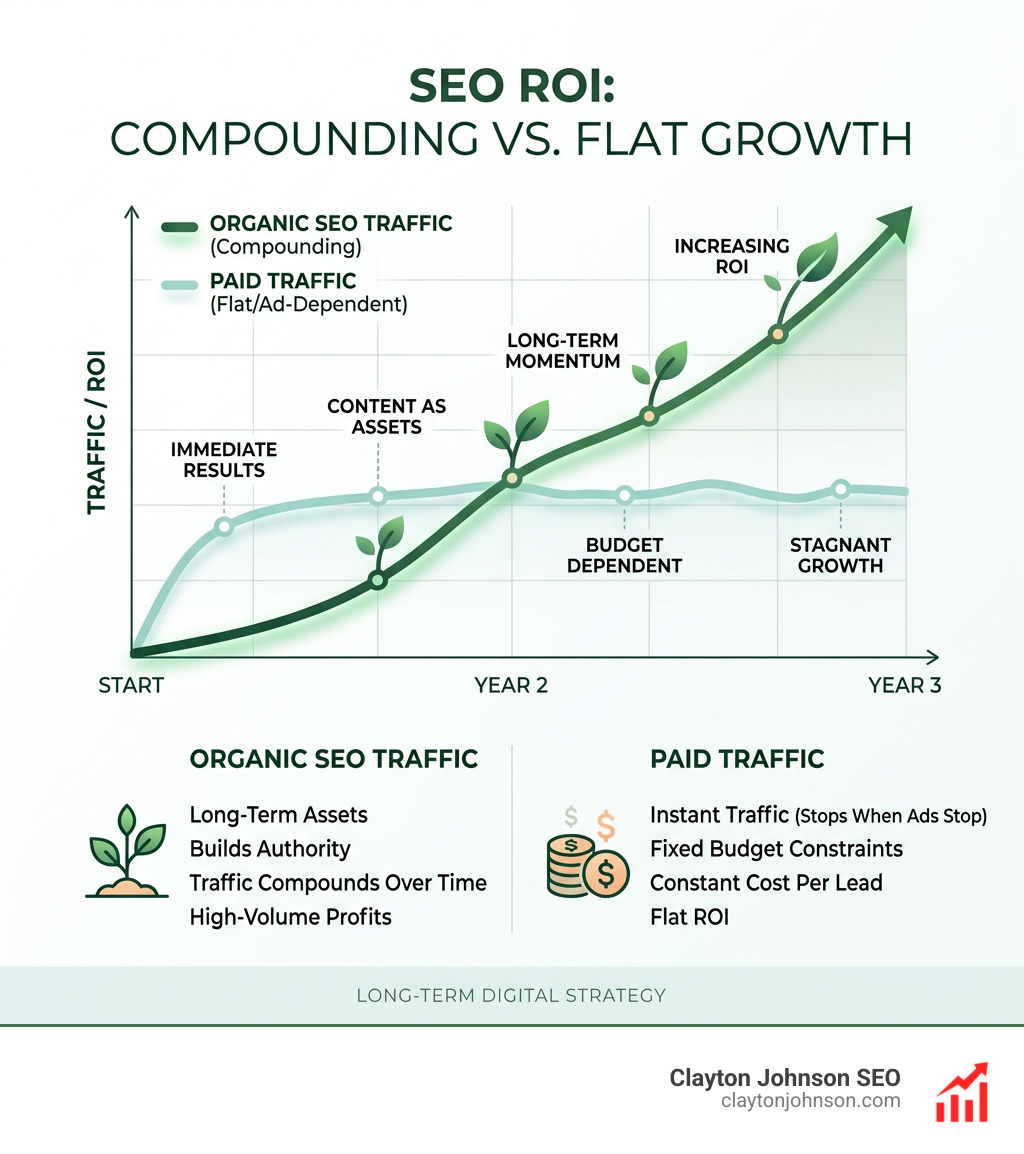
Many businesses confuse SEO with SEM (Search Engine Marketing). While they both aim for visibility, the mechanics are vastly different. SEM is often synonymous with PPC (Pay-Per-Click). It provides instant visibility but requires a continuous budget. SEO, conversely, is an investment in an asset you own.
| Feature | Organic SEO | Paid SEM (PPC) |
|---|---|---|
| Cost | High upfront effort, low long-term cost | Pay for every click |
| Speed | Takes months to build momentum | Instant results |
| Sustainability | Traffic continues if you stop working | Traffic stops when the budget ends |
| Trust | Users trust organic results more | Users often skip over “Ad” labels |
| ROI | Average of $22 earned per $1 spent | Average of $2 earned per $1 spent |
Google processes over 8.5 billion searches every day, and roughly 69% of clicks go to the first five organic results. If you aren’t playing the organic game, you’re missing out on the vast majority of the market.
Mastering On-Page SEO and Content Architecture
On-page SEO is where we tell search engines exactly what a page is about. Modern on-page optimization has moved far beyond “keyword stuffing.” Today, Google prioritizes E-E-A-T: Experience, Expertise, Authoritativeness, and Trustworthiness.
When we build a seo marketing strategy, we focus on content architecture. This means organizing your site into topic clusters—grouping related pages around a central “pillar” page. This signals to Google that you are an authority on a broad subject, not just a single keyword.
Key HTML elements we optimize include:
- Title Tags: These should be descriptive and under 60 characters.
- Meta Descriptions: While not a direct ranking factor, they act as “ad copy” to improve your click-through rate (CTR).
- Header Tags (H1-H3): These provide a logical structure for both users and crawlers.
- Internal Linking: We use descriptive anchor text to help Google find new pages and distribute “link equity” across your site.
Content freshness is also vital. Updating an old article with new data or insights can lead to a 70% boost in organic traffic. For those looking to scale this process, our SEO content marketing services help create high-quality, intent-driven assets that rank.
Building Authority with Off-Page seo marketing strategy
If on-page SEO is what you say about yourself, off-page SEO is what the world says about you. The primary currency here is the backlink. A link from a reputable, relevant website acts as a “vote of confidence” in your content.
However, not all links are created equal. We prioritize quality over quantity. One link from a major industry publication is worth more than a thousand links from low-quality directories. Our off-page seo marketing strategy focuses on:
- Digital PR: Earning mentions in the news or industry blogs.
- Expert Commentary: Providing quotes to journalists via platforms like HARO.
- Statistics Link Building: Creating original data or charts that others want to cite.
The results speak for themselves: high-quality SEO campaigns deliver an ~748% average ROI from SEO. By building domain authority, we make it easier for every future piece of content you publish to rank.
Technical Foundations and Core Web Vitals
You can have the best content in the world, but if your site takes ten seconds to load, no one will read it. Technical SEO ensures that your site is fast, secure, and easy for bots to crawl.
Google now uses Core Web Vitals as a ranking signal. These metrics measure:
- LCP (Largest Contentful Paint): How fast the main content loads.
- FID (First Input Delay): How quickly the site responds to a user’s first interaction.
- CLS (Cumulative Layout Shift): How stable the page layout is as it loads.
As page load time increases from one to three seconds, the probability of a bounce increases by 32%. We also ensure your site uses HTTPS security, has a clean XML sitemap, and is fully optimized for mobile devices, which now account for 58% of all searches. For a deep dive into your site’s health, consider our professional SEO services.

How to Build and Measure Your seo marketing strategy
Building a strategy is a science, not a guessing game. We start with first-party data and competitive intelligence to find the “revenue-generating” opportunities.
Step-by-Step Framework for Scalable Traffic
We don’t just “do SEO”—we build engines. This starts with a structured keyword strategy that aligns with the buyer’s journey.
- Phase 1: Seed Keywords: These are broad terms related to your industry (e.g., “wealth management”).
- Phase 2: Long-Tail Queries: These are specific, multi-word phrases (e.g., “best wealth manager for tech executives”). These often have lower volume but much higher conversion rates.
- Phase 3: Keyword Mapping: We assign each target keyword to a specific URL. This prevents “keyword cannibalization,” where multiple pages on your site compete for the same term.
- Phase 4: Content Planning: We prioritize content based on commercial intent. If a keyword is likely to lead to a sale, it goes to the top of the list.
By focusing on low-volume keywords for high-volume profits, we can capture niche markets that competitors have overlooked.
Integrating AI and LLM Optimization
Search is changing. With the rise of AI Overviews and Large Language Models (LLMs), users are getting answers directly on the search results page. A modern seo marketing strategy must account for “Generative Engine Optimization” (GEO).
AI tools like ChatGPT and Google’s Gemini rely on the web to generate responses. To ensure your brand is cited by these tools, we focus on:
- Clarity and Context: Writing in a way that is easy for LLM crawlers to parse.
- UVP (Unique Value Proposition): Clearly stating what makes your business unique so AI can distinguish you from competitors.
- Brand Knowledge Bases: Creating robust FAQ sections and documentation that serve as “training data” for search engines.
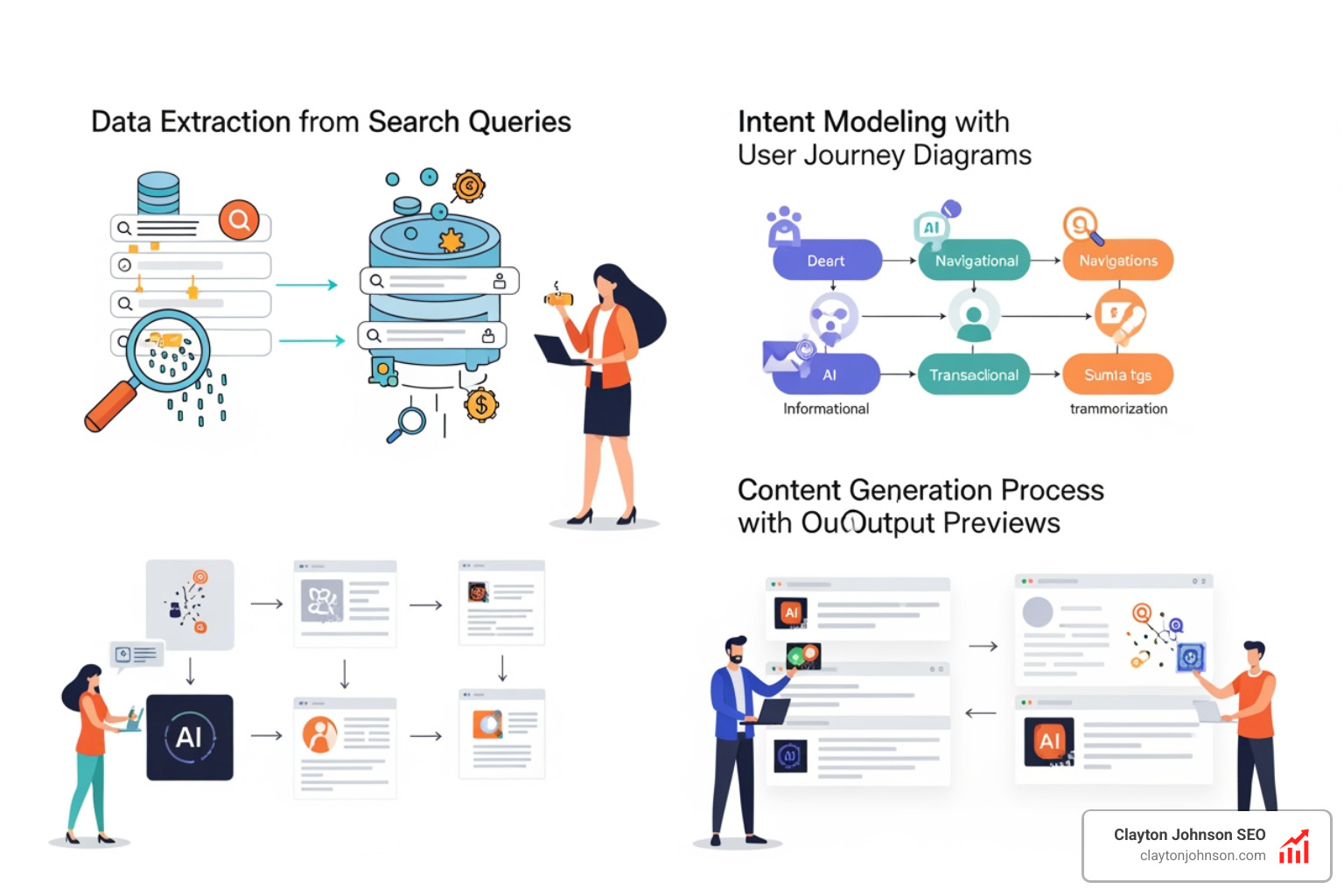
Our AI search optimization strategies help you stay visible in this new “answer engine” era. We use AI to augment our workflows—handling tasks like query extraction and content outlining—so we can focus on the high-level strategy that drives growth.
Executing a Data-Driven seo marketing strategy
The final piece of the puzzle is measurement. We don’t care about vanity metrics like “total keyword rankings.” We care about business impact.
We track:
- Organic Traffic: Are more people finding you through search?
- Conversion Rate: Are those visitors turning into leads or customers?
- Share of Voice: How often does your brand appear compared to your top five competitors?
- SEO ROI: For every dollar we spend, how much revenue is generated?
At Clayton Johnson SEO, we believe in compounding growth. Unlike paid ads, where the traffic stops when the money does, a well-executed SEO strategy builds momentum. Each piece of evergreen content you publish becomes an asset that generates traffic for years.
If you are ready to turn your website into a coherent growth engine, explore our AI SEO workflows or download our SEO template to get started.
Common SEO Misconceptions (and What to Do Instead)
Before we wrap up, let’s debunk a few myths that often derail a good seo marketing strategy.
- “SEO is a one-time task.” In reality, SEO is a continuous process. Algorithms change, competitors publish new content, and technical issues can arise. Regular SEO health checks are mandatory.
- “More content is always better.” Quality trumps quantity every time. One comprehensive, authoritative guide will always outrank five thin, 500-word blog posts.
- “Keywords are the only thing that matters.” Google’s Danny Sullivan has said that “Good SEO is good GEO.” This means focusing on user intent and helpfulness is just as important as including the right words.
- “Results should be immediate.” SEO is a marathon. While technical fixes can show impact in weeks, most strategies take three to six months to show significant revenue growth. Patience is the most underrated SEO skill.
By avoiding these traps and focusing on Clarity → Structure → Leverage, you can build a sustainable SEO strategy that survives any market shift.
Final Thoughts on SEO Marketing Success
A successful seo marketing strategy isn’t about gaming the system; it’s about providing the best possible answer to a user’s question. When you align your business goals with search intent, create a technically sound website, and build genuine authority, search engines have no choice but to rank you.
Whether you are a founder looking for a growth framework or a marketing manager needing to master core SEO, the steps are the same. Start with the data, build for the user, and optimize for the machine.
Are you ready to build a durable growth engine? Let’s get to work.