Top AI Content Audit Tools for Smarter Websites

Why AI Content Audit Tools Are Essential for Modern SEO
AI content audit tools are software platforms that use natural language processing, machine learning, and large language model (LLM) analysis to evaluate, score, and optimize your website content for both search engines and generative AI systems like ChatGPT, Perplexity, and Google AI Overviews.
Top AI content audit tools:
| Tool | Best For | Key AI Features |
|---|---|---|
| SurferSEO | On-page optimization | Content Score, NLP analysis, auto-optimization |
| MarketMuse | Strategic planning | Topical clusters, content gap detection, personalized difficulty |
| ContentKing | Real-time monitoring | Instant health scores, change tracking, alerts |
| Clearscope | Semantic depth | Entity-based optimization, semantic analysis |
| Otterly.ai | AI visibility | Citation tracking, LLM performance monitoring |
Content audits aren’t just about broken links and outdated blog posts anymore. In the current search landscape, if your content isn’t showing up in Large Language Model outputs, you have a visibility problem that traditional SEO tools can’t solve.
The shift is dramatic: 23% of top-traffic content doesn’t drive conversions, and AI overviews are answering questions before users ever visit your site. Meanwhile, only 12 to 15 pages out of hundreds typically drive the majority of your conversions.
AI content audit tools help you find which pages are performing, which are falling behind, and which are no longer worth keeping. They automate the discovery of every page, gather performance metrics, highlight topic gaps, and—most importantly—tell you how well your content performs in generative AI search results.
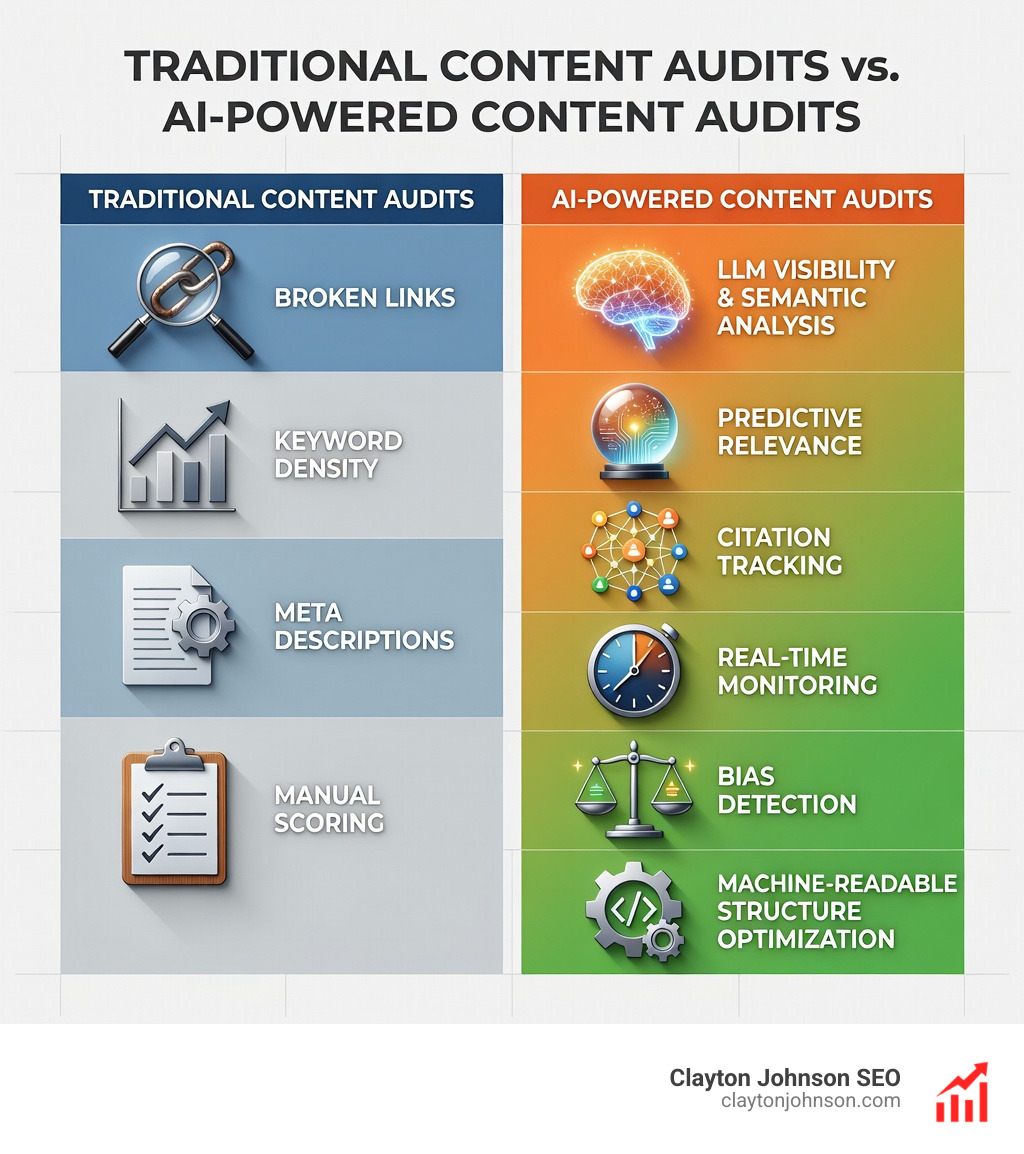
Unlike traditional tools that focus on technical crawling and keyword rankings, AI content audit tools evaluate predictive relevance, semantic clarity, citation potential, and machine-readable structure. They analyze over 500 web signals in real-time, score content for answerability in 200-400 token spans, and identify bias or trust signal gaps that might cause LLMs to skip your content entirely.
I’m Clayton Johnson, and I’ve spent years building scalable SEO systems and AI-augmented workflows that help marketing teams turn fragmented efforts into coherent growth engines—and AI content audit tools are now central to that process. In this guide, I’ll show you which tools deliver the most value, how to use them effectively, and what to look for based on your site size and goals.
Why Modern SEO Requires AI Content Audit Tools
The digital landscape has shifted from a “library” model to an “answer” model. Traditionally, search engines indexed your pages and users clicked through to find information. Today, Large Language Models (LLMs) and Google’s AI Overviews summarize your content directly on the results page. If your content isn’t structured to be “citable” by these models, you effectively disappear.
Modern AI content audit tools address this by moving beyond simple keyword matching. They focus on Generative Engine Optimization (GEO). This involves ensuring your content has a machine-readable structure that AI crawlers like GPTBot or Google-Extended can easily parse. Without these tools, you’re essentially flying blind, hoping the AI “picks” you.
We’ve seen that using AI competitive insights to outsmart your rivals is no longer optional; it’s the baseline for survival. These tools also help with bias detection—ensuring your content doesn’t contain patterns that might trigger safety filters in AI models, which could lead to your site being excluded from summaries.

Shifting from Keywords to Predictive Relevance
In the old days, we obsessed over keyword density. Now, we obsess over predictive relevance. AI models don’t just look for words; they look for entities and topical authority. An audit tool might tell you that while you rank for “best running shoes,” you lack the semantic depth regarding “midsole cushioning technology” or “pronation support” to be considered a true authority by an LLM.
Intent alignment is the new North Star. If a user asks a question, does your content provide a direct, extractable answer? Modern audits score your “entity hygiene”—how clearly you define the people, places, and things your brand is associated with—to ensure the AI understands exactly who you are and what you do.
The Rise of AI Citations and Retrieval
Getting a click is great, but getting a citation in ChatGPT or Perplexity is the new goal. AI citations act as high-value endorsements. If your site is cited, you gain trust and visibility in conversational search.
However, LLMs won’t send you a polite notification saying, “Sorry, your layout was too chaotic, so we skipped you.” You need tools that track these citations in real-time. By monitoring how often your content is retrieved to answer queries, you can adjust your strategy to become more “retrievable.” You can monitor your indexing and search performance trends using Google Search Console to see how traditional search traffic correlates with these new AI-driven shifts.
Top AI Content Audit Tools for Smarter Websites
Choosing the right tool depends on your specific needs—whether you’re a small Minneapolis-based startup or a massive enterprise handling thousands of SKUs. Below is a breakdown of how the top players stack up.
| Feature | SurferSEO | MarketMuse | ContentKing | Otterly.ai |
|---|---|---|---|---|
| Best For | On-page SEO | Strategic Gaps | Real-time Monitoring | AI/LLM Citations |
| Scalability | Medium | High | Very High | Medium |
| Pricing | From $59/mo | From $600/mo | Custom | Variable |
| Integrations | GSC, WordPress | GSC, GA4 | Slack, GA4 | LLM API |
When evaluating these, look for site size scalability and real-time monitoring capabilities. For example, Ahrefs provides an incredible foundation for identifying more than 170 technical and on-page SEO issues, which is the necessary first step before layering on advanced AI analysis.
SurferSEO: The Gold Standard for AI Content Audit Tools
SurferSEO has become a favorite because it simplifies complex NLP (Natural Language Processing) analysis into a single “Content Score.” It reverse-engineers the top-performing pages for any given keyword, analyzing over 500 web signals to tell you exactly what’s missing from your page.
One of its most powerful features is the Auto-optimize function. With a few clicks, it can suggest internal links and structural changes to help you match competitor benchmarks. For marketers looking to stay ahead, mastering these essential AI skills is key to making the most of Surfer’s automated suggestions.
MarketMuse: Strategic Inventory and Gap Detection
If Surfer is a tactical scalpel, MarketMuse is a strategic radar system. It excels at “inventory-level” audits. Instead of looking at one page, it looks at your entire domain to identify “topical clusters.”
It might show you that you have 50 articles on “SEO,” but none of them cover “AI content audits” deeply enough, creating a gap that competitors are exploiting. Its “Personalized Difficulty” score is a game-changer—it tells you how hard it will be for your specific site to rank for a topic based on your existing authority, not just a generic industry average.
Specialized AI Content Audit Tools for LLM Visibility
As we move deeper into the age of AI search, specialized tools are emerging to track brand presence within LLMs:
- Otterly.ai: This tool specifically tracks how brands appear in answers generated by ChatGPT, Gemini, and Perplexity. It monitors mentions and context, giving you a clear view of your AI “share of voice.”
- Rankscale: Focuses on which citations and entities drive AI-generated answers, showing you who else is being cited alongside you.
- Brandwell.ai: Features “AI Traffic Analytics” that monitor visits from AI crawlers like GPTBot. This helps you understand which parts of your site the AI finds most valuable.
These tools complement a comprehensive site audit from Semrush, which covers technical health, Core Web Vitals, and internal linking—the “bones” that support your AI visibility.
Enterprise Solutions for High-Volume Audits
For websites with hundreds of thousands of pages, you need high-speed crawlers and real-time health scores.
- Lumar (formerly Deepcrawl): An enterprise-level platform that can process massive URL counts while providing modules for accessibility and AI search visibility.
- ContentKing: This is the only tool that offers “always-on” monitoring. If a developer accidentally deletes your schema markup or a page starts returning a 404 error, ContentKing alerts you in seconds via Slack.
- JetOctopus: A cloud-based crawler that combines fast crawling with log file analysis, helping you see exactly how search engine bots (and AI bots) are interacting with your site.
How to Conduct an AI-Powered Content Audit
Conducting an audit isn’t a “one and done” task; it’s a cycle. We recommend a quarterly approach to keep up with evolving LLM behaviors.

Step 1: Inventory and Performance Mapping
First, you need to know what you have. Use tools like Screaming Frog to crawl up to 500 URLs for free (or more with a license) to gather titles, meta descriptions, and response codes.
Next, integrate your performance data. Connect your audit tool to GA4 and GSC. We often use reverse conversion path tracking to see which pages actually lead to a sale. You might find that a high-traffic blog post about “AI trends” doesn’t drive any leads, while a low-traffic page about “Minneapolis SEO services” is your biggest revenue generator. For help setting this up, check out our analytics and data services.
Step 2: Semantic and Structural Analysis
Once you have your list, it’s time to get technical with AI.
- Schema Markup: Ensure your pages use JSON-LD schema so AI models can identify your brand, products, and FAQs without guesswork.
- Chunking: LLMs process information in “tokens.” Structure your content into clear, 200–400 word sections with descriptive H2 and H3 headers. This makes it easier for an AI to “clip” your content for a summary.
- Bias Mitigation: Use AI scanners to ensure your content is objective and authoritative. If your content sounds too much like a “sales pitch,” AI models may flag it as low-quality or biased and exclude it from citations.
Step 3: Execution and Human-in-the-Loop Refinement
AI can identify the problems, but humans need to fix them. We use AI prompts to accelerate the rewriting process—for example, asking an LLM to “rewrite this section to be more concise and answer-oriented while maintaining our brand voice.”
The goal is to move assets into one of four categories:
- Keep: High performance, high relevance.
- Improve: High potential, but needs better semantic depth or structural fixes.
- Merge: Two or more pages competing for the same intent (cannibalization).
- Remove: Outdated, thin, or irrelevant content that is “bloating” your site.
Frequently Asked Questions
How do AI content audit tools differ from traditional tools?
Traditional tools focus on technical “plumbing”—broken links, duplicate tags, and page speed. While these are still vital, AI content audit tools focus on the “intelligence” of the content. They analyze meaning, topical depth, and how likely a machine is to understand and cite the information. They operate at a much higher speed for pattern detection and can “read” content like a human would, identifying tone and intent.
Can AI tools identify content that drives conversions?
Yes, especially when integrated with your CRM and analytics. By using reverse conversion path tracking, AI tools can identify that only 12-15 pages on your site are responsible for the majority of your leads. They can then find “gaps” in your content funnel—identifying where a user might be dropping off and suggesting high-intent topics to bridge that gap.
How often should you run an AI content audit?
We recommend a full strategic audit quarterly. However, for large or high-growth sites, real-time monitoring (using a tool like ContentKing) is essential. Because LLM training data and Google’s AI algorithms update frequently, a page that was “AI-ready” three months ago might need a refresh today to maintain its citation status.
Conclusion
The era of “set it and forget it” content is over. To stay visible in a world dominated by generative AI, you must treat your website like a living investment portfolio. AI content audit tools provide the data and automation needed to rebalance that portfolio, ensuring every page serves a purpose—whether it’s ranking in Google or being cited by ChatGPT.
At Clayton Johnson SEO, we specialize in building these advanced content systems and growth strategies. We help founders and marketing leaders in Minneapolis, Minnesota, and beyond diagnose their growth bottlenecks and execute workflows that deliver measurable results.
Don’t let your content get buried by the AI revolution. If you’re ready to transform your website into a high-performing, AI-ready asset, get expert SEO services in Minneapolis and let’s start auditing for the future.