Unlocking the Power of OpenAI: Top Use Cases and Case Studies


Why OpenAI Use Cases Matter for Business Growth
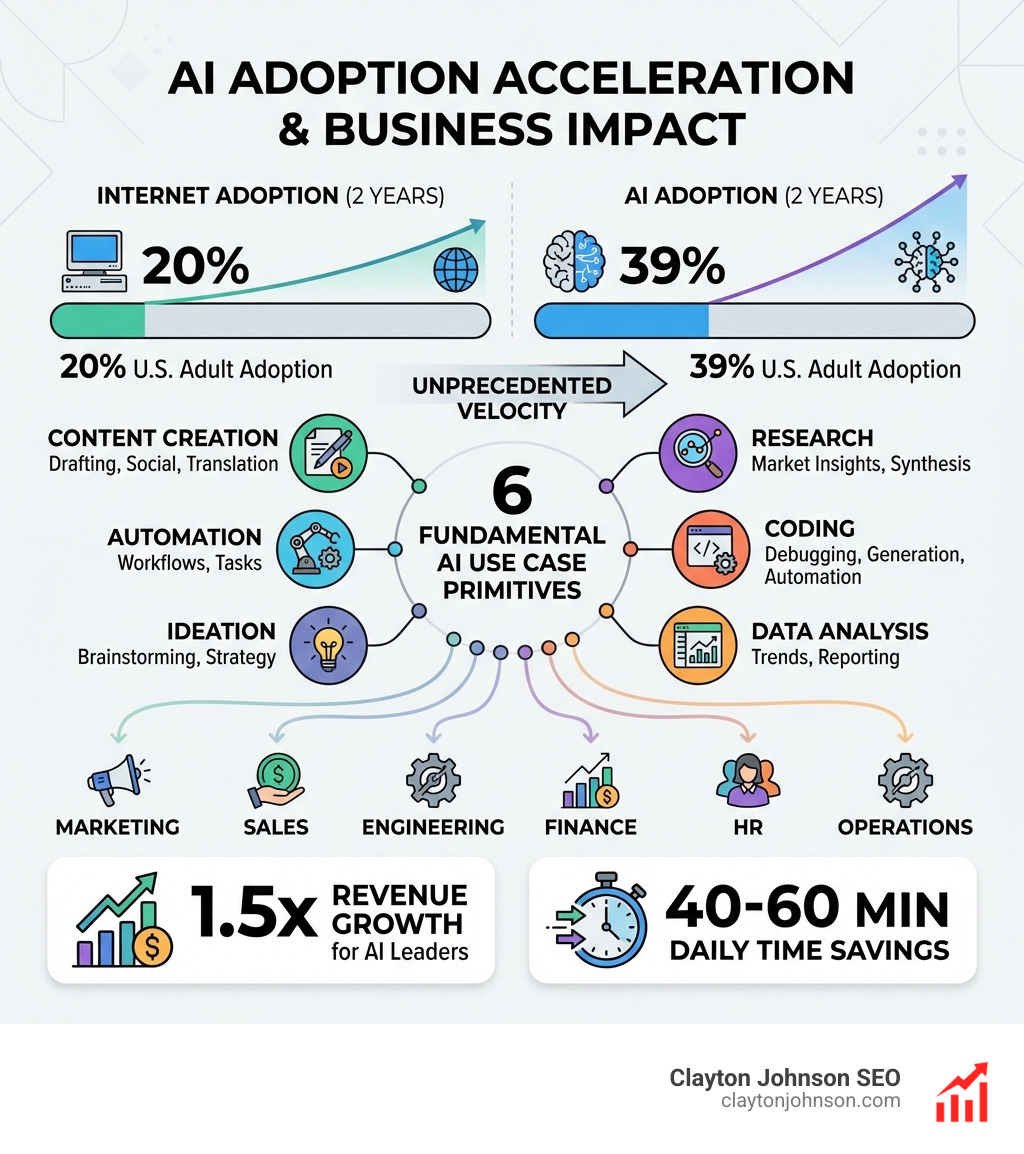
OpenAI use cases are reshaping how businesses operate, with ChatGPT alone reaching 700 million weekly active users and organizations reporting measurable productivity gains of 40-60 minutes per day. The adoption curve is unprecedented—39% of U.S. adults have used AI in just two years, compared to only 20% for the internet in the same timeframe.
Top OpenAI use cases businesses implement today:
- Content creation – Drafting emails, blog posts, social media content, and translations
- Research and analysis – Real-time market insights, competitive intelligence, data synthesis
- Coding assistance – Debugging, code generation, and automation for technical and non-technical teams
- Data analysis – Spreadsheet reconciliation, trend identification, performance reporting
- Process automation – Customer service chatbots, workflow optimization, routine task handling
- Strategic ideation – Brainstorming, scenario planning, decision support
The business impact is measurable. AI leaders see 1.5x faster revenue growth, 1.6x higher shareholder returns, and 1.4x better return on invested capital than their competitors. Companies like Promega saved 135 hours in their first six months using ChatGPT Enterprise for email campaigns alone.
Yet 92% of companies plan to increase AI investment while only 1% believe they’ve reached full maturity—revealing a massive opportunity gap between early experimentation and scaled implementation.
I’m Clayton Johnson, and I’ve spent years building AI-assisted marketing systems and growth frameworks that help businesses translate strategic capabilities into measurable outcomes. Through my work with OpenAI use cases, I’ve seen how the right implementation framework separates productivity gains from transformational business impact.
The Core OpenAI Products and Business Applications
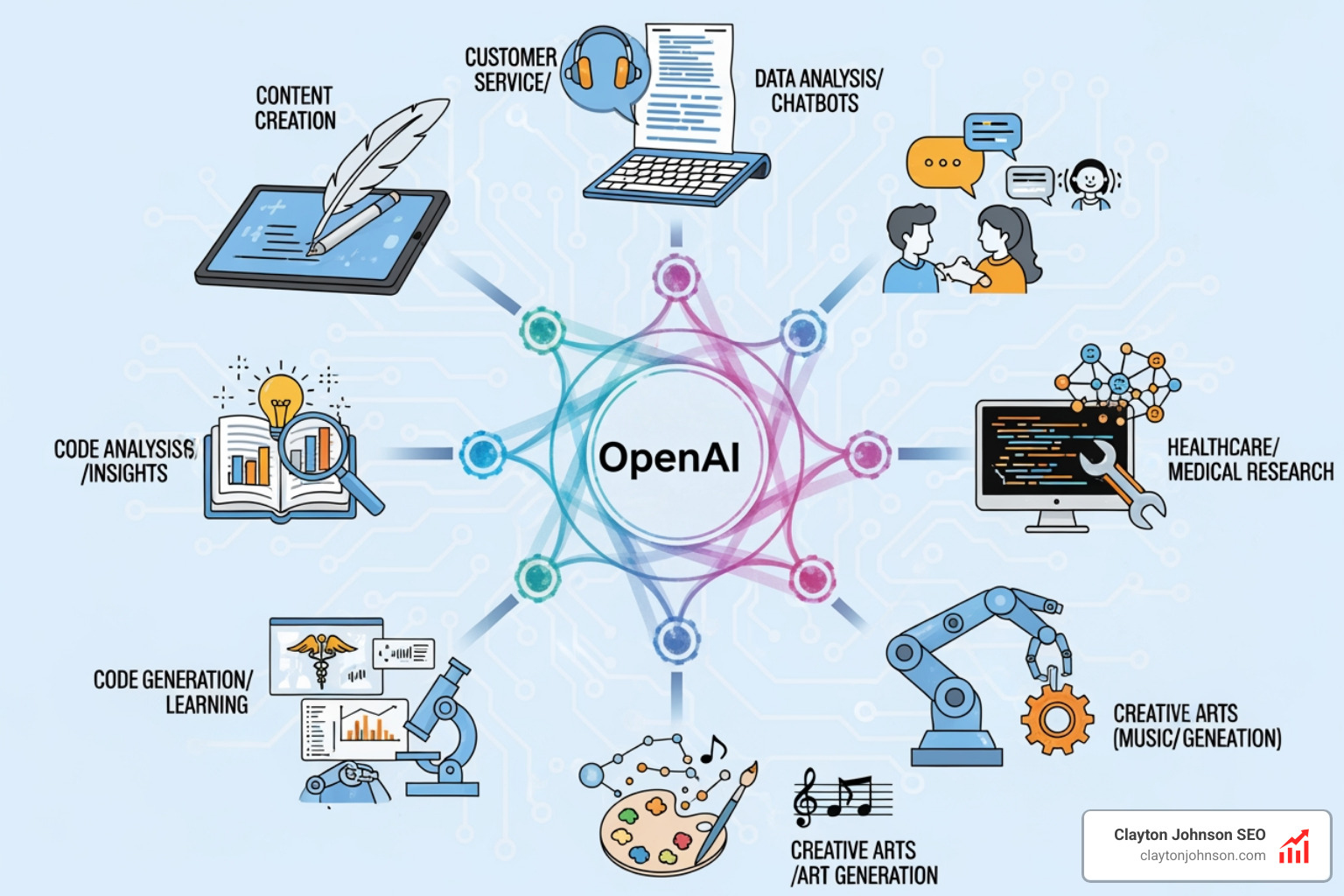
To understand the full scope of openai use cases, we first need to look at the tools in the shed. OpenAI doesn’t just offer a chatbot; it provides a suite of models designed for different cognitive tasks.
- ChatGPT Enterprise: This is the “pro” version of the famous chatbot, offering enterprise-grade security, privacy, and higher speed. It’s where most employees start their AI journey.
- DALL-E 3: The visual engine. Dall-E produces four images in roughly 40 seconds for each prompt, allowing marketing teams to create thumbnails and social assets instantly.
- Codex/GPT-4o for Coding: These models power the ability to turn natural language into functional code, effectively filling the tech talent gap.
- OpenAI API: The “engine” that allows you to plug AI directly into your own software, mobile apps, or internal databases.
- Azure OpenAI: For enterprises already settled in the Microsoft ecosystem, this offers OpenAI models with the added security and compliance of the Azure cloud.
Ready-to-Use vs. Custom API Solutions
We often help clients decide between using “off-the-shelf” products or building custom integrations. Here is how they stack up:
| Feature | ChatGPT (Off-the-Shelf) | OpenAI API (Custom Integration) |
|---|---|---|
| Ease of Use | Instant; no technical skills needed. | Requires developer expertise. |
| Customization | Limited to Custom GPTs and instructions. | Fully customizable to your specific data. |
| Scalability | Manual interaction per user. | Can handle millions of automated requests. |
| Primary Use | Daily productivity and research. | Building custom chatbots or app features. |
Six Fundamental OpenAI Use Cases for Every Department
When we look at over 600 successful implementations, we see that most openai use cases fall into six “primitives.” These are the building blocks of an AI growth strategy that scales.
- Content Creation: Moving from a blank page to a finished draft in seconds.
- Research: Digging through mountains of data to find the “needle” of insight.
- Coding: Writing, debugging, and documenting software.
- Data Analysis: Turning messy spreadsheets into clear visualizations and trends.
- Ideation/Strategy: Using the AI as a sounding board for new product ideas or marketing angles.
- Automation: Connecting tasks together to remove manual effort.
Streamlining Research with OpenAI Use Cases
Gone are the days when ChatGPT’s knowledge ended with events in 2021. Today, the models have real-time internet access. We use this for:
- Market Insights: Quickly summarizing the latest news in a specific niche.
- Competitive Intelligence: Analyzing competitor websites to spot gaps in their offerings.
- Internal Knowledge Bases: Uploading hundreds of PDFs to a Custom GPT so employees can “ask” the company handbook questions.
Content Drafting and Translation
Writing a single blog post takes at least two hours for 78% of writers, and some spend upwards of five. Generative AI can create a full-length draft in mere minutes.
We don’t recommend publishing AI content “raw.” However, using it to draft the first version, create social media snippets, and translate that content for global teams is a massive win. In fact, adoption in lower-income countries is growing 4x faster than in high-income ones, largely because AI bridges the language and communication gap.
Custom OpenAI API Use Cases for Advanced Operations
While ChatGPT is great for individuals, the API is where the magic happens for operations. By integrating the API, businesses can automate complex logic that was previously impossible.
- Sentiment Analysis: Automatically scanning thousands of customer reviews to see if the general mood is shifting.
- Personalized Marketing: Since 71% of consumers today expect personalized interactions, we use the API to generate custom email copy based on a user’s specific past behavior.
- Supply Chain Analytics: Predicting delays by analyzing unstructured data from shipping reports and news feeds.
Custom Chatbots and Process Automation
We often see businesses struggle with “support ticket bloat.” A custom-built chatbot using the OpenAI API can handle complex, multi-step queries 24/7. Unlike old-school bots that rely on rigid “if/then” logic, these bots understand intent. You can even extend these bots with custom agent skills to let them check order statuses or process returns directly.
Real-World Impact: Case Studies from Industry Leaders
It’s one thing to talk about potential; it’s another to see the results. Here is how some of the world’s most innovative companies are using openai use cases to win.
- Promega: This life sciences company saved 135 hours in just six months by using AI to draft email campaigns and translate copy for global markets.
- Tinder: Their engineering team uses AI to handle “chore” tasks in Jira that used to get deprioritized. By using AI to generate first-draft syntax for non-intuitive languages like Bash, they ship faster.
- Poshmark: The finance team used AI to generate Python code that reconciles millions of spreadsheet rows, turning a manual nightmare into a streamlined report.
- BBVA: The bank automated parts of their credit analysis by using a Custom GPT to pull unstructured data from press releases and financial reports.
To stay competitive, you can also start using AI competitive insights to see exactly how your rivals might be implementing these same tools.
Measuring Success in OpenAI Use Cases
How do you know if it’s working? BCG found that AI leaders see 1.5x faster revenue growth. We typically look at:
- Time Saved: Are employees getting 40-60 minutes back in their day?
- Output Quality: Is the work produced higher quality (Harvard studies suggest a 40% improvement)?
- Cost Reduction: Are we resolving more customer queries without increasing headcount?
How to Identify and Scale AI Implementation
Most companies fail because they try to do everything at once. We recommend a structured three-step process identifying and scaling AI use cases:
- Identify Opportunities: Ask your team to list tasks that are repetitive, manual, or where they feel “stuck.”
- Use the Impact/Effort Matrix: Map these ideas. Focus on “Quick Wins”—tasks that have a high impact but require low effort (like drafting a weekly newsletter).
- Workflow Mapping: Don’t just look at tasks; look at the whole process. How can AI assist from the initial research phase all the way to final reporting?
Key Considerations for Business Integration
Before you go all-in, keep these guardrails in mind:
- Cybersecurity: Ensure you are using Enterprise versions of tools so your data isn’t used to train public models.
- Data Privacy: Never put PII (Personally Identifiable Information) into a public AI prompt.
- Bias Mitigation: AI can mirror the biases in its training data. Always have a human expert review the final output.
- Human-AI Collaboration: The goal is to augment your team, not replace them. AI handles the “doing,” while your team handles the “thinking” and “supervising.”
Frequently Asked Questions about OpenAI Use Cases
What are the best OpenAI use cases for small businesses?
Small businesses often see the most ROI in content marketing (drafting blogs and social posts) and customer service (using Custom GPTs to answer common customer questions). It allows a small team to “punch above their weight.”
How does Azure OpenAI differ from standard OpenAI products?
Azure OpenAI provides the same models (like GPT-4) but hosts them on Microsoft’s infrastructure. This is ideal for businesses in Minneapolis and beyond that need specific compliance certifications or want to keep their AI data within their existing cloud environment.
What are the primary security risks when implementing OpenAI?
The biggest risk is “data leakage”—employees putting sensitive company data into the free version of ChatGPT. Moving to an Enterprise plan or using the API ensures your data remains private and is not used for training.
Conclusion
The era of “experimenting” with AI is over. The data shows that the gap between AI leaders and laggards is widening every day. Whether you are streamlining your research, automating your customer support, or scaling your content production, the right openai use cases can provide a durable engine for growth.
At Clayton Johnson SEO, we specialize in building the systems and SEO content marketing services that turn AI potential into measurable revenue. If you’re ready to move beyond the hype and start executing a practical AI-assisted workflow, we’re here to help you navigate the journey.