Why Your Business Needs a Growth System to Survive


Why Most Businesses Stay Stuck — And What Growth Systems Actually Fix
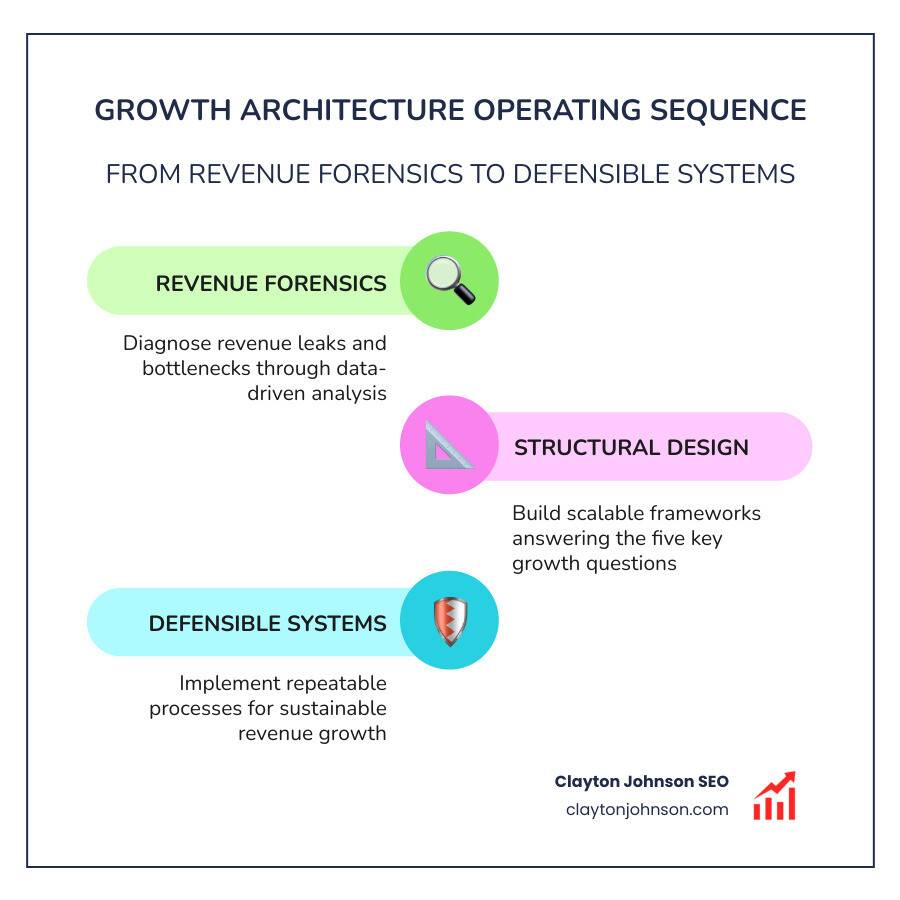
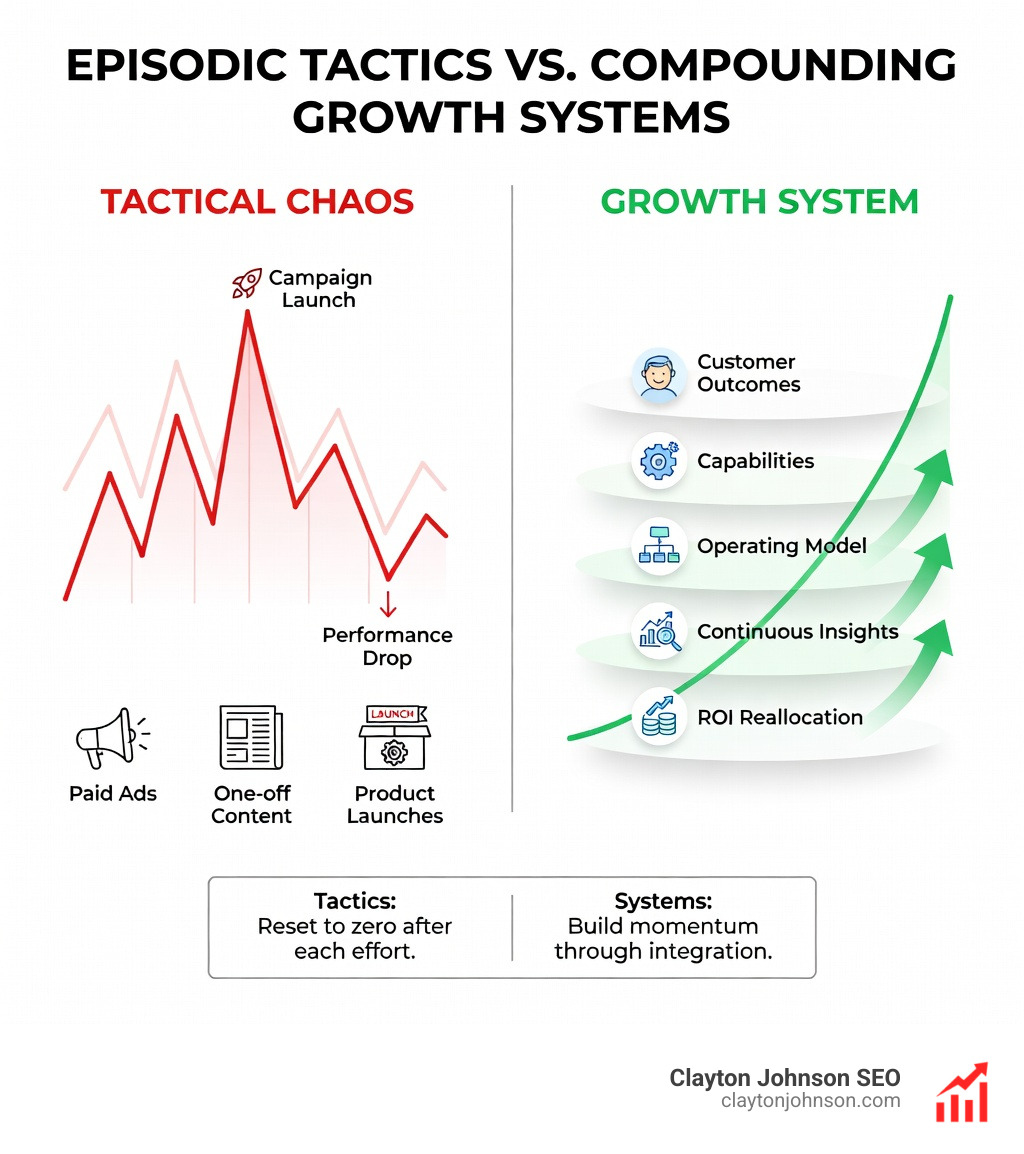
Growth Systems are structured, repeatable frameworks that integrate marketing, sales, operations, and product development into a single compounding engine — instead of running disconnected campaigns that spike and fade.
Here’s the fast answer if you need it:
What is a Growth System?
| Element | Description |
|---|---|
| Definition | An integrated set of capabilities driving short- and long-term business growth |
| Goal | Compounding, predictable revenue — not one-off campaign wins |
| Core components | Customer outcomes, capabilities blueprint, operating model, continuous insights, ROI reallocation |
| Who needs it | Founders and marketing leaders stuck in tactical chaos |
| Key benefit | Growth champions earn 4.2x revenue valuation vs 1.7x for lower-quartile peers |
Most founders hit the same wall. 🧱
Traffic exists but doesn’t convert. Content gets published but doesn’t compound. SEO is reactive. The team is busy — but growth feels random.
The problem isn’t effort. It’s architecture.
Businesses running on disconnected tactics are essentially on a treadmill — working harder to stay in place. Research across 2,142 public companies confirms this: only the companies that built integrated growth systems — not just ran campaigns — consistently outperformed peers on valuation, shareholder returns, and EBITDA.
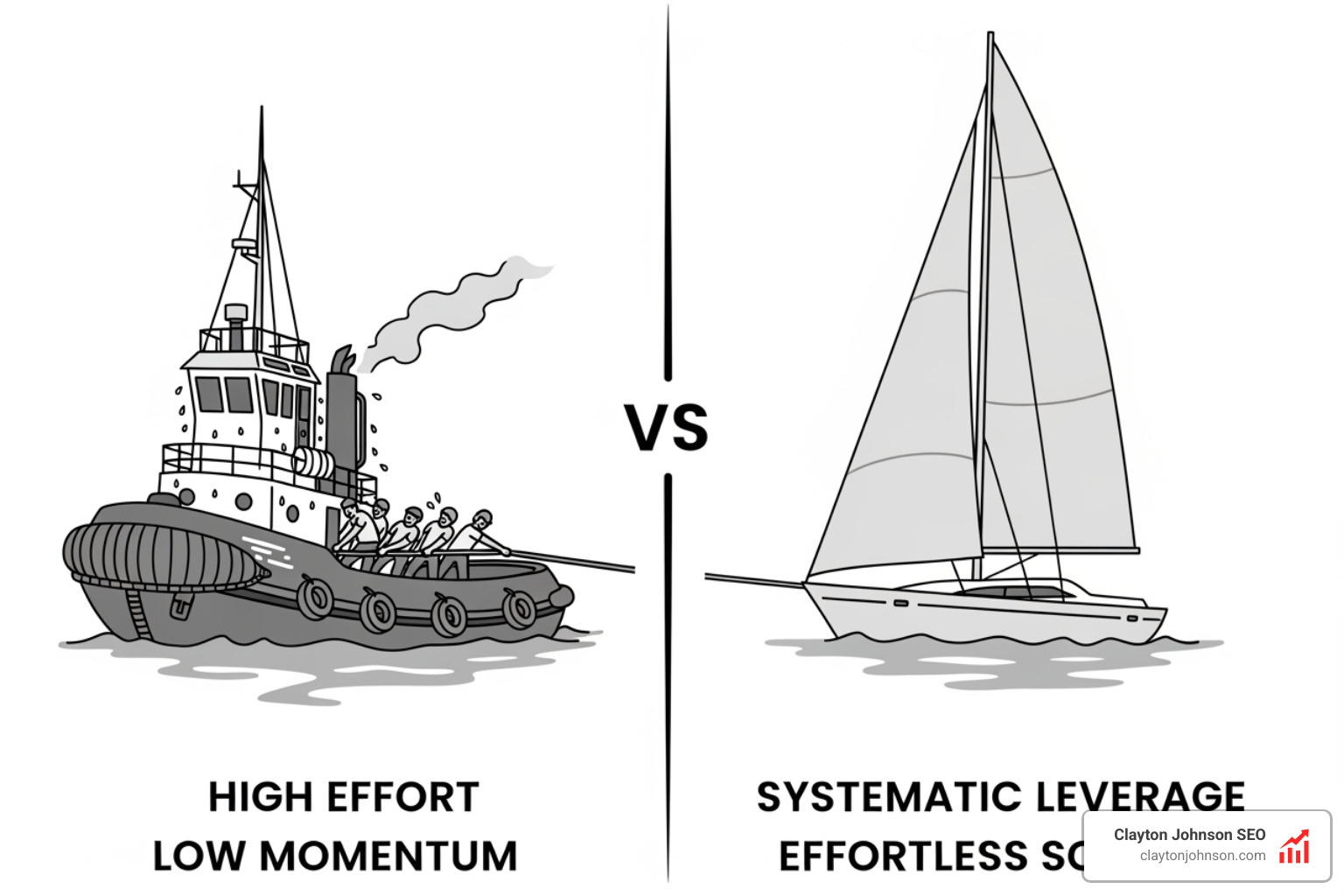
The difference between a “Smooth Sailer” company (one that scales with momentum) and a “Tugboat” company (one that grinds for every inch) almost always comes down to systems, not effort.
This guide breaks down exactly what a growth system is, how to build one, and what measurable results you can expect when you do.
I’m Clayton Johnson — an SEO strategist and growth operator who specializes in building structured Growth Systems that turn fragmented marketing into compounding revenue infrastructure. My work sits at the intersection of technical SEO, AI-assisted workflows, and strategic frameworks built for founders at the $500K–$20M ARR stage. Let’s get into it.
Defining Growth Systems: More Than Just Marketing Tactics
When we talk about Growth Systems, we aren’t talking about a “cool new hack” for your LinkedIn ads. We are talking about systems thinking applied to revenue.
A growth system is a structured methodology that views your business activities—marketing, sales, product, and customer success—as interconnected parts of a larger whole. Unlike traditional marketing which focuses on isolated “campaigns,” a system emphasizes how each activity influences and supports the others. This creates what we call “operational harmony.”
According to research, “Growth Champions”—those who consistently perform in the top half of their industry—earn an average valuation of 4.2 times revenue. Compare that to the 1.7x valuation for lower-quartile companies that rely on sporadic tactics. The difference is the Growth Systems they have in place.
The Pitfalls of the Product Death Cycle
Many founders fall into the “Product Death Cycle.” This happens when you believe the answer to slowing growth is simply to “build a more featured product.”
You build a feature, it doesn’t move the needle, so you build another. This Product Death Cycle is a result of a solution-first bias. You are chasing features rather than architecting a system that connects your product to a viable market and a scalable channel. Creating a system to grow consistently requires moving away from feature-chasing and toward infrastructure-building.
Why Growth Systems Outperform Episodic Campaigns
Episodic campaigns are like a sugar high. You get a spike in traffic, but when the budget stops, the growth stops. Growth Systems are different because they focus on asset building.
- Predictable Pipeline: Systems use automation and repeatable processes to ensure leads don’t just “happen”—they are manufactured.
- Lower CAC: By integrating Demand Generation, you create a “flywheel” effect where your existing authority lowers the cost of acquiring the next customer.
- Market Share Dominance: Companies that master their growth rules are 1.7 times more likely to generate peer-beating shareholder returns.
| Feature | Short-Term Campaigns | Long-Term Growth Systems |
|---|---|---|
| Focus | Immediate ROI / Clicks | Compounding Equity / Enterprise Value |
| Execution | Manual / Episodic | Automated / Continuous |
| Knowledge | Siloed in “Hacks” | Institutionalized in Frameworks |
| Outcome | Temporary Spikes | Predictable Scaling |
The Core Components of a Scalable Growth Architecture
To move from a “Tugboat” to a “Smooth Sailer,” you need a blueprint. A high-performing growth architecture consists of five interconnected components that prevent silos and ensure every dollar spent builds toward a Product Market Fit that lasts.
- Define a Compelling Customer Outcome: You aren’t selling a product; you’re selling a transformation.
- Architect the Right Capabilities: What specific “muscles” does your company need? (e.g., SEO authority, programmatic M&A, or high-velocity sales).
- Create the Right Operating Model: This is how your team actually works together—breaking down silos between marketing and product.
- Renew Insights Continuously: Embedding feedback loops so you aren’t guessing what the market wants.
- Measure Return and Reallocate Investment: Systematically moving budget from what’s “okay” to what’s “explosive.”
The Four Fits: A Growth Systems Framework for Scaling
One of the biggest mistakes in business is thinking that Product Market Fit isn’t the only thing that matters. In reality, there are four fits that must align for effortless growth:
- Market-Product Fit: Does your product solve a specific, high-value problem for a specific category?
- Product-Channel Fit: You don’t “pick” channels; your product dictates them. For example, a low-ARPU (Average Revenue Per User) product cannot survive on high-touch enterprise sales.
- Channel-Model Fit: Your business model (pricing) must align with how you acquire customers.
- Model-Market Fit: Is the market big enough to support your revenue goals based on your pricing? This is essential for Brand Growth.
Building the Infrastructure for Sustainable Growth
A system is only as good as the tools that run it. Modern Growth Systems rely on:
- AI Automation: Reclaiming 150+ hours annually per leader by automating repetitive marketing and administrative tasks.
- CRM Integration: Ensuring Traffic Generation data flows directly into sales workflows without manual entry.
- Cross-functional Teams: Moving away from “Marketing vs. Sales” and toward “Revenue Engineering.”
Implementing a Growth System: A Step-by-Step Roadmap
Building a system isn’t an overnight task—it’s a multi-year journey. It requires a cultural mindset shift from the CEO down. You have to stop asking “How do we get more leads today?” and start asking “How do we build a lead-generation machine?”

Step 1: Defining Differentiated Customer Outcomes
The foundation of every great system is a “problem-first” approach. This concept, originally coined by David Bland, forces you to validate the market’s pain before you ever touch a line of code or a marketing deck.
- What is the specific category you want to own?
- What is the “hook” that provides immediate value?
- How does the user experience “Time to Value” in the first 5 minutes?
Step 2: Architecting Core Capabilities and Operating Models
Once you know the outcome, you need the engine. This involves using Strategic Frameworks to map out your “Blueprints.”
If your growth comes from SEO, your capability isn’t just “writing blogs”—it’s a “Taxonomy-driven SEO system.” If your growth comes from M&A, it’s a “Programmatic M&A engine.” Breaking silos is key; your product team should be just as invested in acquisition as your marketing team.
Step 3: Measuring and Optimizing Your Growth Systems
You cannot manage what you do not measure. But we aren’t just looking at “likes” or “shares.” We are looking at Financial Metrics that drive enterprise value:
- EBITDA Growth: Are we becoming more profitable as we scale?
- Valuation Multiples: Are we building a “Growth Champion” valuation (4.2x) or a “Laggard” valuation (1.7x)?
- Reclaimed Founder Time: Is the system freeing you from the “daily grind” so you can lead with clarity?
Industry-Specific Applications and Real-World Impact
Growth Systems aren’t just for Silicon Valley startups. They are transforming traditional industries by replacing “gut feel” with data-driven infrastructure.
Growth Systems in Manufacturing and Service Sectors
In manufacturing, the impact is often immediate. Companies implementing these systems have seen an average 47% EBITDA increase in the initial phase. By using the Business Model Canvas to identify inefficiencies, manufacturers can reclaim over 150 hours annually for their leadership teams.
A common “quick win” here is the installation of scalable bookkeeping and daily/weekly metrics. Instead of waiting 45 days for a financial report, founders use proactive metrics to “pull levers” before issues escalate. This often leads to a 2.3x average valuation growth over a multi-year period.
Scaling B2B SaaS and Agencies with Predictable Pipelines
For SaaS and agencies, growth is a power-law game. Usually, 70% of total growth comes from one dominant channel. A growth system helps you identify that channel and build a “Fractional Growth Engine” around it.
This includes:
- SDR Systems: Automated outbound that feels personal.
- Conversion Optimization: Using Conversion Optimization to ensure that a 1% lift in conversion compounds into a 20% lift in ARR.
- Category Leadership: Moving away from being a “commodity” and toward owning a specific market niche. Implementing a growth system is about making scaling feel “smooth” rather than forced.
Frequently Asked Questions about Growth Systems
What is the difference between a growth tactic and a growth system?
A tactic is a single action, like “running a Google Ad.” A system is the entire infrastructure that makes that ad work: the landing page, the automated email follow-up, the CRM integration, and the data feedback loop that tells you if the ad was actually profitable. Tactics are episodic; systems are continuous.
How long does it take to see results from a growth system?
While “quick wins” (like 20% margin improvements) can happen in the first 90 days, a full growth system typically takes 12 to 24 months to fully mature. This is because you are building infrastructure, not just turning on a faucet. However, the result is a 2.3x average valuation growth over a multi-year period.
Can small businesses implement growth systems without a large budget?
Absolutely. In fact, small businesses need systems more than large ones because they have fewer resources to waste. You can start by automating one core process—like lead follow-up or customer onboarding—and then use the time you reclaim to build the next part of the system.
Conclusion
The data is clear: the era of “growth at any cost” via random tactics is over. Today’s “Growth Champions” are those who invest in structured growth architecture. These companies don’t just grow; they scale with compounding leverage, earning valuation premiums that are 4.2 times higher than their competitors.
At Clayton Johnson, we are building Demandflow.ai to solve the one core problem most founders face: they don’t lack tactics; they lack a structured growth operating system.
By combining actionable strategic frameworks, AI-augmented workflows, and measurable growth modeling, we provide the infrastructure you need to move from tactical chaos to predictable scaling. If you’re tired of the “Tugboat” grind, it’s time to install a Growth System that works for you.
Ready to move from tactical chaos to structured growth?
Free Health Assessment