Organic vs Paid Social Media: The Ultimate Balancing Act

Why Every Paid Social Campaign Needs an Organic Foundation
An organic social media marketing strategy is the system you use to grow your brand on social platforms without paying for distribution — relying instead on content quality, community engagement, and platform algorithms to earn reach.
Here is what a strong organic-plus-paid hybrid strategy looks like:
| Element | Organic Social | Paid Social |
|---|---|---|
| Primary goal | Build trust, community, loyalty | Drive reach, conversions, scale |
| Cost | Time and content investment | Ad spend |
| Speed | Slower, compounding | Fast, immediate |
| Sustainability | Long-term asset | Stops when budget stops |
| Best used for | Brand credibility, relationships | Amplification, targeting |
The smartest brands do not choose one. They use organic to build the soul of their brand — then use paid to amplify what is already working.
Here is a frustrating truth most marketers discover too late: paid social campaigns built on a hollow brand presence burn budget fast.
You can target the right audience with the right creative. But if someone clicks your ad and lands on a social profile with no community, no personality, and no proof of trust — they leave. And you pay for that click anyway.
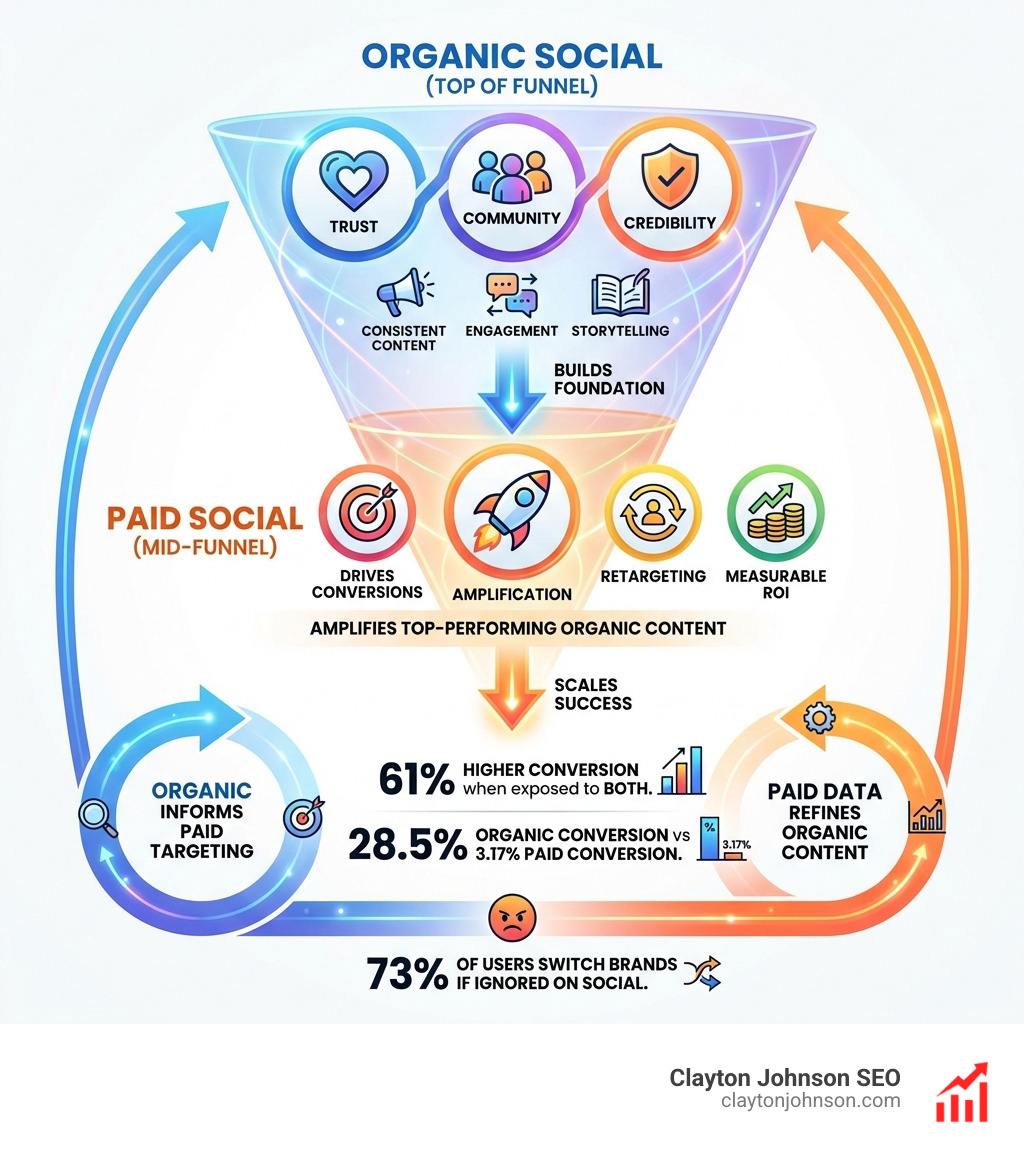
Organic social is not the “free” alternative to paid ads. It is the foundation that makes paid ads believable. Research backs this up: prospects exposed to both organic and paid content are 61% more likely to convert. That gap is not a coincidence — it is the compounding effect of trust built before the ad ever runs.
Yet many founders and marketing leaders treat organic social as an afterthought — something to tick off the checklist between campaign launches. The result is fragmented content, disengaged audiences, and paid spend that underperforms.
This guide walks you through how to build an organic social media strategy that works with your paid efforts — not separately from them.
I am Clayton Johnson, an SEO and growth strategist who has spent years building structured content and social media systems that turn fragmented marketing into measurable, compounding growth. My work developing organic social media marketing strategies for founders and marketing leaders has shown me that the brands winning on social are the ones who architect their organic presence before they scale with paid.
Organic social media marketing strategy further reading:
The Soul of the Machine: Why Organic Presence is Non-Negotiable
In the modern attention economy, your organic social media marketing strategy acts as the “soul” of your business. While paid ads are the megaphone, organic content is the actual conversation. Without a soul, your marketing feels mechanical, transactional, and ultimately, forgettable.
For many businesses in Minneapolis and beyond, the temptation is to bypass the “slow” organic route and jump straight into paid advertising. However, this ignores a fundamental shift in consumer behavior. People don’t just buy products; they buy into values, vibes, and voices. Organic social is where your brand’s voice, values, and vibe come through clearly.
The Power of Trust and Conversions
The data tells a compelling story. Organic search traffic has a 28.5% conversion rate, while paid search traffic often hovers around 3.17%. Why the massive discrepancy? Trust. When a user finds you through organic content, they perceive you as an authority rather than a solicitor.
At Clayton Johnson SEO, we view social media as one of the critical digital marketing pillars. It creates a layer of trust that makes every other marketing effort — from email to SEO — more effective.
The Challenge of Declining Reach
We have to be honest: organic reach is harder than it used to be. On Facebook, average organic reach is roughly 1.65%. On Instagram, it sits around 3.5%. Platforms have become “pay-to-play” ecosystems that prioritize sponsored content. This decline in reach often leads marketers to give up on organic entirely.
However, suppressing organic reach does not mean organic is dead. It means the bar for quality has been raised. A strong organic social media marketing strategy ensures that your brand remains visible to your most loyal advocates, even when algorithms shift.
The Benefits of an Organic-First Mindset
Focusing on organic growth offers several long-term advantages that money simply cannot buy:
- Credibility and Authority: Consistent, helpful content positions you as a thought leader in your niche.
- Cost-Effectiveness: While it requires a significant time investment, organic content doesn’t require a daily ad budget to exist.
- Customer Feedback Loop: Organic social is a two-way street. It provides a direct line to your customers’ pain points and desires.
- Brand Personality: It is the only place where you can be human, humorous, and authentic without the pressure of a “Buy Now” button attached to every post.
Common Challenges in Organic Growth
Building a flourishing community is a marathon, not a sprint. You will likely face:
- Slow Scaling: It takes time to find your “true fans.”
- Resource Intensity: Creating high-quality video and graphics requires consistent effort.
- Algorithm Volatility: What works today (like static images) might be deprioritized tomorrow in favor of short-form video.
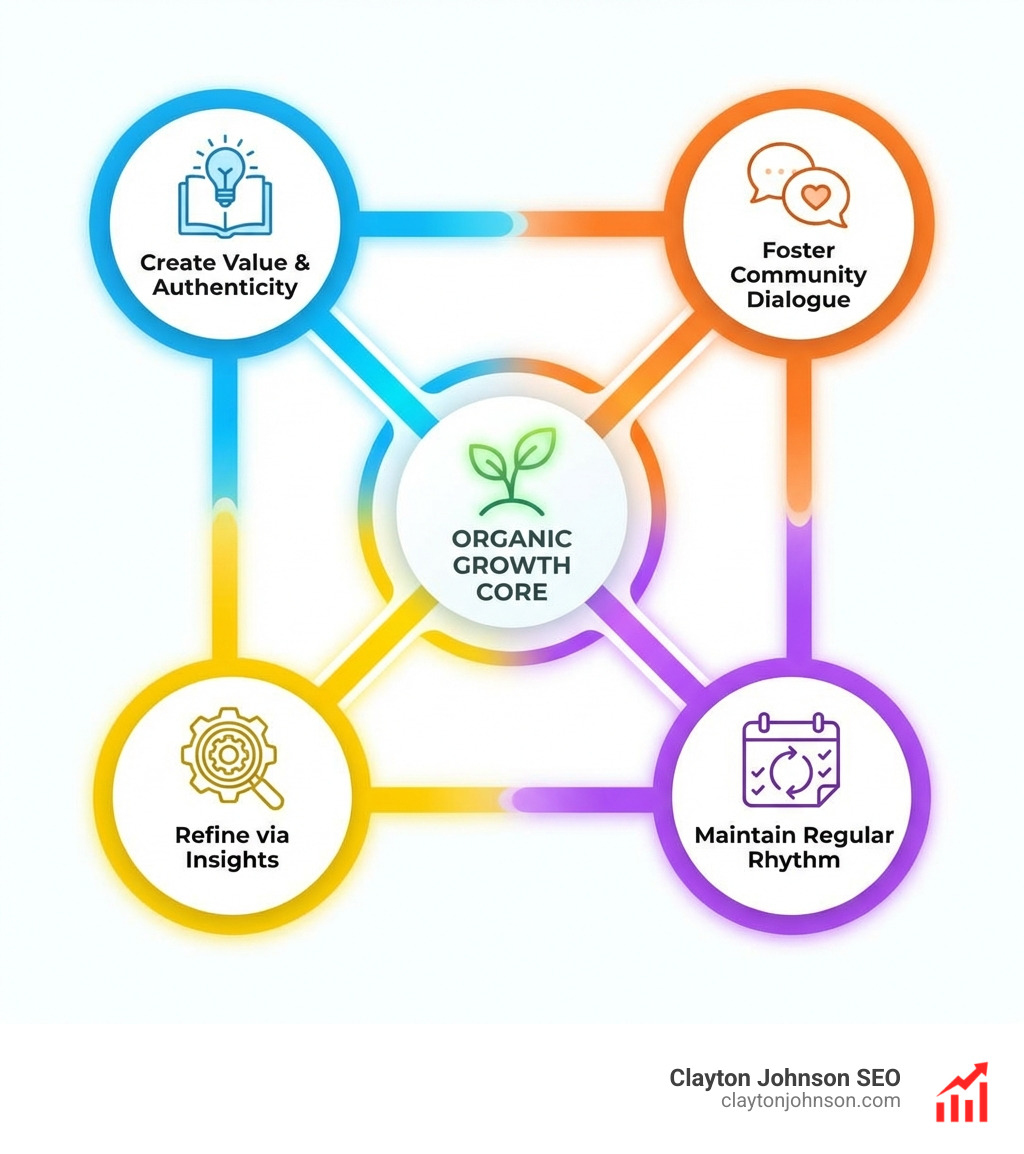
The 6-Step Framework for a High-Performance organic social media marketing strategy
To move from “random acts of posting” to a structured growth architecture, we recommend the 6 Ms Framework. This repeatable process ensures your social efforts align with your business objectives.
1. Define Your Mission and Goals
Without a mission, social media marketers risk cluttered feeds and wasted effort. Your mission should act as your North Star. Are you trying to generate revenue, create brand evangelists, or educate your audience on specific industry challenges?
Use the SMART framework (Specific, Measurable, Achievable, Relevant, and Time-bound) to set your objectives. For example, instead of saying “we want more followers,” aim to “increase Instagram engagement by 15% over the next 90 days.” This clarity allows you to track progress effectively.
2. Identify and Understand Your Target Audience
Success in organic social depends on high-quality data. In fact, 82% of marketers say having high-quality data on their target audience is essential to succeeding. You need to understand not just who they are, but how they think.
Conduct “listening tours.” Read the comments on your competitors’ posts. Join relevant Facebook or LinkedIn groups to see what questions people are actually asking. As Gary Vaynerchuk said, “Content is king, but context is God.” If you don’t understand the context of your audience’s lives, your content will fall on deaf ears.
3. Choose the Right Platforms
You don’t need to be everywhere. It is better to have a deep, engaging presence on two platforms than a shallow, automated presence on five.
- LinkedIn: The powerhouse for B2B. It is responsible for 80% of B2B leads generated through social media.
- Facebook: Still vital for reaching business decision-makers, who spend 74% more time on the platform than average users.
- Instagram: Ideal for visual storytelling and reaching younger demographics (2 billion monthly users).
- YouTube: The second largest search engine. 93% of brands gained a new customer due to a video on social media.
4. Develop a Content Strategy
Your content should be organized into “thematic buckets.” This prevents the daily grind of wondering “what should I post today?” A typical mix might include:
- 40% Value: Educational tips, how-to guides, and industry news.
- 30% Engaging: Polls, questions, and interactive stories.
- 20% Brand: Behind-the-scenes, mission statements, and employee spotlights.
- 10% Community: User-generated content and customer testimonials.
5. Process Management
Document your workflows. From idea creation to post-publishing, having a system ensures consistency. This is where SEO content marketing overlaps with social — your social posts should often be micro-versions of your larger authority-building assets.
6. Monitor and Optimize
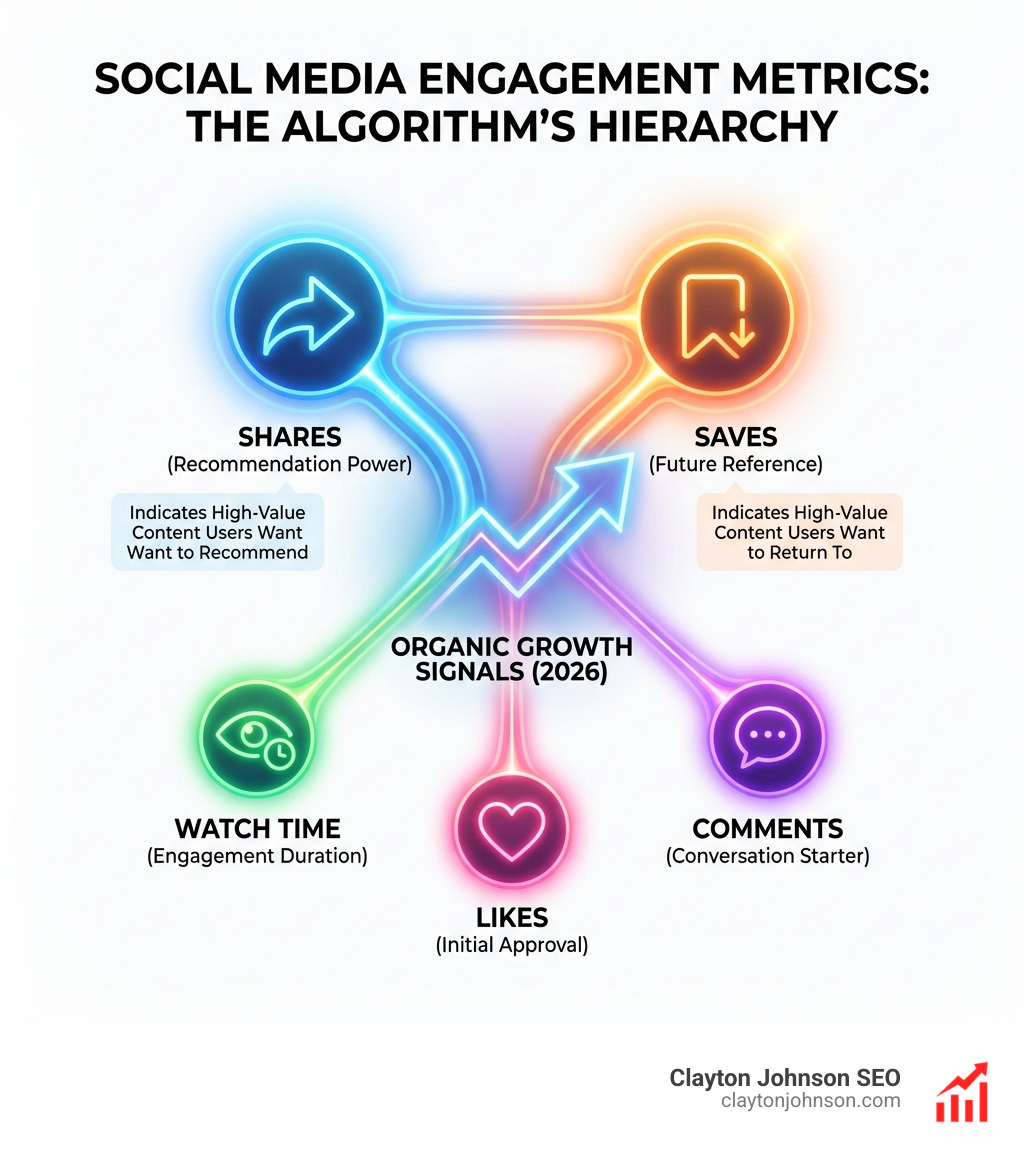
Use social media metrics to track your “social health.” Don’t just look at vanity metrics like follower count. Focus on engagement rate, shares, and saves. These are “votes” for value. If a post gets shared 100 times, the algorithm sees it as high-value and expands its reach.
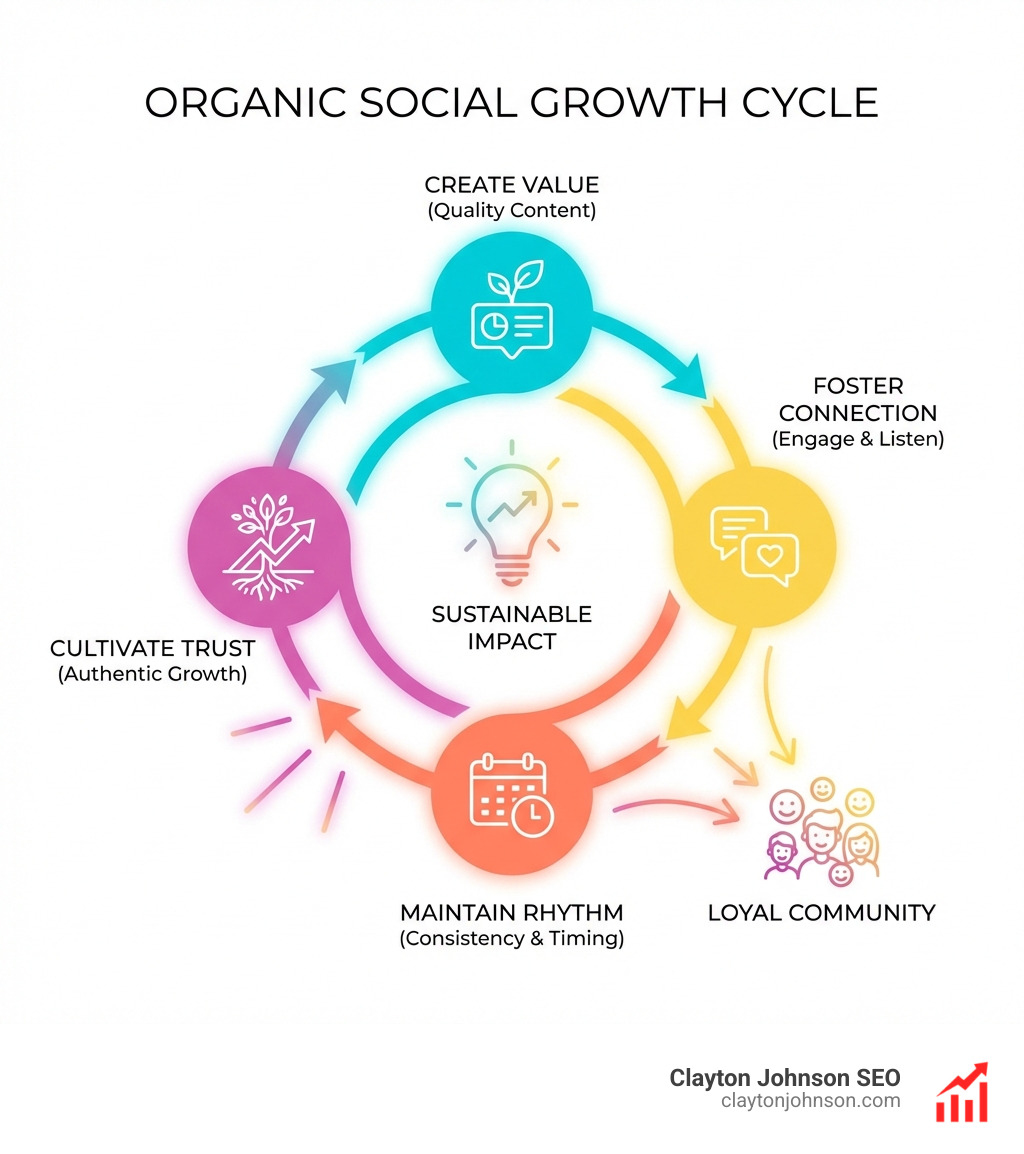
Cracking the Code: Algorithms and Audience Engagement
To maximize your organic social media marketing strategy, you must understand how platforms decide what to show users. Modern algorithms prioritize “meaningful social interactions.”
Leverage Key Algorithm Signals
According to Instagram head Adam Mosseri, the top signals for ranking are watch time, likes, and sends. If people are sending your content to their friends via DM, that is a massive signal to the platform that your content is worth promoting.
- Short-form video: Reels and TikToks are currently the best way to get discovered by non-followers.
- Social SEO: Optimize your profiles and captions with keywords. People are increasingly using TikTok and Instagram as search engines.
- The 3-Scroll Lens: Look at your own feed. What story are you telling a new visitor in the first three scrolls? Ensure there is visual variety and a clear brand narrative.
Social Customer Care
Social media is a two-way street. 73% of social users agree that if a brand doesn’t respond on social, they’ll buy from a competitor. Engagement is not just about liking comments; it’s about participating in the conversation. Dedicate 15-20 minutes daily to respond to messages and comments. Brands that reply see a 40% increase in engagement compared to those that don’t.
Fostering a Loyal Online Community
Community building is about finding your “base fans.” Use interactive tools like polls and AMA (Ask Me Anything) sessions to make your followers feel heard.
- User-Generated Content (UGC): This is the ultimate social proof. UGC drives 28% higher engagement than branded content and is perceived as 2.4x more authentic.
- Employee Advocacy: Your team is your greatest asset. Content shared by employees can increase reach by up to 561%. It makes the brand feel human and trustworthy.
The Hybrid Powerhouse: Combining Organic and Paid for Maximum ROI
The most effective strategy isn’t organic or paid; it’s an integrated hybrid. Organic builds the trust that makes paid advertising actually convert.
1. Boost Your Top Organic Posts
Don’t guess what will work as an ad. Look at your organic data. If a post is already snowballing and getting high engagement, that is your best candidate for a “boost.” You are investing in content that has already been “vetted” by your community.
2. Use Organic Insights to Inform Paid Targeting
Your organic audience provides a wealth of data. Which topics are they commenting on? Which pain points are they mentioning? Use these insights to refine your ad copy and targeting parameters.
3. Prevent Ad Fatigue
Ads can become stale quickly. By maintaining a vibrant organic presence, you provide a constant stream of fresh “social proof” that supports your paid campaigns. When a prospect sees your ad and then visits your profile to find a thriving, helpful community, the friction to buy disappears.
4. Full-Scale Integration
At Demandflow, we believe in structured growth architecture. This means your social strategy shouldn’t live in a silo. It should be connected to your SEO, your email marketing, and your overall business goals. Organic social nurtures the relationship, while paid social closes the deal.
Real-World Success Stories: Organic Growth in Action
Several brands have mastered the art of organic growth by focusing on community and authenticity:
- Glossier: This beauty brand built a billion-dollar empire by championing authenticity and inclusivity. They focused on user-generated content and fostered real conversations, turning customers into brand evangelists.
- Coca-Cola’s #ShareACoke: By encouraging people to share photos of personalized bottles, they leveraged UGC to drive massive organic visibility and engagement.
- Wendy’s: Known for its witty “banter,” Wendy’s used a distinct, humorous voice to stand out in a crowded fast-food market, gaining millions of followers without relying solely on promotional ads.
- Airbnb: They built a global brand through emotional storytelling and user-generated photos, selling an “experience” rather than just a place to stay.
- Miami Beach: Their “Breaking Up with Spring Break” campaign used POV-style videos to reach over 20 billion views, proving that even government entities can go viral with the right organic strategy.
Frequently Asked Questions about Organic Social Media
Is organic social media growth still possible?
Yes, but it requires more strategy than ever before. You cannot simply post and hope for the best. You must focus on high-quality output, participate in trends wisely, and prioritize community engagement over broadcasting.
How long does it take to see organic results?
Organic growth is a compounding asset. Most brands see measurable engagement improvements within 60-90 days of consistent effort, but building a substantial, loyal community typically takes 6 to 12 months.
Should I use organic or paid social media?
Use both. Organic is for building trust, authority, and long-term relationships. Paid is for scaling reach and driving immediate conversions. An integrated, hybrid approach is the only way to achieve sustainable ROI.
Conclusion: Building Your Growth Architecture
Most companies don’t lack tactics; they lack structured growth architecture. At Clayton Johnson SEO and Demandflow.ai, we help founders and marketing leaders move past the “daily grind” of social media into a system that produces compounding growth.
Your organic social media marketing strategy is the foundation of your authority-building ecosystem. By combining actionable strategic frameworks with AI-augmented workflows, you can turn your social presence from a cost center into a long-term asset.
Next Steps for Founders:
- Audit your current presence: Is your “3-scroll story” clear and compelling?
- Define your content pillars: Stop posting at random and start posting with purpose.
- Engage daily: Treat social media like a networking event, not a billboard.
- Integrate with paid: Use your organic winners to fuel your paid campaigns.
Ready to build a social strategy that actually scales? Explore our social media marketing services and see how we can help you architect your brand’s future.