Winning the No-Click Game with Better Content Strategy

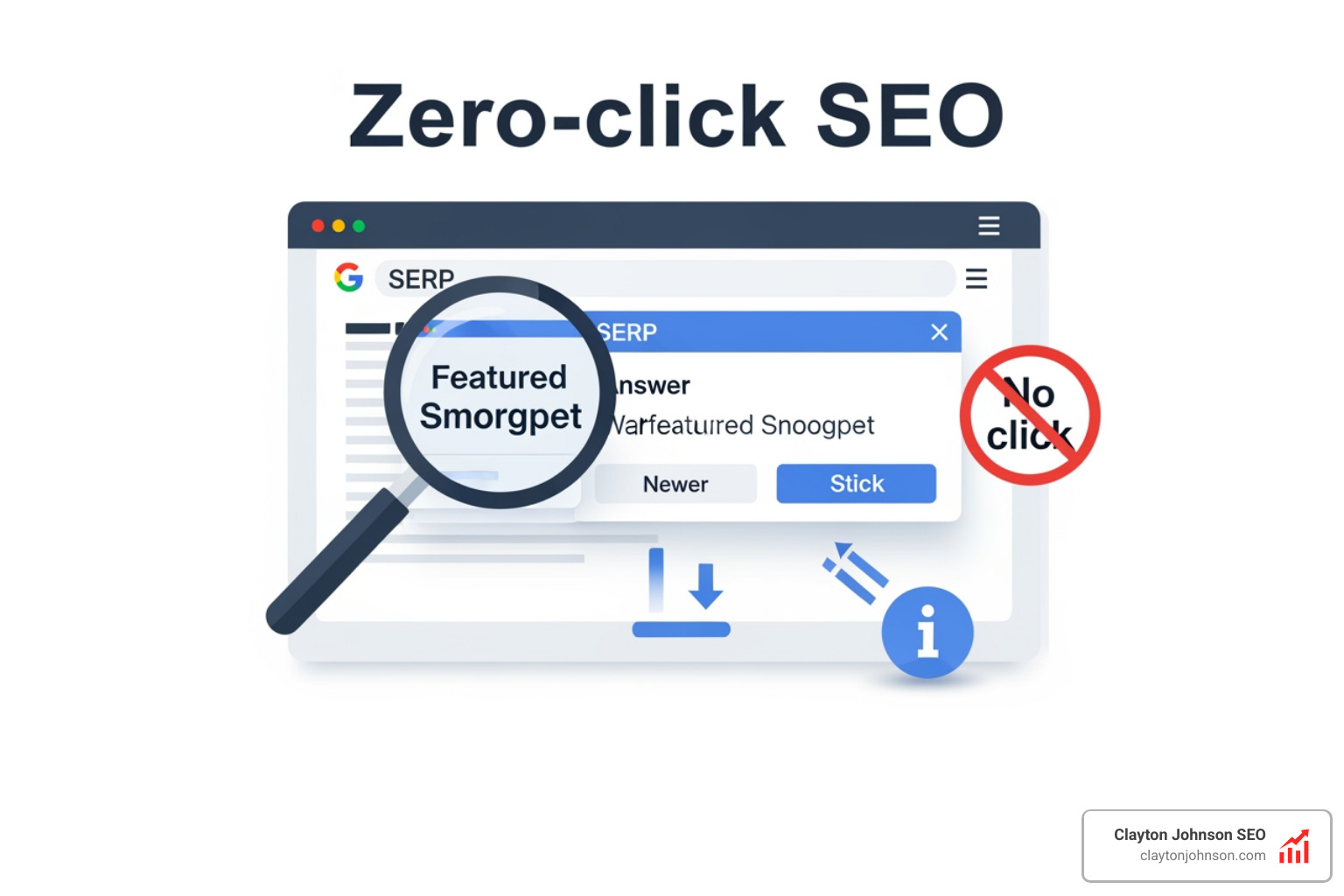
Zero click SEO is the practice of optimizing your content to appear in SERP features — like AI Overviews, Featured Snippets, and Knowledge Panels — even when users never visit your site.
Quick answer for busy readers:
| What It Is | Why It Matters | What To Do |
|---|---|---|
| Users get answers directly on the SERP | Over 60% of searches now end without a click | Optimize for visibility, not just traffic |
| Driven by AI Overviews, Featured Snippets, Knowledge Panels | Impressions rise while CTR falls | Shift KPIs to SERP presence and brand mentions |
| Affects every niche and business model | AI search converts 23x better than traditional organic | Structure content for machine readability and citations |
Here’s the uncomfortable truth most SEOs are still ignoring.
Your rankings might be improving. Your impressions might be climbing. But your clicks? Flat. Or falling.
That’s not a bug. That’s the new search reality.
Over 60% of Google searches now end without a single click to any external website. Google answers the question directly — via an AI Overview, a knowledge box, a Featured Snippet — and the user moves on. No visit. No session. No conversion opportunity. At least, not the kind you used to measure.
This isn’t a temporary blip. It’s a structural shift. In the US, only 374 out of every 1,000 Google searches result in a click to the open web. The rest stay on Google.
And with AI Overviews now triggering on a growing share of queries — up more than 100% in a matter of months — the pace is accelerating.
The question isn’t whether zero-click search is real. It’s whether your strategy is built for it.
I’m Clayton Johnson — SEO strategist and the architect behind the growth frameworks at Clayton Johnson SEO. I’ve spent years building scalable content systems and AI-augmented SEO workflows, and zero click SEO has become one of the most strategically important shifts I help founders and marketing leaders navigate. This guide gives you the full framework for winning visibility in a world where the click is no longer the finish line.
The Mechanics of Zero Click SEO and the Answer Engine Era
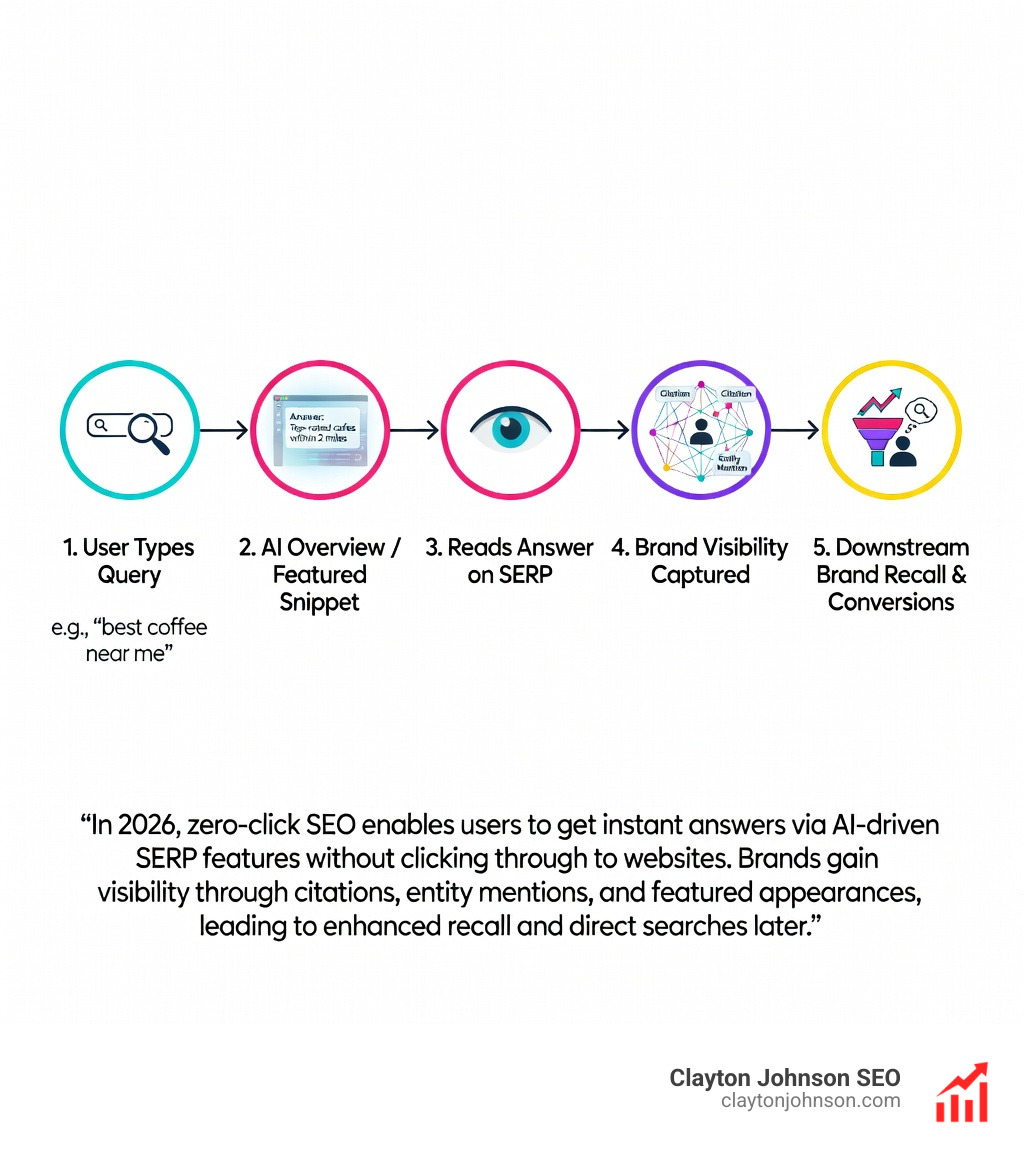
The traditional “click economy” is undergoing a massive restructuring. For decades, SEO was a simple exchange: you provide high-quality content, and Google provides a link that sends traffic to your site. Today, that exchange is being replaced by the “Answer Engine” model.
Google is no longer just a library catalog; it is an assistant that summarizes the books for you. This shift is driven by several mechanical changes in how search works:
- AI Overviews (AIOs): These generative summaries synthesize information from multiple sources. A recent zero-click search study highlights that nearly 60% of mobile searches now end without a click. AIOs are a primary driver, as they satisfy user intent instantly.
- Information Gain: Google prioritizes content that provides new information or a unique perspective. If your content is just a rehash of what’s already out there, an AI will summarize it, and the user will never need to visit your page.
- Mobile Dominance: On mobile, the “real estate” is limited. A single AI Overview or Featured Snippet can take up the entire screen, making it even less likely that a user will scroll down to the traditional blue links.
- Referral Traffic vs. Brand Impressions: While referral traffic is declining, brand impressions are skyrocketing. Being cited in an AI Overview or appearing in a Knowledge Panel builds “mental availability.” Even without the click, you are winning the battle for authority.
At Clayton Johnson SEO, we view this not as a threat, but as an evolution. By shifting to a modern SEO strategy, we help brands move from “hoping for a click” to “dominating the answer.”
Anatomy of the Modern SERP: Beyond the Blue Link
To win at zero click SEO, we have to understand the “battleground.” The modern Search Engine Results Page (SERP) is a fragmented collection of features designed to keep users on-page.
Featured Snippets
Often called “Position Zero,” these are the concise boxes that answer “what is,” “how to,” or “list of” queries. They are the original zero-click feature and still account for a massive share of voice search answers.
AI Overviews
The newest and most powerful feature. Unlike snippets, which pull from one source, AIOs synthesize multiple sources. While they can slash clicks by up to 34.5% for informational queries, being a cited source is critical for brand legitimacy.
Knowledge Panels
These appear on the right side of the desktop SERP (or top of mobile) for entities like brands, people, or books. They pull from the Knowledge Graph and provide immediate factual data.
People Also Ask (PAA)
Appearing in roughly 78% of search results, PAA boxes are a goldmine for zero click SEO. Each question answered is an opportunity to put your brand in front of a user who is still in the “discovery” phase.
Local Packs
For businesses in Minneapolis, Minnesota, the Local Pack is the ultimate zero-click feature. It provides the address, phone number, and reviews without the user ever visiting your website.
Direct Answer Boxes
These handle factual queries like “weather in Minneapolis” or “5 x 12.” These are pure zero-click; there is almost no chance of driving traffic here, so the goal is simply brand association where possible.
Video Carousels
Google often pulls “Key Moments” from YouTube videos directly into the SERP. This allows users to watch the exact segment they need without leaving the Google ecosystem.
| Feature | Primary Goal | User Intent |
|---|---|---|
| Featured Snippet | Direct Answer | Quick Fact/Process |
| AI Overview | Synthesis | Complex Research |
| Knowledge Panel | Authority | Entity Validation |
| Local Pack | Conversion | Nearby Service/Retail |
| People Also Ask | Exploration | Secondary Questions |
Structuring Content for Zero Click SEO Visibility
If you want to be the source that Google chooses for these features, you can’t write “fluff.” You need to structure your content for machine readability. We recommend the “Inverted Pyramid” approach.
- Lead with the Answer: Start your section with a 40-60 word block that directly answers the target question. No “We will explore…” Just give the answer.
- Use Paragraph Snippets: AI and snippets love concise, objective definitions. Use active voice and short sentences.
- Comparison Tables: For queries like “X vs Y,” use a clean HTML table. Google loves to scrape these for comparison snippets.
- Bulleted Lists: For “steps to” or “best of” queries, use ordered or unordered lists with clear, descriptive headers.
This type of SEO content marketing ensures that even if the user doesn’t click, they see your brand as the definitive authority on the topic.
Technical Requirements for Zero Click SEO Success
Beyond the writing, your site’s “plumbing” must be optimized for AI and search bots. This is where Schema markup becomes your secret weapon.
- FAQPage Schema: This tells Google exactly what questions you are answering, increasing the odds of appearing in PAA boxes.
- HowTo Schema: Essential for step-by-step guides. It helps Google parse the sequence of your instructions for AIOs and snippets.
- SameAs Entity Links: This connects your brand to other authoritative profiles (like your LinkedIn, Wikipedia, or Crunchbase). It helps Google’s Knowledge Graph understand that “you are who you say you are.”
- JSON-LD: This is the preferred format for structured data. It creates “semantic triples” (Subject-Predicate-Object) that make your content unambiguous for LLMs (Large Language Models).
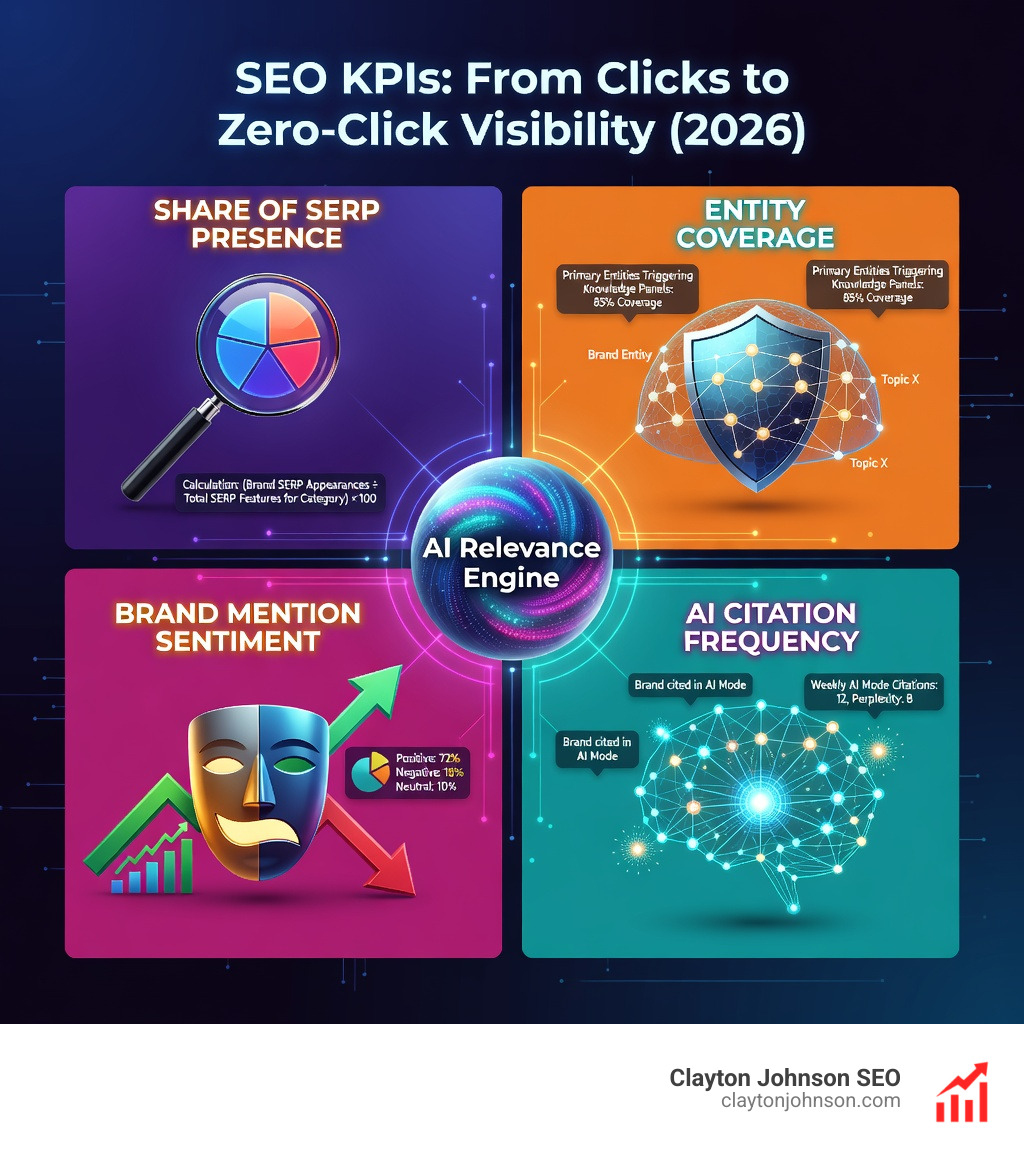
Measuring Success: New KPIs for a No-Click World
If your boss or client is only looking at “Organic Sessions” in GA4, they’re going to think you’re failing. In a zero click SEO world, we need to track “Visibility Metrics.”
Share of SERP Presence
This measures how much of the “real estate” you own for your core keywords. If you rank #1 but a competitor has the AI Overview, the Featured Snippet, and the PAA box, they are winning the “mental share.”
- Calculation: (Brand SERP Appearances ÷ Total SERP Features for Category) × 100.
Entity Coverage
Are you being associated with the right topics in the Knowledge Graph? We track how many of your primary and secondary entities trigger Knowledge Panels or citations in AI results.
Brand Mention Sentiment
Since AI Overviews synthesize your reputation, we monitor the sentiment of brand mentions across the web. If Reddit and 3rd-party reviews are negative, the AI Overview will reflect that.
AI Visibility Index
Tools like the Semrush AI Visibility Index help us track how often your brand is cited in Google’s AI Mode, ChatGPT, and Perplexity.
The Future of Search: From SEO to Answer Engine Optimization
We are moving toward a future of “Zero-Search Discovery.” This is where AI systems proactively surface your brand based on a user’s context and history—before they even type a query.
To prepare, your strategy must evolve into Answer Engine Optimization (AEO). This involves:
- Generative Engine Optimization (GEO): Optimizing for citations in LLMs like ChatGPT and Gemini. This requires building a “citation footprint” across authoritative, scraped sites like Reddit, LinkedIn, and industry-specific journals.
- RAG System Alignment: Understanding how Retrieval-Augmented Generation (RAG) works. AI models “chunk” your content; if your content is poorly structured, the “chunk” the AI retrieves will be nonsensical.
- Holistic Search Optimization: You cannot rely on Google alone. You must be visible where your customers are — whether that’s YouTube, TikTok, or Amazon.
At Clayton Johnson SEO, we build structured growth architecture via Demandflow.ai. We don’t just chase keywords; we build authority ecosystems that ensure you are surfaced whenever a relevant question is asked, regardless of the platform.
Frequently Asked Questions about Zero Click SEO
What is the difference between zero-click and traditional SEO?
Traditional SEO focuses on driving traffic to a website via rankings and high Click-Through Rates (CTR). Zero click SEO focuses on maximizing brand visibility and authority directly on the Search Engine Results Page, accepting that many users will get their answer without ever clicking through to the site.
How do AI Overviews impact organic click-through rates?
AI Overviews can significantly reduce CTR, especially for informational queries. Studies show that organic clicks can drop by over 30% when an AI summary is present. However, the clicks that do come through are often higher intent, as the user has already been “pre-qualified” by the AI’s summary.
Can zero-click results still drive business revenue?
Absolutely. Zero-click results build brand awareness, trust, and “mental availability.” When a user sees your brand cited as the expert in an AI Overview or Featured Snippet, it influences their downstream decisions. Furthermore, features like Local Packs and Product Carousels can drive offline foot traffic or direct purchases without a traditional blog post click.
Conclusion
The “No-Click Game” isn’t a game of loss; it’s a game of influence.
While it’s easy to lament the decline of traditional referral traffic, the reality is that search has become more powerful than ever. By appearing as the definitive answer in an AI Overview or a Featured Snippet, you aren’t just getting a “visitor”—you are gaining an authoritative citation in the mind of your customer.
Winning at zero click SEO requires a visibility-first mindset. It requires deep topical authority, a commitment to E-E-A-T (Experience, Expertise, Authoritativeness, and Trustworthiness), and a technical infrastructure that speaks the language of AI.
At Clayton Johnson SEO, we help you build that infrastructure. Through Demandflow.ai, we provide the structured growth architecture you need to move beyond simple tactics and start building a compounding asset.
Ready to stop chasing clicks and start winning the zero-click game? Let’s build your authority ecosystem together.
Clayton Johnson SEO Scalable Authority Retainer Framework
Each retainer applies to a single domain and is designed to build the topical depth and backlink density required for AI inclusion.
-
Foundation Authority — $1,997 / month
- 1 DR45+ PR link per month
- 2 Done-for-You articles per month
- Focus: Foundational authority + initial AI eligibility signals.
-
Growth Authority — $2,997 / month
- 2 DR45+ PR links per month
- 4 Done-for-You articles per month
- Focus: Increased link velocity + expanded cluster depth.
-
Competitive Authority — $3,997 / month
- 3 DR45+ PR links per month
- 6 Done-for-You articles per month
- Focus: Stronger backlink concentration + AI Overview positioning.
-
Scale Authority — $6,997 / month
- 7 DR45+ PR links per month
- 14 Done-for-You articles per month
- Focus: Accelerated authority density + market dominance.
-
Market Leader Authority — $9,997 / month
- 10 DR45+ PR links per month
- 20 Done-for-You articles per month
- Focus: High-consistency authority + scalable AI citation dominance.