Why Enterprise SEO Is a System, Not a Tactic
An SEO strategy for enterprises requires structured growth infrastructure, not just scaled-up tactics. Here’s what sets enterprise SEO apart:
Enterprise SEO Core Requirements:
- Scale Management – Optimizing 10,000+ pages (often millions) with consistent technical standards
- Cross-Functional Governance – Aligning marketing, product, engineering, and legal teams
- Technical Debt Resolution – Managing legacy CMS platforms, complex site architectures, and crawl budget
- Nonlinear Buyer Journeys – Mapping content to awareness, consideration, and decision stages
- ROI Attribution – Connecting organic visibility to revenue, not just rankings
The data is clear: organic search leads close at 14.6%, while outbound leads convert at only 1.7%. Yet most enterprises struggle to ship content, manage duplicate pages across domains, and secure stakeholder buy-in. The amount of data created online is astounding—and continues to grow exponentially. Without structured systems, even household brands get buried.
Large organizations face unique challenges at scale. A single robots.txt error can block millions of pages. Departmental silos create conflicting priorities. Change management processes turn simple updates into multi-month initiatives. And with AI Overviews now appearing in a majority of searches, enterprises must optimize for entity authority and structured intelligence, not just keyword rankings.
I’m Clayton Johnson, and I’ve spent years building taxonomy-driven SEO systems and AI-augmented workflows for organizations scaling from fragmented efforts to cohesive growth infrastructure. This guide walks through the strategic foundations, technical requirements, and organizational alignment needed for an SEO strategy for enterprises that compounds over time.
Defining the SEO Strategy for Enterprises
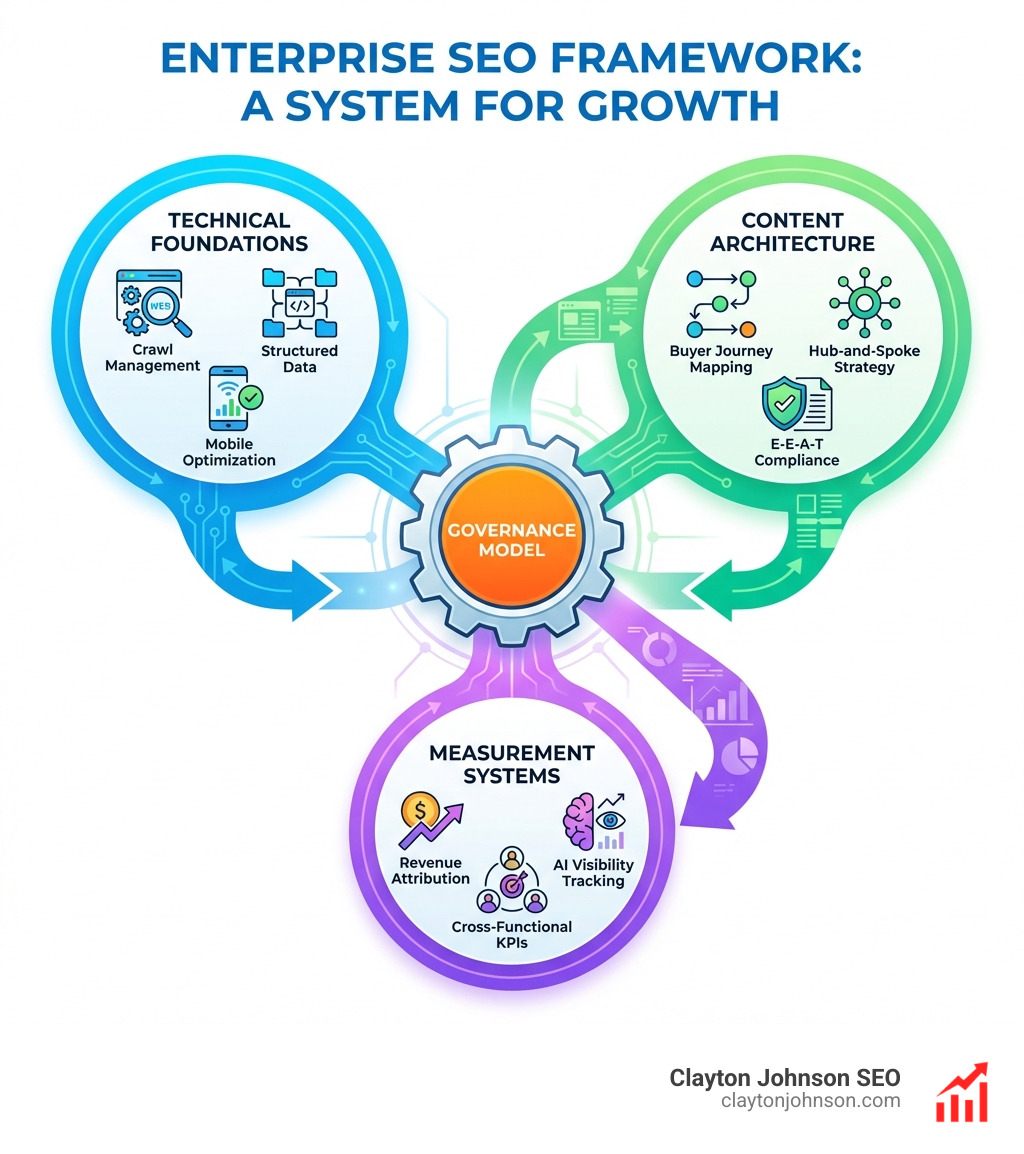
When we talk about an SEO strategy for enterprises, we aren’t just talking about a “big website.” We are talking about a complex ecosystem where a single change can ripple across millions of URLs. In the enterprise world, “large” is defined by Google as a site with one million or more unique pages. However, even “medium” sites with 10,000+ pages face the same hurdles of governance and technical debt.

The primary differentiator is the shift from tactical execution to organizational governance. In a small business, you might write a blog post and hit publish. In an enterprise, that same post might need approval from legal, brand compliance, and the product team before it sees the light of day. According to McKinsey & Company research, B2B buyers are increasingly comfortable transacting online, with 77% willing to spend $50,000 or more on a single digital solution. To capture this revenue, your SEO must be a well-oiled machine.
| Feature | SMB SEO | Enterprise SEO |
|---|---|---|
| Page Count | Hundreds to thousands | 10,000 to millions |
| Primary Goal | Ranking for specific keywords | Brand authority & revenue compounding |
| Decision Making | Owner or small marketing team | Cross-functional committees & legal |
| Technical Focus | On-page & basic backlinks | Crawl budget, JS rendering, & tech debt |
| Content Strategy | Linear blog posts | Taxonomy-driven hub-and-spoke models |
Why Large Organizations Need a Dedicated SEO Strategy for Enterprises
Enterprises often suffer from the “invisible giant” syndrome. They have massive brand recognition, but their organic visibility is fragmented. A dedicated SEO strategy for enterprises ensures that your brand reputation translates into search dominance. Without a centralized strategy, different business units often end up competing against each other for the same keywords—a phenomenon known as keyword cannibalization.
Furthermore, enterprise SEO is about compounding revenue. When you have millions of visitors, a 1% increase in conversion rate due to better-targeted organic traffic can result in millions of dollars in additional annual revenue. For those looking to navigate these complexities, professional SEO consulting services can provide the external perspective needed to break through internal gridlock.
Unique Challenges: Scale, Governance, and Technical Debt
The “big site” comes with “big problems.” The most common is technical debt. Many enterprises run on legacy CMS platforms or a patchwork of subdomains and subdirectories built over decades. This creates a nightmare for site architecture and sitemaps. Google has a 50,000 URL limit per XML sitemap; we often see enterprises struggling to manage thousands of these files.
Governance is the second major hurdle. Departmental silos—where marketing doesn’t talk to engineering, and product doesn’t talk to SEO—lead to “change freezes” and red tape. We’ve seen multi-million dollar projects stalled because the SEO requirements weren’t baked into the initial engineering sprint. Mastering enterprise SEO means mastering the art of the business case to prove that SEO isn’t just a marketing cost, but a core product function.
Technical Foundations: Managing Scale and Crawl Budget
On a site with millions of pages, Googlebot doesn’t have the time or resources to visit every single URL. This is where “crawl budget” becomes the most important metric you’ve never heard of. If Google is wasting its time crawling low-value pages—like faceted navigation filters or old session IDs—it won’t find your high-converting product pages.
To improve crawl efficiency, we must aggressively manage the robots.txt file. By disallowing unimportant URLs, we direct the “crawling energy” toward the pages that actually drive revenue. Google’s documentation on managing crawl budget makes it clear: site speed and Core Web Vitals are not just “nice-to-haves” for large sites; they are essential for ensuring your pages get indexed in the first place.
International SEO and Multilingual Localization
For global enterprises, the challenge is multiplied by language and geography. Take Apple as an example: their homepage currently has 137 language and location variations. To manage this, you must implement hreflang tags correctly. These tags tell search engines which version of a page to show based on the user’s location and language settings.
Localization is more than just translation. It’s about cultural nuance. A term that works in the US might be completely irrelevant in Japan. We often help clients integrate advanced analytics and data services to track how different regions interact with localized content, ensuring that the global strategy is backed by local data.
Technical SEO Improvements at Scale
When managing millions of pages, you cannot optimize them one by one. You must use template-level enhancements. This includes:
- Structured Data (JSON-LD): Implementing schema at the template level to help search engines understand your entities.
- Mobile-First Indexing: With over half of all traffic coming from mobile, a slow mobile experience leads to a 53% bounce rate.
- Internal Linking: Using automated systems to ensure that link equity flows from high-authority “pillar” pages to deep “spoke” pages.
- Automated Audits: Using tools like Google Search Console to monitor for broken links and indexation errors across the entire domain.
Content Architecture: Mapping the Nonlinear Buyer Journey
The traditional sales funnel is dead in the enterprise B2B world. The Gartner research shows that the B2B buying journey is nonlinear; buyers revisit stages, jump from awareness to decision, and loop back to consideration.

A Forrester survey found that 90% of respondents wanted relevant content at each step of the journey. This requires a robust content architecture that satisfies Google’s E-E-A-T (Experience, Expertise, Authoritativeness, and Trustworthiness) guidelines. We don’t just write content; we build authority-building ecosystems.
Winning Content Tactics: Snippets and Striking Distance Keywords
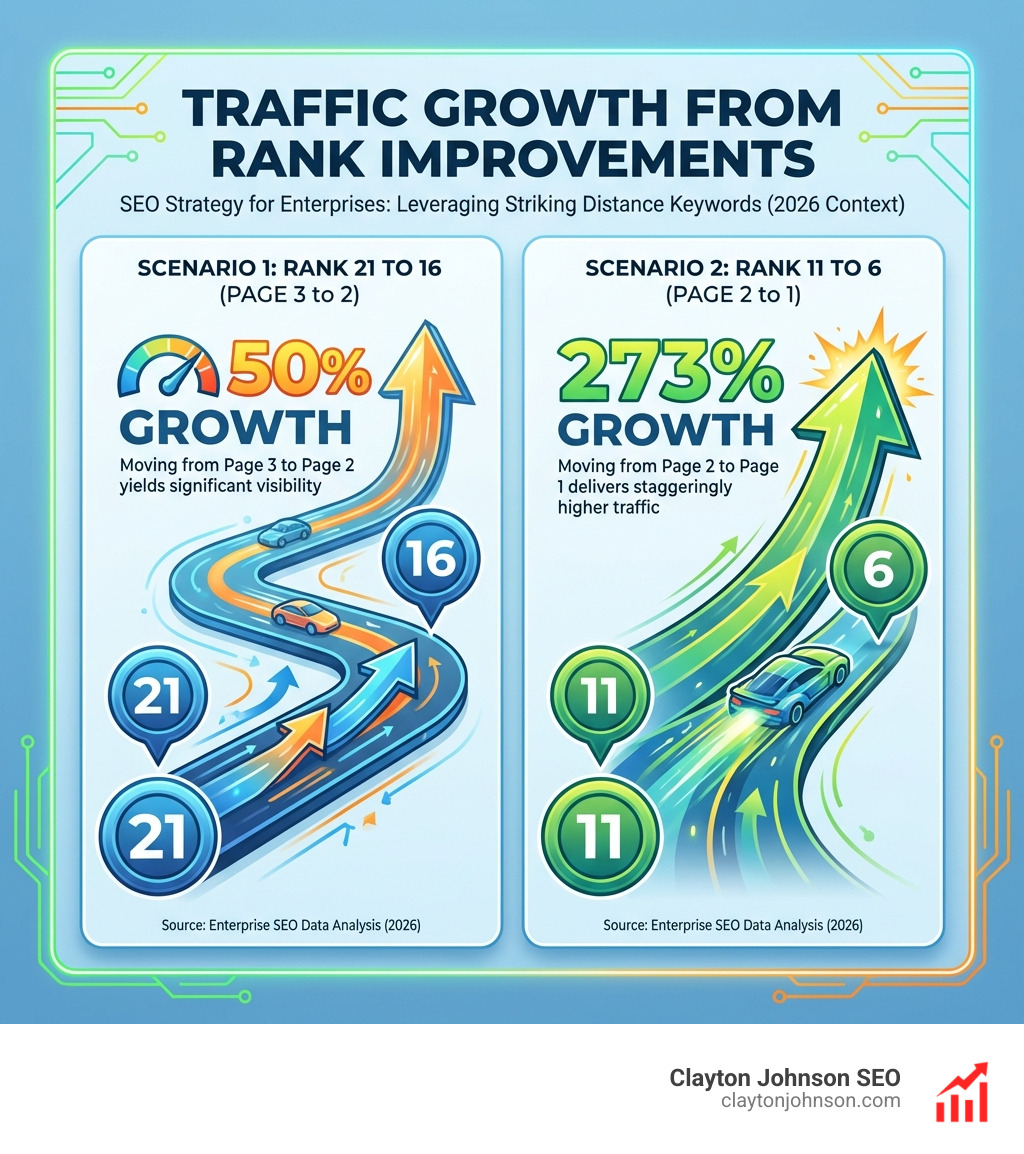
One of the fastest ways to see growth in an SEO strategy for enterprises is to target “striking distance” keywords. These are keywords where you already rank in positions 11-20 (page 2). Moving from position 11 to position 6 can result in a staggering 273% traffic growth.
Additionally, optimizing for Featured Snippets and “People Also Ask” (PAA) boxes allows you to leapfrog the competition. By providing 40-50 word concise answers or structured tables, you can capture the “zero-click” searchers who want immediate answers. As Search Engine Land explains, landing these placements is competitive but yields massive brand authority. For those struggling to produce this volume of high-quality material, our SEO content marketing services focus on creating these high-impact assets at scale.
Implementing a Hub-and-Spoke Content Strategy
To organize millions of pages, we use the hub-and-spoke model.
- Pillar Pages (Hubs): Comprehensive guides on broad topics (e.g., “Cloud Security”).
- Cluster Content (Spokes): Highly specific articles that link back to the hub (e.g., “Cloud Security for Financial Services”).
This strategy creates a “moat” of topical authority. It also allows for programmatic SEO, where you create thousands of high-quality landing pages based on a specific database or taxonomy. Companies with more than 30 landing pages achieve 7x the results of those with fewer than ten.
Governance and Collaboration: Building a Center of Excellence
The biggest obstacle to an SEO strategy for enterprises isn’t Google—it’s the internal organization. To succeed, you must build an SEO “Center of Excellence” (CoE). This is a centralized team or framework that sets the playbooks, training, and documentation for the rest of the company.
As McKinsey reported, business silos are the #1 barrier to digital priorities. An SEO CoE breaks these silos by creating a shared language between the “creative” marketing teams and the “technical” engineering teams.
Measuring ROI and SEO Strategy for Enterprises KPIs
In an enterprise, “more traffic” isn’t a good enough KPI. You need to connect SEO to revenue. This requires:
- CRM Integration: Connecting Google Search Console and GA4 data to your CRM (like Salesforce) to see which keywords lead to closed-won deals.
- Micro-Conversions: Tracking whitepaper downloads, webinar signups, and demo requests as leading indicators of revenue.
- Branded vs. Non-Branded: Separating traffic from people who already know your name from new visitors who found you via generic industry terms.
For companies looking to squeeze more value out of their existing traffic, conversion optimization is the logical next step after establishing organic visibility.
Building Cross-Functional Influence Without Authority
Most SEO leaders have a “dotted line” responsibility but no direct authority over the engineering or product roadmaps. To get things done, you must:
- Speak their language: Don’t talk about “meta tags” to an engineer; talk about “site performance” and “server load.”
- Build a Business Case: Show the ROI of a proposed change. If fixing a redirect chain will capture an estimated $500k in lost revenue, it moves to the top of the sprint.
- Share Success Stories: Evangelize small wins to build trust for larger initiatives.
The Future of Enterprise Search: AI and Discovery
The search landscape is shifting from “links” to “answers.” With the rise of Generative AI and AI Overviews, Google is increasingly answering queries directly on the SERP. This has led to a “zero-click” phenomenon, where a majority of searches end without a click to a website.
However, this isn’t the end of SEO—it’s an evolution. Enterprises must now focus on entity consistency. You want your brand to be the “structured intelligence” that feeds the LLMs (Large Language Models). By following Google’s ranking systems guide, you can ensure your content is the source of truth for these AI summaries.
How AI is Changing the SEO Strategy for Enterprises
AI is changing the “how” and the “what” of search:
- Visual Search: Users are searching with images, requiring enterprises to optimize image context and alt text more than ever.
- Searchless Discovery: Algorithms (like those on TikTok or YouTube) are pushing content to users before they even search.
- AI Crawlers: Bots like GPTBot are now visiting your site to train future models. Managing how these bots interact with your data is a new pillar of technical SEO.
Frequently Asked Questions about Enterprise SEO
What is the difference between traditional and enterprise SEO?
The main difference is scale and complexity. Traditional SEO focuses on individual keywords and single pages. SEO strategy for enterprises focuses on systems, governance, and technical infrastructure that can manage 10,000 to millions of pages across multiple departments and potentially multiple global regions.
How do you manage crawl budget for millions of pages?
We manage crawl budget by using the robots.txt file to “disallow” low-value pages, fixing long redirect chains that waste crawler time, and optimizing site speed. We also manage URL parameters (like those used for sorting or filtering) to prevent the creation of infinite duplicate pages that “trap” search engine bots.
What tools are recommended for enterprise-level SEO?
Standard tools like Google Search Console are essential for monitoring health. For deep crawls, we recommend Screaming Frog or Sitebulb. However, the most important “tool” in an enterprise is a custom analytics dashboard that integrates your SEO data with your CRM and business intelligence (BI) systems to prove revenue impact.
Conclusion
Mastering an SEO strategy for enterprises requires moving past the “quick fix” mindset. It requires building structured growth architecture. At Demandflow.ai, we believe that most companies don’t lack tactics—they lack the systems to execute them at scale.
By implementing taxonomy-driven systems, focusing on authority-building ecosystems, and leveraging AI-augmented workflows, we help organizations turn search into a compounding growth engine. Clarity leads to structure, which leads to leverage, and ultimately, compounding growth.
If you are ready to stop chasing individual keywords and start building a structured growth infrastructure for your brand, work with me to scale your enterprise growth. We specialize in helping companies in Minneapolis and beyond navigate the “big site, big problems” landscape to emerge as search leaders.