Why Most SEO Reports Are a Complete Waste of Time
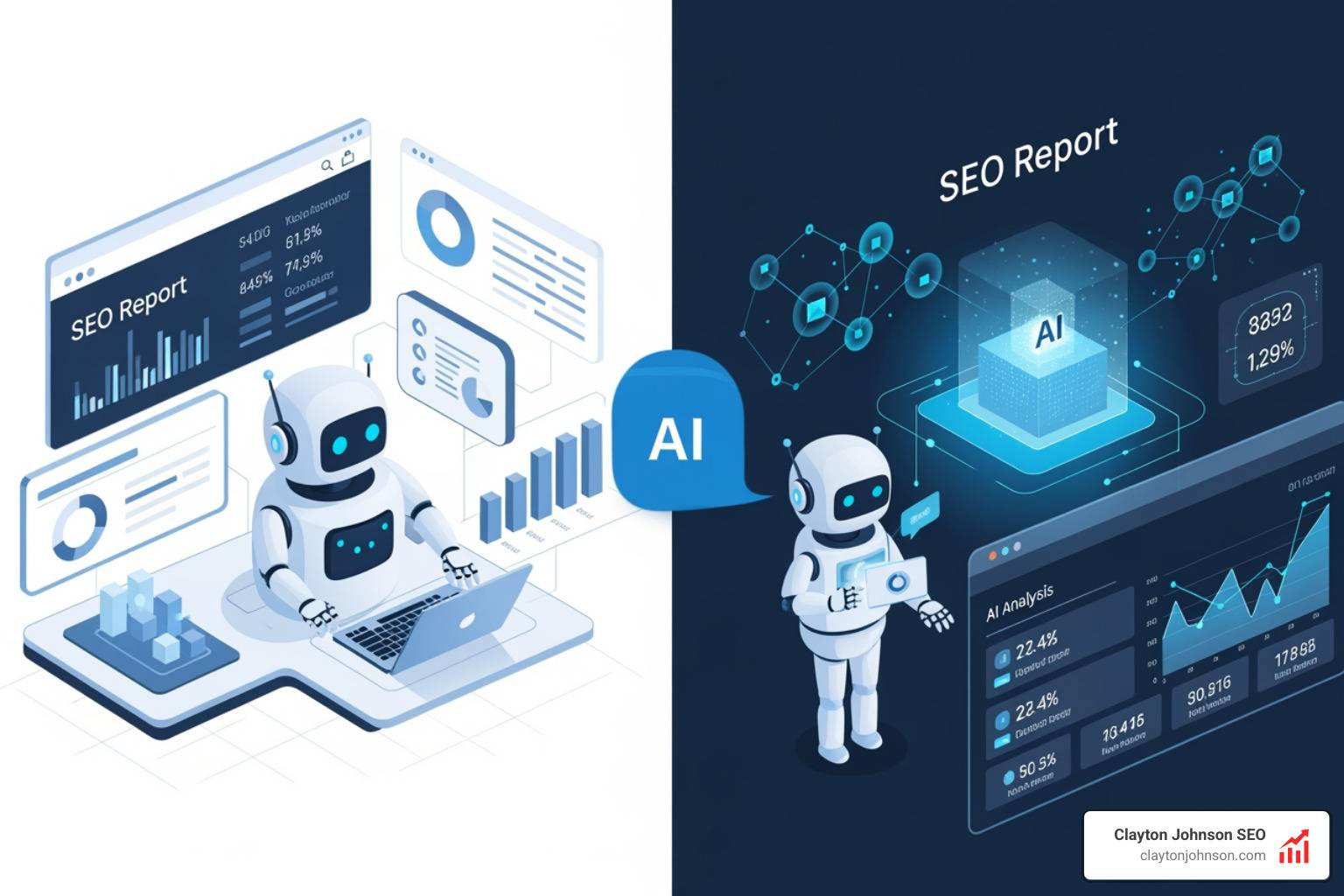
Automated AI SEO reports eliminate the 40+ hours most teams waste monthly on manual data aggregation, delivering real-time insights while you focus on strategy instead of spreadsheets. Here’s what you need to know:
Core Components of Automated AI SEO Reports:
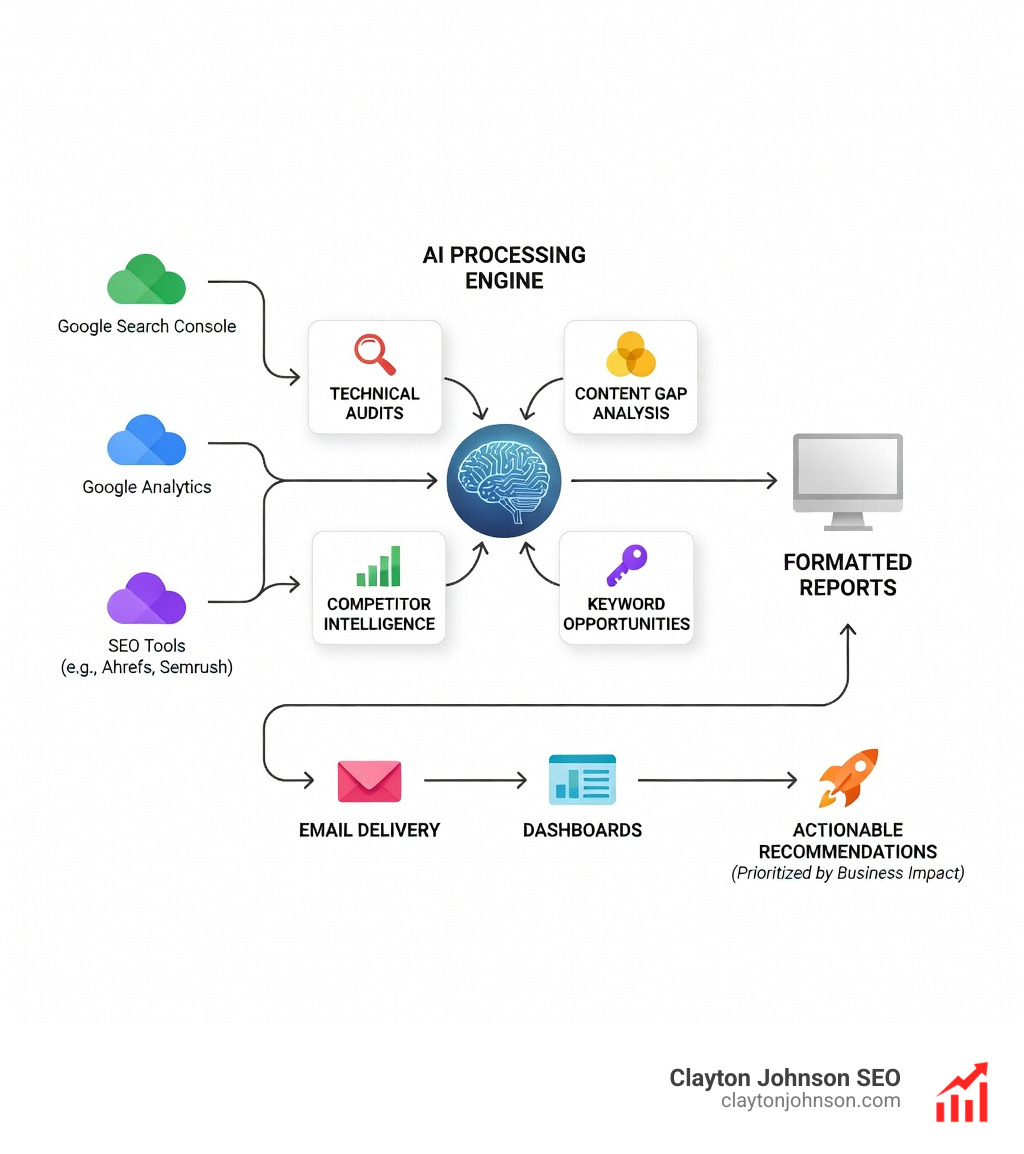
- Instant data collection from Google Search Console, Analytics, and third-party SEO tools
- AI-powered analysis using machine learning to identify trends, anomalies, and opportunities
- Automated delivery via scheduled emails, PDFs, or white-labeled dashboards
- Actionable recommendations generated by LLMs that interpret raw data into strategic next steps
- Real-time monitoring of keyword rankings, technical issues, and competitor movements
The traditional approach to SEO reporting is broken. Manual reporting requires 40 hours monthly for site audits and another 30 hours for keyword analysis. By the time you finish compiling data from multiple platforms, reconciling discrepancies, and building visualizations, the insights are already outdated. Meanwhile, search rankings shift, competitors launch new content, and technical issues compound.
AI-powered automation flips this equation entirely. Modern platforms aggregate data from Google Search Console, Analytics, Ahrefs, Semrush, and other sources in real-time, then use natural language processing to generate human-readable summaries with prioritized action items. Instead of spending days building reports, you get comprehensive analysis delivered automatically while you sleep.
I’m Clayton Johnson, and I’ve built automated reporting systems that reduced client communication overhead by 50% while improving strategic clarity through AI-generated insights. Throughout this guide, I’ll show you exactly how to implement Automated AI SEO reports that save time, improve accuracy, and provide the strategic visibility needed for compounding growth.
Terms related to Automated AI SEO reports:
Why You Need Automated AI SEO Reports
In the modern digital landscape, staying competitive isn’t just about working harder; it’s about building better infrastructure. According to recent data, 78% of organizations now use AI in their marketing operations. If you aren’t one of them, you’re essentially bringing a spreadsheet to a supercomputer fight.
Manual reporting is the “silent killer” of agency and in-house productivity. We’ve seen teams spend three hours a week just cleaning data—time that could be spent on high-level positioning or creative strategy. By shifting to Automated AI SEO reports, businesses have reported saving an average of $2,400 in their first year compared to paying for a bloated stack of manual tools.
Beyond cost, there is the issue of accuracy. Humans make typos. We miss the rogue JavaScript update that broke 200 product pages on a Friday night. AI doesn’t sleep. It provides “continuous compliance,” catching technical glitches at machine speed.
| Feature | Traditional Manual Reporting | Automated AI SEO Reports |
|---|---|---|
| Time Investment | 40-70 hours per month | < 1 hour (setup & review) |
| Data Freshness | Outdated by the time it’s sent | Real-time or daily updates |
| Insight Depth | Surface-level metrics (clicks/ranks) | Contextual intent & semantic gaps |
| Scalability | Hard to scale without hiring | Infinite scalability |
| Error Rate | High (human error) | Low (algorithmic precision) |
If you want to stop guessing and start ranking, you need to leverage The Top Automated SEO Audit Tools for Faster Rankings.
How to Generate Automated SEO Reports in 4 Steps
Setting up an automated system doesn’t require a computer science degree. We like to think of it as building a “growth engine” that runs in the background.

- Define Your Objectives: Are you looking for lead generation, brand visibility in AI search, or technical health? Your goals dictate which metrics the AI prioritizes.
- Connect Your Data Sources: Link your primary accounts (GSC, GA4) to your chosen AI reporting platform. This is the “fuel” for your engine.
- Select Your KPIs: Choose 1-2 primary KPIs tied to revenue (like organic conversions) and supportive metrics (like AI Visibility Score).
- Schedule and Automate: Set the frequency (weekly or monthly) and delivery method.
For a deeper dive into the technical side of this process, check out our guide on AI-Driven SEO Audits.
Setting Up Your First Automated AI SEO Report
The first step is API integration. Most modern tools allow for “one-click” connections. You’ll want to link Google Search Console to track actual search performance and Google Analytics 4 to monitor conversions.
If you’re an agency, white-labeling is your best friend. You can customize the report with your branding, making it look like your team spent days hand-crafting a PDF that the AI actually generated in three minutes. Scheduled delivery ensures your clients or stakeholders receive their updates every Monday morning without you ever lifting a finger.
Integrating Data Sources for Holistic Insights
To get a truly “agentic” view of your SEO, you need to go beyond the basics. We recommend using automation platforms like n8n to connect various APIs. For example, you can use the Website SEO Analyzer and Audit AI via RapidAPI to fetch raw JSON data, then use a Large Language Model (LLM) to transform that data into a structured Markdown summary.
This allows you to track:
- Keyword Groups: Organizing terms by topic rather than just a massive list.
- Backlink Profiles: Monitoring link-building opportunities and toxicity.
- Multi-channel Attribution: Seeing how a brand mention in ChatGPT leads to a direct visit on your site.
Core Data Points in AI-Generated Reports
What actually goes into these reports? It’s more than just a line graph showing traffic going up. AI allows us to see the “why” behind the numbers.
A comprehensive report should cover:
- Technical Health: Real-time alerts for 404 errors, slow-loading images, or schema markup issues.
- Core Web Vitals: Tracking how Google views your site’s user experience.
- Content Gaps: Identifying topics your competitors are ranking for that you haven’t covered yet.
- Competitor Intelligence: Benchmarking your visibility against the “big players” in your niche.
Not sure which tool to use? See our breakdown: Which AI SEO Platform Is Your Perfect Match?
Analyzing Content Gaps and User Intent
This is where LLMs like GPT-4 or Claude shine. Traditional tools tell you that a keyword has “high volume.” AI tells you the search intent.
By analyzing the top-ranking pages, AI can determine if a user wants a “how-to” guide, a product comparison, or a local service. It can then cluster keywords into “semantic clusters,” allowing you to build pillar pages that dominate an entire category. This is the secret sauce for moving from Zero to Hero in content optimization.
Tracking AI Visibility and Brand Mentions
Search is changing. With the rise of AI Overviews and ChatGPT, being #1 on Google is no longer the only goal. You need to track your AI Visibility Score.
This metric benchmarks how often your brand is cited in AI-generated answers. AI reports can now scan millions of queries to see if you are being mentioned as a “top recommendation” in LLM responses. This “share of voice” in the AI ecosystem is critical for The Future of SEO.
Beyond Data: Using AI for Strategic Growth
Automated AI SEO reports shouldn’t just be a record of the past; they should be a roadmap for the future. We call this “Predictive Strategy.” Instead of waiting for a traffic drop to react, an agentic SEO system spots the trend early and suggests a course correction.
Interpreting Automated AI SEO Reports for Strategy
The real value of AI isn’t the data—it’s the interpretation. AI can perform “anomaly detection.” If your traffic drops by 40% over a weekend, the AI identifies that a rogue JavaScript update broke your navigation and alerts you immediately.
It also helps with resource allocation. If the report shows that a specific cluster of pages has a high “rankability” score but low current traffic, you know exactly where to put your content budget for the highest ROI. You can Automate Your Success by letting the data drive your calendar.
Enhancing Client Communication with AI Summaries
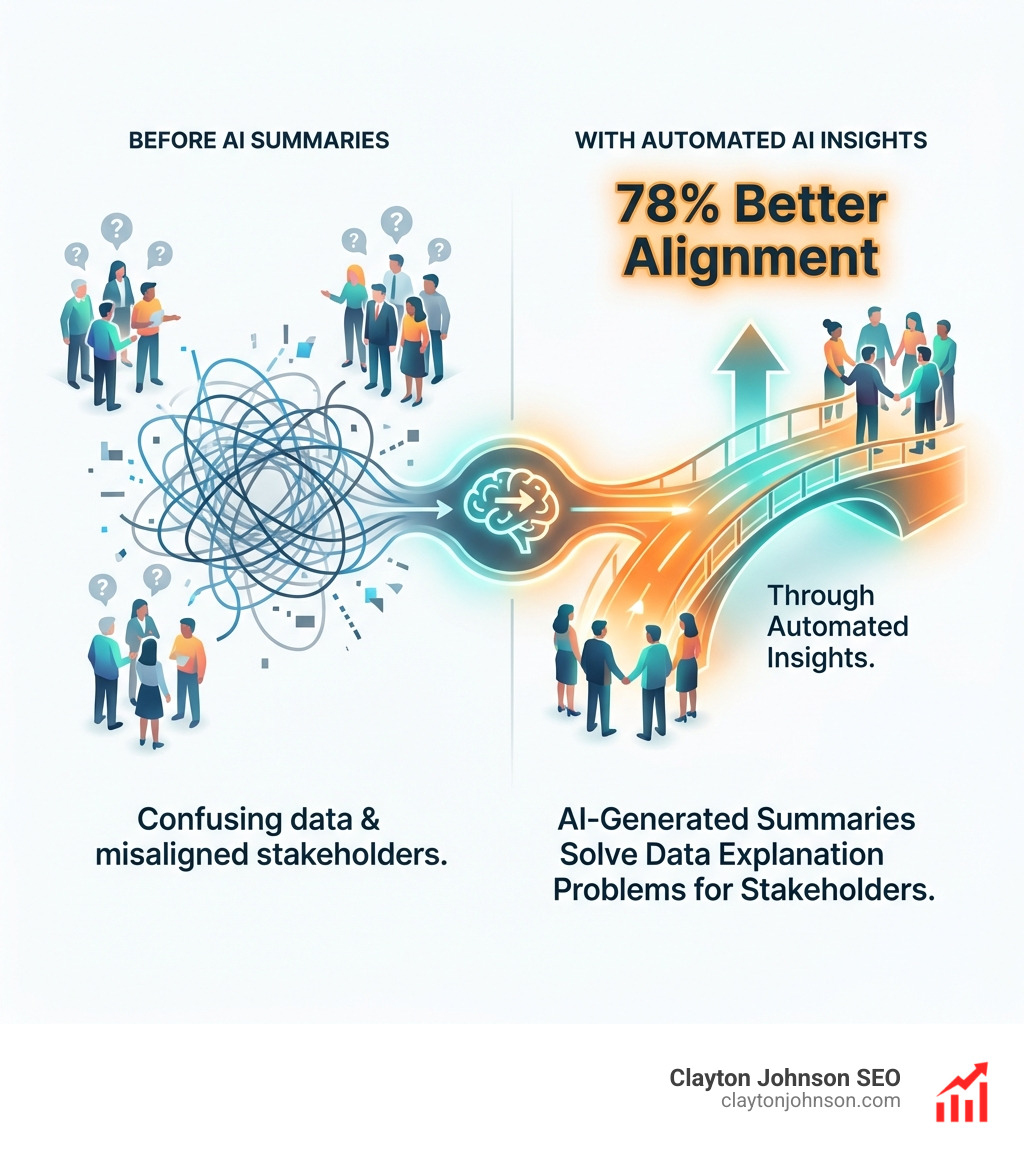
One of the biggest headaches for SEOs is explaining “SEO-speak” to a CEO. AI summaries use Natural Language Generation to turn complex data into “Executive Summaries.”
Instead of showing a client a technical audit of 500 pages, the AI writes: “We fixed 200 broken links this month, which improved our technical health score by 15% and is expected to boost organic traffic by 5% next month.” This level of transparency and clarity is what builds long-term trust. It’s about The Truth About AI SEO—making the invisible value of your work visible.
Frequently Asked Questions about Automated SEO Reporting
How accurate are AI-generated SEO insights?
AI is incredibly accurate at processing massive datasets, but it isn’t perfect. It can occasionally produce “false positives” (like flagging a intentional redirect as an error). This is why we recommend a “human-in-the-loop” approach. Use AI for the heavy lifting, but have a strategist review the final recommendations.
Can automated reports replace a human SEO strategist?
No. AI provides the “what” and the “how,” but humans provide the “why.” Strategic empowerment means using AI to handle the tactical execution so you can focus on creative decision-making and competitive positioning. AI is the engine; you are still the driver.
What are the privacy risks of using AI for SEO data?
When using Automated AI SEO reports, it is vital to set clear data handling protocols. Ensure you are using reputable tools with secure API connections and that you aren’t feeding sensitive proprietary information into public LLMs. Most enterprise SEO tools have strict compliance measures to protect your data.
Conclusion
At the end of the day, SEO isn’t just about keywords—it’s about structured growth architecture. Most companies don’t lack tactics; they lack the infrastructure to make those tactics scale.
By implementing Automated AI SEO reports, you are moving from a reactive state to a proactive one. You are building a system that provides clarity, structure, and leverage. This is exactly what we do at Clayton Johnson and through Demandflow.ai—helping founders and marketing leaders build growth engines that compound over time.
Stop wasting your life in spreadsheets. Start building your architecture.
Ready to take the next step? Explore our SEO Services and let’s build something that grows.