When You Can’t Pay Your Mortgage: Short Sale vs Foreclosure Explained
short sale vs foreclosure are two very different outcomes for homeowners who can no longer afford their mortgage — and choosing the wrong path can cost you years of financial recovery.
Here is a quick comparison to address the core difference:
| Factor | Short Sale | Foreclosure |
|---|---|---|
| Who initiates | Homeowner (with lender approval) | Lender |
| Process type | Voluntary | Involuntary |
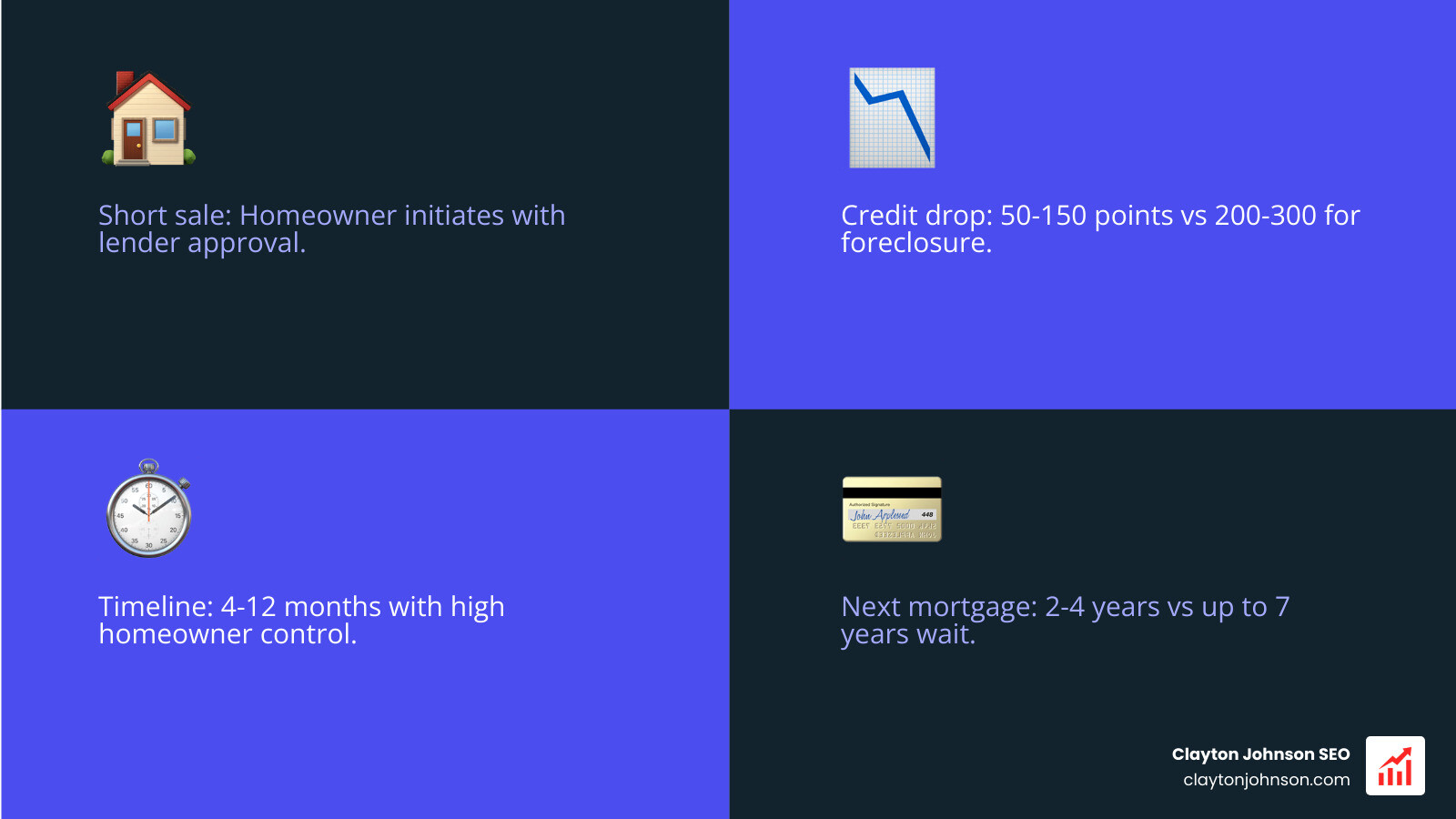
| Credit score impact | 50–150 point drop | 200–300 point drop |
| Stays on credit report | 7 years | 7 years |
| Time to next mortgage | 2–4 years (conventional) | Up to 7 years |
| Timeline | 4–12 months | 3 months to 3+ years |
| Homeowner control | High | None |
Both options mean losing your home. But how you lose it shapes your financial future for years.
A sudden job loss, a medical crisis, or an underwater mortgage can push any homeowner toward this decision. The stakes are high — and most people don’t realize how much better a short sale can be until it’s too late to choose it.
I’m Clayton Johnson, an SEO and growth strategist who works at the intersection of structured decision-making and financial clarity — including helping founders and marketing leaders understand the real-world mechanics behind topics like short sale vs foreclosure that affect long-term financial positioning. The sections below break down exactly why a short sale is almost always the smarter path forward.
Understanding the short sale vs foreclosure Process
When we look at the mechanics of a short sale, the defining characteristic is cooperation. In a short sale, we, as the homeowners, realize that the market value of our home has dipped below the balance of our mortgage. We are “underwater.” Instead of waiting for the bank to take the house, we ask the lender for permission to sell the property to a third party for less than what is owed.
Foreclosure is the opposite. It is an involuntary legal seizure. A foreclosure occurs when the lender moves to repossess the collateral (the home) because mortgage payments have stopped. This process usually culminates in a public auction where the home is sold to the highest bidder, often for a fraction of its true value.
The primary difference in the short sale vs foreclosure debate is control. In a short sale, you are the seller. You hire the agent, you show the home, and you participate in the negotiation. In a foreclosure, the bank’s attorneys handle everything, and you are eventually served an eviction notice.
Navigating the short sale vs foreclosure timeline
The clock ticks differently for each process. A short sale typically follows a 4-12 month window. It requires a mountain of documentation, including a hardship letter, tax returns, and bank statements, to prove to the lender that you truly cannot pay. Because the lender has to approve the final sale price, the “short” in short sale definitely doesn’t refer to the speed of the transaction!
Foreclosure timelines are heavily influenced by state laws. In Minnesota, the process is generally swifter than in “judicial” states like New York. Typically, the foreclosure process begins after you have missed three to four payments (about 120 days). Once the lender issues a notice of default, a pre-foreclosure period begins. If the debt isn’t cured, the home goes to auction. In some regions, a non-judicial foreclosure can wrap up in just 3-5 months, while judicial cases can drag on for over 900 days.
Why lenders prefer a short sale over foreclosure
You might wonder why a bank would ever agree to take less money than they are owed. The answer is simple: cost reduction. Foreclosing on a property is expensive. Lenders have to pay for legal fees, property preservation (mowing the lawn, fixing broken windows), and eventually, the costs of selling the home as a “Real Estate Owned” (REO) property.
By agreeing to a short sale, the lender avoids the “zombie foreclosure” scenario where a house sits vacant and decaying. It allows them to get bad debt off their books faster and often results in a higher recovery of the asset’s value than a public auction would. For the bank, it’s about mitigating loss; for us, it’s about preserving dignity and financial health.
Why a Short Sale is Better for Your Credit Score
If you are worried about your FICO score—and you should be—the short sale vs foreclosure decision is a no-brainer. While both will leave a mark, the depth of the “dent” varies significantly.
A short sale typically results in a credit score drop of 50 to 150 points. On your credit report, it will often show up as a “settled” account or “paid for less than the full balance.” While not perfect, it signals to future lenders that you worked proactively to resolve your debt.
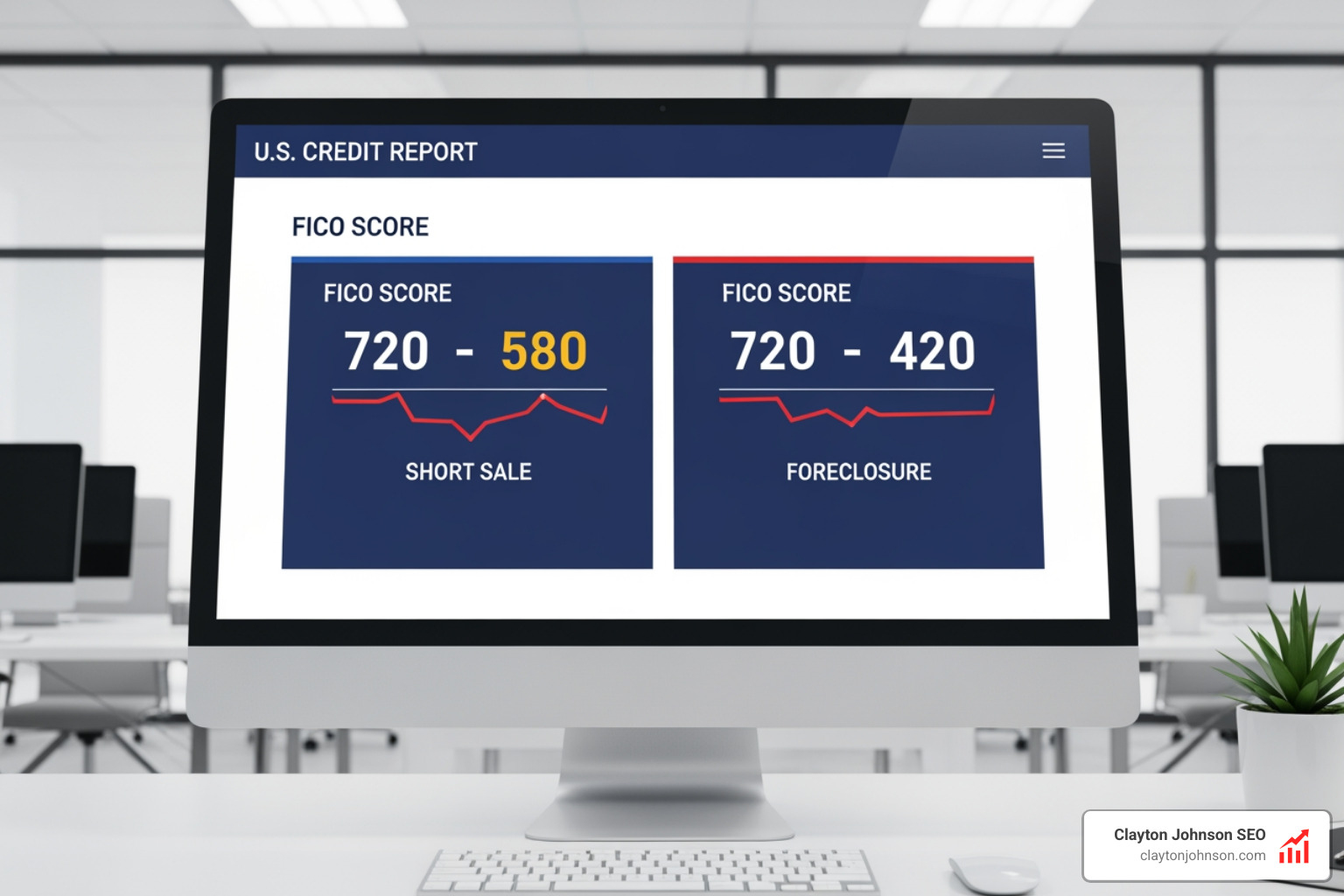
A foreclosure is much more damaging, often slashing scores by 200 to 300 points. Because a foreclosure is preceded by months of missed payments, the cumulative impact is devastating. This mark stays on your credit report for seven years and can even affect your ability to get a job or a security clearance. At Clayton Johnson, we understand that maintaining a strong digital and financial footprint is key to long-term leverage. If you want to learn more about how we apply this structured approach to online growth, check out our SEO services.
short sale vs foreclosure: Impact on future borrowing
The most practical reason to fight for a short sale is the “waiting period” for your next home. We all want to own again someday, and a short sale gets you back in the game much faster.
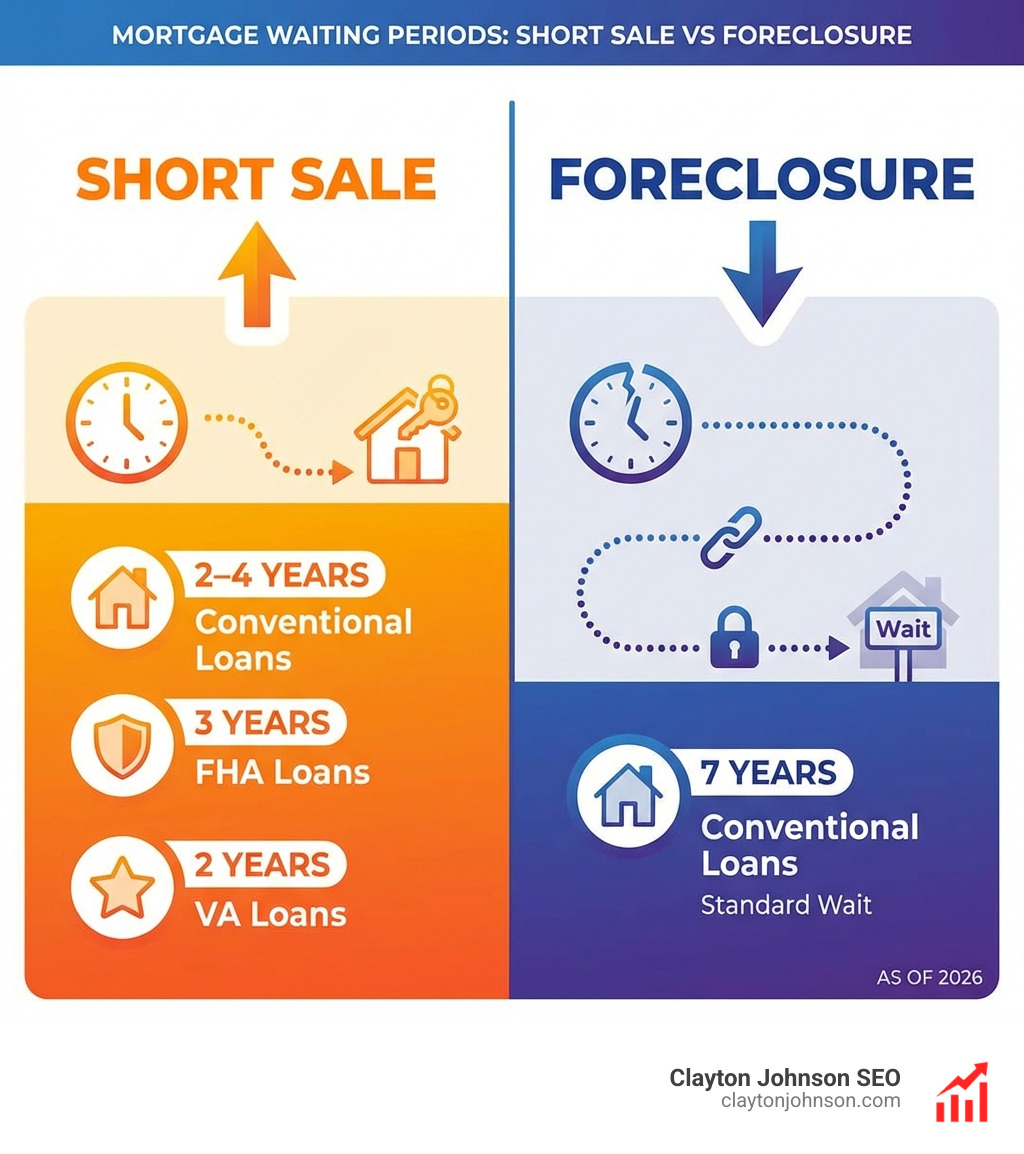
- Conventional Loans: After a short sale, you might qualify for a mortgage in just 2-4 years. After a foreclosure, the standard wait is 7 years.
- FHA Loans: You could be eligible for an FHA loan in 3 years after a short sale.
- VA Loans: For veterans, the wait can be as short as 2 years after a short sale.
Foreclosure creates a much higher barrier to entry. Lenders view a foreclosure as a total default, whereas a short sale is seen as a managed settlement.
Financial Consequences: Deficiency Judgments and Taxes
One of the scariest parts of losing a home is the “deficiency.” If you owe $300,000 and the house sells for $250,000, there is a $50,000 gap. In many cases, the lender has the legal right to pursue a “deficiency judgment” to collect that remaining balance from you.
In a short sale, we have the opportunity to negotiate. A skilled real estate attorney can often get the lender to waive the right to a deficiency in writing as a condition of the sale. In a foreclosure, especially a judicial one, the lender is much more likely to pursue you for the difference.
Then there are the “phantom taxes.” When a lender forgives debt, the IRS sometimes treats that forgiven amount as taxable income. If the bank forgives $50,000, they might send you a 1099-C, and you could owe taxes on that “income.” However, there are often legal protections for primary residences that can mitigate this. It is vital to compare your options, such as Short Sale vs. Deed in Lieu of Foreclosure, to see which provides the best tax protection.

Alternatives to Distressed Property Sales
Before committing to either path in the short sale vs foreclosure battle, we always recommend exploring every possible alternative. You might not have to lose the house at all.
- Loan Modification: The lender changes the terms of your loan (lower interest rate or longer term) to make payments affordable.
- Forbearance Agreement: A temporary pause or reduction in payments during a short-term hardship, like a medical leave.
- Deed in Lieu of Foreclosure: You voluntarily “hand over the keys” and the title to the bank. It is faster than a foreclosure but often carries a similar credit impact.
- Repayment Plans: If you missed a few payments, the lender might let you “catch up” by adding a small amount to your future monthly bills.
- Bankruptcy: While a last resort, Chapter 13 bankruptcy can sometimes allow you to keep your home by restructuring your debt over several years.
Conclusion
Navigating the complexities of short sale vs foreclosure requires more than just luck; it requires a structured strategy. At Clayton Johnson, we believe that clarity leads to leverage. Whether you are building a business or rebuilding your financial life, having a “growth architecture” is what separates those who struggle from those who compound their success.
If you are a founder or marketing leader looking to apply this level of structured thinking to your company’s growth, explore our structured growth architecture at Demandflow.ai. We help you turn tactics into a compounding operating system.
Frequently Asked Questions
Can I buy a house immediately after a short sale?
Generally, no. Most lenders require a waiting period of at least 2 years for a conventional loan, though FHA and VA guidelines can sometimes be more flexible if you didn’t default on any payments leading up to the sale.
Who pays the closing costs in a short sale?
In a short sale, the lender typically pays the real estate commissions and other closing costs. This is a major benefit for the homeowner, as you likely don’t have the cash on hand to cover these expenses.
Does a short sale or foreclosure affect my ability to rent?
Yes, both can. Many landlords run credit checks. A foreclosure is often viewed more harshly by property managers than a short sale. If you have a short sale on your record, being upfront with a potential landlord and showing a stable income can help bridge the gap.