Why AI-Driven SEO Audits Are No Longer Optional
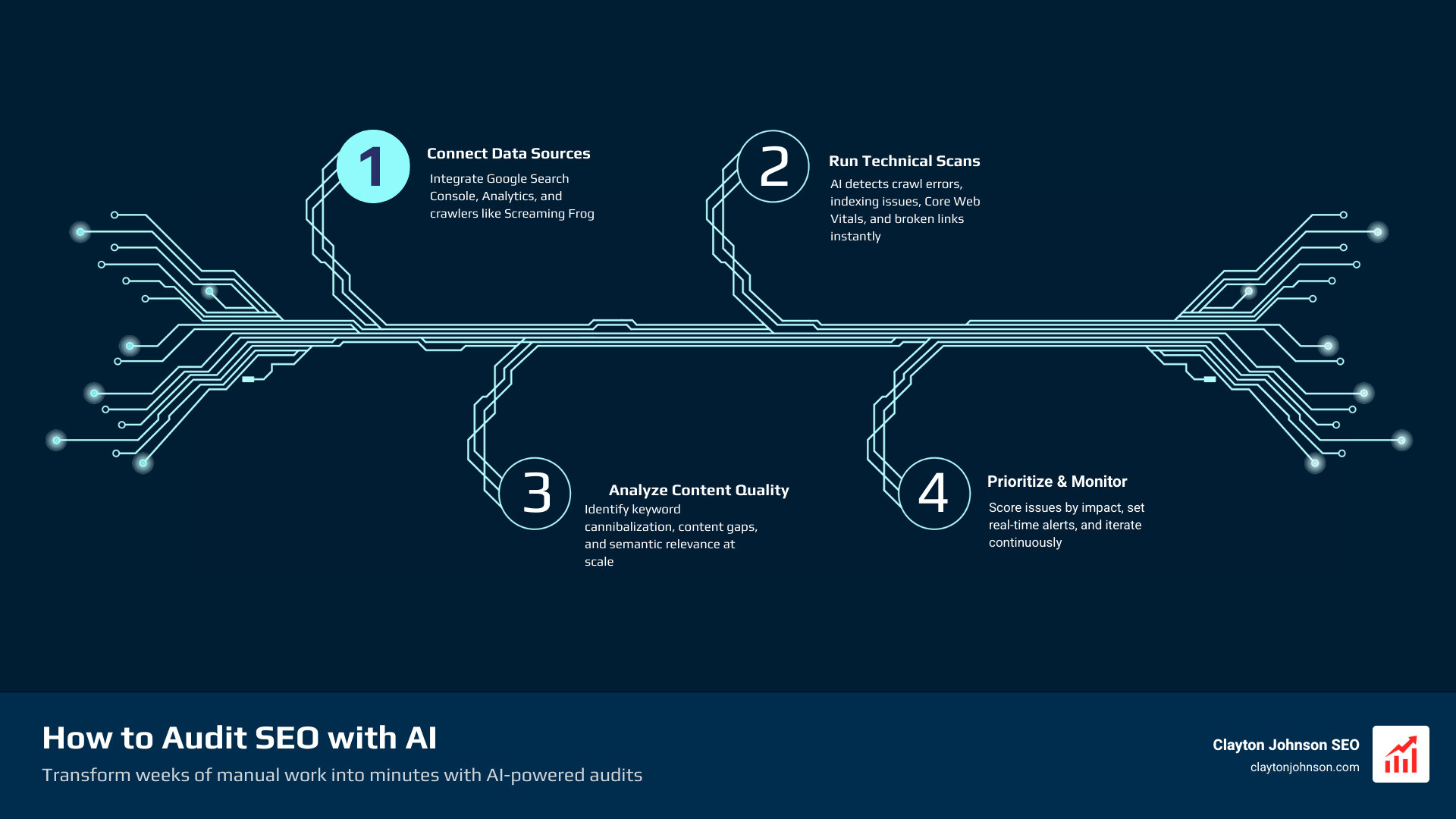
How to audit SEO with AI in five essential steps:
- Connect your data sources — Integrate Google Search Console, Analytics, and a crawler like Screaming Frog or Sitebulb
- Run automated technical scans — Let AI identify crawl errors, indexing issues, Core Web Vitals problems, and broken links at machine speed
- Analyze content quality at scale — Use AI to detect keyword cannibalization, content gaps, and semantic relevance across hundreds or thousands of pages
- Prioritize fixes by impact — AI scores issues by urgency and potential ranking impact, so you fix what matters first
- Monitor and iterate continuously — Set up real-time alerts and recurring audits to catch problems before they tank your traffic
Running an SEO audit site-by-site requires 40 hours of work per month. Analyzing keywords? Another 30 hours. By the time your team generates reports, the data is already outdated.
Meanwhile, Google pushes 500+ algorithm updates yearly, millions of new pages publish daily, and search patterns shift by the hour. Manual audits can’t keep pace with that scale — and neither can most marketing teams.
AI changes the equation. It doesn’t just speed up the audit process; it transforms how you detect technical issues, uncover hidden ranking opportunities, and optimize for emerging search behaviors like AI Overviews, conversational queries, and answer engines. What used to take weeks now takes minutes, freeing your team to focus on strategy instead of spreadsheet wrangling.
But AI isn’t a replacement for human judgment. It’s a force multiplier. The best results come from combining AI’s data-processing power with human expertise in brand positioning, content strategy, and business goals.
This guide walks you through exactly how to audit SEO with AI — from setting up your tools and integrating data sources to identifying technical snags, content gaps, and competitive blind spots. You’ll learn which AI capabilities matter most, how to prioritize fixes, and how to avoid common pitfalls like false positives and tool complexity.
I’m Clayton Johnson, and I’ve spent years building AI-assisted SEO frameworks that help founders and marketing leaders turn fragmented efforts into structured growth engines. In this guide, I’ll show you how to audit SEO with AI in a way that’s both efficient and strategically sound.
How to audit seo with ai definitions:
Why You Must Learn How to Audit SEO with AI
If you feel like you’re running a race where the finish line keeps moving, you aren’t alone. In the modern search landscape, staying “optimized” is a moving target. Data shows that 78% of organizations now use AI in their marketing operations. If your competitors are using machine learning to find their blind spots while you’re still manually checking meta tags, you’re essentially bringing a knife to a drone fight.
The sheer volume of data is the primary driver for this shift. With millions of new pages published daily and search patterns shifting by the hour, human-led audits are often “dead on arrival.” By the time a manual report is finished, a new algorithm update has likely changed the rules.
Learning how to audit SEO with AI allows us to:
- Process Massive Datasets: AI can correlate server logs, crawl data, and ranking trends in seconds.
- Identify Hidden Patterns: Machine learning spots clusters of underperforming pages that humans might overlook.
- Gain a Competitive Edge: Predictive AI can forecast which content gaps are most likely to yield traffic gains.
At Clayton Johnson SEO, we believe in AI-Driven SEO Audits not just for speed, but for the structural clarity they provide. We move from reactive “fixing” to proactive “growth architecture.”
The Core Components of an AI-Powered Website Audit
An AI-powered audit isn’t just a traditional audit done faster; it’s a more comprehensive look at your site’s health. It covers everything from the “bones” of your site (technical SEO) to the “soul” of your content (quality and relevance).
| Feature | Manual SEO Audit | AI-Powered SEO Audit |
|---|---|---|
| Speed | Weeks to months | Minutes to hours |
| Data Scope | Small samples | Entire site (100k+ pages) |
| Pattern Recognition | Human-detected | Algorithmic clustering |
| Predictive Insights | None (Historical only) | Forecasts ranking impact |
| Actionability | Static checklist | Prioritized roadmap |
To start, you need a solid foundation. This usually involves a tool like the Screaming Frog SEO Spider, which can now integrate with AI APIs to perform bulk analysis on your crawl data.
Technical Monitoring and How to Audit SEO with AI at Scale
Technical SEO is where AI truly shines. It can identify “silent killers” like redirect chains, orphan pages, and JavaScript rendering issues that might be invisible to a casual observer. Tools like Sitebulb provide visual maps of your site architecture, helping you see where your crawl budget is being wasted.
When we look at how to audit SEO with AI at scale, we focus on:
- Crawlability: Ensuring bots aren’t getting stuck in “calendar traps” or infinite faceted navigation.
- Indexing: Using AI to cluster URLs that are “Discovered – currently not indexed” to find systemic blockers.
- JavaScript Execution: Comparing pre-rendered and post-rendered HTML to ensure your critical content is actually being seen by search engines.
Content Quality and Answer Engine Optimization (AEO)
Content is no longer just about keywords; it’s about satisfying search intent. AI helps us move beyond simple “keyword density” and into semantic relevance. By using Top AI Content Audit Tools, we can perform entity analysis—checking if our content covers the concepts, products, and platforms that search engines expect to see.
This is the heart of Answer Engine Optimization (AEO). AI search engines like ChatGPT, Claude, and Google’s AI Overviews don’t just look for links; they look for answers. An AI audit can tell you if your content is “liftable”—meaning, is it structured in a way that an AI can easily cite it in a generated response?
Step-by-Step Process for Conducting Your AI SEO Audit
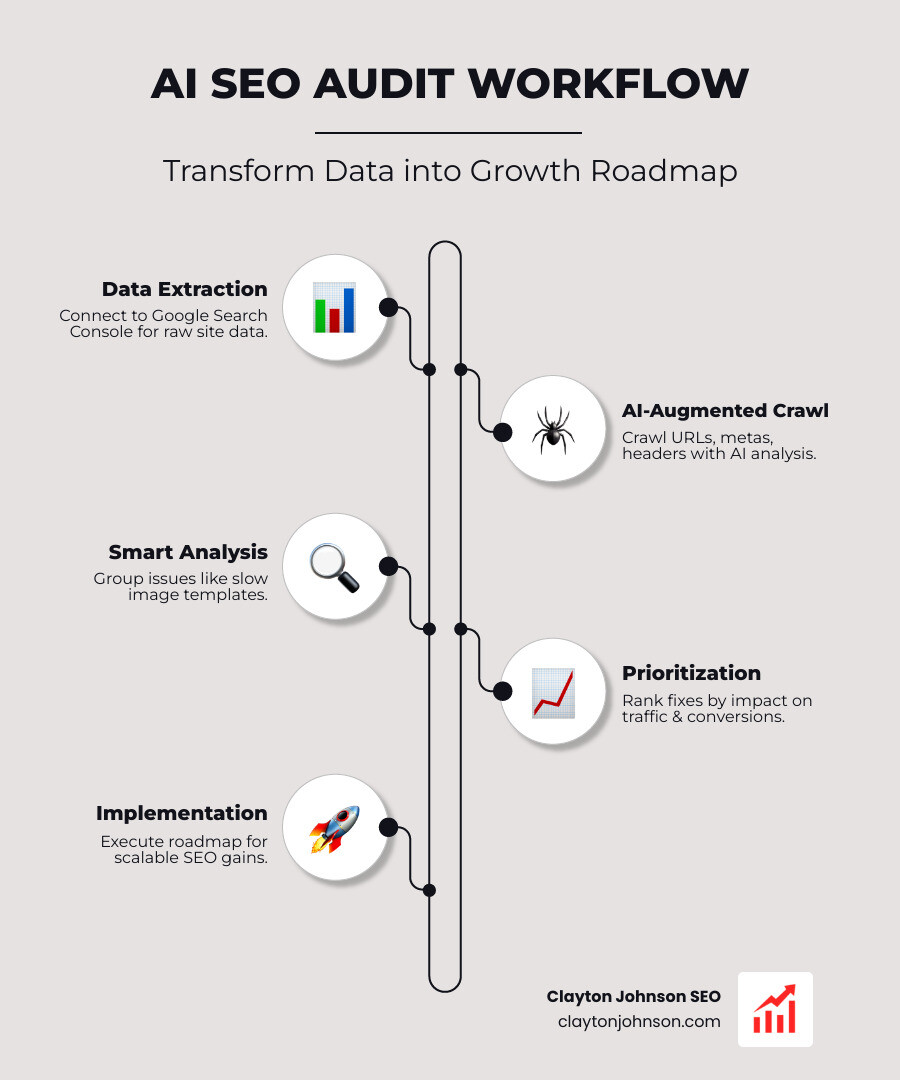
Ready to get your hands dirty? Here is the workflow we use to transform raw data into a growth roadmap.
Step 1: Data Extraction and Tool Integration
You can’t audit what you can’t see. Start by connecting your site to Google Search Console. This is your primary source of truth for how Google perceives your site.
Step 2: Running the AI-Augmented Crawl
Use a crawler to gather every URL, meta tag, and header on your site. If you’re using a tool like Screaming Frog, you can connect it to the OpenAI API to analyze page titles or generate summaries for every page as it crawls.
Step 3: Analysis and Prioritization
This is where the magic happens. Instead of a list of 5,000 “errors,” AI helps us group issues. For example, it might find that 80% of your slow-loading pages share the same image template. Fixing that one template is much more efficient than manual optimization.
Integrating AI with Google Search Console and Analytics
To get real-time value, Google Search Console Integration is essential. It allows for continuous monitoring rather than a one-off report. By layering Google Analytics data on top, we can see which technical issues are actually hurting your bottom line.
For instance, if AI detects a 40% traffic drop on your highest-converting landing pages, it can immediately correlate that with a recent JavaScript update. This kind of “detective work” used to take hours of manual cross-referencing.
Identifying Hidden Opportunities and How to Audit SEO with AI for GEO
Beyond fixing errors, AI helps us find “hidden gems.” This is where Generative Engine Optimization (GEO) comes in. GEO is the practice of optimizing your content specifically to be included in AI-generated responses.
In The Ultimate Guide to AI-Driven SEO Strategy and Systems, we discuss how to use AI to:
- Find Ranking Gaps: Identify topics where your competitors are being cited by AI but you are absent.
- Optimize for Conversational Queries: Search is becoming a conversation. AI audits can help you reformat your content to answer the “who, what, where, and why” questions that drive voice and AI search.
- Local SEO Precision: For businesses in Minneapolis, Minnesota, AI can audit your NAP (Name, Address, Phone) consistency across the web to ensure local AI agents recommend you correctly.
Frequently Asked Questions about AI SEO Audits
When you’re Content Auditing for Humans Who Use Robots, questions are bound to arise. Here are the most common ones we hear.
What is the difference between GEO and AEO?
Think of AEO (Answer Engine Optimization) as the broad goal: making your content the best answer for any engine (Google, Alexa, Siri). GEO (Generative Engine Optimization) is a specific subset focused on Large Language Models (LLMs) like ChatGPT or Perplexity. GEO involves making your content highly “citable” so the AI gives you credit when it generates an answer.
Can AI tools replace human SEO experts?
In a word: No. AI is fantastic at finding patterns and processing data, but it lacks “business soul.” It doesn’t understand your unique brand voice, your specific profit margins, or the nuances of your industry’s culture. AI provides the data; humans provide the strategy. At Clayton Johnson SEO, we use AI to do the heavy lifting so our experts can focus on the high-level growth architecture.
Which AI tools are best for technical audits?
For deep crawls, Screaming Frog and Sitebulb are industry standards that have integrated AI features. For real-time monitoring, tools like Siteimprove or Nightwatch are excellent. If you want a more “agentic” experience—where the AI suggests and prioritizes fixes autonomously—platforms like GoInsight.ai or Demandflow are the future.
Conclusion: Building for Compounding Growth
The goal of learning how to audit SEO with AI isn’t just to have a cleaner website. It’s to build a structured growth infrastructure that compounds over time. Most companies don’t lack tactics—they lack a system.
At Clayton Johnson SEO, we are building Demandflow.ai to solve this exact problem. We combine actionable strategic frameworks with taxonomy-driven SEO systems to move you away from “content marketing” and toward “growth architecture.”
Clarity leads to structure. Structure leads to leverage. And leverage leads to the kind of compounding growth that defines market leaders. If you’re ready to see how our AI SEO Services can transform your site, let’s start with an audit.

Ready to future-proof your visibility? Explore our AI SEO Strategy and let’s build something that lasts.