What Competitive Pressure in Business Actually Means (And Why It Matters)
What is competitive pressure in business is one of the most searched strategy questions — and for good reason. Here’s the short answer:
Competitive pressure is the force that rivals put on your business — making it harder to grow, charge what you want, or keep customers coming back.
It comes from two directions:
- Direct competitors — businesses selling the same thing to the same people
- Indirect competitors — alternatives that solve the same problem differently
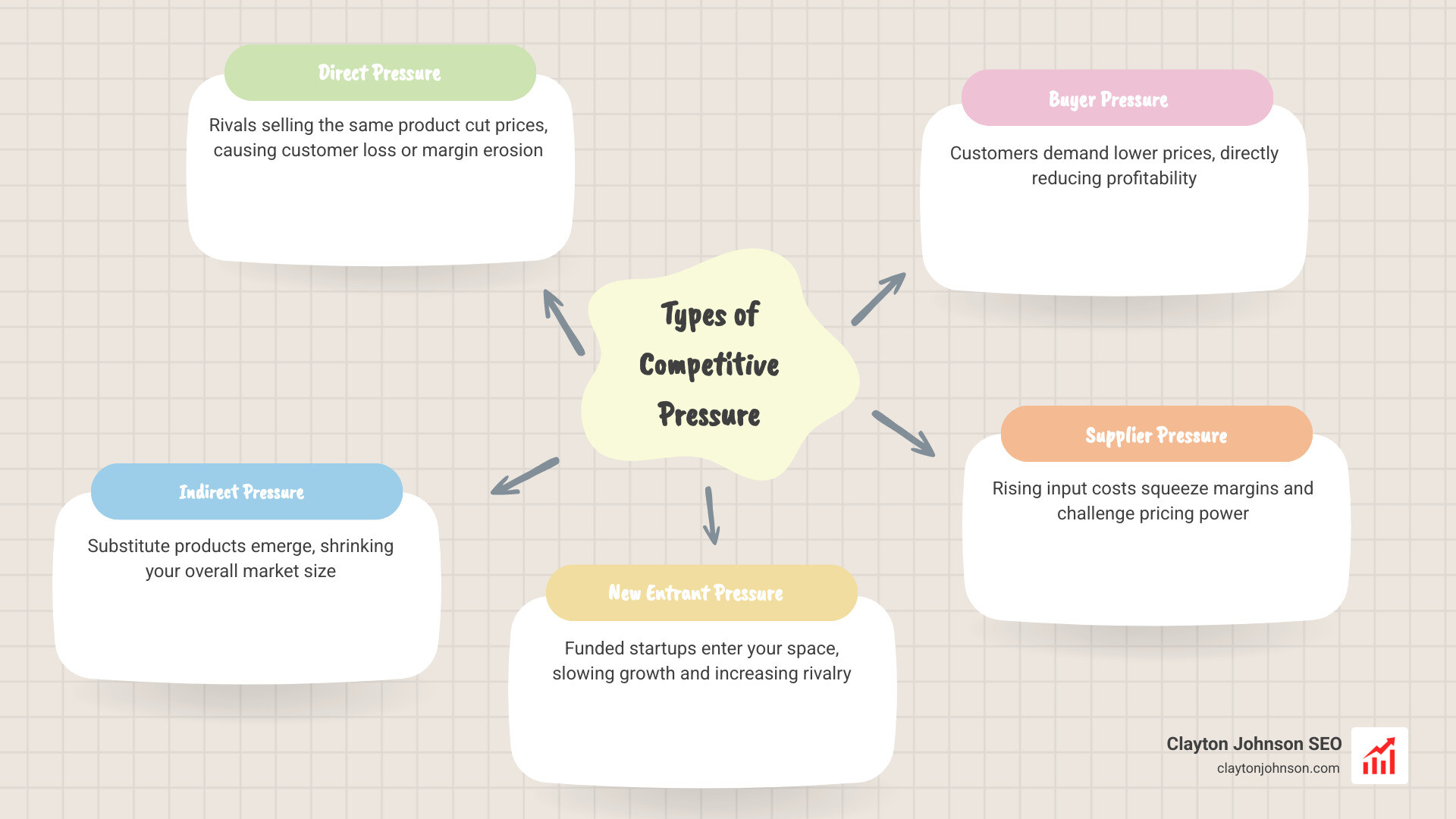
Quick breakdown:
| Type | Example | Effect |
|---|---|---|
| Direct pressure | A rival cuts prices | You lose customers or margin |
| Indirect pressure | A substitute product emerges | Your market shrinks |
| New entrant pressure | A funded startup enters your space | Growth slows |
| Buyer pressure | Customers demand lower prices | Profitability drops |
| Supplier pressure | Input costs rise | Margins get squeezed |
The intensity of this pressure varies by industry. In some markets, it’s a slow burn. In others — especially saturated, fast-moving ones — it can threaten a business’s survival almost overnight.
And if you’re running a growing company trying to win online visibility and attract better clients, understanding where this pressure comes from is the first step to doing something about it.
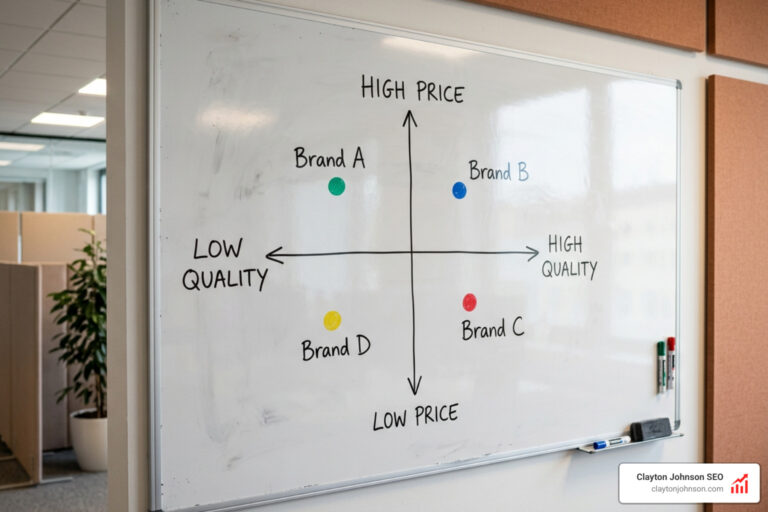
What is Competitive Pressure in Business?
When we talk about what is competitive pressure in business, we are essentially describing the “heat” in the kitchen. As Chris Daily notes, it is a term used to describe the intensity of competition within an industry. It isn’t just about one rival opening a shop across the street; it is the cumulative effect of market forces that challenge your growth, squeeze your pricing power, and make customer acquisition feel like an uphill battle.

In modern business, this pressure manifests in several ways:
- Direct Rivals: These are the folks selling a nearly identical product. When they innovate or drop prices, you feel it instantly.
- Indirect Rivals: These are the “sneaky” competitors. They don’t sell what you sell, but they solve the same problem. For example, a movie theater’s indirect competitor isn’t just another theater—it’s Netflix or a local bowling alley.
- Customer Retention Challenges: High pressure means your customers have endless options. If your service slips even slightly, the “switching cost” for them is often zero, leading to high churn.
- Market Fluidity: This refers to how quickly product spaces change. Research shows that as market fluidity increases, firms face more pressure to constantly redefine their offerings just to stay relevant.
For startups, the ecosystem is even more intense. You aren’t just fighting for customers; you’re fighting for VC attention and trying to outpace “copycat” products that appear the moment you show a hint of success. Understanding how to think about competitive pressure requires looking beyond your own four walls and realizing that the market is a living, breathing set of constraints.
The Five Forces Framework for Analyzing Pressure
To truly master the market, we have to look at the gold standard of competitive analysis: Michael Porter’s Five Forces Model. Porter, a Harvard Business School professor, identified that competitive pressure doesn’t just come from your direct rivals—it comes from five distinct “competitive forces.”
Here is a look at how these forces distribute pressure across an industry:
| Force | Direction | Impact on Your Business |
|---|---|---|
| Competitive Rivalry | Horizontal | Intense price wars and high marketing spend. |
| Threat of New Entrants | Horizontal | New players bring new capacity and desire for market share. |
| Threat of Substitutes | Horizontal | Customers find a different way to get the same result. |
| Bargaining Power of Buyers | Vertical | Customers force prices down or demand higher quality for less. |
| Bargaining Power of Suppliers | Vertical | Suppliers raise prices, eating into your profit margins. |
Understanding these forces is the key to how to master the 5 forces of competition. For instance, high entry barriers—like massive capital requirements or exclusive access to distribution channels—can protect you. If it’s easy for anyone to start a business in your niche, the pressure will always be high. Conversely, economies of scale allow larger firms to spread costs over more units, creating a massive price advantage that smaller players struggle to match.
Using market industry and competitive analysis helps you identify which of these five holes is leaking the most profit from your bucket.
How Saturated Markets Impact What is Competitive Pressure in Business
We’ve all seen it: a new trend emerges, and suddenly there are 500 companies offering the exact same solution. This is market saturation. It happens because of globalization (competition is now global, not local) and technological advancements that have lowered the barriers to entry.
In a saturated market, the competitive analysis 101 rule is that your Marketing ROI will naturally diminish. Why? Because you’re bidding on the same keywords and fighting for the same eyeballs as everyone else. This leads to “consumer weariness”—customers become cynical and bored with copycat products, making it even harder to earn their trust.
Bargaining Power and Substitute Threats
Don’t overlook the “vertical” pressure. If you rely on a single supplier for a key component, they hold the cards. They can raise prices, and you have to eat the cost. On the flip side, if your customers are large corporations that make up 80% of your revenue, they have the power to dictate your prices.
Then there’s the threat of substitutes. This is different from a direct competitor. A substitute for a high-end steakhouse isn’t just another steakhouse; it’s a high-quality home meal kit. To fight this, businesses must build brand loyalty and increase switching costs—making it “painful” or inconvenient for a customer to leave. We see this in software ecosystems where all your data is stored in one place; leaving for a rival becomes a massive chore. Using strategic frameworks for competitive analysis allows us to map these threats before they become existential crises.
The Impact of Pressure on Innovation and ESG
Does competitive pressure make a company “better”? It’s a double-edged sword. While it can drive the innovation pace, it can also force companies to cut corners.
A fascinating area of research on Competitive Pressure and ESG (Environmental, Social, and Governance) shows a clear trade-off. When businesses are under extreme financial strain due to competition, they often deprioritize “costly” ESG activities.
- The 4% Stat: A one standard deviation increase in product fluidity (a measure of competitive pressure) is associated with a nearly 4 percent reduction in ESG scores.
- Financial Constraints: Firms with less “slack” in their budget are the first to drop sustainability initiatives when a rival starts undercutting their prices.
- Capital Intensity: Industries that require heavy equipment and massive upfront investment feel this squeeze even more acutely.
Essentially, when the “war” for market share gets bloody, long-term social norms and climate attitudes often take a backseat to short-term survival.
Founder Burnout and Startup Survival
We cannot talk about business pressure without talking about the human cost. The startup world is a pressure cooker. Statistics show that 72% of founders experience burnout at some point in their journey.
The pressure isn’t just from the market; it’s from the “pedigree” bias in VC funding. Top venture capital funds still lean heavily toward founders with specific backgrounds, leaving many brilliant innovators fighting for scraps. This is why companies like Upside Health—which targets chronic pain management affecting over 145 million Americans—are so vital; they tackle massive problems despite the intense competitive and systemic pressures. To survive, you must stop letting your rivals win with a competitive content gap finder and start finding the “white space” they’ve missed.
Strategies to Overcome Competitive Pressure
So, how do we win? We don’t just work harder; we work smarter by building a system of differentiation.
- Strategic Partnerships: You don’t have to go it alone. By partnering with others, you can access new audiences without the massive cost of traditional customer acquisition.
- Affiliate Marketing: This is a performance-based powerhouse. For example, a software brand (Vyond) managed to reverse a revenue decline and achieve a 24% YOY increase simply by leveraging a smart affiliate partnership campaign.
- Influencer Marketing: This isn’t just for lifestyle brands anymore. The global influencer market is expected to reach $32.55 billion soon. It allows you to borrow the trust an influencer has already built with your target audience.
- Competitive Intelligence: You must stop guessing and start positioning with competitive intelligence. This means knowing your rival’s next move before they make it.
By using AI competitive insights to outsmart your rivals, we can identify exactly where a competitor is weak and strike there, rather than fighting them head-on where they are strong.
Using AI to Navigate What is Competitive Pressure in Business
Artificial Intelligence has changed the game for how we respond to what is competitive pressure in business. We no longer have to manually track every price change or blog post from a rival.
- AI-Powered Analysis: Tools can now “score” your brand against competitors in real-time.
- APVision & Real-Time KPIs: Advanced systems like APVision allow businesses to track partner success and optimize campaigns on the fly. This level of operational efficiency was impossible a decade ago.
- Data-Driven Decisions: Instead of “gut feelings,” we use AI competitive analysis tools to see content gaps, backlink opportunities, and shifts in consumer sentiment.
When you how to score your brand with AI-powered competitive analysis, you move from a reactive state (panicking because a rival launched a sale) to a proactive state (knowing your brand’s unique value is protected by a moat of data).
Frequently Asked Questions about Competitive Pressure
How does competitive pressure affect pricing and market share?
Competitive pressure usually acts as a “price ceiling.” If your rivals offer a similar product for $50, you’ll find it very hard to charge $100 unless you can prove significantly higher value. If you can’t differentiate, you’re forced into a “race to the bottom” on price, which erodes your market share and profit margins.
Can startups survive high competitive pressure without massive funding?
Yes, but it requires extreme focus. Startups survive by finding “niches within niches”—areas the big, funded players are too slow or too “corporate” to serve. By focusing on a specific customer pain point (like chronic pain management) and building a community, a startup can thrive without a billion-dollar war chest.
What role do channel conflicts play in competitive intensity?
Channel conflicts happen when your own distribution partners start competing with you or each other. For example, if a manufacturer sells directly on their website while also selling through retailers, it creates a “vertical” pressure. Managing these relationships with clear boundaries and transparent pricing is essential to prevent your own partners from becoming your biggest competitive headache.
Conclusion
At the end of the day, understanding what is competitive pressure in business isn’t about fearing your rivals—it’s about respecting the forces at play and building a system to navigate them.
Our philosophy at Clayton Johnson SEO is simple: Clarity → Structure → Leverage → Compounding Growth. We don’t just chase the latest SEO tactics; we build durable systems. By using Strategic Frameworks for Competitive Analysis, we help you turn fragmented marketing efforts into a coherent growth engine.
Don’t let market pressure push you around. Use it as fuel to innovate, differentiate, and ultimately, outsmart the competition. Ready to see how your brand stacks up? It’s time to stop guessing and start building your moat.