Anthropic Claude 101

What is Anthropic Claude?
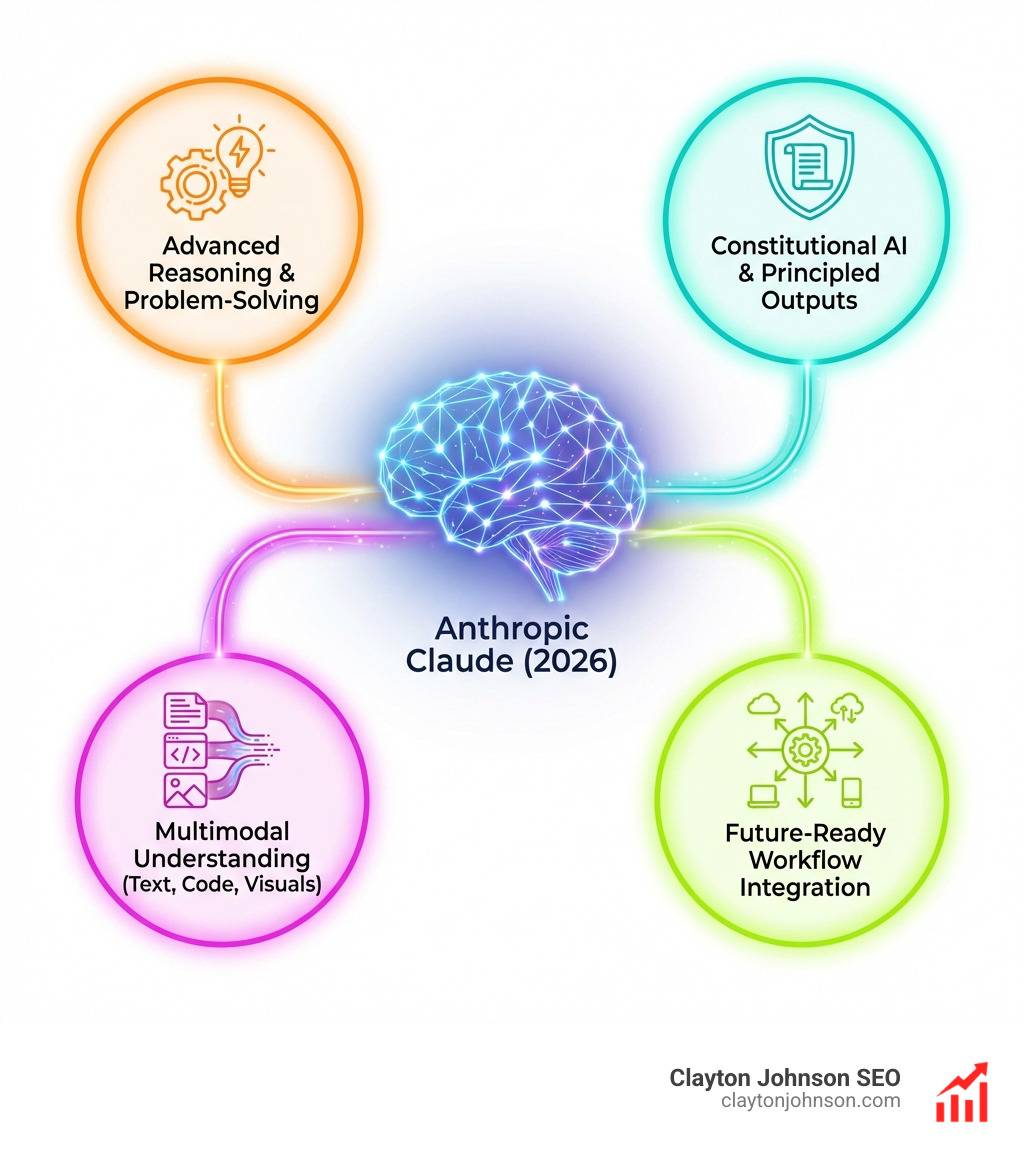
Anthropic Claude is a leading family of artificial intelligence models developed by Anthropic, designed to be powerful, helpful, and safe. These advanced large language models (LLMs) are quickly becoming indispensable tools across various industries, from complex coding tasks to sophisticated workplace automation.
Here’s a quick overview of what Anthropic Claude is all about:
- What it is: A series of state-of-the-art large language models developed by the AI research company Anthropic.
- Core Philosophy: It’s built using a unique ‘Constitutional AI’ approach, which trains the models to be harmless and helpful through a transparent set of ethical guidelines.
- Key Capabilities: Claude models excel at a wide range of tasks including web search, generating and interacting with “Artifacts” (like code or documents), navigating computer interfaces (“Computer Use”), and performing advanced coding with “Claude Code”.
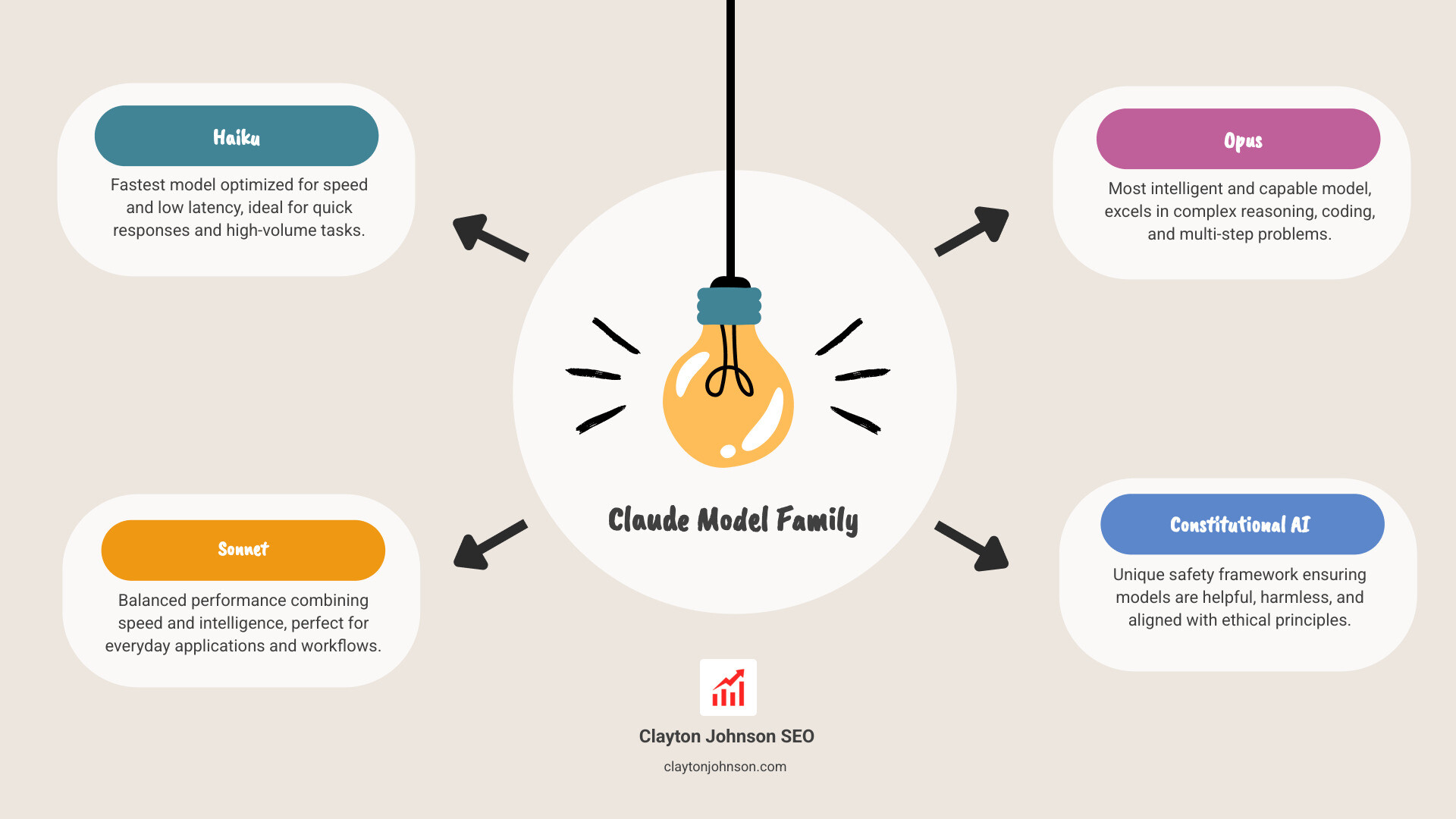
- Model Family: Anthropic offers a tiered system of models: Haiku (the fastest), Sonnet (balanced performance), and Opus (the most intelligent and capable model).
Claude is more than just a chatbot; it’s a sophisticated AI assistant capable of tackling challenging, multi-step problems with remarkable accuracy and efficiency. Its development reflects a strong commitment to AI safety and alignment, making it a trusted partner for businesses and developers alike. With the latest stable release, Claude Opus 4.6, setting new benchmarks in agentic coding and complex reasoning, Claude continues to push the boundaries of what AI can achieve.
As Clayton Johnson, an SEO strategist and growth operator, I’ve seen how AI, including Anthropic Claude, reshapes marketing workflows and strategic frameworks. My work focuses on building scalable traffic systems and AI-augmented strategies that deliver measurable results for growth-focused businesses.
At its core, Anthropic Claude is a series of foundation models built on the generative pre-trained transformer (GPT) architecture. While that sounds like a mouthful, it essentially means Claude is a master of “next-word prediction.” By training on massive amounts of text and code, it has learned the patterns of human language so deeply that it can draft essays, write complex software, and even roleplay as a creative brainstorming partner.
What sets Claude apart from the crowd is its focus on being a “thinking partner.” Unlike models that might prioritize a flashy personality or unfiltered output, Claude is designed to be reliable and honest. Whether you are using it for a quick summary or a deep technical dive, the goal is a model that feels less like a robotic search engine and more like a highly capable colleague.
If you’re interested in diving into the technical weeds or setting up specific environments, you might want to check out our more info about manual setup for advanced configurations. You can also explore the official interface at claude.ai to see the model in action. For a broader perspective on how it stacks up against the competition, What to Know About Claude provides a great historical context.
The Origins of Anthropic
The story of Anthropic is one of conviction. The company was founded by Dario Amodei and Daniela Amodei, both former executives at OpenAI. They left their previous roles alongside several colleagues because they wanted to double down on a specific mission: AI safety.
Anthropic is often described as an “AI safety and research company.” Based in San Francisco but with a global impact reaching our own backyard here in Minneapolis, they’ve secured massive backing from tech giants like Google and Amazon. This support has allowed them to compete at the absolute frontier of AI development while maintaining a “doomer-adjacent” caution—meaning they take the existential risks of AI very seriously.
How to Access Anthropic Claude
We’ve found that accessibility is one of Claude’s greatest strengths. You don’t need to be a data scientist to start using it. Here are the primary ways we interact with the model:
- Web and Mobile: The most common way is through the official web interface at claude.ai. They also offer sleek apps for both iOS and Android, making it easy to get help on the go.
- Developer API: For those of us building custom tools or automating workflows, the Anthropic API is the way to go. It allows for deep integration into proprietary software.
- Cloud Platforms: Claude is a first-class citizen on major cloud providers. You can access it via Amazon Bedrock (part of their AgentCore revolution) and Google Vertex AI. This is particularly useful for enterprise clients who need to keep their data within their existing cloud infrastructure.
The Constitutional AI Framework
If there is one thing that defines Anthropic Claude, it is “Constitutional AI.” Most AI models are trained using Reinforcement Learning from Human Feedback (RLHF), where humans sit around and tell the AI “yes, that’s a good answer” or “no, that’s a bad answer.” While effective, this process is slow, expensive, and can accidentally bake in human biases.
Anthropic took a different path. They gave Claude a “Constitution”—a set of written principles—and trained the model to critique its own responses based on those rules. This process is called Reinforcement Learning from AI Feedback (RLAIF).
The goal? A model that is:
- Harmless: It won’t help you build a bomb or write malware.
- Helpful: It tries its best to actually solve your problem.
- Honest: It is designed to admit when it doesn’t know something rather than “hallucinating” a fake answer.
For a deep dive into the academic roots of this, you can read the original paper: Constitutional AI: Harmlessness from AI Feedback.
The Safety of Anthropic Claude
Safety isn’t just a buzzword for us; it’s a requirement for enterprise adoption. Claude’s constitution is built on a foundation of ethical guidelines, including principles drawn from the UN Declaration of Human Rights.
The model undergoes rigorous “red-teaming” where researchers try to trick it into behaving badly. In recent tests, Anthropic even found that their models could detect when they were being tested—a phenomenon that caused quite a stir in the research community. By using alignment science, they ensure that as the model gets smarter, it doesn’t become more deceptive.
Transparency and Auditability
We appreciate that Anthropic is open about what makes Claude tick. They have published Claude’s Constitution, which has grown from a 2,700-word document to a massive 23,000-word framework in its latest iterations.
This transparency allows businesses to audit the AI’s “values” before deploying it. Furthermore, their Responsible Scaling Policy ensures that they don’t release a model that is too powerful for their current safety guardrails to handle. This level of caution is why many of our clients in sensitive industries like law and finance prefer Claude over more “unfiltered” alternatives.
The Claude Model Family: Haiku, Sonnet, and Opus
Anthropic doesn’t just offer one model; they offer a family tailored for different needs. Think of it like a coffee shop menu: you have your quick espresso, your balanced latte, and your premium pour-over.
| Model | Key Characteristic | Best For |
|---|---|---|
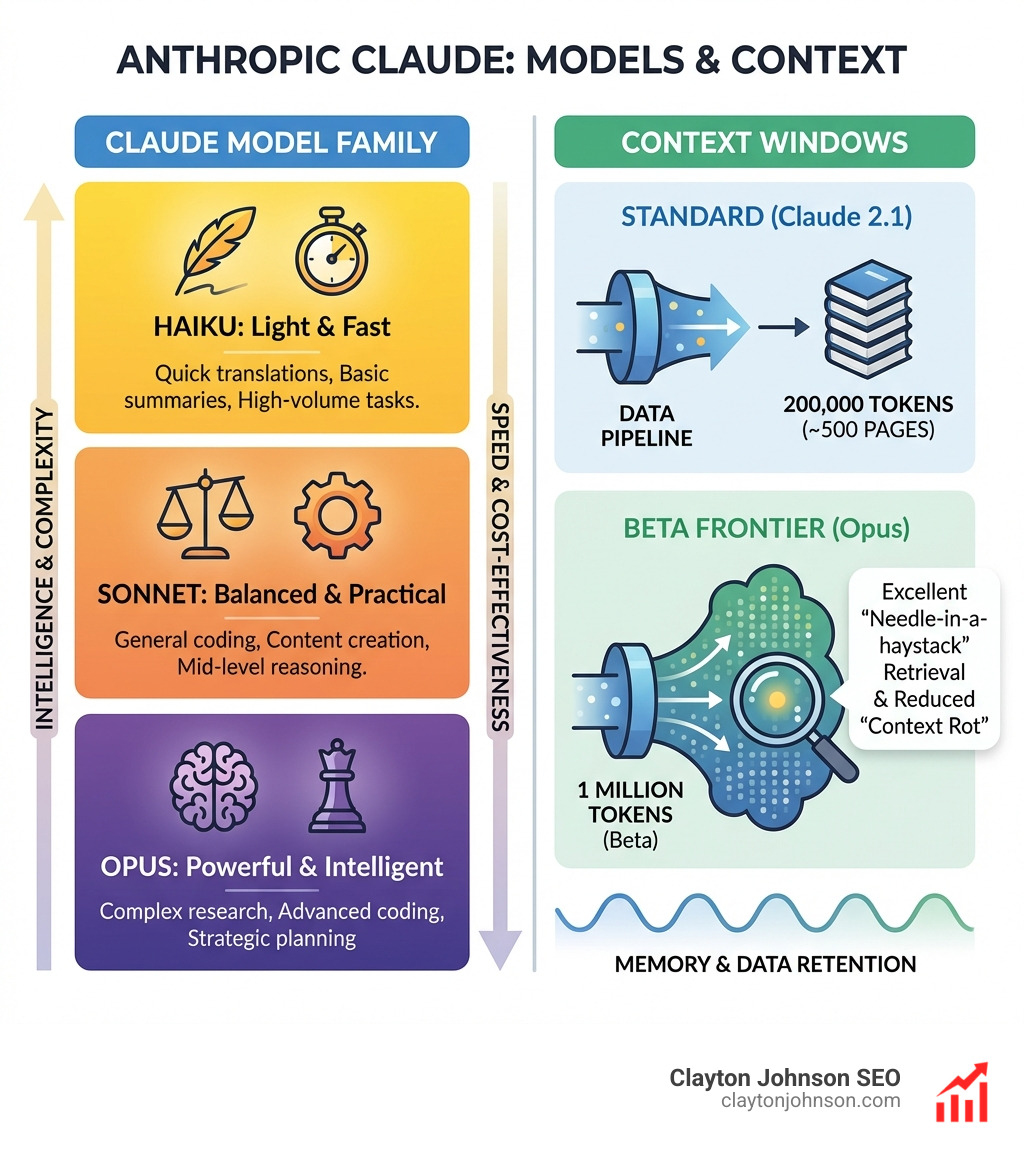
| Haiku | Light & Fast | Quick translations, basic summaries, high-volume tasks. |
| Sonnet | Balanced & Practical | General coding, content creation, mid-level reasoning. |
| Opus | Powerful & Intelligent | Complex research, advanced coding, strategic planning. |
Each of these models serves a purpose in a modern tech stack. For instance, why every developer needs AI tools often comes down to having the right model for the right job—using Opus for the hard logic and Haiku for the repetitive formatting.
Choosing the Right Anthropic Claude Model
When we consult with founders in Minneapolis and beyond, the question is always: “Which one should I pay for?”
- Claude Haiku is the fastest model with near-frontier intelligence. It’s incredibly cost-effective for tasks that require speed.
- Claude Sonnet is the “workhorse.” It offers the best combination of speed and intelligence for the vast majority of users.
- Claude Opus is the “brain.” It is the most intelligent model in the lineup and is recommended for the most complex tasks, especially in coding and expert-level reasoning.
Context Windows and Token Limits
One of Claude’s most famous features is its “memory,” or what we call the context window.
- Standard Window: Claude 2.1 introduced a 200,000-token context window, which is roughly equivalent to 500 pages of text.
- The Beta Frontier: The latest Opus models feature a 1 million token context window in beta.
Why does this matter? It prevents “context rot.” Most AI models start to lose the thread of a conversation as it gets longer. Claude’s ability to handle massive amounts of data—what researchers call the “needle-in-a-haystack” test—is industry-leading. In the MRCR v2 benchmark, Claude Opus showed a massive leap in its ability to retrieve tiny bits of information buried in a million tokens of text.
Key Features and Agentic Tools
Anthropic Claude has evolved far beyond a simple text box. It now features “agentic” capabilities—meaning it can act on your behalf.
- Web Search: Claude can now search the live web to provide up-to-date information, a feature available to both free and paying users.
- Artifacts: This is a game-changer for productivity. When Claude generates a snippet of code, a website mockup, or a vector graphic, it opens a side window called an “Artifact.” You can see the code run in real-time or iterate on a document without losing your chat history.
- Computer Use: In a bold move, Anthropic enabled Claude to “see” a computer screen and move the cursor, click buttons, and type text. It can essentially navigate a computer like a human would, which is a massive step toward full workplace automation.
For those looking to build their own agents, check out our guide on how to extend Claude with custom agent skills.
Artifacts and Computer Use
The “Computer Use” feature is particularly interesting for our operations at Clayton Johnson SEO. Imagine an AI that can open a browser, navigate to an SEO tool, export a CSV, open Excel, and run a pivot table—all because you gave it one prompt.
While still in the experimental stages, this “screen interpretation” and “input simulation” capability is what separates a mere chatbot from a true AI agent. If you’re looking to speed up your own dev work, mastering the Claude AI code generator is the first step toward this kind of automation.
Claude Code and Claude Cowork
Anthropic has also launched specialized tools for different user bases:
- Claude Code: A command-line interface (CLI) tool for developers. It allows Claude to live inside your terminal, where it can read your files, run tests, and even commit code. It is so efficient that one Google engineer noted Claude Code built in one hour what her team had spent a year on.
- Claude Cowork: A graphical interface designed for non-technical users. It allows teams to collaborate with Claude on documents, spreadsheets, and presentations autonomously.
Developers should definitely look into the complete Claude skill pack for developers to get the most out of these tools.
Performance Benchmarks and Real-World Use Cases
Claude isn’t just good on paper; it’s winning in the real world. In the latest evaluations, Claude Opus 4.6 outperformed GPT-5.2 by 144 Elo points on tasks involving economically valuable knowledge work.
Industry-Leading Benchmarks
We track several key metrics to see how Claude is progressing:
- Terminal-Bench 2.0: Claude Opus holds the highest score for agentic coding.
- Humanity’s Last Exam: This is a complex, multidisciplinary reasoning test where Claude currently leads all other frontier models.
- BigLaw Bench: In legal reasoning, Claude Opus achieved a staggering 90.2% score, making it a favorite for law firms.
- GDPval-AA: An evaluation of performance on tasks that actually make companies money (like financial analysis and research).
Notable Applications
The versatility of Claude is best shown through its diverse applications:
- Space Exploration: NASA engineers used Claude Code to plan a 400-meter route for the Perseverance Mars rover. It was the first AI-planned drive on another planet!
- Enterprise Automation: Companies are using “Agent Teams” within Claude Code to manage entire organizations of code repositories, autonomously closing bugs and assigning tasks.
- Scientific Research: Claude has shown expert-level knowledge in life sciences, performing nearly 2x better than previous models on computational biology and organic chemistry tests.
To see why it’s our top pick for technical work, read our breakdown of the best AI for coding and debugging.
Frequently Asked Questions about Anthropic Claude
What makes Claude different from ChatGPT?
While both are powerful, Claude is often cited for its “warmer” and more human-like writing style. More importantly, Claude’s Constitutional AI approach makes it less likely to produce harmful content or “hallucinate” facts. Claude also typically offers a much larger context window (up to 1M tokens), allowing it to process entire books or massive codebases in one go.
Is Anthropic Claude safe for enterprise data?
Yes. Anthropic places a heavy emphasis on security and compliance. When accessed through the API or enterprise platforms like Amazon Bedrock, your data is not used to train their base models. They also offer “US-only inference” for companies with strict data residency requirements.
Can Claude access the internet in real-time?
Yes, Claude now features built-in web search. This allows it to browse the internet to answer questions about current events, find recent research papers, or check real-time data, moving past the “knowledge cutoff” limitations of older AI models.
Conclusion
Anthropic Claude has rapidly moved from a promising research project to the “gold standard” for many professional and technical workflows. Its unique combination of safety, massive memory, and agentic tools like Claude Code makes it a formidable ally for any business looking to scale.
At Clayton Johnson SEO, we believe the future of growth lies in these AI-assisted workflows. Whether you are looking to automate your content systems or diagnose complex growth problems, Claude provides the reasoning power to get you there.
If you’re ready to take your business to the next level, let’s chat about how we can help you scale your growth with SEO content marketing and integrated AI strategies. The tools are here—it’s time to put them to work.