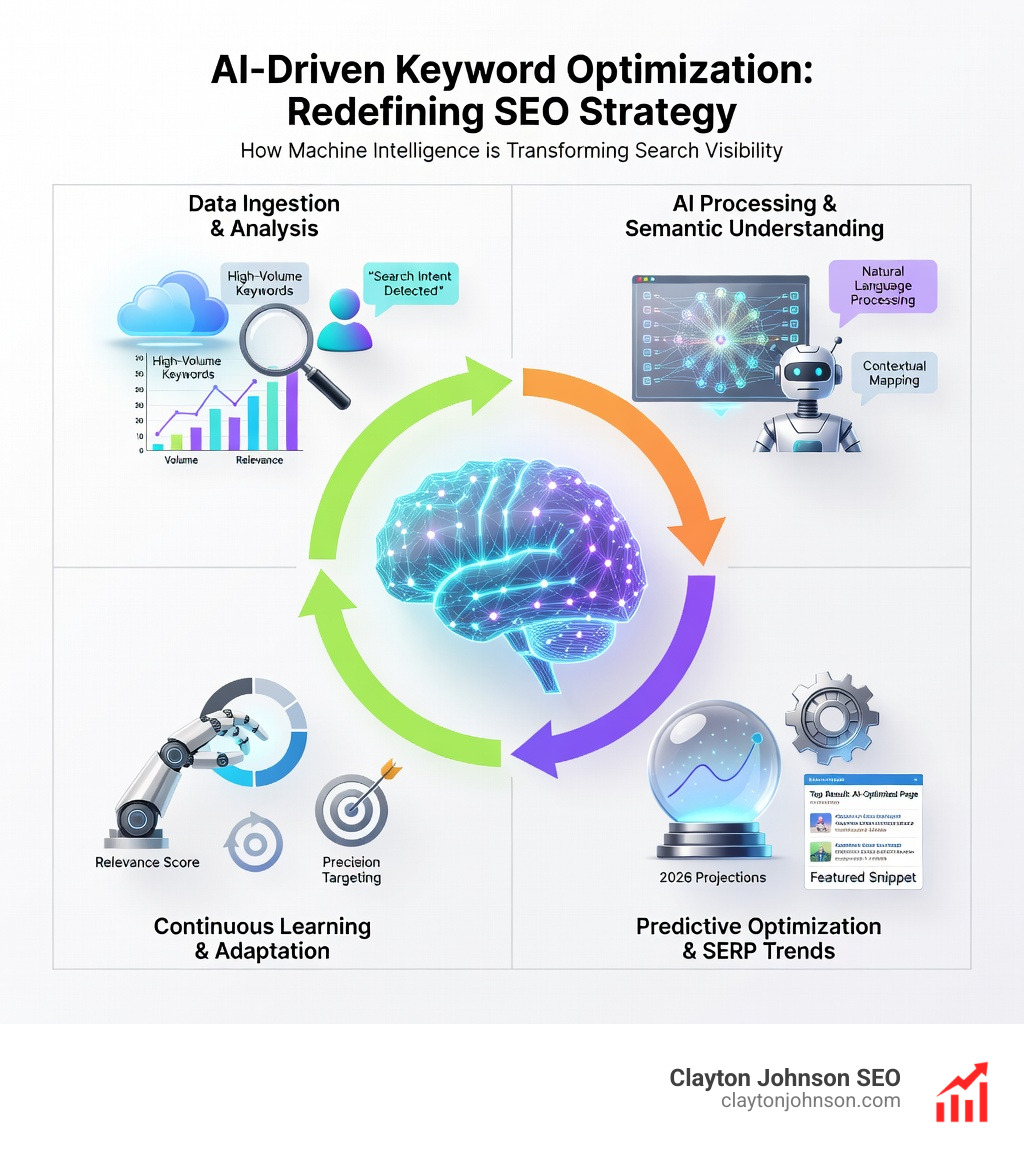
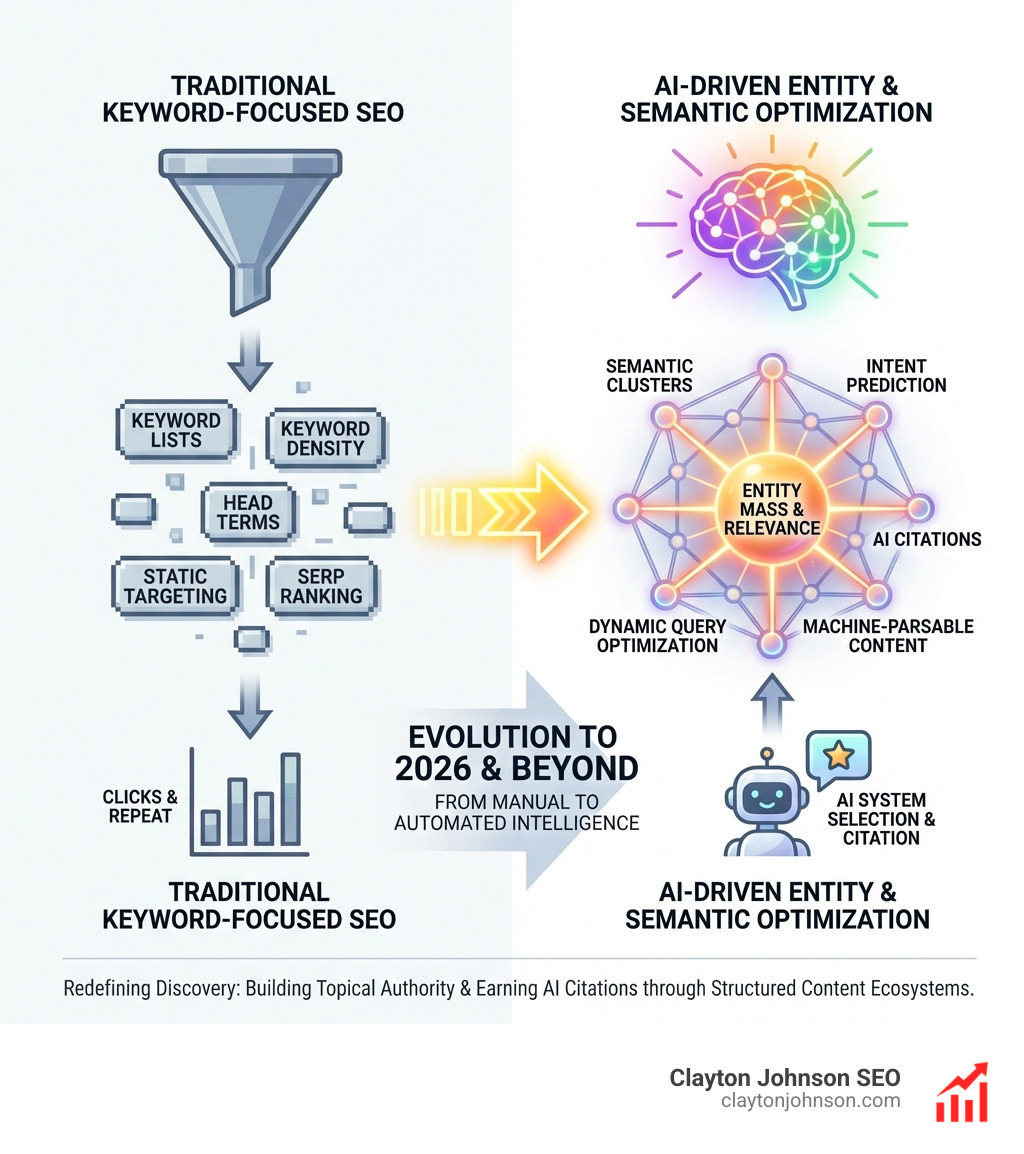
AI driven keyword optimization is fundamentally changing how content gets discovered, selected, and cited in search. Here’s what’s shifting:
| Traditional Approach | AI-Driven Approach |
|---|---|
| Manual keyword lists | Machine learning-powered semantic clusters |
| Keyword density focus | Entity mass and contextual relevance |
| Ranking for head terms | Being selected and cited by AI systems |
| Time-consuming SERP analysis | Automated intent prediction and gap analysis |
| Static keyword targeting | Dynamic, conversational query optimization |
If you’ve been doing keyword research the same way for years, you’re already behind. Google’s AI Overviews now appear in billions of searches monthly, reaching deeper into SERPs to pull content from positions 21-100. AI referrals to top websites spiked 357% year-over-year in June 2025, hitting 1.13 billion visits. Meanwhile, queries showing AI Overviews with 8+ words have grown 7x since launch.
The old game was simple: rank for a head term, drive clicks, repeat.
The new game is different: be the best possible answer to a real-world prompt, get cited before anyone clicks, build entity mass through semantic reinforcement.
AI doesn’t read your content like a person. It parses it like a database. It evaluates extractability—how easily your content can be broken into machine-readable, confidence-scored fragments. It measures entity strength—how consistently your expertise is reinforced across the broader web. It prioritizes semantic clarity—content that answers questions directly, uses structured formatting, and provides verifiable sources.
This shift isn’t cosmetic. It’s structural.
Traditional keyword research focused on finding the right words. AI-driven optimization focuses on building topical authority, creating machine-parsable content, and earning citations from AI systems that increasingly sit between searchers and your website.
The bottleneck isn’t finding keywords anymore—it’s understanding which ones AI systems will actually use, how to structure content so it gets selected, and how to automate the entire process without losing strategic control.
I’m Clayton Johnson, and I’ve built SEO systems for companies across multiple industries by focusing on structured strategy, AI-augmented workflows, and measurable outcomes. My approach to AI driven keyword optimization combines technical depth with practical execution—turning fragmented keyword lists into coherent content ecosystems that earn both rankings and AI citations.
The Shift to AI Driven Keyword Optimization
The transition from “Googling” as a simple keyword search to engaging with a generative engine is the biggest pivot in digital history. Googling has become a verb, but the way we do it is evolving. We no longer just type “best coffee Minneapolis”; we ask, “Where is a quiet coffee shop in Minneapolis with fast Wi-Fi and dairy-free options?”
This shift to AI driven keyword optimization means we must stop thinking about isolated words and start thinking about Entity Mass. In the eyes of an AI, your brand is an entity. The more consistently you are mentioned alongside specific topics across the web, the “heavier” your entity becomes, exerting a gravitational pull on search results.

From Text Strings to Semantic Entities
Search engines have moved from matching text strings to understanding concepts. Through Natural Language Processing (NLP) and knowledge graphs, systems now understand the relationship between “espresso,” “caffeine,” and “dark roast” without you having to explicitly link them every time.
As detailed in Stanford’s Information Retrieval Textbook, modern retrieval is about vectors and semantic space. When we use AI driven keyword optimization, we are essentially positioning our content in the right “neighborhood” of this semantic galaxy so that when a user asks a question, the AI sees our content as the most mathematically relevant neighbor.
Why Traditional Research is Failing in the AIO Era
Traditional research is a bottleneck. It involves hours of manual exports and days of sorting spreadsheets. But while you’re sorting, the SERP is changing. Google Search Generative Experience (SGE) and AI Overviews (AIO) are creating “zero-click” environments.
According to the BrightEdge Report on AI Overviews, queries with 8+ words have grown 7x. These long-tail, conversational queries are where the AI lives. If you only target high-volume head terms, you miss the 89% of AI citations that come from outside the top 10 organic results. AI is reaching deeper—into positions 31-100—to find helpful, topic-rich content. If you want to stay visible, you need our SEO services to help you pivot toward this new reality.
Building a Hybrid AI Workflow for Keyword Research
We don’t believe in “set it and forget it” AI. The best results come from a Hybrid AI Workflow: the speed of the machine plus the strategy of the human. This involves using AI for the heavy lifting—ideation, clustering, and gap analysis—while humans handle the final validation and creative “hook.”
Step 1: Ideation and Brainstorming with LLMs
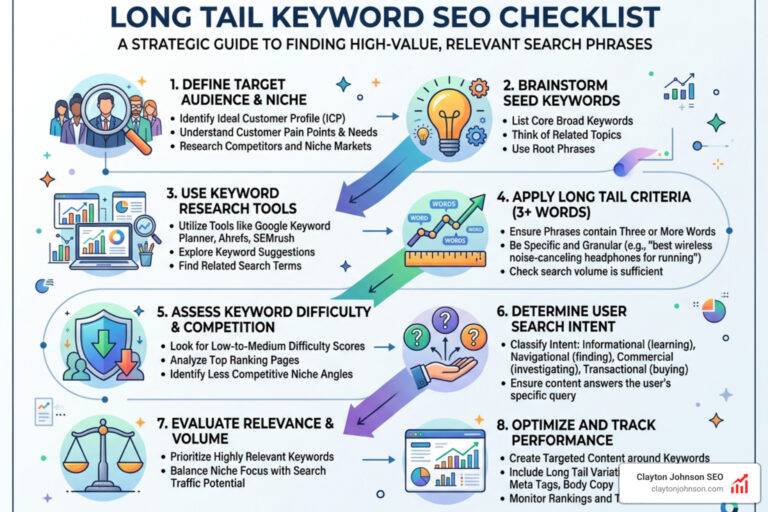
Large Language Models (LLMs) like ChatGPT are unparalleled brainstorming partners. Instead of just looking at search volume, use LLMs to find “angles.”
- Prompting for Intent: Ask the AI to “Identify the top 10 pain points for a first-time homebuyer in Minneapolis.”
- Prompting for Gaps: “What are the questions about SEO strategy that most experts forget to answer?”
This provides a “seed” list that goes beyond what a standard tool might suggest. If you need help refining these prompts, working with an SEO consultant can ensure your AI inputs aren’t “garbage in.”
Step 2: Scaling Clusters with AI Driven Keyword Optimization
Once you have your seeds, you need to group them. A flat list of 500 keywords is useless. AI driven keyword optimization allows you to transform that list into 20-30 “Topical Clusters.”
Tools like KeywordIQ or Semrush’s Keyword Strategy Builder use machine learning to calculate “Thematic Distance.” They group keywords not just by spelling, but by intent. This allows us to build SEO content marketing plans that cover a pillar topic (e.g., “SEO Strategy”) and all its supporting sub-topics (e.g., “AI keyword tools,” “semantic SEO,” “entity building”) to maximize topical authority.
Step 3: Gap Analysis and Competitor Intelligence
AI can analyze thousands of competitor keywords in seconds. Recent research on on-the-fly keyword generation shows that AI can now predict which keywords will be profitable before they even show up in traditional databases. By comparing your domain’s “thematic vector” against a competitor’s, AI identifies exactly where your content is “thin.” This isn’t just about finding missing words; it’s about finding missing expertise.
Optimizing Content for AI Selection and Visibility
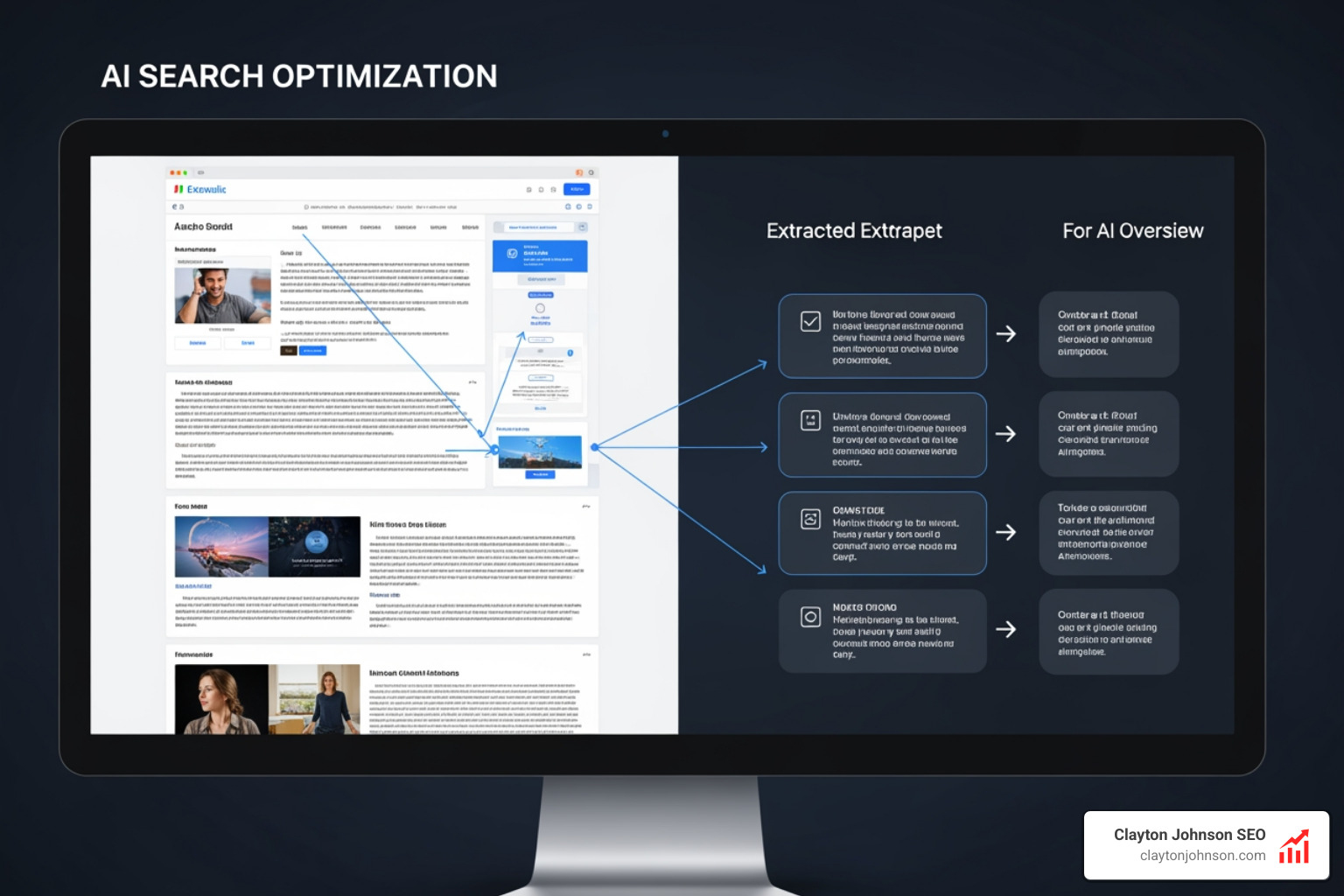
In the AI era, visibility is no longer just about “ranking.” It’s about selection. AI assistants parse your page, extract the best bits, and present them in a summary. If your content isn’t “extractable,” you don’t exist.
Structuring for Machine-Parsable Extraction
AI systems prioritize clarity. They don’t want to read a 3,000-word wall of text to find one answer. To improve your Google rankings, you must structure your content for “modular consumption”:
- Q&A Formats: Use direct questions as H3s and provide the answer in the very first sentence of the following paragraph.
- Bulleted Lists: AI loves lists. They are easy to “lift” for a featured snippet or an AIO summary.
- Heading Hierarchy: Use H2s and H3s to define clear “content slices.”
- Schema Markup: Use schema.org (JSON-LD) to explicitly tell the AI what your content is about. This is like providing a map for the machine.
For more on this, check out how Google uses AI in search to understand the technical side of content selection.
Capturing Long-Tail Intent via AI Driven Keyword Optimization
Long-tail keywords are the lifeblood of Minneapolis SEO in 2025. Users are asking longer, more specific questions.
- The 8-Word Query: Searches like “how to fix a leaky faucet in an old Victorian house” have grown 7x.
- Prompt Completeness: Your content must answer the entire prompt. If a user asks a multi-part question, your article should provide a multi-part answer in a single, structured section.
Avoiding Common AI SEO Mistakes
We see the same mistakes over and over that kill AI visibility:
- Walls of Text: If an AI can’t find the “nugget” of information quickly, it will move to a competitor.
- Hidden Content: Don’t put your best answers inside accordions or “read more” tabs that require a click to render. AI models may ignore what they can’t see immediately.
- Unanchored Claims: Avoid vague fluff like “we are the best.” Use facts. Instead of “quiet dishwasher,” say “42 dB dishwasher designed for open-concept kitchens.”
- Decorative Symbols: Using stars or arrows in your text might look nice to humans, but it can confuse AI parsers. Keep it clean.
Measuring Success in the Era of AI Overviews
Success metrics are changing. We used to just look at “Position 1.” Now, we track Share of Voice in AI Overviews.
Tracking AI Citation Presence
Every minute, 5.9 million searches happen on Google. With AIOs, your CTR might drop by 30%, but your impressions might spike by 49%. Why? Because AI is showing your brand to more people, even if they aren’t clicking through to your site immediately.
We track:
- AIO Citation Rate: How often is our content used as a source in an AI summary?
- Referral Spikes: Are we seeing traffic from “AI Referrals” (ChatGPT, Perplexity, etc.)?
- Brand Mentions: Is our “Entity Mass” growing in the broader semantic web?
As an SEO expert, Clayton Johnson focuses on these “next-gen” metrics to ensure our clients aren’t just ranking, but are actually influencing the AI’s answer.
Frequently Asked Questions about AI SEO
What is the difference between AI search optimization and traditional SEO?
Traditional SEO focuses on keywords, backlinks, and technical site health to rank a page. AI search optimization (or GEO/AEO) focuses on extractability and entity mass, ensuring that AI models can easily parse and cite your content as a reliable source for a generated answer.
How do I get my content cited in Google AI Overviews?
To get cited, your content needs to be semantically clear, authoritative, and well-structured. Use Q&A formats, lead with direct answers, and ensure your site has strong E-E-A-T signals (Expertise, Authoritativeness, Trustworthiness). Interestingly, 89% of citations come from pages that aren’t even in the top 10 organic results, so focus on being the best answer, not just the highest-ranked one.
Which AI tools are best for keyword clustering?
For automated clustering, tools like SurferSEO, ClusterAI, and Semrush’s Keyword Strategy Builder are excellent. They use LLMs to analyze the thematic relationship between thousands of keywords, allowing you to build a comprehensive content plan in minutes rather than weeks.
Conclusion
The era of manual keyword research is over. To win in today’s landscape, you must embrace AI driven keyword optimization. By shifting from “text strings” to “semantic entities,” building a hybrid workflow, and structuring your content for machine-parsable extraction, you can turn search engine changes into your biggest competitive advantage.
At Clayton Johnson SEO, we specialize in building these AI-assisted workflows. We help founders and marketing leaders in Minneapolis and beyond diagnose growth problems and execute strategies that deliver measurable results in the age of AI.
Ready to stop guessing and start dominating? Automate your strategy with our SEO Services and let’s build your entity mass together.