Content Auditing for Humans Who Use Robots


Why Your Content Library Is Probably Underperforming (And How AI Can Fix It)
AI driven content audits use artificial intelligence and machine learning to systematically evaluate your website’s content for quality, performance, relevance, and technical health—automating what used to take weeks of manual work into hours or minutes.
Quick Answer: What AI Driven Content Audits Do
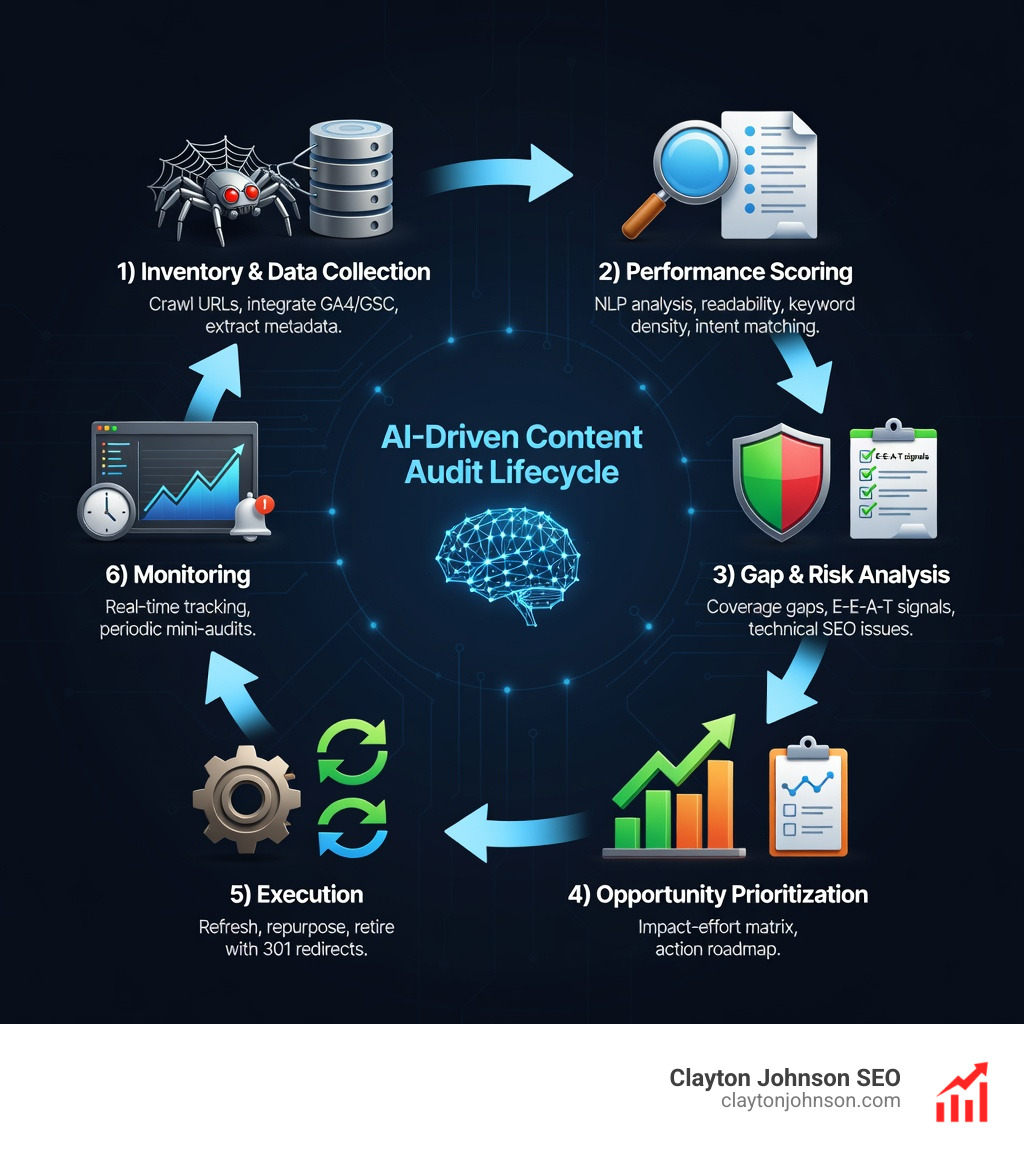
- Automate inventory of thousands of pages using crawlers and analytics data
- Score content quality with NLP for readability, keyword density, and user intent
- Identify gaps and risks in coverage, E-E-A-T signals, and technical SEO
- Prioritize actions through impact-effort matrices for refresh, repurpose, or retire decisions
- Monitor performance with real-time tracking and alerts for content decay
Every marketer knows the feeling: you’ve built a content library over months or years, but now it feels vast and unwieldy. Is it all working for you? Or are parts of it gathering digital dust?
Manual audits of large sites can take weeks or months. A site with 5,000 blog posts might require an entire team just to inventory and score performance. According to research, AI completes these audits in minutes, processing datasets that would be nearly impossible for humans to analyze at scale.
The shift isn’t just about speed. AI eliminates human bias in evaluation, reveals patterns across thousands of pages that humans would miss, and provides data-backed recommendations for SEO, engagement, and conversion optimization. One case study showed that pruning underperforming content guided by AI analysis led to a 50% increase in organic traffic.
But AI isn’t a replacement for strategy—it’s a force multiplier. It handles the grunt work (crawling, scoring, gap detection) while humans focus on interpretation, editorial decisions, and brand alignment.
I’m Clayton Johnson, and I’ve spent years building scalable traffic systems and AI-augmented marketing workflows, including frameworks for AI driven content audits that turn fragmented content libraries into strategic growth engines. Here’s how to build yours.
Why AI Driven Content Audits are Essential for Modern SEO
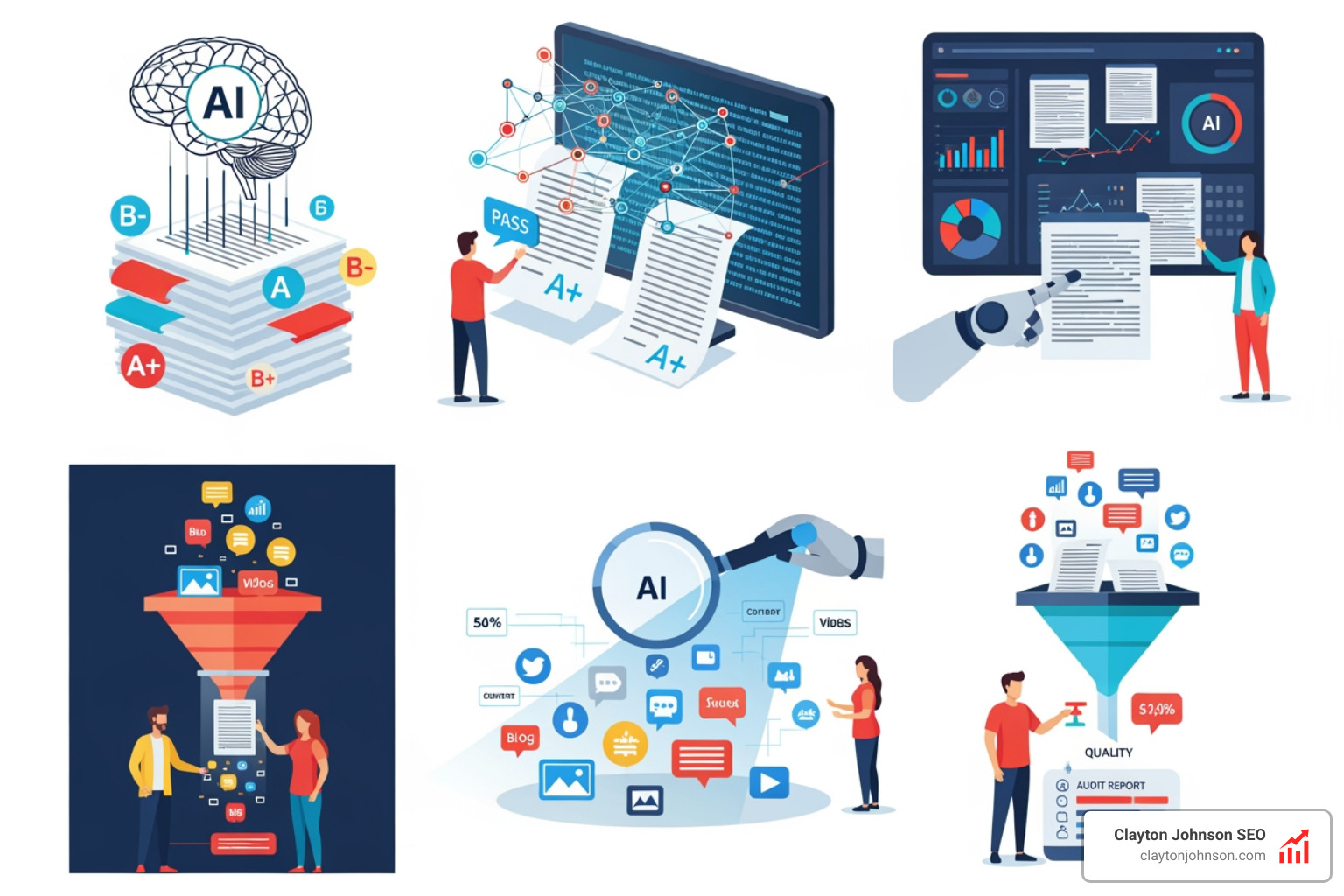
In the past, a content audit was a “once-a-year” headache. We would export a CSV, stare at bounce rates, and guess why a page wasn’t ranking. Today, that approach is a recipe for digital decay. AI driven content audits have become essential because the search landscape has shifted from simple keyword matching to complex intent and entity recognition.
By leveraging SEO Services, businesses can now use AI to see what the human eye misses. AI doesn’t just look at traffic; it looks at patterns. It can analyze thousands of pages to find “content clusters” that are working and “content graveyards” that are dragging down your site’s authority.
One of the most compelling reasons to adopt AI is its ability to audit for diversity and source demographics. Scientific research on AI-assisted content diversity shows that machine learning can extract entities and label topics to ensure your content represents a wide range of voices—a factor that is becoming increasingly important for brand trust and editorial integrity.
Furthermore, AI is the only way to keep up with Google’s focus on E-E-A-T (Experience, Expertise, Authoritativeness, and Trustworthiness). AI models can score your content against these signals, identifying where you need more citations, better author bios, or updated statistics. This gives you a massive competitive edge, allowing you to move faster than rivals who are still manually checking their blog posts.
The Core Challenges of Manual Audits and the AI Solution
Let’s be honest: manual audits are a resource drain. If you have a site with 10,000 pages, a human auditor might spend months just getting a handle on the inventory. This leads to “sampling,” where you only look at the top 10% of your pages and ignore the “long tail” where hidden SEO gold (or technical rot) lives.
AI solves these challenges by providing a holistic overview. It combines Analytics & Data with deep content analysis. Tools like the Screaming Frog SEO Spider can now be paired with LLMs to not only find broken links but also summarize page content and suggest improvements in bulk.
| Feature | Manual Content Audit | AI Driven Content Audit |
|---|---|---|
| Speed | Weeks to Months | Minutes to Hours |
| Accuracy | Prone to human error and bias | Data-backed and objective |
| Scalability | Limited to small samples | Handles 100,000+ pages easily |
| Cost | High (Labor intensive) | Lower (30-50% cost savings) |
| Insights | Surface-level metrics | Deep semantic & intent analysis |
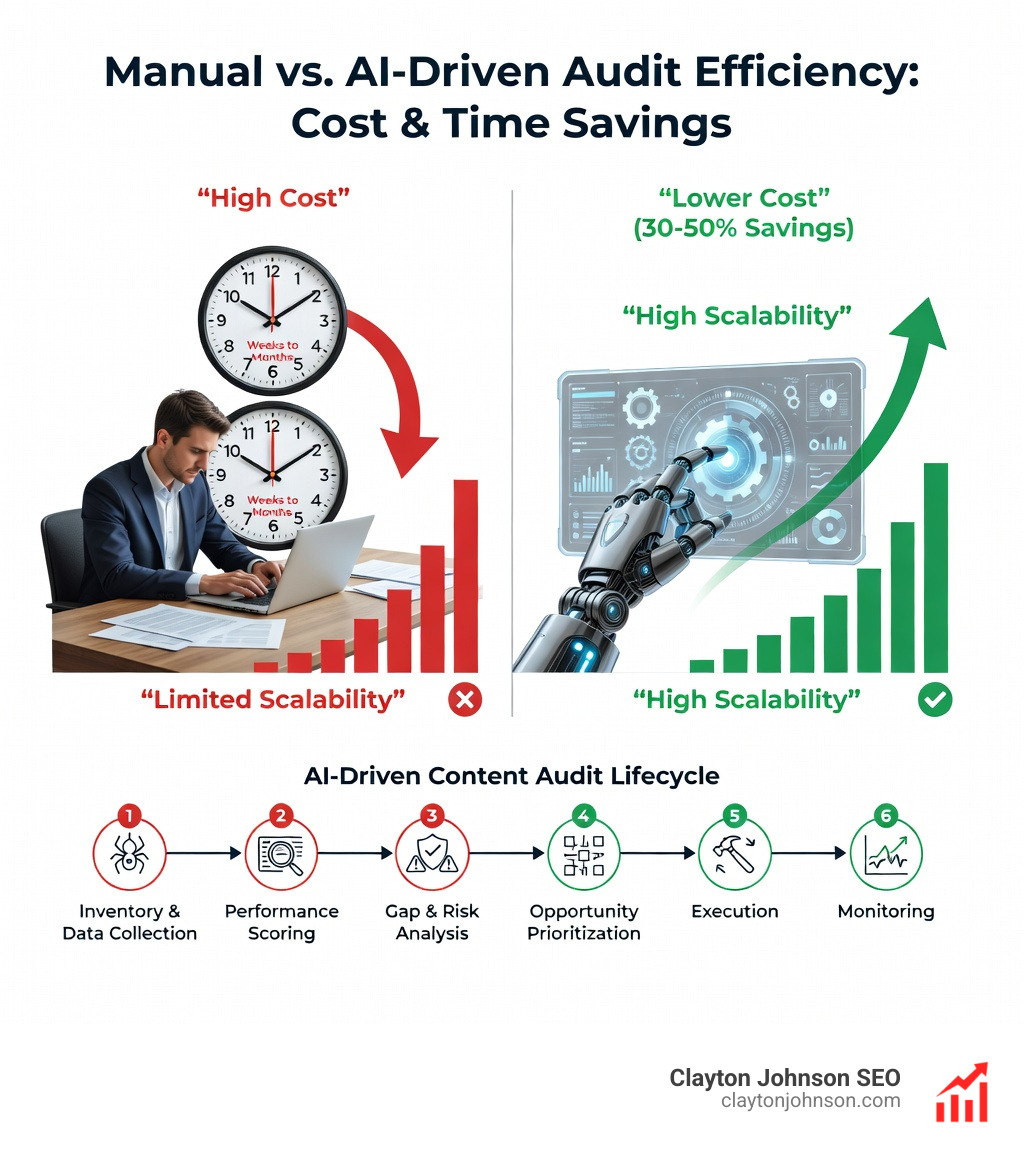
By automating the inventory and technical SEO checks, we free up our team to do what they do best: high-level strategy and creative storytelling. Instead of spending 40 hours in a spreadsheet, we spend 40 hours actually improving the content that matters.
Step-by-Step Guide to Executing Your Audit

Ready to stop guessing and start optimizing? Performing an AI-powered audit is a structured process. It starts with goal setting. Are you looking to boost Google Rankings, increase engagement, or prune outdated content?
Once your goals are set, you can use Using AI Competitive Insights to Outsmart Your Rivals to see how your content stacks up against the top players in your niche. This isn’t just about copying them; it’s about finding the “content gaps” they missed.
Phase 1: Inventory and Data Collection
The first step is gathering your “digital assets.” You need a master list of every URL on your site.
- URL Export: Use a crawler to export all live URLs.
- GA4 Integration: Pull in engagement data like bounce rates and average session duration.
- Search Console Data: Use Google Search Console to identify pages with high impressions but low click-through rates (CTR).
- Metadata Extraction: AI can automatically pull titles, meta descriptions, and H1 tags to check for duplicates or missing information.
- Content Mapping: Group your pages by topic or “silo” to see where your site has the most authority.
Phase 2: Performance Scoring and AI Driven Content Audits Analysis
This is where the “robot magic” happens. Using Natural Language Processing (NLP), we can score each page based on:
- Readability: Is the content too complex for your audience?
- Sentiment Analysis: Does the tone match your brand voice?
- Keyword Density & Intent: Does the page actually answer the question the user is searching for?
- Gap Analysis: AI compares your page to high-ranking competitors and tells you exactly what topics or subheadings you are missing.
Phase 3: Scaling eCommerce Catalogs with AI Driven Content Audits
For eCommerce managers in Minneapolis or beyond, managing thousands of product descriptions is a nightmare. AI agents can audit product catalogs to ensure brand consistency across every single SKU.
- Attribute Extraction: AI can scan images and text to ensure product features are listed accurately.
- Marketplace Performance: Analyze how your products perform on third-party sites compared to your own.
- Compliance Monitoring: In industries like healthcare or finance, AI ensures that all claims are legally compliant and up to date.
- Inventory Intelligence: AI can flag content for products that are consistently out of stock or have high return rates due to “misleading” descriptions.
Optimizing for the Future: LLM Readiness and AI Search Visibility
The game of SEO is changing. It’s no longer just about ranking #1 on Google; it’s about being the “cited source” for AI search engines like Perplexity, ChatGPT, and Google’s AI Overviews (SGE).
Our research shows that AI models prioritize content that is “chunkable.” This means your content needs to be broken down into clear, logical sections (usually 200–400 tokens) that an AI can easily extract. To see how ready your site is, tools like the LLM Content Assessor can score your pages on “answerability” and “citation value.”
Key Factors for AI Search Visibility:
- Entity Hygiene: Are your brand names, locations, and key terms clearly defined for a machine to understand?
- Schema Markup: Are you using technical code to tell search engines exactly what your content is about?
- Q&A Formatting: Directly answering common questions in your text makes it 25% more likely to be cited by an AI.
- E-E-A-T Signals: Including author credentials and date stamps increases trust scores by over 30%.
Actionable Strategies: Refresh, Repurpose, or Retire
Once your AI driven content audits are complete, you’ll have a list of actions. We like to use a 30/60/90-day roadmap to execute these changes.
- Refresh: If a page has high traffic but low engagement, use AI to update stats, expand sections, and improve headlines.
- Repurpose: If a blog post is a “rockstar,” have AI turn it into a Twitter thread, a video script, or an infographic.
- Retire (Prune): If a page has zero traffic and zero backlinks, it might be time to delete it. Use 301 redirects to send any residual “link juice” to a more relevant page.
- Consolidate: If you have three mediocre posts about “SEO in Minneapolis,” use an SEO Consultant to help you merge them into one powerhouse guide.
This process prevents “content decay”—the natural drop in rankings that happens as information becomes outdated. By running these audits quarterly, you ensure your content remains a strategic asset rather than digital clutter.
Frequently Asked Questions about AI Content Auditing
How often should I run an AI-driven content audit?
We recommend a full audit once a year, with “mini-audits” every quarter for your most important content silos. If you are in a fast-moving industry like tech or finance, monthly checks on your top-performing pages are a smart move.
Can AI replace human editors in the audit process?
No. AI is the “archaeologist” that finds the artifacts, but the human is the “curator” who decides which ones belong in the museum. You still need a human to ensure brand voice, check for AI “hallucinations,” and make final editorial calls.
What are the best tools for large-scale eCommerce audits?
For large catalogs, we like tools that offer “agentic AI” capabilities, such as Datagrid or Gryffin AI, which can handle thousands of SKUs. For technical health at scale, Screaming Frog remains the industry standard.
Conclusion
At Clayton Johnson SEO, we believe that content is your biggest strategic asset—but only if it’s working for you. AI driven content audits allow us to stop guessing and start using data to drive growth. Whether you are looking for SEO Services Minneapolis or a global strategy, our frameworks are designed to turn your content library into a compounding engine for traffic and revenue.
Don’t let your hard work gather digital dust. Use the robots to help the humans, and start your AI-powered audit today.