Stop the Suffering by Mapping Every Customer Pain Point


Stop the Suffering: Understanding Customer Journey Pain Points
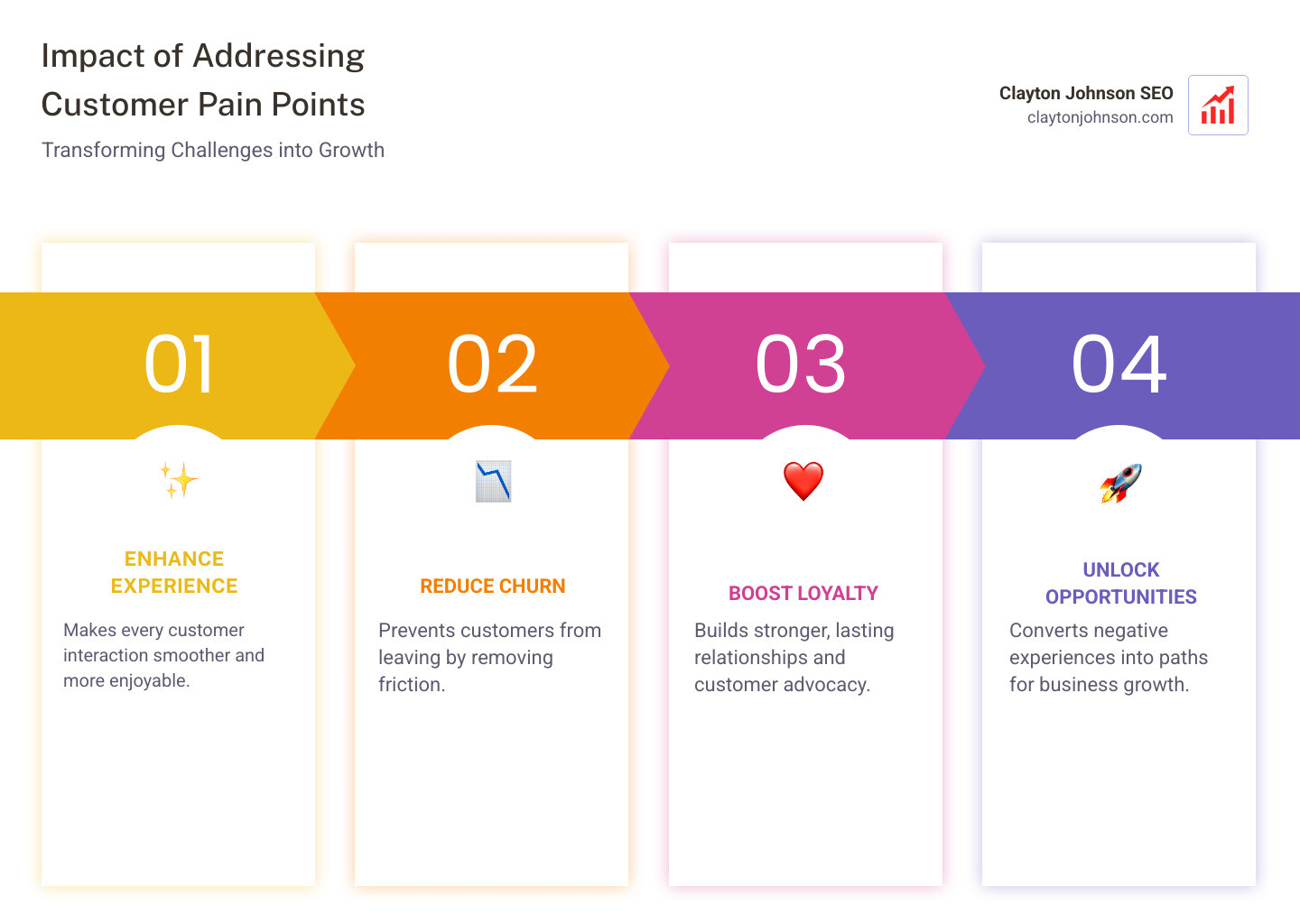
Customer journey pain points are the specific problems or frustrations your customers face when interacting with your business. Resolving these obstacles is vital for success because it:
- Improves Customer Experience: Makes every interaction smoother and more enjoyable.
- Reduces Churn: Keeps customers from switching to competitors.
- Boosts Satisfaction & Loyalty: Builds stronger, lasting relationships.
- Unlocks New Opportunities: Transforms negative experiences into positive business growth.
Every customer interaction is a chance to build trust – or risk losing it. Frustrations, delays, and missteps can sour the experience and drive customers to competitors. These moments of friction, or customer pain points, can have ripple effects across satisfaction, retention, and loyalty.
Ignoring these “sneaky little pinches” can be costly. For example, one media company saw overall customer satisfaction drop by nearly 40% during a three-month onboarding process. This happened even though each individual customer interaction seemed to go well. This shows the danger of missing the bigger picture: the entire customer journey.
Understanding and addressing these issues isn’t just about fixing problems. It’s about turning challenges into opportunities for customer delight and competitive advantage.
As Clayton Johnson, I specialize in helping businesses diagnose growth problems and build strategic frameworks. My experience includes aligning SEO strategy, content systems, and AI-assisted marketing workflows to specifically address customer journey pain points for measurable outcomes. This guide will show you how to identify and resolve these critical obstacles.
What Are Customer Journey Pain Points?
In the simplest terms, customer journey pain points are hurdles. They are the friction points that make it difficult, annoying, or expensive for a person to do business with you. According to research on Eliminating customer experience pain points in complex customer journeys through smart service solutions, these issues often arise in “complex service delivery networks” where multiple touchpoints and providers are involved.
When we talk about “hidden friction,” we are referring to the subtle things that drain a customer’s energy. This includes interaction cost (the physical and mental effort required to complete a task) and cognitive load (the amount of brainpower needed to understand your interface or process). If a customer has to think too hard or click too many times, they experience “pain.”
At Clayton Johnson SEO, we believe that understanding these points is the foundation of any customer strategy. If you don’t know where the shoe pinches, you can’t fix the walk.
The Three Levels of Experience Friction
To truly master the art of the smooth experience, we need to look at Three Levels of Pain Points in Customer Experience. Not all pain is created equal; it manifests at different depths of the relationship.
- Interaction Level: These are surface-level frustrations. Think of a “usability issue” like a broken button or a confusing drop-down menu. It’s a single moment of “ouch.”
- Journey Level: This is the cumulative pain of a specific goal. For example, a customer might find your website easy to use (low interaction pain), but the process of ordering, tracking, and finally receiving a product takes months with no updates. That is a journey-level failure.
- Relationship Level: This is the deepest level. It involves a total loss of trust. If a user pays for a premium, ad-free subscription but still sees ads, or if a company is non-transparent about pricing, the relationship itself becomes the pain point.
Why Addressing Pain Points is a Growth Imperative
Why should you care? Because pain kills profit. Research shows that 89% of consumers value service as a critical factor in their purchasing decisions. In fact, 59% of consumers say customer service is more important than price.
When you eliminate customer journey pain points, you aren’t just being “nice”—you are driving revenue growth. A retail brand once reduced cart abandonment by 20% simply by turning a complex multi-step checkout into a single-page process. Solving these issues provides a massive competitive advantage; while your competitors are making their customers jump through hoops, you are providing a paved road.
The 4 Core Categories of Customer Friction
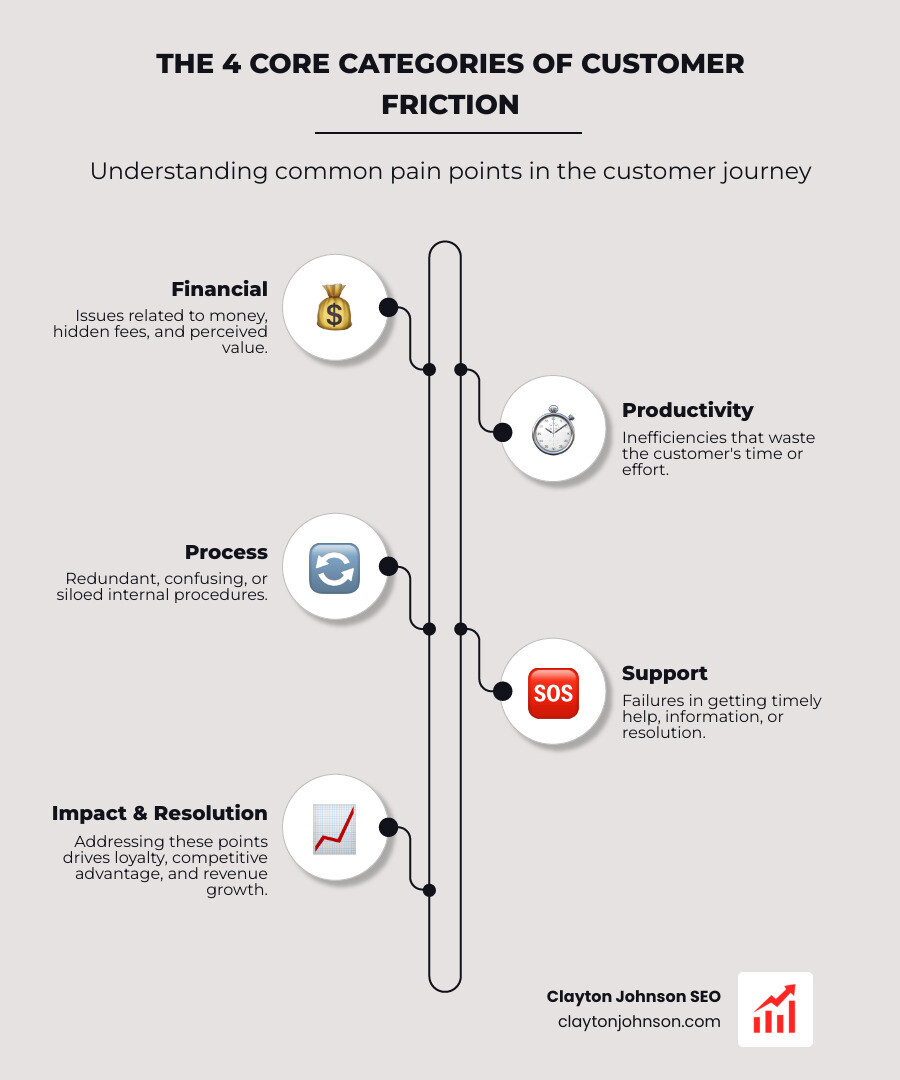
To solve these problems, we first have to categorize them. Most customer journey pain points fall into one of four buckets.
| Category | Description | Common Example |
|---|---|---|
| Financial | Issues related to money, fees, and perceived value. | Hidden “convenience” fees added at the final checkout screen. |
| Productivity | Inefficiencies that waste the customer’s time. | Having to re-enter the same data on three different forms. |
| Process | Redundant or confusing internal procedures. | Being passed between four different departments to solve one issue. |
| Support | Failures in getting help or information. | A knowledge base that is out of date or “buried” in the footer. |
Financial and Productivity Hurdles
Financial pain points are often the most explosive. Take the Etsy seller fee strike example. When the platform increased transaction fees from 5% to 6.5%, it caused thousands of sellers to go on strike. Unexpected price hikes or hidden fees destroy trust instantly.
Productivity pain points are quieter but just as deadly. Did you know that only 20% of users who start a labor-intensive online registration process actually finish it? If your sign-up form looks like a tax return, you are losing 80% of your potential business before it even starts. This is where services for conversion optimization become vital. We look for these “leaks” in your funnel and plug them by simplifying the user’s path.
Process and Support Obstacles
Process pain points often happen because companies are “wired for transactions, not journeys.” Departments like Sales, Marketing, and Support often operate in silos. A customer might have a great experience with a sales rep, but then the “hand-off” to the implementation team is a disaster.
Support obstacles are equally frustrating. If your support info is buried or if your agents aren’t empowered to actually solve problems (forcing a “never-ending chain of escalation”), your customers will leave. A solid sales strategy must include a plan for what happens after the deal is closed to ensure the process remains frictionless.
Proven Methods to Identify Customer Journey Pain Points
You can’t fix what you can’t see. Identifying customer journey pain points requires a mix of hard data and human empathy.

How to Identify Customer Journey Pain Points
The Gartner journey mapping guide emphasizes that you must see the journey through the customer’s eyes, not your own. Here are the most effective ways to do that:
- Talk to Your Sales and Support Teams: These folks are on the front lines in Minneapolis and beyond. They hear the complaints every day. Ask them, “What is the one thing customers complain about most?”
- Analyze Support Logs: Look for “clusters.” If 50 people asked the same question about your pricing page last week, your pricing page is a pain point.
- Conduct Open-Ended Surveys: Don’t just ask for a 1-10 score. Ask, “What was the most frustrating part of your experience today?”
- Social Listening: Monitor what people are saying about you on social media and review sites. Sometimes the most honest feedback happens where you aren’t looking.
To get the most out of this, you need to understand who your customers are. Our buyer persona examples can help you segment your audience so you can identify specific pain points for specific groups—because a “Startup Founder Sam” will have very different frustrations than a “Marketing Manager Mike.”
Advanced AI and Behavioral Analysis
In the modern era, we can go beyond manual surveys. Tools like MonkeyLearn text analysis and Zeda.io feedback tools use AI to sift through thousands of comments and identify sentiment.
Machine learning can categorize support tickets automatically, flagging “angry” or “frustrated” customers for immediate intervention. Behavioral data—like heatmaps or click-tracking—can show you exactly where users are getting stuck on your site. If users keep clicking a non-clickable image, that’s a productivity pain point you can fix in minutes.
Strategic Frameworks for Resolving Experience Obstacles
Once you’ve mapped the pain, it’s time to stop the suffering. This requires a shift from being “reactive” to being “proactive.”

Resolving Customer Journey Pain Points with Smart Technology
Technology is a double-edged sword; it can create pain, but it can also solve it. Smart service solutions often use two types of AI:
- Mechanical AI: This handles repetitive, rules-based tasks. Think of automated security checks or smart kiosks that reduce wait times.
- Thinking AI: This is for decision-making. It can provide real-time tracking for deliveries or “smart queue management” that tells a customer exactly how long their wait will be, reducing the anxiety of the unknown.
By leveraging these, you can address “information-themed” pain points. For example, providing a real-time navigation map for a complex physical location (like an airport or a large retail store) removes the “fear” of getting lost or missing a deadline. We use customer segmentation insights to determine which tech solutions will actually help your specific audience rather than just adding more “digital noise.”
Departmental Responsibility and Closing the Loop
Addressing customer journey pain points is not just a “customer service” job. It is a company-wide responsibility:
- Support: Must be empowered to solve issues without endless escalations.
- Engineering: Must prioritize fixing the “bugs” that cause the most interaction pain.
- Marketing: Must be transparent about pricing and features to avoid relationship-level pain.
- Executive Leadership: Must track CX metrics (like NPS or Churn) at the highest level to ensure sustainable change.
The most important step is “closing the loop.” If a customer complains and you fix the problem, tell them. This transforms a moment of friction into a moment of extreme loyalty.
Frequently Asked Questions about Customer Journey Pain Points
What is the difference between a pain point and a usability issue?
A usability issue is a type of interaction-level pain point (like a confusing menu). A pain point is a broader term that includes usability but also covers things like high prices, slow shipping, or rude staff. All usability issues are pain points, but not all pain points are usability issues.
Which department is responsible for fixing customer journey pain points?
Everyone! While Support identifies them, Engineering might need to fix the code, Marketing might need to change the messaging, and Sales might need to set better expectations. It requires cross-functional alignment.
How does resolving pain points impact business revenue?
Directly. Reducing friction leads to higher conversion rates, lower churn (customers staying longer), and more referrals. Research shows that a one-point improvement in customer satisfaction can lead to a 3% increase in revenue growth.
Conclusion
At Clayton Johnson SEO, we don’t just look at keywords; we look at the human beings behind the search queries. We know that a successful growth strategy isn’t just about getting people to your site—it’s about what happens once they arrive.
By mapping and resolving every customer journey pain point, you build a business that people love to use and are eager to recommend. Whether you are in Minneapolis or operating globally, the goal remains the same: stop the suffering and start the delighting.
Ready to transform your customer experience into a growth engine? Start your journey with a comprehensive Customer Strategy today. We’ll help you diagnose the friction, choose the right strategy, and execute with measurable results.