The Ultimate Guide to AI SEO Workflows

Why Smart Teams Implement AI SEO Workflows (And How to Start)
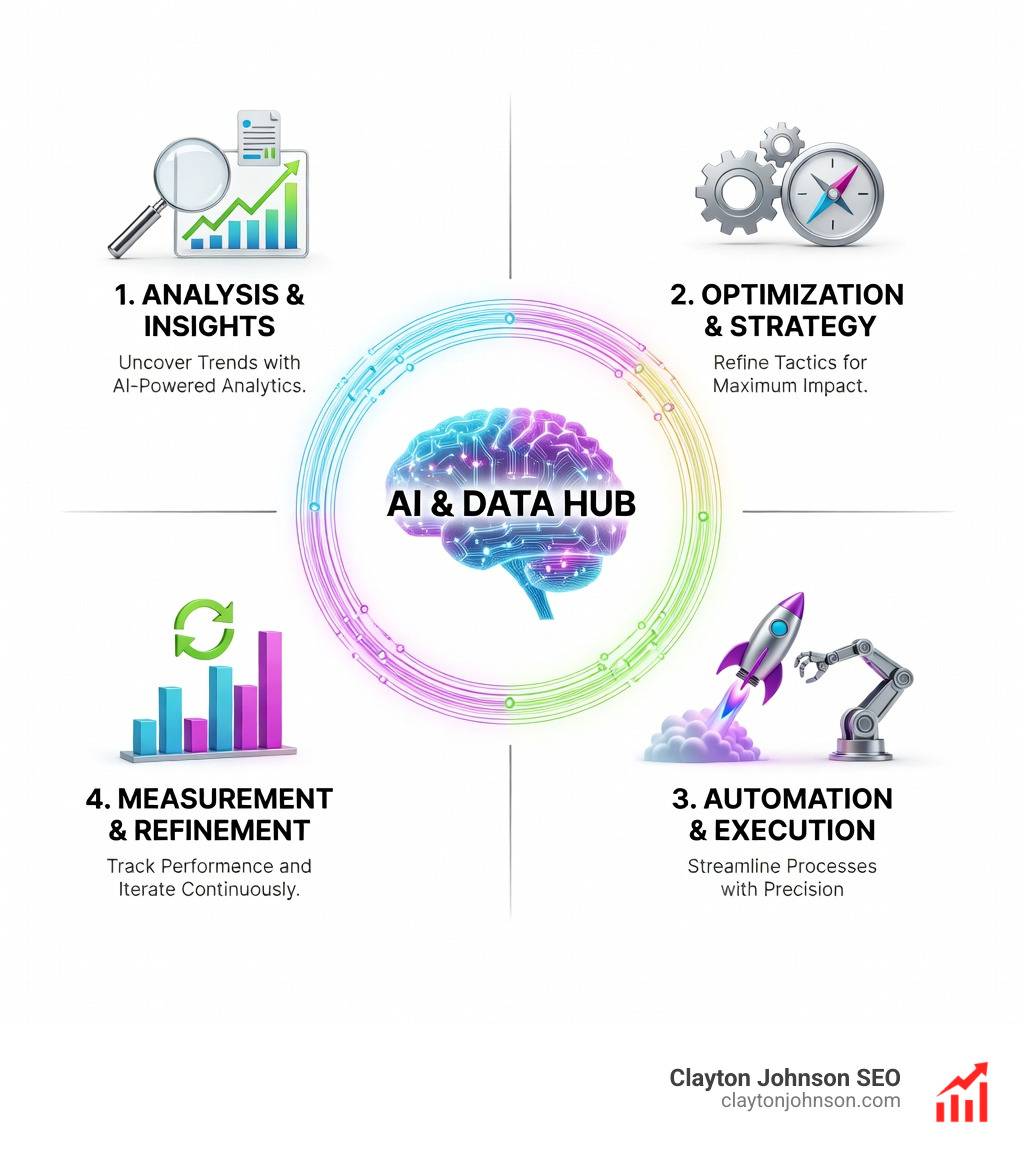
Implement AI SEO workflows and you can automate up to 80% of the repetitive tasks that consume your team’s time — freeing you to focus on strategy, not spreadsheets.
Here is a quick overview of how to get started:
- Map your current SEO process — identify the tasks eating the most time (keyword research, audits, reporting)
- Start with one workflow — automate keyword clustering or rank tracking before scaling
- Connect your tools — link Google Search Console, GA4, and an AI layer (ChatGPT, Claude, or a dedicated SEO platform)
- Build prompt libraries — standardize reusable prompts for briefs, meta descriptions, and content outlines
- Add human checkpoints — review AI outputs for accuracy, brand voice, and quality before publishing
- Measure impact — track time saved, ranking movement, and content output velocity
SEO has always been time-intensive. Keyword research. Content briefs. Technical audits. Competitor analysis. Reporting. For most marketing teams, these tasks pile up faster than they can execute.
The problem is not strategy. It is execution capacity.
And the numbers reflect how urgent this is. 96.55% of pages get no organic traffic from Google. Meanwhile, only about 36% of searches result in a click to the open web. The bar for ranking — and staying visible — keeps rising.
At the same time, 67% of businesses now use AI for content marketing and SEO, with 78% reporting satisfaction with the results. Teams that integrate AI are not just moving faster. They are compounding advantages while competitors are still working in spreadsheets.
“AI won’t replace SEOs — but SEOs who use AI will replace those who don’t.”
This guide is built for founders and marketing leaders who want a systematic approach, not a collection of disconnected AI tools. You will learn how to build a connected workflow where every stage — research, content, technical SEO, and reporting — feeds into the next.
I’m Clayton Johnson, an SEO strategist focused on building scalable traffic systems and AI-augmented marketing workflows that turn fragmented efforts into compounding growth engines. I have spent years helping founders and marketing leaders implement AI SEO workflows that replace execution chaos with structured, measurable infrastructure.
Terms related to implement ai seo workflows:
- AI assisted SEO workflows
- SEO AI workflow automation
- AI SEO strategy framework
Why You Must Implement AI SEO Workflows
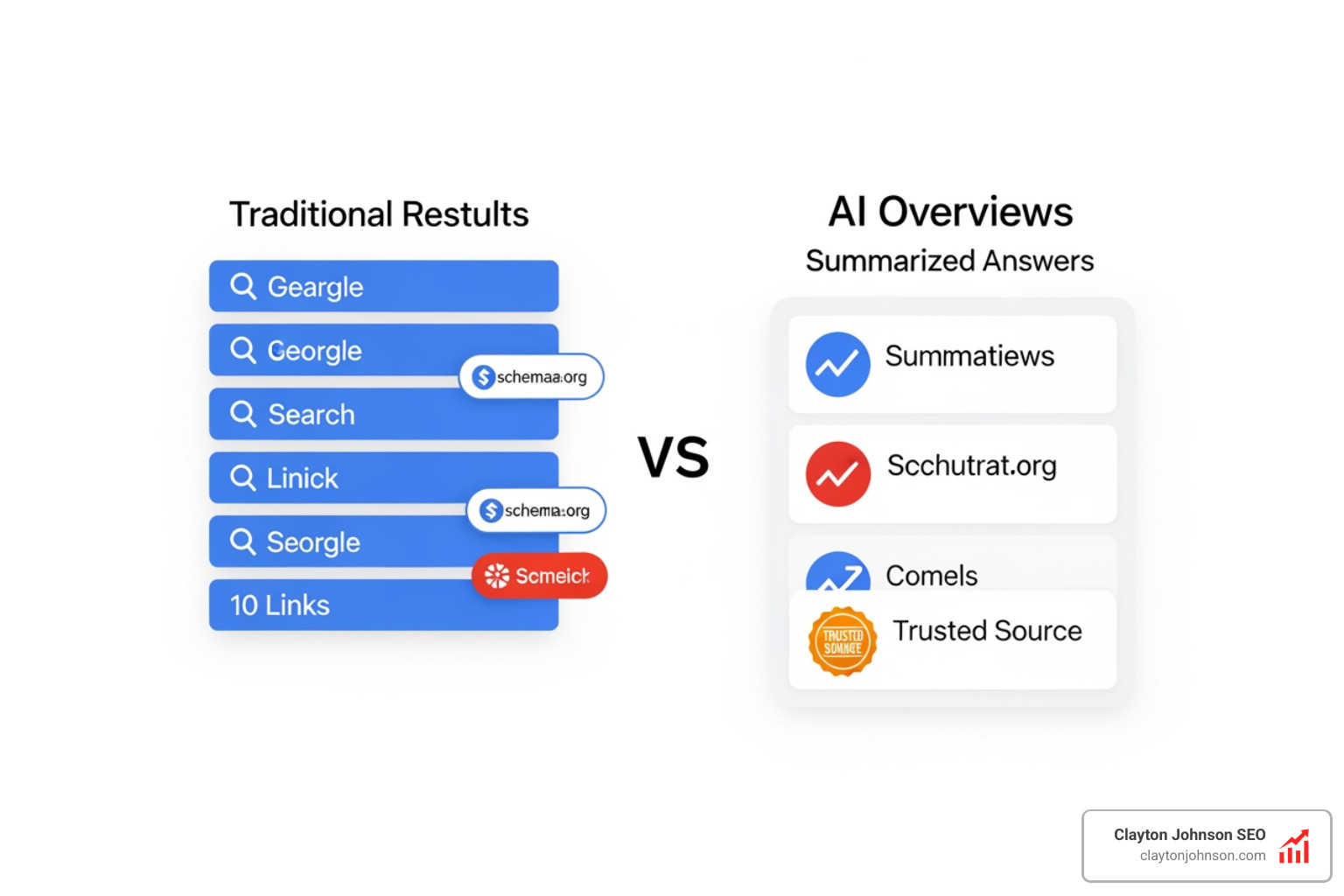
The search landscape is undergoing a seismic shift. We are moving from a world of “ten blue links” to an ecosystem of AI Overviews, conversational answers, and zero-click searches.
According to SparkToro, only about 36% of U.S. Google searches resulted in clicks to the open web. This means the “old way” of doing SEO—manually grinding out individual articles and hoping for the best—is no longer viable. To win today, you need to produce higher-quality content, faster, and with better technical precision.
When you implement AI SEO workflows, you aren’t just “using ChatGPT.” You are building a structured growth architecture. McKinsey research indicates that over 60% of organizations adopting generative AI deploy it into marketing and sales, with early adopters reporting a 10–20% revenue uplift.
Manual SEO vs. AI-Augmented SEO
| Feature | Manual SEO | AI-Augmented SEO |
|---|---|---|
| Keyword Research | Hours of spreadsheet filtering | Minutes via semantic clustering |
| Content Briefs | 45-60 minutes per brief | 2-5 minutes via AI templates |
| Technical Audits | Monthly manual crawls | Real-time automated alerts |
| Data Analysis | Limited to basic sorting | Python-powered deep insights |
| Scalability | Linear (more people = more cost) | Exponential (software-led growth) |
The Core Stages of an Integrated AI SEO Workflow
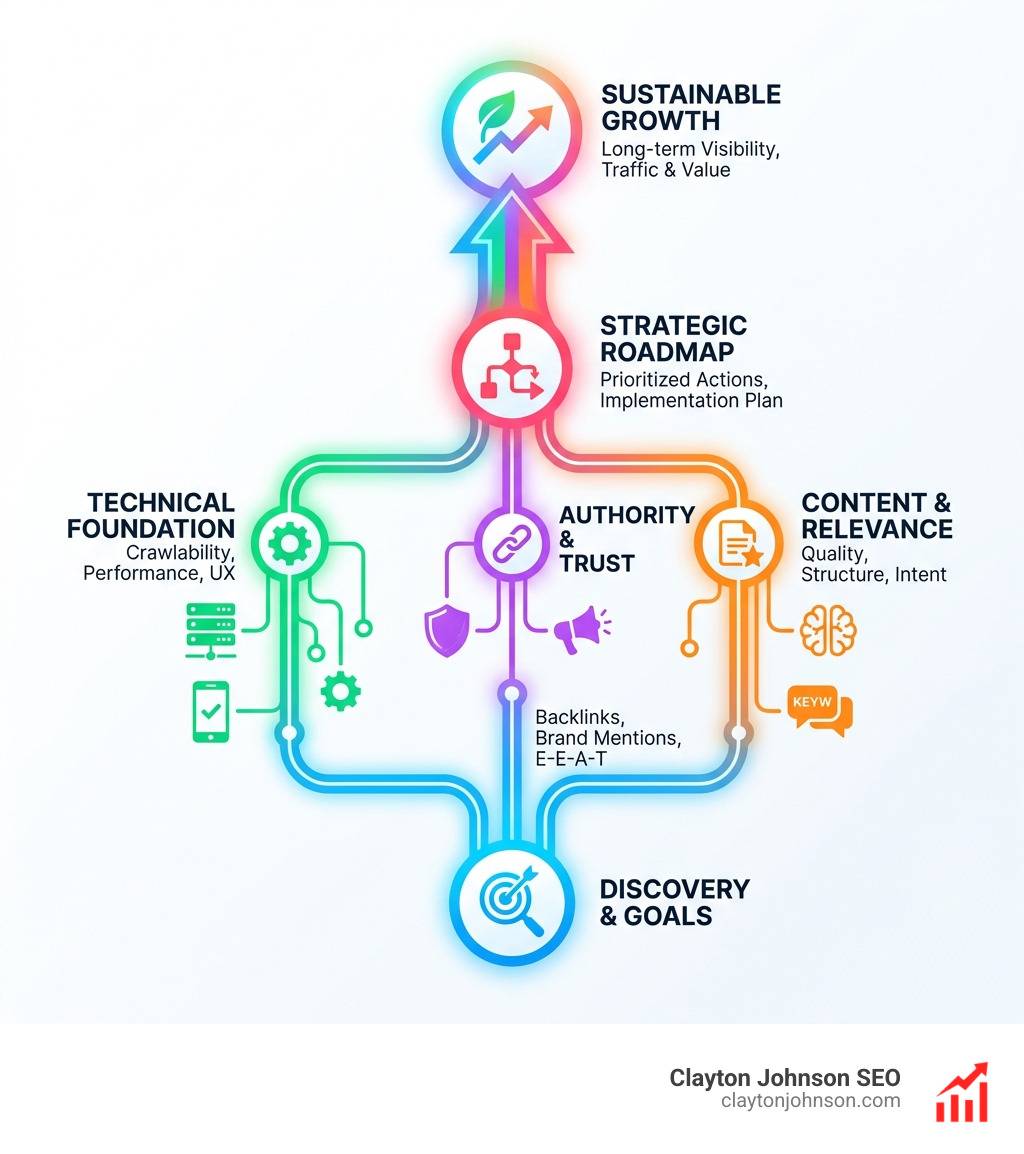
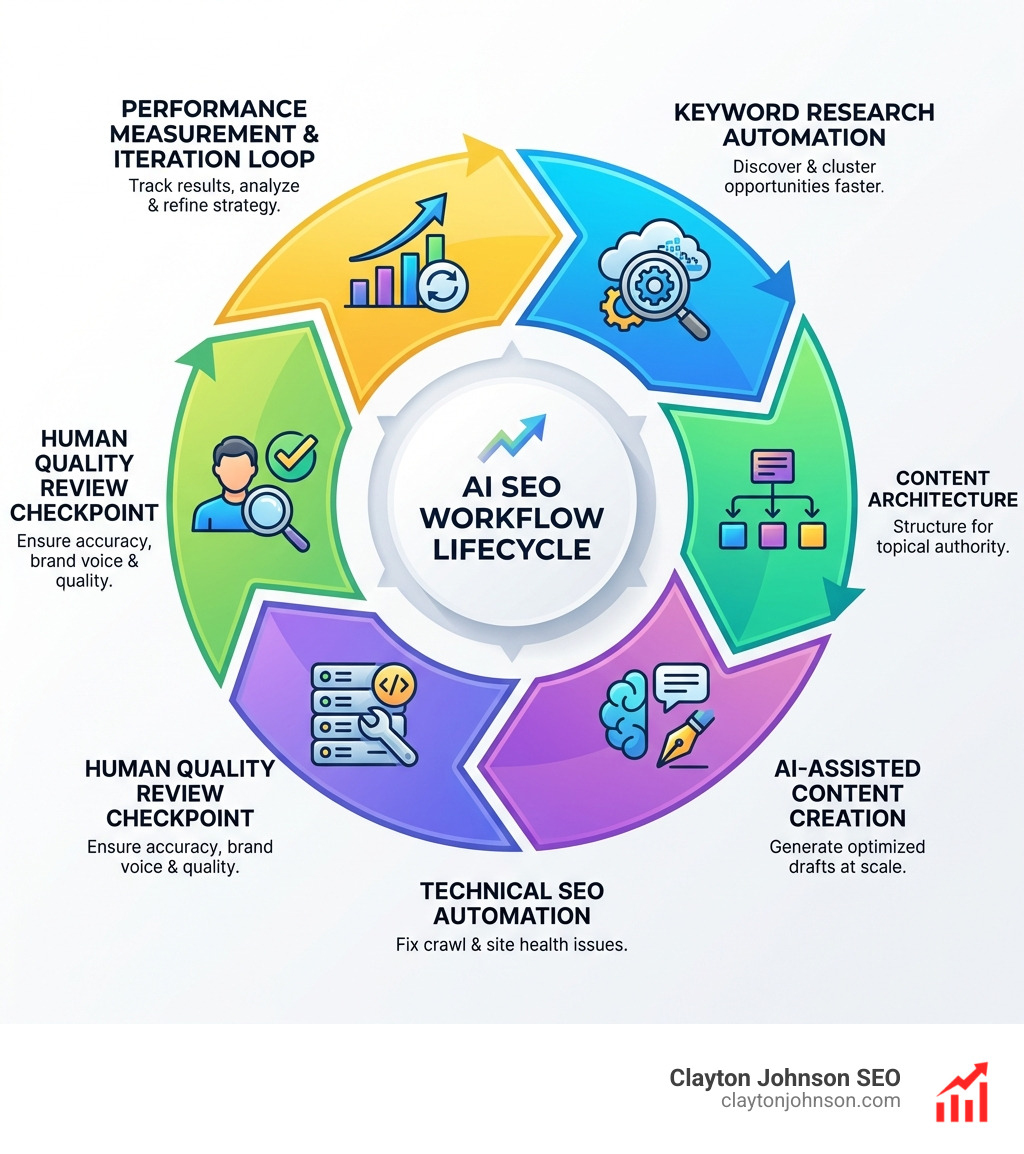
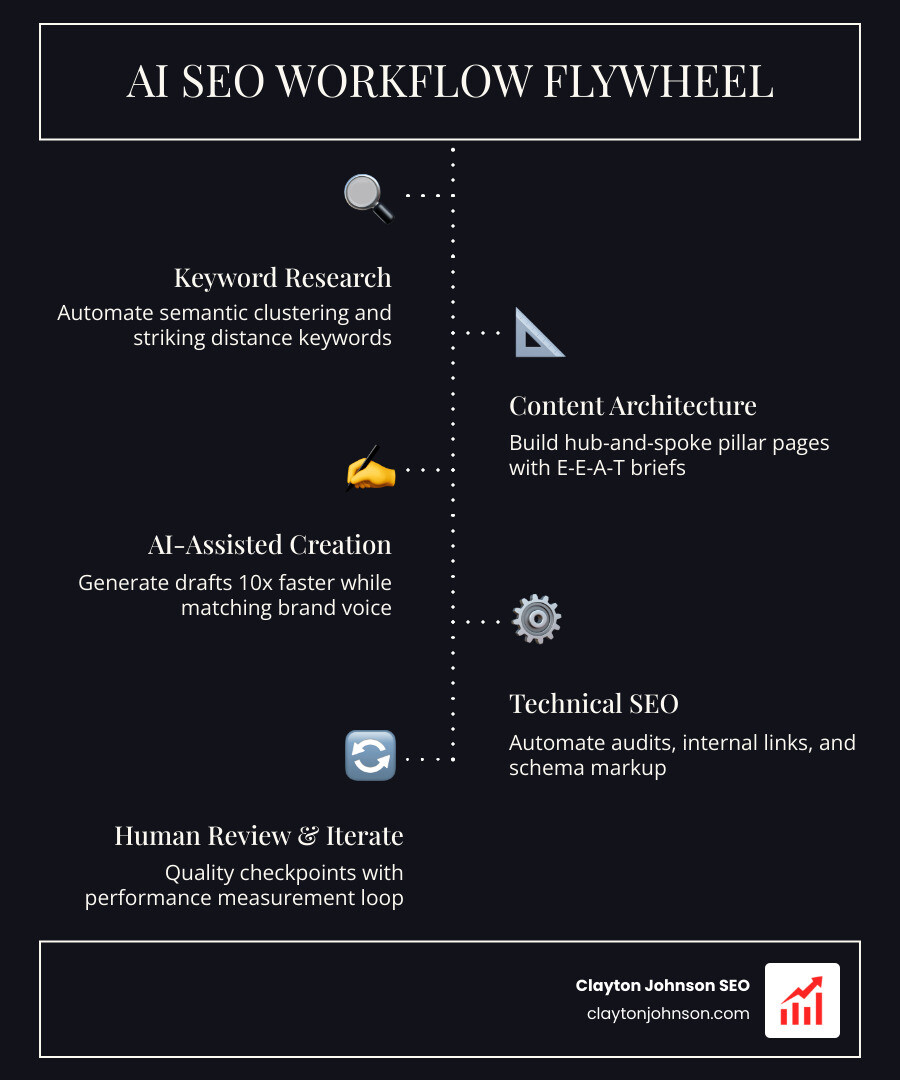
A successful AI SEO strategy isn’t about one-off prompts; it’s about a connected pipeline. At Clayton Johnson SEO and through our Demandflow platform, we view this as a systematic operating system. The real power of AI comes when Stage 1 (Research) automatically informs Stage 2 (Briefs), which triggers Stage 3 (Drafting).
The core stages include:
- Strategic Planning: Aligning keyword discovery with business goals and ICPs.
- Keyword Automation: Using AI to cluster thousands of terms by intent.
- Content Architecture: Building topic clusters as interconnected pages around a central topic.
- Technical SEO: Automating site health checks and internal linking.
- Performance Tracking: Connecting GSC and GA4 to AI for revenue attribution.
More info about AI SEO services
Phase 1: Automate Research and Implement AI SEO Workflows for Keywords
Keyword research used to be about finding high-volume, low-difficulty terms. Today, it’s about understanding search intent. Search intent is the hidden “why” behind the query—is the user looking to learn (informational), compare (commercial), or buy (transactional)?
When you implement AI SEO workflows for research, you can move beyond basic lists:
- Semantic Clustering: Instead of targeting “SEO services” and “SEO agency” as separate tasks, AI groups them into a single cluster, preventing keyword cannibalization.
- Striking Distance Keywords: Use AI to identify keywords ranking in positions 4–10. These are your biggest opportunities for quick traffic wins.
- Data Analysis for Non-Coders: You don’t need to be a developer to use advanced data science. Tools like Google Colab allow you to run Python scripts generated by ChatGPT to filter thousands of rows of GSC data in seconds.
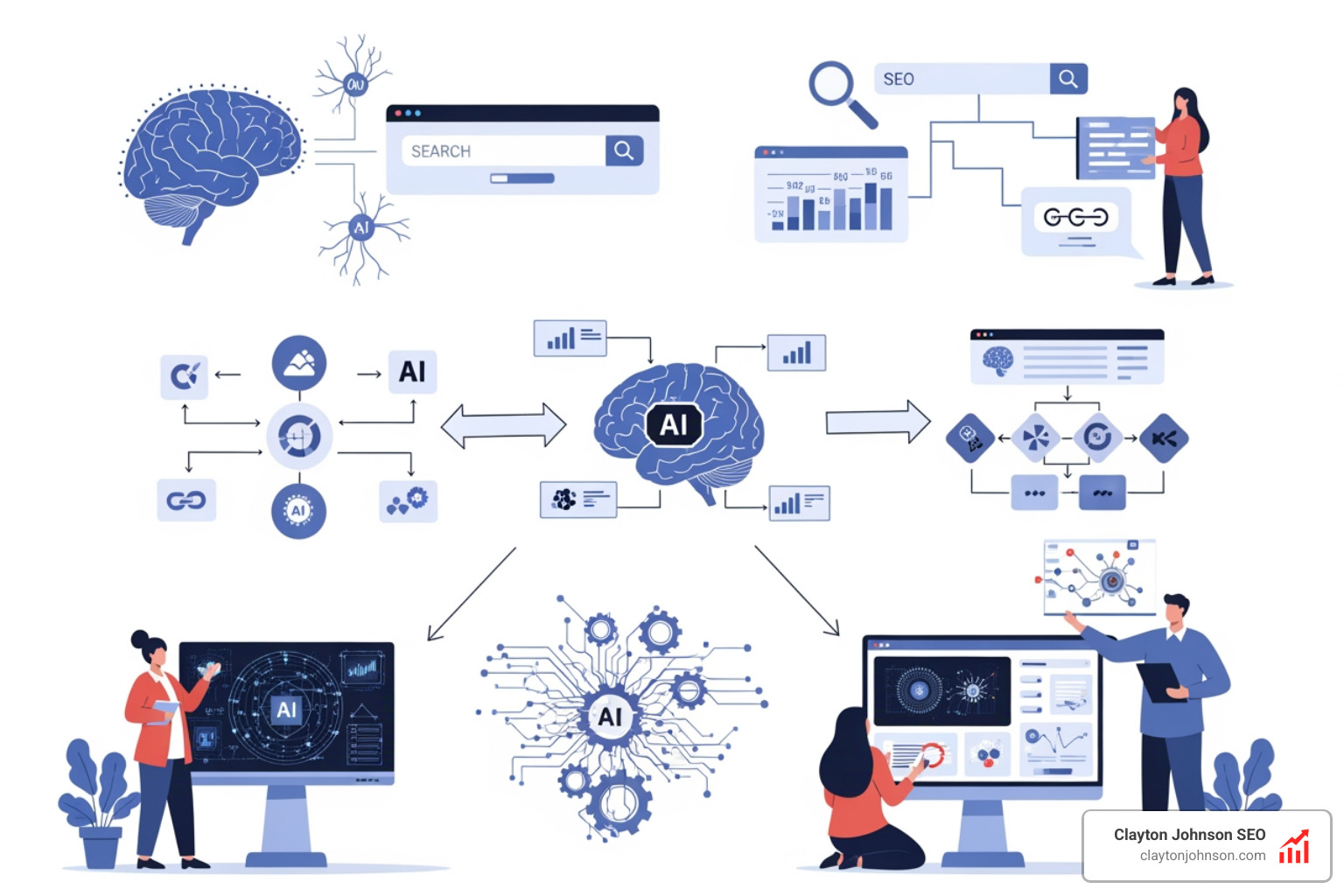
Phase 2: Content Architecture and Pillar Page Development
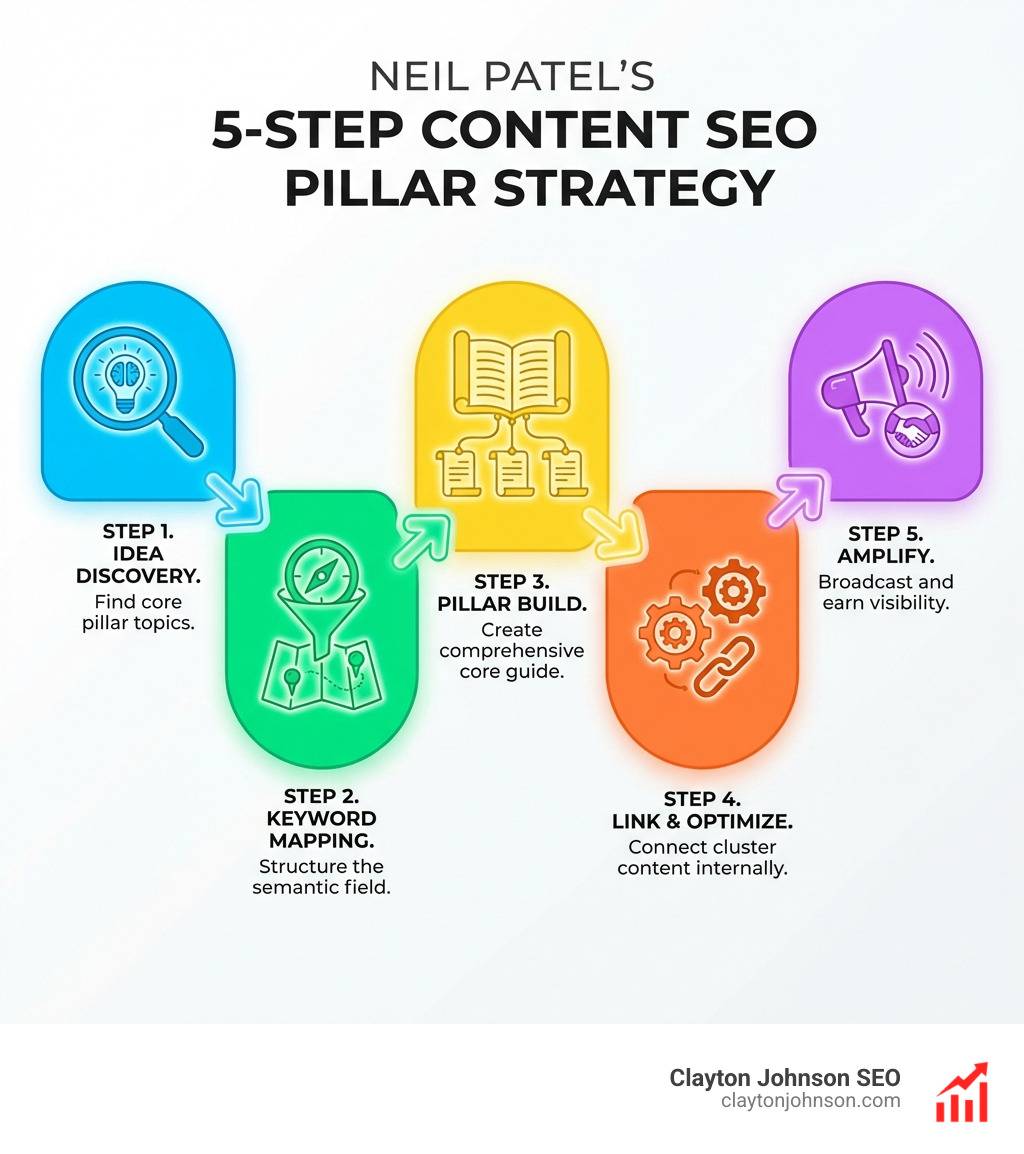
Once you have your clusters, you need to build a hub and spoke model. This involves creating one comprehensive “pillar page” (the hub) and multiple supporting “cluster posts” (the spokes) that link back to it.
AI accelerates this by:
- Generating Data-Driven Briefs: AI can scan the top-ranking competitors for a target keyword and tell you exactly which subheadings, questions, and entities you need to include to rank.
- Maintaining Brand Voice: By feeding your brand guidelines into an AI SEO workflow, you ensure that even AI-assisted drafts sound like your company, not a generic bot.
- Competitive Positioning: Use AI to identify “content gaps”—topics your competitors cover that you have missed—and automatically add them to your content calendar.
Technical SEO and Link Building Automation
Technical SEO is the foundation of AI readiness. If search engines can’t crawl your site efficiently, your content won’t rank, and AI engines won’t cite you.
Google has directly emphasized internal linking practices, specifically descriptive anchor text and a structure that helps users navigate. AI can scan your site and suggest internal links between relevant cluster pages, which strengthens internal linking’s role in navigation and engagement.
In link building, AI helps with:
- Prospecting: Identifying high-authority sites in your niche that have covered similar topics.
- Personalization: Drafting outreach emails that reference specific articles on a journalist’s site, increasing your response rate.
- Broken Link Detection: Automatically finding broken links on competitor sites and suggesting your content as a replacement.
Scaling Technical Audits to Implement AI SEO Workflows
Waiting for a monthly manual audit is too slow. Smart teams use automated crawls with tools like Screaming Frog or Sitebulb, connected to Slack or email alerts.
When you implement AI SEO workflows for technical audits, you can monitor:
- Crawl Health: Catching 404 errors or redirect loops before they impact rankings.
- Core Web Vitals: Ensuring your site meets Google’s speed and stability standards.
- Log-File Insights: Using AI to analyze how often Googlebot visits your most important pages.
- Schema Markup: Automatically generating JSON-LD code for products, FAQs, and reviews to help AI engines understand your data.
Maintaining Quality: The Role of Human Oversight
While we love automation, we never advocate for “set it and forget it” AI content. To rank in the modern era, you must align with what Google explicitly says it wants: helpful, reliable, people-first content.
Pure AI content often suffers from “SEO oatmeal”—it’s bland, generic, and lacks unique insight. McKinsey research highlights that organizations achieving the most success with AI use a hybrid model.
The Human-in-the-Loop Workflow:
- AI Research: AI clusters keywords and generates a brief.
- Human Strategy: An SEO expert reviews the brief to ensure it aligns with business goals.
- AI Drafting: AI creates a first draft based on the structured brief.
- Human Editorial: A writer adds personal anecdotes, SME quotes, and fact-checks the output to prevent hallucinations.
- AI Optimization: AI checks the draft against on-page SEO requirements and schema.
- Human Approval: Final sign-off before publishing.
Frequently Asked Questions about AI SEO
How do AI SEO workflows improve ROI?
By automating the 80% of SEO that is repetitive (data entry, basic drafting, technical monitoring), your team can focus on the 20% that drives 80% of the results (strategy, high-level creative, partnership building). This reduces the cost per lead and accelerates the time-to-rank. PwC reports that 73% of executives adopting AI in marketing realized a positive ROI in under 12 months.
Can non-coders use AI for SEO data analysis?
Absolutely. By using AI as a bridge, non-technical marketers can generate Python scripts for Google Colab to perform complex tasks like filtering “striking distance” keywords from Google Search Console exports or visualizing keyword opportunities by subfolder. You simply describe what you want to do, and the AI provides the code to do it.
What are the risks of using AI-generated content?
The primary risks are hallucinations (AI confidently stating false information), lack of brand voice, and potential “thin content” penalties if the output isn’t enriched by human expertise. To mitigate this, always use a “human-in-the-loop” process and ensure your content meets E-E-A-T (Experience, Expertise, Authoritativeness, Trustworthiness) standards.
Conclusion
The gap between the companies that win at SEO and those that struggle isn’t a lack of tactics—it’s a lack of structured growth architecture.
At Clayton Johnson SEO, we help Minneapolis businesses and national brands implement AI SEO workflows that turn search into a compounding asset. Whether you are looking to scale your content production, automate your technical audits, or optimize for the new world of AI Overviews, the path forward is clear: Clarity → Structure → Leverage → Compounding Growth.
If you are ready to stop manual grinding and start building a systematic growth engine, let’s talk.