How AI Helps Roofing Companies Smash Sales Records


Why AI Marketing for Roofing Companies Is Changing How Roofers Win Jobs
AI marketing for roofing companies is the use of artificial intelligence tools to generate more leads, respond faster, and convert more homeowners into paying customers — without hiring a bigger team.
Here’s what AI marketing does for roofers, at a glance:
| What AI Does | Why It Matters |
|---|---|
| Responds to leads in under 3 minutes, 24/7 | 78% of customers choose the first business that responds |
| Predicts storm demand before it peaks | Lets you activate campaigns before competitors react |
| Automates scheduling, follow-ups, and intake | Frees your team to focus on revenue-generating work |
| Optimizes content to get cited by AI search tools | Puts your business in front of buyers using Google, ChatGPT, and more |
| Filters low-intent leads automatically | Your team only talks to people ready to book |
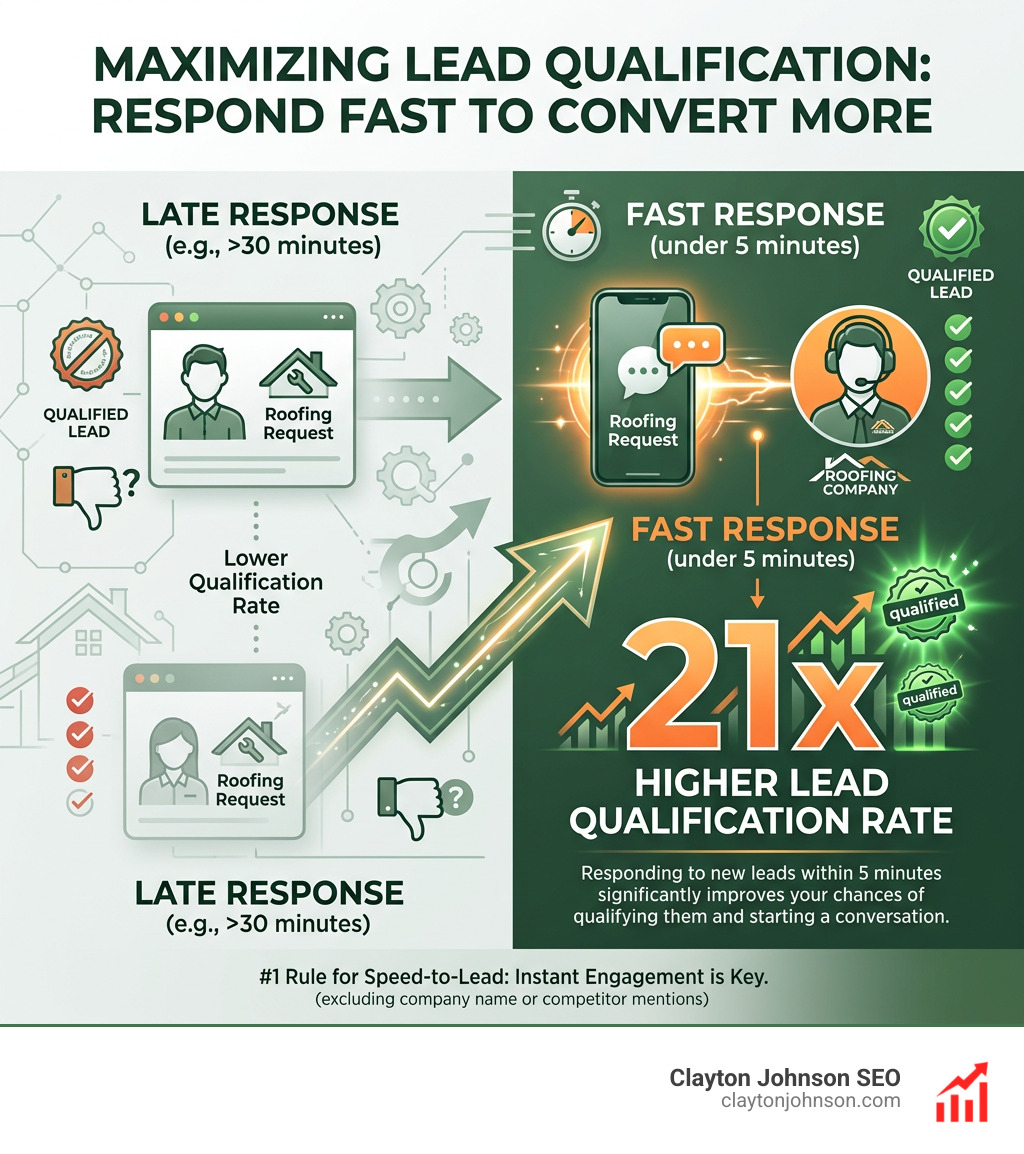
The stakes are real. Roofing companies miss up to 26% of inbound calls. Responding within five minutes makes a business up to 21 times more likely to qualify a lead. Most roofers are losing jobs simply because no one picked up.
AI fixes that — and a lot more.
I’m Clayton Johnson, an SEO strategist and AI marketing specialist who has spent nearly two decades helping businesses build scalable systems that turn search visibility into revenue, including applying AI marketing for roofing companies to drive measurable lead growth. In the sections below, I’ll walk you through exactly how to build and implement an AI-powered marketing system for your roofing business.
The Core Pillars of AI Marketing for Roofing Companies
In the old days, roofing marketing was simple: buy a Yellow Pages ad, slap a magnet on the truck, and hope for a hailstorm. Then came the internet, and we all had to learn SEO. But today, the game is shifting again. We are moving from traditional search engines to “Answer Engines.”
When a homeowner asks their phone, “Who is the best metal roofing contractor near me?” they aren’t looking for a list of ten blue links. They want a single, trusted recommendation. This shift is why ai marketing for roofing companies is no longer optional—it’s the new standard for survival.
The core pillars of this new era are built on speed and authority. Statistics show that 78% of customers choose the first business that responds. If you’re on a roof and can’t answer the phone, you’ve already lost the job to the guy using an AI receptionist. Furthermore, research published by Harvard Business Review shows that responding within 5 minutes makes a business up to 21× more likely to qualify a lead compared to waiting just 30 minutes.

To win in this environment, we focus on SEO services that align with how AI models actually “read” your business. This means moving beyond keyword stuffing and focusing on your digital footprint as a whole. We need to feed clean data to AI agents so they can cite your company as the local authority.
Using AI Marketing for Roofing Companies to Build an AI Résumé
Think of your website not as a brochure, but as an “AI résumé.” AI models like ChatGPT, Perplexity, and Google Gemini are looking for specific signals to decide if you are trustworthy enough to recommend. This is called AI Engine Optimization (AEO).
To build a high-ranking AI résumé, we use three specific technical strategies:
- Semantic Triples: We structure your data in a way that AI understands “Subject-Predicate-Object.” For example: “[Your Company] – [Installs] – [GAF Asphalt Shingles].” This clarity helps AI categorize your services without guesswork.
- Content Chunking: Instead of massive walls of text, we break information into 150-300 word sections with clear subheadings. This makes it easier for AI to “scrape” and use your content in its answers.
- FAQ and How-To Schema: These are snippets of code that tell search engines exactly what questions you are answering. Using FAQ schema can improve your click-through rates by 20–30% and helps you qualify for AI-generated answer cards.
This is critical because 67% of customers prefer self-service options, including the ability to book appointments or get answers without a phone call. If your website is structured correctly, the AI can act as your first-line salesperson.
Leveraging AI Marketing for Roofing Companies to Predict Storm Leads
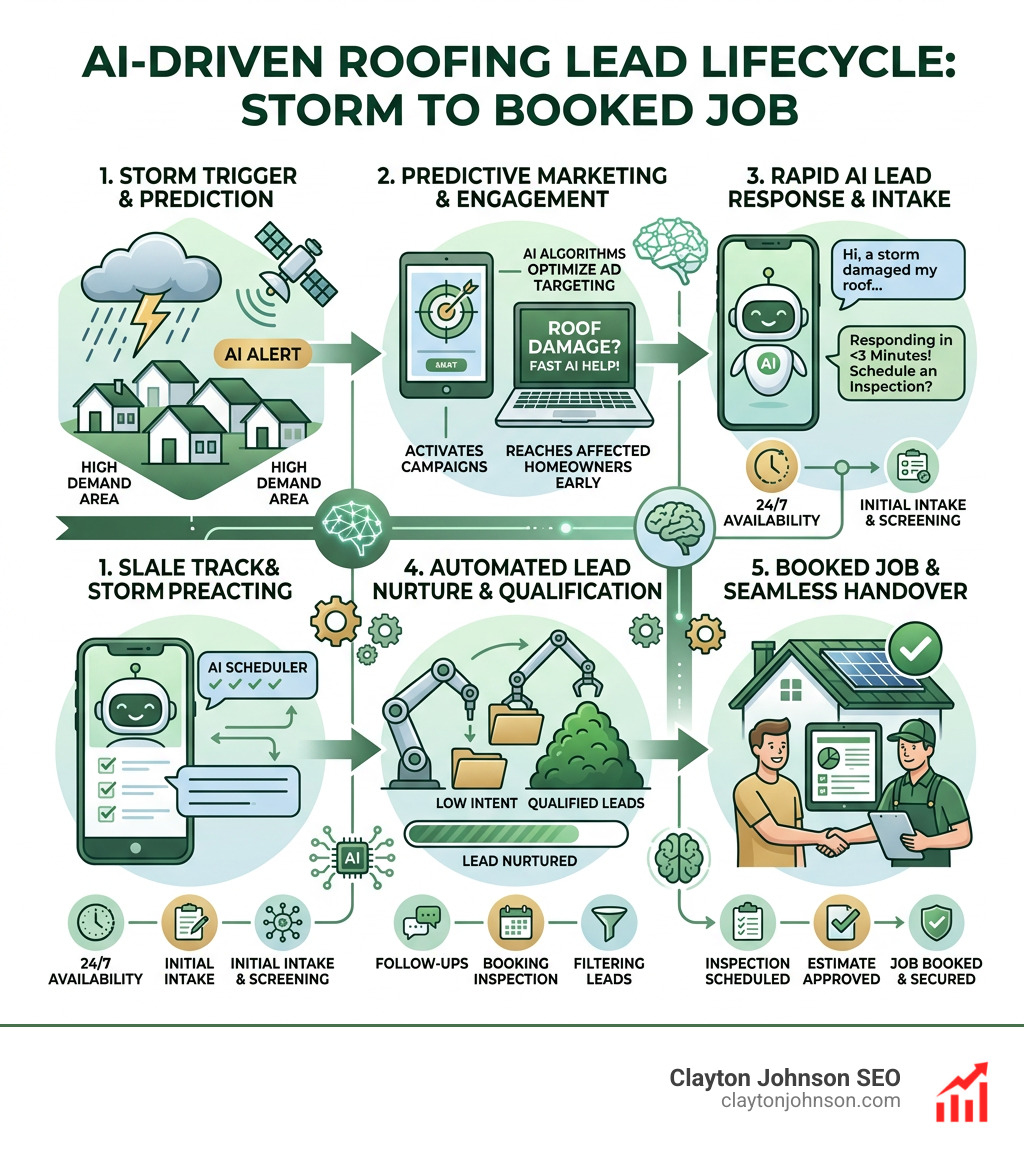
One of the most powerful aspects of ai marketing for roofing companies is the ability to stop being reactive. Most roofers wait for the phone to ring after a storm. With AI, we can see the leads coming before the clouds even clear.
By integrating NOAA (National Oceanic and Atmospheric Administration) storm data with predictive AI models, we can identify specific neighborhoods hit by hail or high winds. We then trigger hyper-local ads and SEO updates for those ZIP codes 48 hours before the competition even gets their crews on the road.
| Feature | Manual Lead Targeting | AI-Driven Predictive Targeting |
|---|---|---|
| Response Time | Hours or days after storm | Pre-storm or within minutes |
| Data Source | Visual inspection/News | NOAA Radar + Housing Age Data |
| Lead Quality | Mixed (Tire-kickers) | High (Scored by insurance likelihood) |
| Cost | High (Wasted broad ads) | Low (Surgical precision) |
| Scalability | Limited by human staff | Unlimited automated reach |
This “storm surge” strategy allows us to target high-intent keywords like “emergency roof leak repair” or “hail damage insurance claim” exactly when search volume spikes by 200%.
Essential AI Tech Stack: From Drones to Intake Assistants
You don’t need a degree in computer science to use AI. You just need the right “stack” of tools. In our experience, top-performing roofing companies use a combination of these specialized tools:
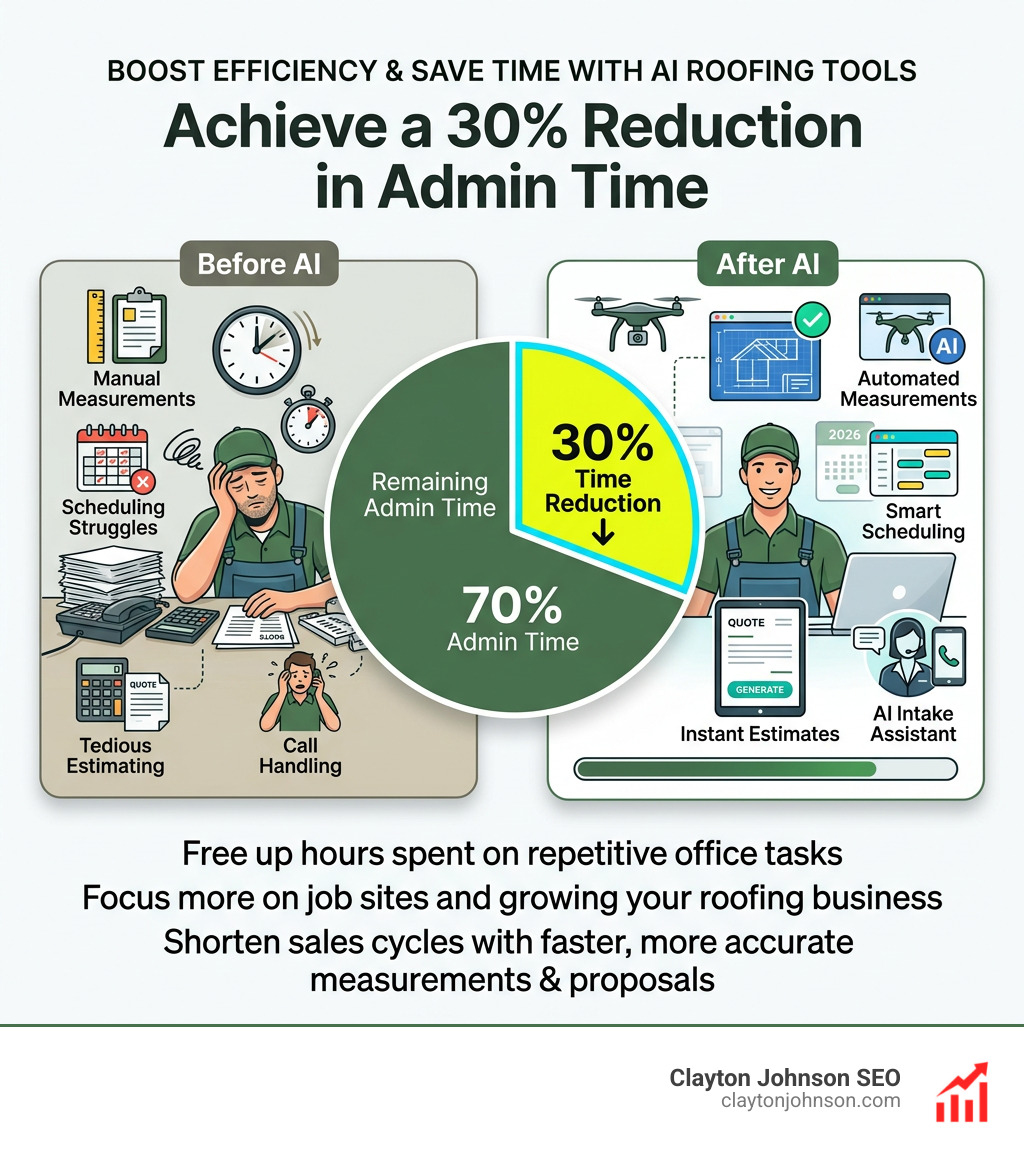
- Drones & Measurements: Tools like EagleView and IMGING use AI to scan roofs and provide instant, accurate measurements. This shortens the sales cycle because you can provide an estimate before you even leave the driveway.
- AI Intake Assistants: Whippy and other AI receptionists handle the around 26% of calls from potential customers that are not answered during busy seasons. They can qualify the lead, check your schedule in JobNimbus, and book the inspection automatically.
- Visualization & Bidding: Renoworks lets homeowners see what a new metal roof would look like on their actual house using AI. Couple this with SumoQuote to create professional, high-converting proposals in minutes.
By automating these repetitive tasks, McKinsey estimates that up to 30% of administrative tasks can be automated with existing technology. For a roofer, that means more time on the job site and less time buried in spreadsheets. For more on how to build these automated engines, check out the ultimate guide to AI content systems.
Implementing the 5-Phase AI Growth Framework
Strategy without execution is just a hallucination. To help roofing companies scale, we use a structured 5-phase framework. This isn’t about chasing the “tool of the week.” It’s about building a durable system where clarity leads to compounding growth.
We don’t just rely on one AI model to tell us what to do. We use a “peer review” system where one AI generates a strategy and a second, different model audits it for flaws. This ensures the plan is realistic for a roofing business’s specific constraints, like budget and seasonality.

Phase 1-3: Digital Audit, Strategy Generation, and Model Peer Review
The first step is a “ruthless audit” of your digital footprint. We scrape your current website, social media, and Google Business Profile to see what the world (and AI) thinks of you. We often find that 92% of companies say valuable insights sit outside their CRM. We bring that data together.
Next, we use AI agents to conduct deep research on your local competitors. We look for “content gaps”—questions homeowners are asking that no one in your city is answering. We then generate a 12-month AI-driven SEO strategy and systems plan.
Finally, we perform the AI Peer Review. We take the strategy generated by Model A (say, ChatGPT) and feed it into Model B (like Claude or Gemini) with the prompt: “Critique this roofing marketing plan for a company with a $5,000/month budget in a hail-prone region. Find the weaknesses.” This process removes “AI hallucinations” and gives us a battle-tested roadmap.
Phase 4-5: Applying Real-World Constraints and Interactive Delivery
AI is great, but it doesn’t know that your best crew is taking a vacation in July or that your supplier is out of certain shingles. In Phase 4, we apply your real-world business constraints. We adjust the plan for roofing seasonality—focusing on repairs during the winter and full replacements during the peak season.
In Phase 5, we move away from static, boring PDF reports. We deliver your marketing strategy and performance data via an interactive dashboard or chatbot. This allows stakeholders to ask questions like, “How many metal roofing leads did we get from the north side of town last month?” and get an answer instantly. This level of analytics and data allows for “Capacity Marketing”—turning your ads up when your schedule is empty and turning them down when you’re booked out six weeks.
Measuring Success: KPIs and Avoiding Common AI Pitfalls
To know if your ai marketing for roofing companies is actually working, you have to track the right numbers. We look at two types of indicators:
- Lead Indicators (The “Early Wins”):
- AI Share of Voice: How often is your company cited by ChatGPT or Google Search Generative Experience for local roofing queries?
- NAP Consistency: Is your Name, Address, and Phone number 100% consistent across the web? Inconsistencies are a major “trust killer” for AI models.
- Lag Indicators (The “Bottom Line”):
- Speed-to-Lead: Are you responding in under 3 minutes?
- Lead-to-Job Conversion: AI should be filtering out “tire-kickers,” so your conversion rate on booked appointments should actually go up.
One common mistake we see is “thin content.” Some roofers use AI to churn out hundreds of low-quality blog posts. This backfires. AI search tools are smart enough to recognize fluff. Instead, we focus on authority assets—things like your specific insurance claim process, safety certifications, and local project galleries. Roofers who consistently publish high-quality visual content see organic traffic rise 25–40% within six months.
The Future of AI in the Roofing Industry
The future of roofing isn’t just about better shingles; it’s about better systems. We are already seeing the rise of predictive maintenance. Imagine an AI system that monitors local weather patterns and house ages, then automatically emails a past customer: “Your roof is 15 years old and just survived a 60mph wind event. Would you like a free AI-assisted drone inspection this Tuesday?”
We are also moving toward voice-activated search. Homeowners are increasingly using Alexa or Siri to find contractors. Optimizing for these “natural language” queries requires a different approach than traditional SEO. You can learn more about this in our guide on how to use AI for voice search like a pro.
The goal of ai marketing for roofing companies is to make your business the “obvious choice” for both humans and machines. By building a transparent, data-rich, and lightning-fast organization, you don’t just survive the next storm—you own it.
If you’re ready to stop chasing leads and start building a scalable traffic system, it’s time to audit your digital footprint. At Clayton Johnson SEO, we specialize in turning fragmented marketing into coherent growth engines. Let’s build the system that puts you on more roofs.
AI Search Frequently Asked Questions
How can I make my roofing company show up higher on Google without paying for ads? Focus on your Google Business Profile. Collect high-quality reviews, post weekly updates with photos of your work, and ensure your service areas are clearly defined. AI search tools prioritize local relevance and verified customer trust.
What kind of content helps roofers rank faster in search engines? Educational, “problem-solving” content works best. Instead of just saying “We fix roofs,” write about “How to spot hail damage on an asphalt roof” or “The pros and cons of metal vs. shingle roofing in [Your City].” Use original photos and videos to prove you are a real local expert.
Is SEO or paid advertising better for roofing companies? It’s not an “either/or” situation. We recommend a 60/40 split. SEO builds long-term authority and lowers your lead cost over time, while paid ads provide immediate volume during storm surges. AI helps optimize the spend between both to maximize ROI.
How do customer reviews impact my roofing SEO? Reviews are a massive signal for AI models. Not only does the star rating matter, but the keywords customers use in their reviews (like “best metal roofer” or “fast insurance claim”) help AI understand what you are good at. Always respond to every review to show you are active.
Should I still blog as a roofer? Yes, but only if the content is high-value. Don’t write for the sake of writing. Use “content chunking” to answer specific questions that homeowners are actually asking. One high-quality study or guide on local roofing costs can earn you dozens of backlinks and AI citations.
What is the best way to track my roofing marketing ROI? Track your “Revenue-to-Cost” ratio. Aim for at least a 4:1 return. Use a CRM like JobNimbus or ServiceTitan integrated with your marketing tools so you can see exactly which lead source turned into a signed contract and a final check.