How AI Schema Generators Save Your Technical SEO

Why an AI Schema Markup Generator Is a Game-Changer for Technical SEO
An ai schema markup generator uses artificial intelligence to automatically create structured data code (JSON-LD) that tells search engines exactly what your content means — no coding required.
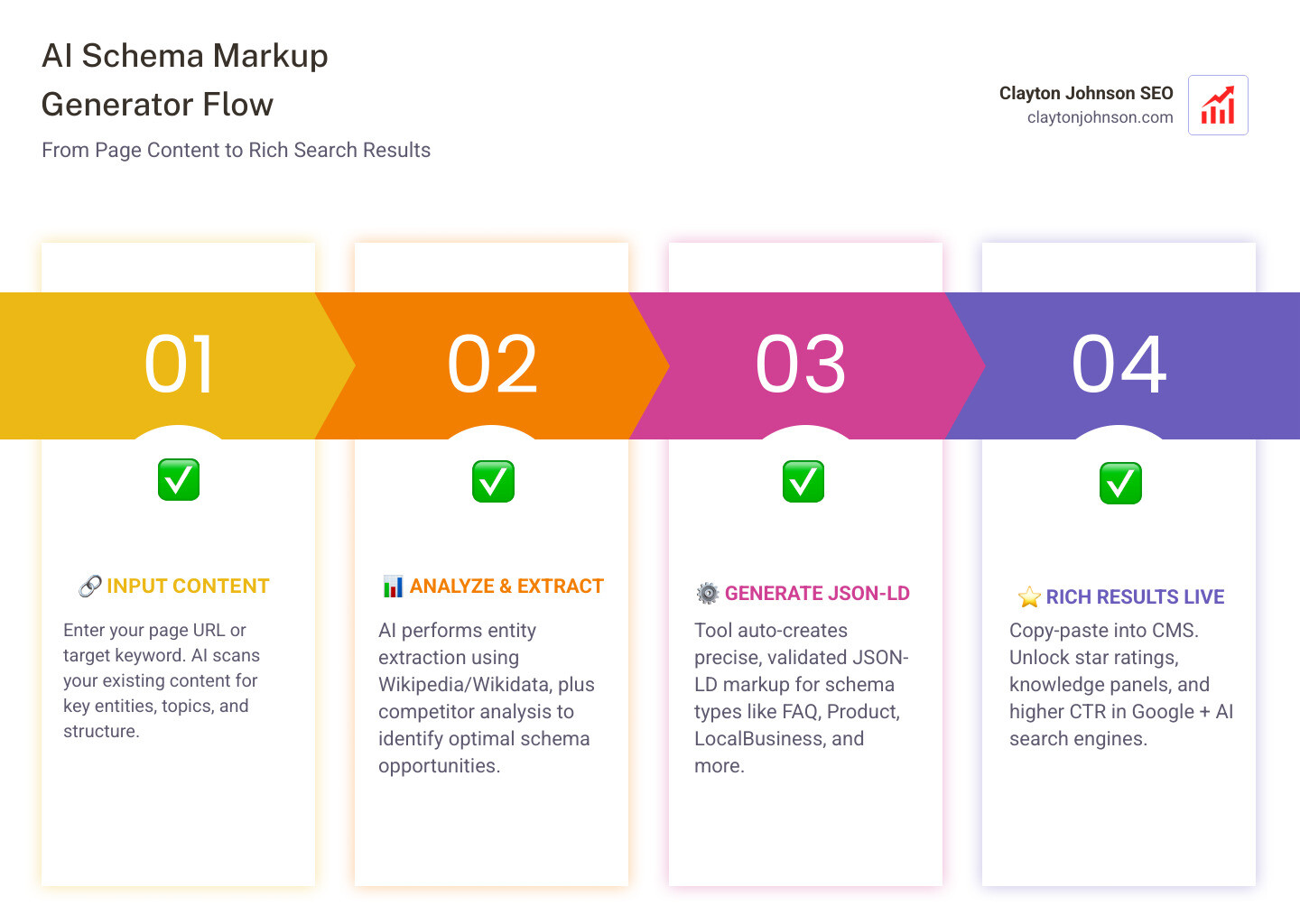
Here’s how to use one in 4 steps:
- Enter your page URL or target keyword into the tool
- The AI analyzes your content and top-ranking competitors
- It generates ready-to-use JSON-LD schema markup
- Copy and paste the code into your CMS or HTML
Top AI schema markup generators to know:
| Tool | Best For | Key Feature |
|---|---|---|
| Schemawriter.ai | Local SEO & agencies | Competitor entity extraction |
| SEO Ella | Non-technical users | Auto-apply schema to any site |
| Alli AI | Enterprise scale | 17M+ automated code fixes |
| Schemaforge | Free users | 20+ schema types, 100% free |
| Addlly AI | AI search visibility | ChatGPT, Gemini, Perplexity optimization |
Most business owners understand that showing up in Google matters. What fewer realize is that how Google understands your content matters just as much as what your content says.
Schema markup is the bridge between your content and search engine comprehension. It’s the structured data layer that unlocks rich results — those eye-catching star ratings, FAQs, product prices, and knowledge panels you see in search. Done right, it can meaningfully improve click-through rates and help your content get cited by AI-powered answer engines like ChatGPT, Gemini, and Perplexity.
The problem? Writing schema markup manually is genuinely painful. Even experienced marketers wrestle with JSON syntax errors, outdated schema rules, and validation failures in Google Search Console. One misplaced bracket and the whole thing breaks.
That’s exactly where AI schema generators change the game. They remove the technical barrier entirely — automating what used to take developers hours into a process that takes seconds.
I’m Clayton Johnson, an SEO strategist with nearly two decades of experience building scalable search systems, and I’ve integrated ai schema markup generators into client workflows to consistently compress technical SEO timelines and surface compounding ranking gains. In the sections ahead, I’ll walk you through exactly how these tools work, which ones lead the market, and how to build structured data into a durable growth system for your site.
The Evolution of the AI Schema Markup Generator for Modern SEO
In the early days of structured data, implementing schema was a task reserved for developers who could navigate the strict syntax of schema.org. It was a manual, error-prone process involving brackets, commas, and nested hierarchies. If a marketer wanted to add an FAQ section or a product price, they had to wait for a dev sprint.
The shift toward an ai schema markup generator represents a fundamental change in how we handle AI-driven SEO strategy and systems. Modern tools don’t just provide a template; they perform “entity extraction.” This means the AI reads your page, identifies the key “entities” (people, places, things, or concepts), and cross-references them with authoritative databases like Wikipedia and Wikidata.
By connecting your content to these global knowledge graphs, you give search engines the maximum chance of understanding your topic. This isn’t just about “ranking”; it’s about becoming a recognized entity in the eyes of the algorithm.
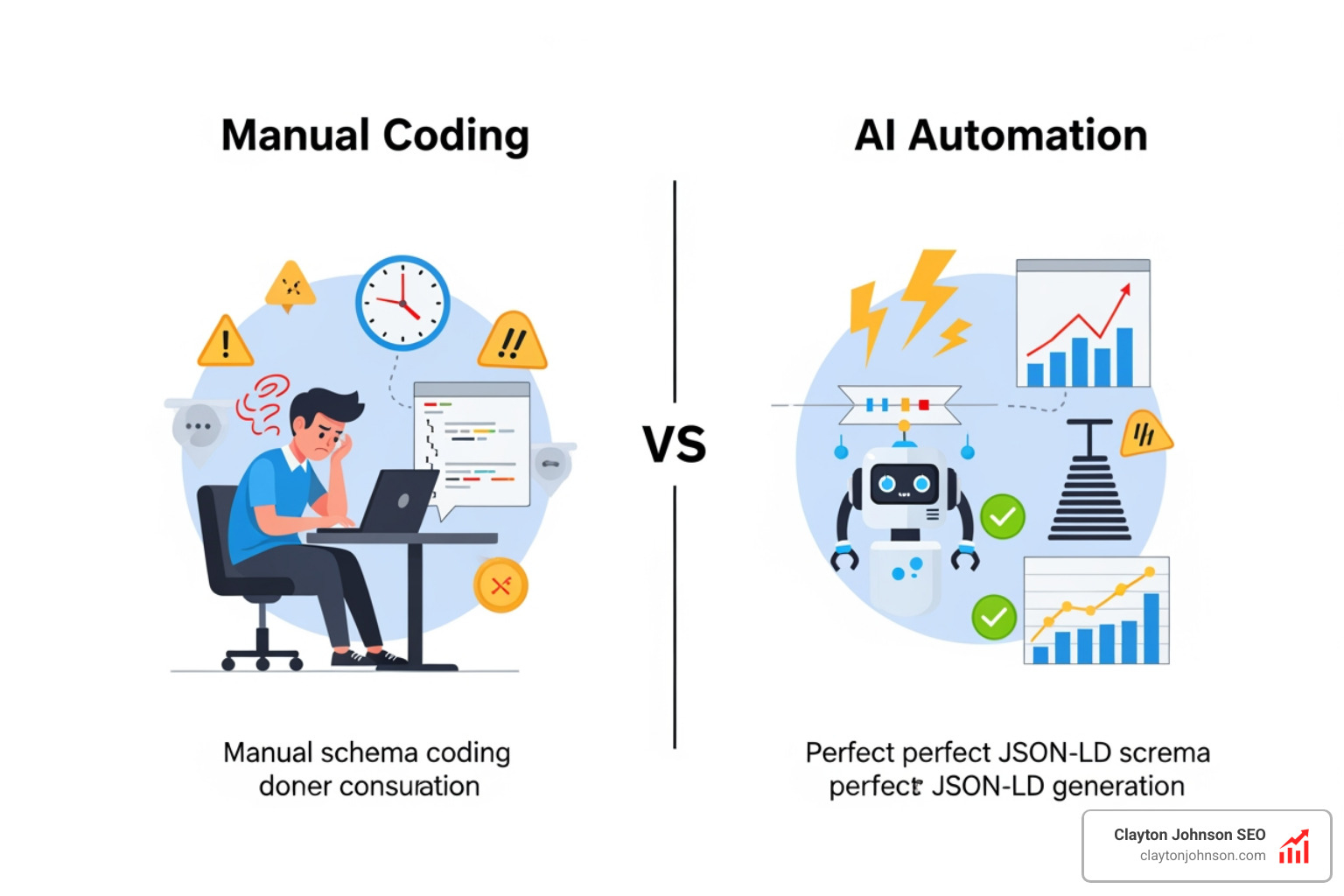
Manual Coding vs. AI Automation
| Feature | Manual Schema Coding | AI Schema Generation |
|---|---|---|
| Speed | 30–60 minutes per page | Under 30 seconds |
| Accuracy | High risk of syntax errors | Validated JSON-LD output |
| Scalability | Difficult for 100+ pages | Bulk generation capabilities |
| Entity Depth | Limited to user knowledge | Deep Wikipedia/Wikidata links |
| Maintenance | Manual updates required | Automated sync with content |
Why an ai schema markup generator is essential for AI search
We are moving into an era of “Generative Engine Optimization” (GEO). Traditional search engines are being joined by Large Language Models (LLMs) like ChatGPT, Gemini, and Perplexity. These models don’t just “crawl” links; they synthesize answers.
To get your brand mentioned in a ChatGPT response or cited in a Perplexity answer, your data must be machine-readable. Structured data acts as the “language of AI.” When an LLM looks for facts to ground its response, it prioritizes sites that provide clear, structured context. Using an ai schema markup generator ensures your content is formatted for these AI SEO workflows, increasing the likelihood of earning highly valuable LLM citations.
Key features of a high-performance ai schema markup generator
When selecting a tool, you shouldn’t just look for a simple code generator. High-performance systems include:
- YAKE Extraction: Using “Yet Another Keyword Extractor” technology to find relevant terms from top-ranking competitors.
- Competitor Analysis: Crawling the top 10 search results to see which entities they are using so you can match or exceed their topical authority.
- Google API Integration: Validating the data against Google’s own standards to ensure it qualifies for rich snippets.
- Built-in Editor: Allowing you to fine-tune the JSON-LD without touching the actual code.
This level of detail is a core part of how to use AI for on-page SEO that actually ranks.
Supported schema types for business growth
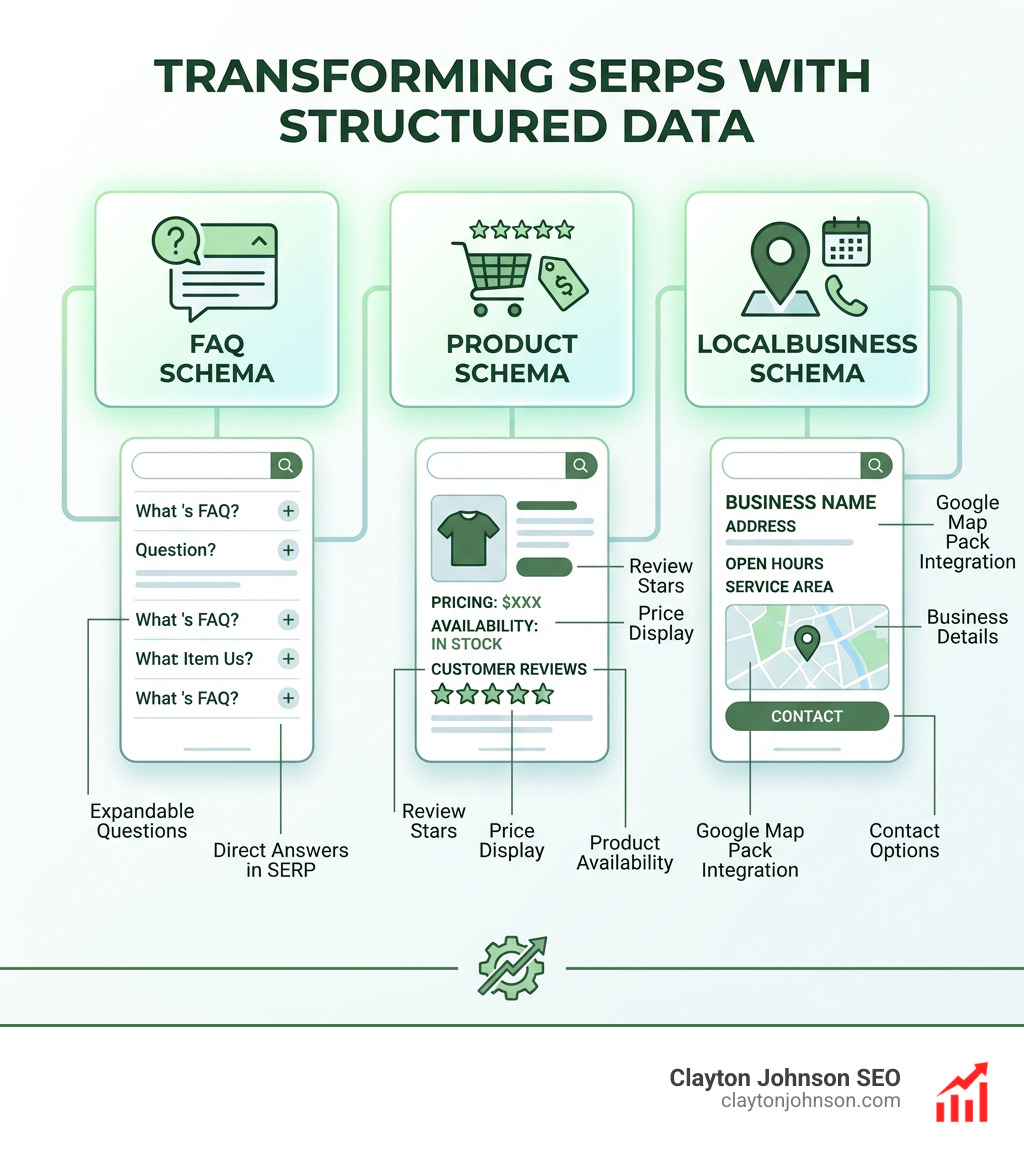
A robust ai schema markup generator should support a wide variety of schema types to cover different business needs. Common types include:
- LocalBusiness: Essential for ranking in the “Map Pack” and providing Google with your address, hours, and service area.
- FAQ: Turns your content into expandable questions directly in the search results, taking up more “real estate.”
- Product: Displays price, availability, and review stars, which is critical for e-commerce conversion.
- Organization: Establishes your brand’s identity and links your social profiles.
- Article: Helps news and blog content get indexed faster and featured in “Top Stories.”
Understanding which schema to use is a vital component of a comprehensive keyword strategy.
Implementing AI-Driven Systems for Compounding Growth
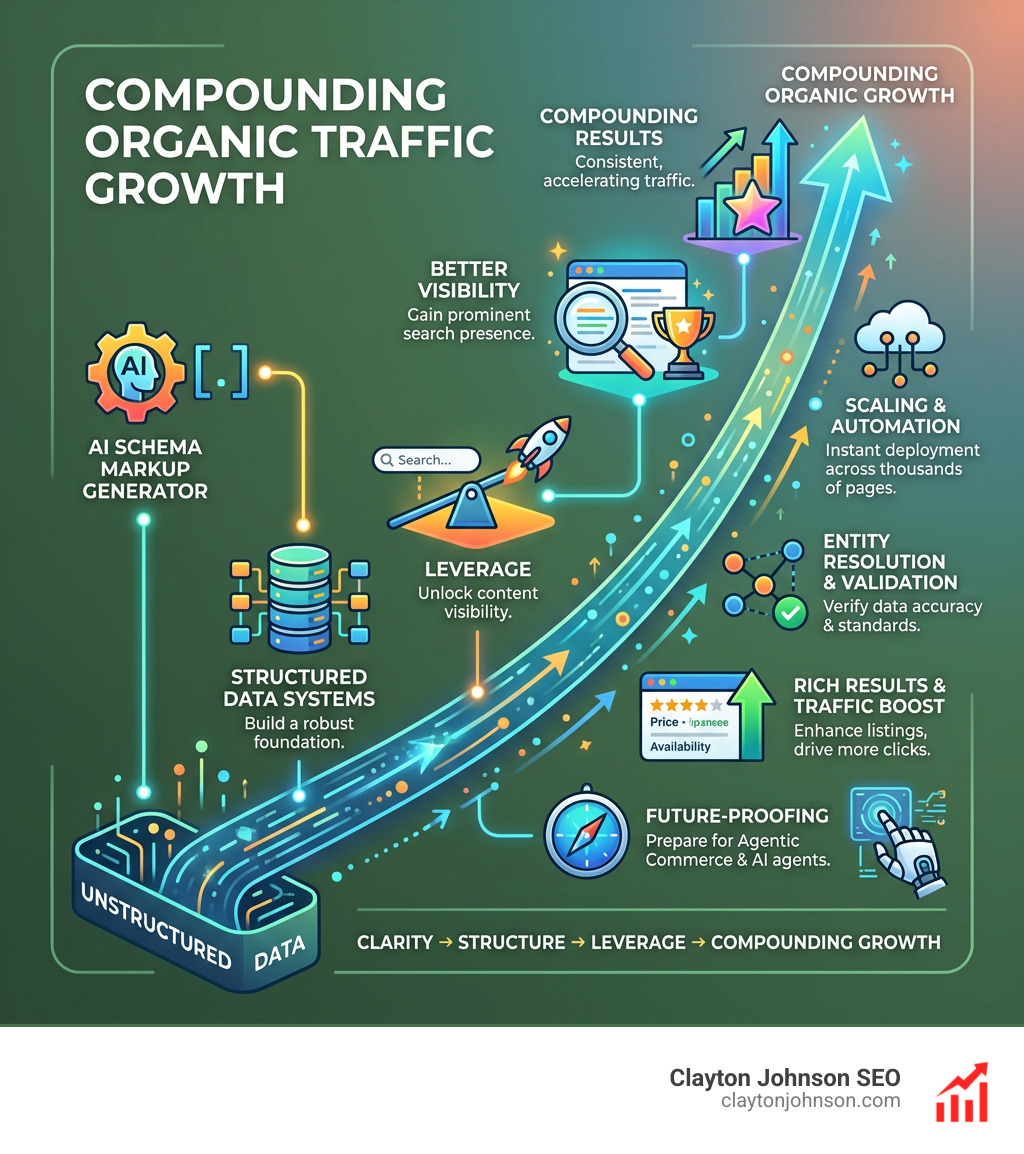
At Clayton Johnson SEO, we believe in the philosophy of Clarity → Structure → Leverage → Compounding Growth. An ai schema markup generator provides the “Structure” that allows you to “Leverage” your content for better visibility.
Implementing these tools isn’t just a one-time task; it’s about building a system. When you automate your structured data, you free up your team to focus on high-level strategy rather than fixing broken brackets. You can explore our SEO services or our AI tools guide to see how we integrate these systems for our partners.
Scaling technical SEO with automated workflows
For agencies or enterprise sites, manual implementation is impossible. Tools like Alli AI have demonstrated the power of scale, performing millions of code fixes instantly. By using an ai schema markup generator that integrates directly with your CMS (like WordPress via a plugin) or via API, you can deploy schema across thousands of pages simultaneously.
This automation is a key part of modern AI-driven SEO audits. Instead of just identifying a lack of schema, the system identifies the gap and generates the solution in one motion.

Measuring results and validating your markup
Generating the code is only half the battle; you must ensure it works. Google provides the Rich Results Test to see if your page qualifies for enhanced listings. Additionally, the Schema.org Validator helps ensure your code follows official global standards.
What results can you expect? While every site is different, the research shows significant impact:
- Alli AI has reported organic traffic improvements of up to 300%.
- Kino Indonesia achieved a 50% increase in organic traffic in just one month by optimizing content with structured data.
- Junior developers using AI tools have seen 70% faster task completion for technical implementations.
Regularly auditing SEO with AI allows you to catch errors before they impact your rankings.
Future-proofing your site for agentic commerce
As we look toward the future, “Agentic Commerce” — where AI agents make purchasing decisions or recommendations for users — will rely almost entirely on structured data. If an AI agent can’t verify your product’s price, shipping time, or reliability through schema, it won’t recommend you to the user.
By adopting an ai schema markup generator today, you aren’t just chasing a trend; you are building a durable system. This aligns with our focus on AI governance and long-term brand building. We don’t just advise on strategy; we build the systems that operationalize it.
Summary Checklist for Using AI Schema Generators
- Audit First: Use AI to audit your current SEO and identify missing schema opportunities.
- Choose Your Tool: Select a generator that matches your scale (e.g., Schemawriter for local, Alli AI for enterprise).
- Extract Entities: Ensure your generator is pulling data from Wikipedia and Wikidata to provide “grounding” for AI engines.
- Validate: Never publish without running your JSON-LD through Google’s Rich Results Test.
- Monitor: Watch your Google Search Console for “Enhancements” to see your rich results come to life.
By moving from manual coding to automated, AI-enhanced systems, you transform a technical hurdle into a competitive advantage. This is the essence of compounding growth: building systems that work for you while you sleep.