How to Audit Your Content Without Losing Your Mind


Why Most Enterprise Content Audits Fail Before They Start
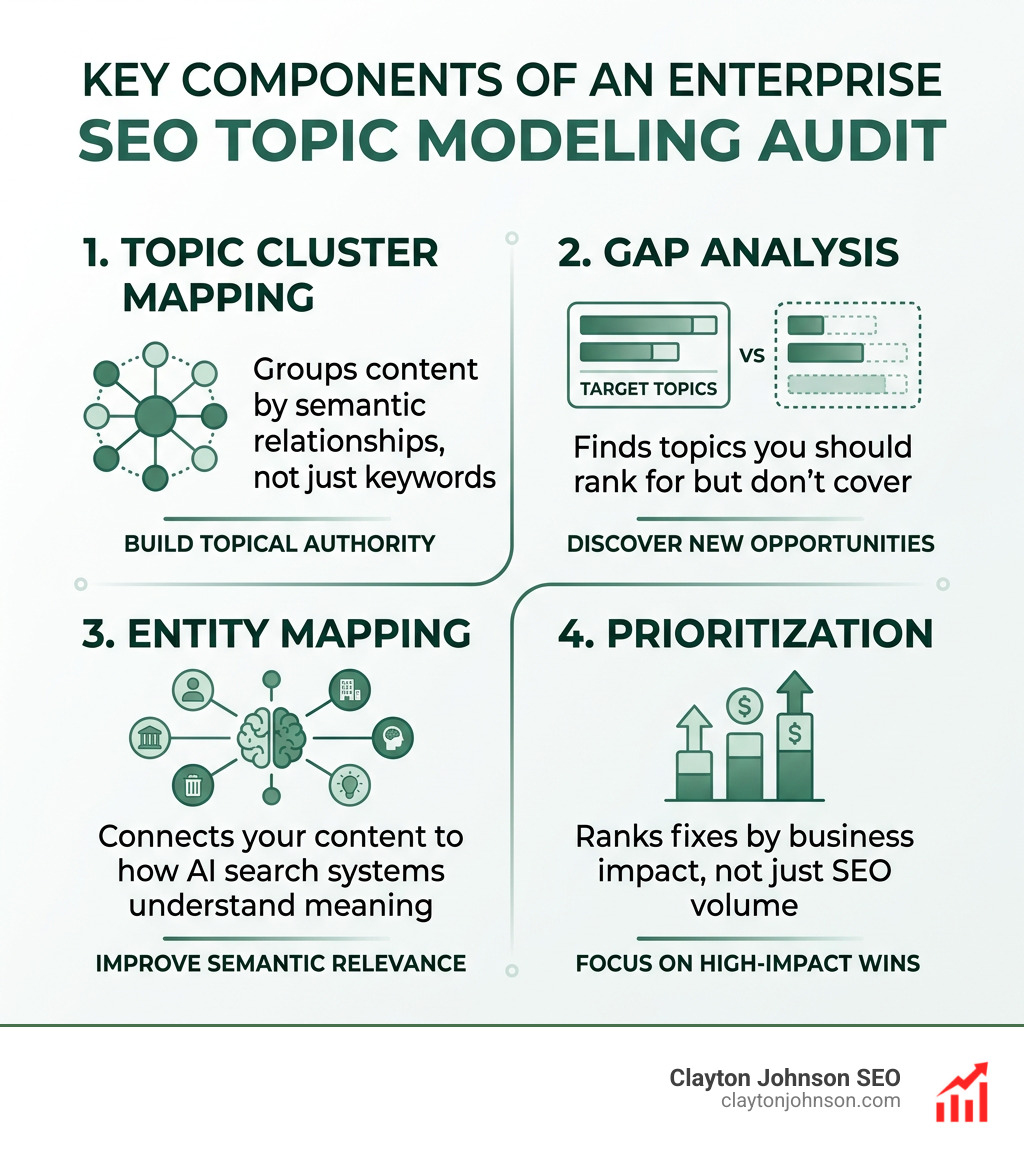
An enterprise seo topic modeling audit is the process of systematically mapping your large-scale website’s content against semantic topic clusters, entity relationships, and search intent — so you can find gaps, fix overlaps, and build real topical authority at scale.
Here’s what it covers at a glance:
| Audit Component | What It Does |
|---|---|
| Topic cluster mapping | Groups content by semantic relationships, not just keywords |
| Gap analysis | Finds topics you should rank for but don’t cover |
| Overlap detection | Identifies keyword cannibalization and duplicate intent |
| Entity mapping | Connects your content to how AI search systems understand meaning |
| Prioritization | Ranks fixes by business impact, not just SEO volume |
Most enterprise teams skip this process — and pay for it with sprawling content, wasted crawl budget, and pages that compete against each other instead of search competitors.
The scale alone makes it brutal. When you’re managing thousands of pages across multiple teams, a simple keyword list won’t tell you why your content isn’t ranking. What you need is a structured way to see how topics connect — and where your content architecture breaks down.
And the stakes are real. Research shows that enterprises implementing full SEO audit recommendations have seen organic traffic surge by as much as 900% in a single week. The difference between that outcome and stagnation is usually a systematic, topic-first approach.
I’m Clayton Johnson, an SEO strategist who has spent nearly two decades building scalable frameworks for enterprise content — including running enterprise seo topic modeling audits for complex, high-volume sites where AI-assisted clustering and intent mapping are the only practical way to manage the data. In the sections ahead, I’ll walk you through exactly how to do this without getting buried in spreadsheets.
The Strategic Framework for an Enterprise SEO Topic Modeling Audit
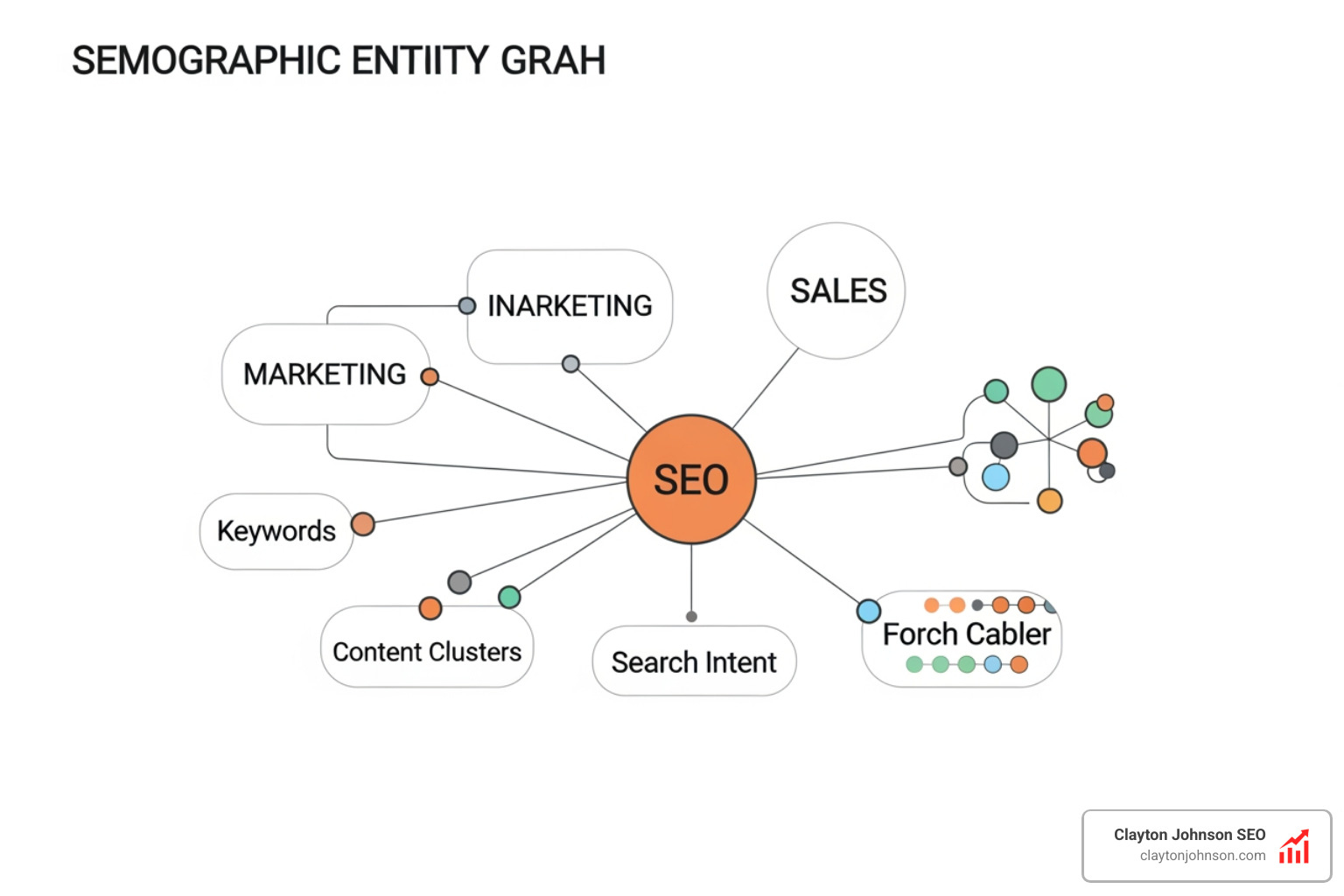
When we approach an enterprise seo topic modeling audit, we aren’t just looking for “missing keywords.” We are looking for entity clarity. In enterprise search, search engines no longer just match strings of text; they interpret the relationship between entities (people, places, things, and concepts).
According to Conductor, 72% of enterprises have had success with SEO. However, that success is rarely accidental. It stems from a robust information architecture that treats content as a connected ecosystem rather than a collection of isolated blog posts.
For a site with 100,000+ URLs, manual mapping is a death sentence for your productivity. We use a framework that blends human strategic oversight with machine-driven clustering.
| Feature | Manual Content Mapping | AI-Driven Topic Clustering |
|---|---|---|
| Speed | Weeks or months | Hours or days |
| Accuracy | High for small sets; prone to human error at scale | High pattern recognition; requires expert validation |
| Scalability | Non-existent | Infinite |
| Relationship Mapping | Limited to visible links | Identifies semantic “hidden” connections |
Why Topic Modeling is Essential for Large-Scale Sites
In the modern search era, AI search systems interpret intent before retrieval. This means your site’s “eligibility” to rank is determined by how well your infrastructure supports a specific topic. If your content is fragmented—meaning you have ten pages touching on the same concept without a clear pillar—search engines struggle to identify your “canonical” answer.
An enterprise seo topic modeling audit addresses several critical infrastructure requirements:
- Crawl Budget Management: By identifying thin or duplicate topic coverage, we can tell Googlebot exactly where to spend its energy.
- Discoverability: Ensuring that sub-topics are logically nested under pillar pages so they are easily found.
- Retrieval-Augmented Generation (RAG) Readiness: As search evolves toward answer engines, having modular, entity-mapped content is what ensures your brand is cited as a source.
Identifying Gaps and Overlaps in an Enterprise SEO Topic Modeling Audit
The “meat” of the audit lies in finding where your content strategy has “leaks.” We often find that large sites suffer from massive keyword cannibalization—multiple pages fighting for the same intent. This dilutes your topical authority and confuses the ranking algorithm.
By using more info about SEO strategy, we can perform a content consolidation exercise. We look for:
- Topical Gaps: What are your competitors talking about that you’ve ignored?
- Topical Overlaps: Do you have five different “Ultimate Guides” to the same product?
- Entity Mapping: Are your internal links using descriptive, varied anchors that resolve back to your main pillar hubs?
Integrating AI and Automation into Your Enterprise SEO Topic Modeling Audit
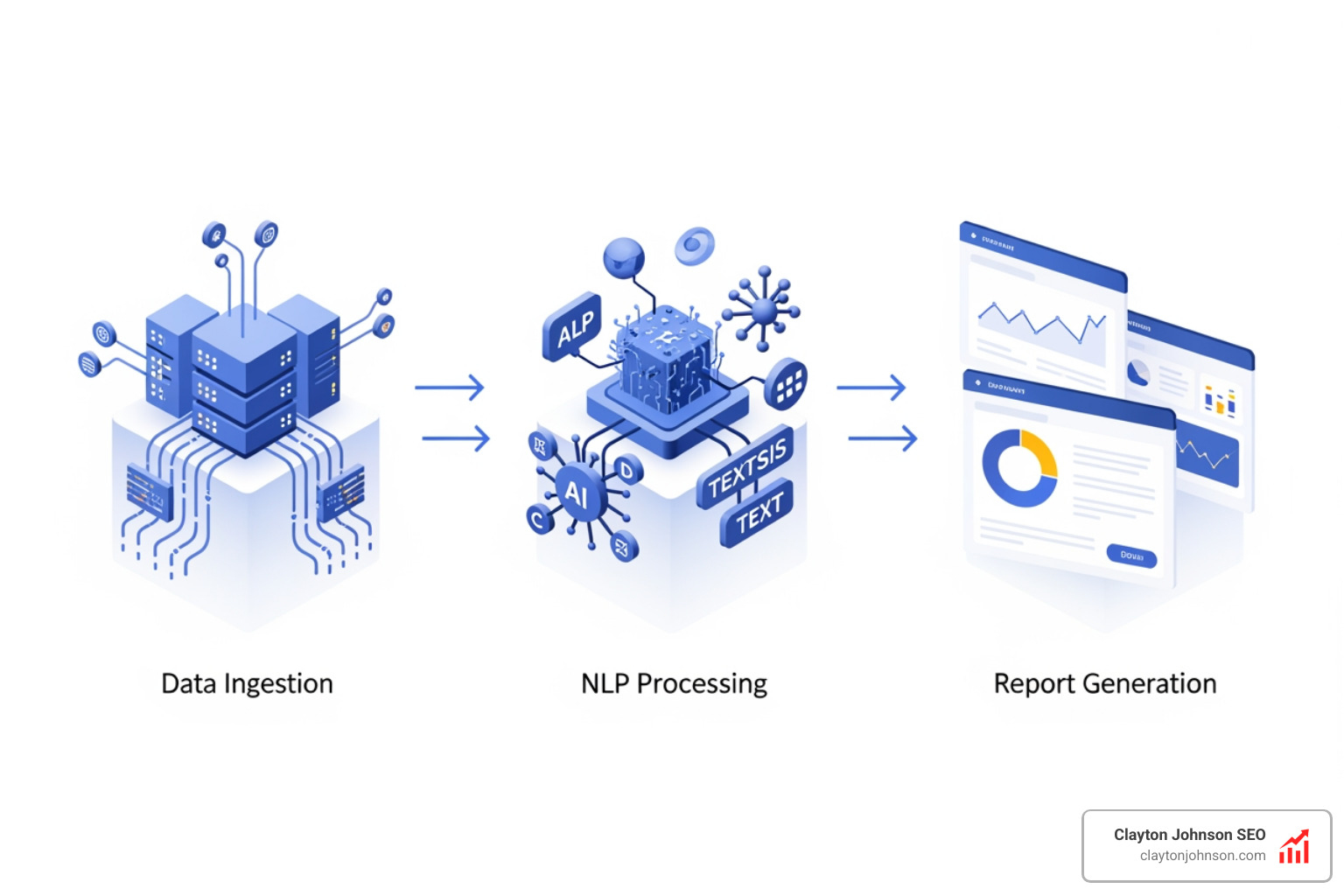
Automation is the only way to survive an audit of this magnitude. We leverage Natural Language Processing (NLP) to analyze your existing corpus. Tools like Keyword Insights allow us to cluster thousands of keywords by intent automatically.
Instead of guessing which pages belong together, we use scalable data processing to see how Google currently groups your URLs. This allows us to move from “detection” to “analysis” much faster. Predictive analytics can even help us forecast which topic clusters will provide the highest ROI before we ever write a single word of new content.
Operationalizing Audit Findings for Scalable Growth
An audit that sits in a PDF on a shared drive is useless. In the enterprise world, the “hardest fix” is often selling the changes internally. McKinsey reported that departmental silos are the biggest barrier to digital priorities.
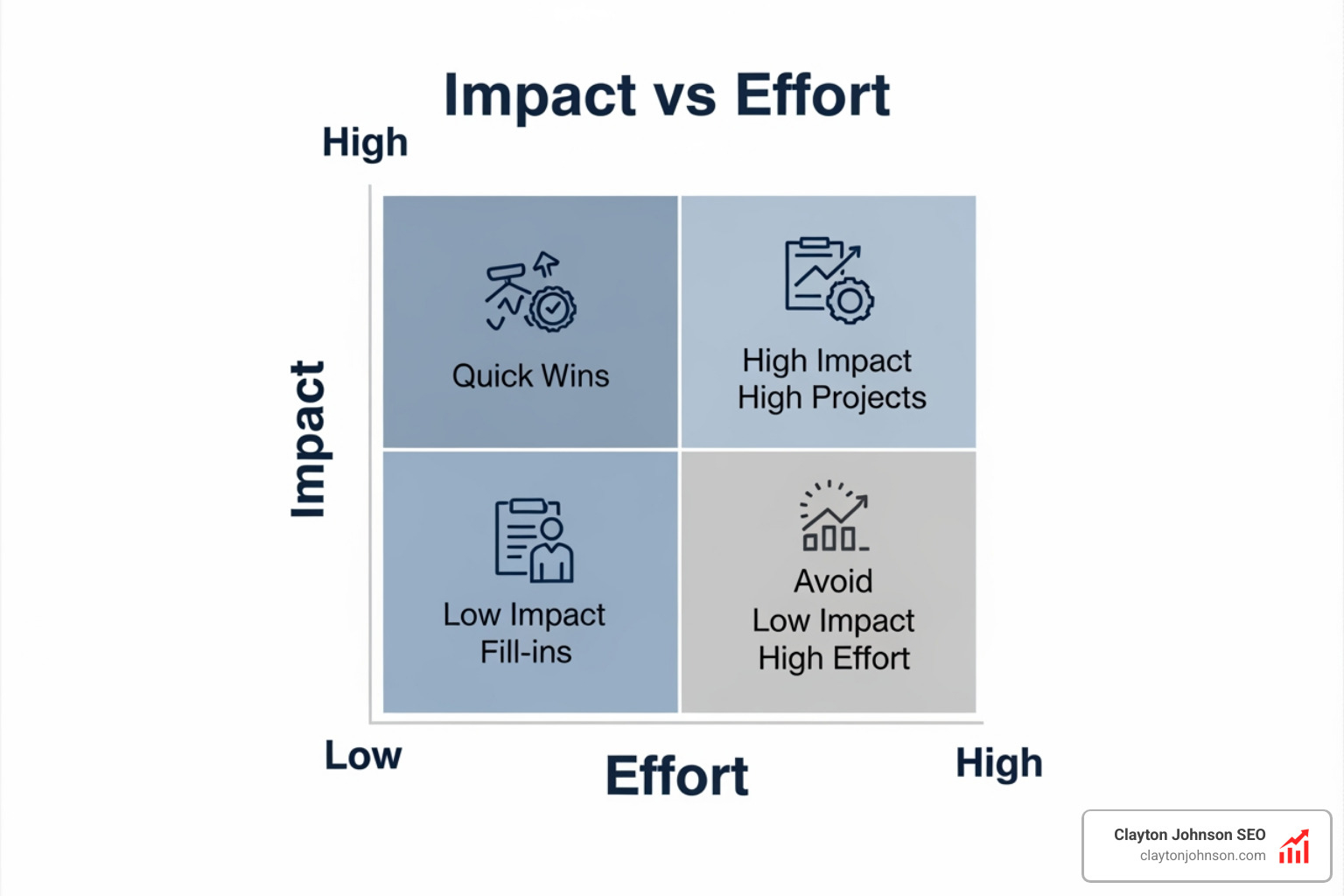
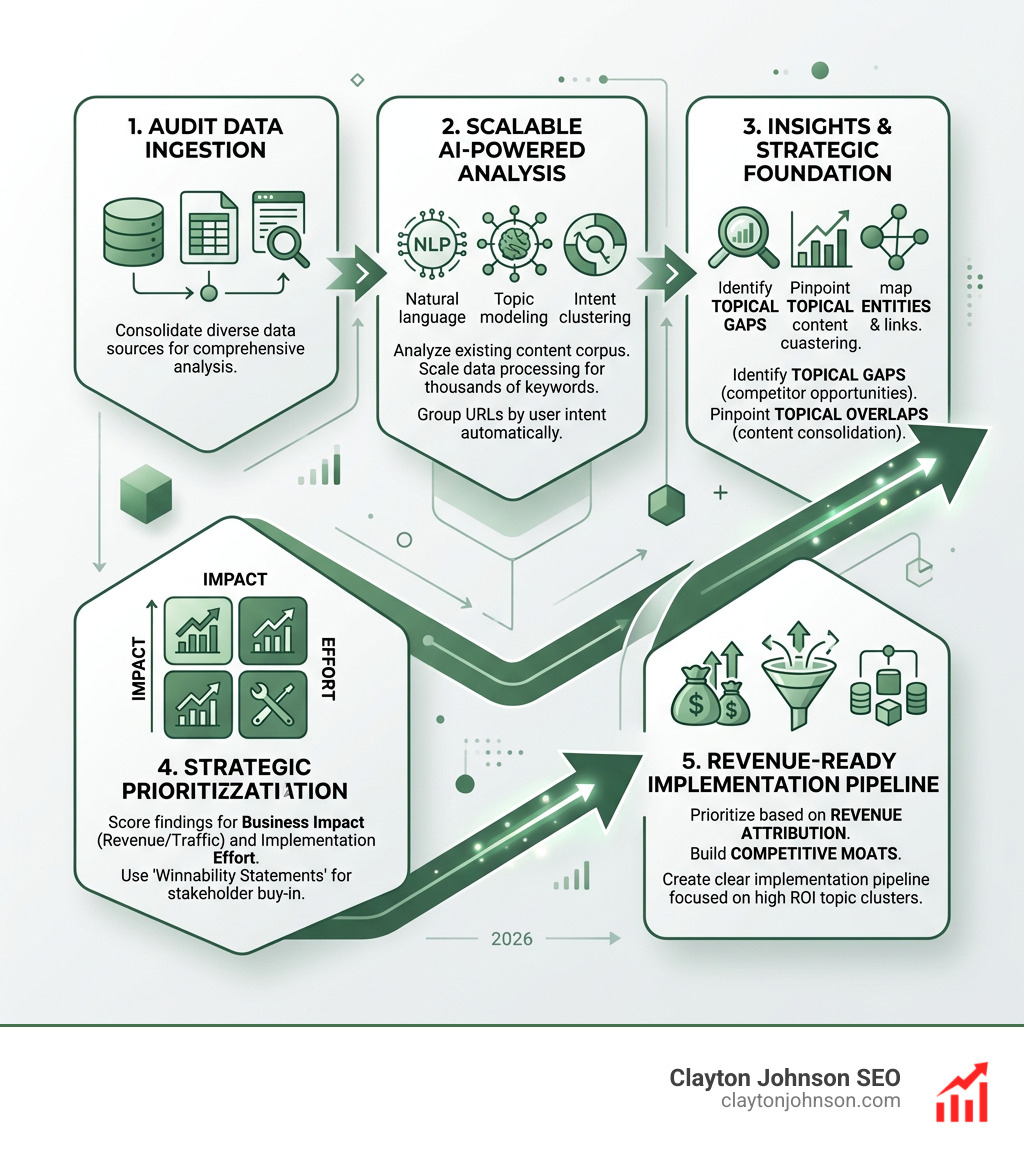
To overcome this, we use an Impact vs. Effort Matrix. We score every finding from our enterprise seo topic modeling audit on a scale of 1-10 for both business impact (revenue/traffic) and developer/content effort. This allows us to create a clear implementation pipeline that stakeholders can actually get behind.
Prioritizing Topic Clusters Based on Business Impact
We don’t just chase search volume. We chase more info about growth systems that tie back to the bottom line. This involves writing “Winnability Statements.”
A winnability statement is a one-sentence pitch to your CFO: “By consolidating these 15 fragmented articles into one authoritative pillar hub, we can capture the ‘Featured Snippet’ for our highest-margin product category, which currently has a $200 CPC in paid search.”
We prioritize based on:
- Revenue Attribution: Which topics actually lead to conversions?
- Competitive Moats: Where do we have a structural advantage that competitors can’t easily copy?
- Resource Allocation: Can we fix this with a simple redirect, or does it require a 3-month engineering sprint?
Governance Frameworks for Ongoing Topic Maintenance
Enterprise SEO is not a one-time project; it’s infrastructure. To prevent “content sprawl” from returning, you need a Center of Excellence (CoE). This group sets the taxonomy standards and ensures template compliance across the entire organization.
Ongoing governance includes:
- Content Lifecycle Management: Setting “expiration dates” for content so it is regularly refreshed or pruned.
- Taxonomy Standards: Ensuring that every new page created by the marketing team fits into an existing entity map.
- Quality Benchmarks: Using AI-assisted checks to ensure new content meets E-E-A-T (Experience, Expertise, Authoritativeness, Trustworthiness) standards before it goes live.
Measuring Success and Proving ROI to Stakeholders
At Clayton Johnson SEO, we focus on measurable outcomes. One case study on e-commerce revenue lift showed that even small performance gains across a large site can translate into millions of dollars in annual revenue.
For our enterprise seo topic modeling audit, our KPIs go beyond simple rankings. We track:
- Organic Share of Voice (SoV): How much of the “topic” do we own compared to competitors?
- Indexation Efficiency: Are our “money pages” being crawled more frequently than our “noise pages”?
- Multi-touch Attribution: How many organic touchpoints does it take before a lead converts?
By using executive reporting frameworks and KPI dashboards, we turn SEO from a “marketing cost” into a “revenue engine.” We prove that by structuring your content correctly, you aren’t just ranking for keywords—you’re building a durable business asset.
Common Pitfalls in Enterprise Topic Modeling
Even with the best tools, things can go sideways. The most common mistake we see is over-automation. While AI is great for clustering, it lacks the “business intuition” to know which topics are truly strategic. You might cluster 5,000 keywords perfectly, but if they don’t align with your product roadmap, you’ve wasted your time.
Another pitfall is ignoring technical debt. You can have the best topic model in the world, but if your site has “index bloat” or a messy Screaming Frog crawl report, search engines will never see your beautiful content.
Finally, don’t forget the human element. SEO governance is about people. Without a clear RACI matrix (Responsible, Accountable, Consulted, Informed), your audit findings will die in a Jira backlog.
The Future of Topic Modeling and AI Search
As we move toward a “Search Generative Experience” (SGE), the traditional “blue link” is becoming less important than being the “cited source” in an AI summary. The only way to win in that environment is through the entity clarity we’ve discussed.
Your enterprise seo topic modeling audit is essentially your roadmap for becoming an “Authority” in the eyes of an LLM (Large Language Model). By organizing your site into modular, schema-backed entities, you make it easy for AI to understand, trust, and recommend your brand.
If you’re ready to stop guessing and start building a scalable traffic system, it’s time to look at your content through the lens of topic modeling. It’s a big job, but with the right framework, you can do it without losing your mind.