How to Audit Your Financial Firm’s SEO Without Losing Your Mind


What an SEO Audit Actually Does for Financial Firms
SEO audit financial firms need is a systematic review of your website’s technical health, content quality, and authority signals — all to find what’s holding you back from ranking higher and winning more clients.
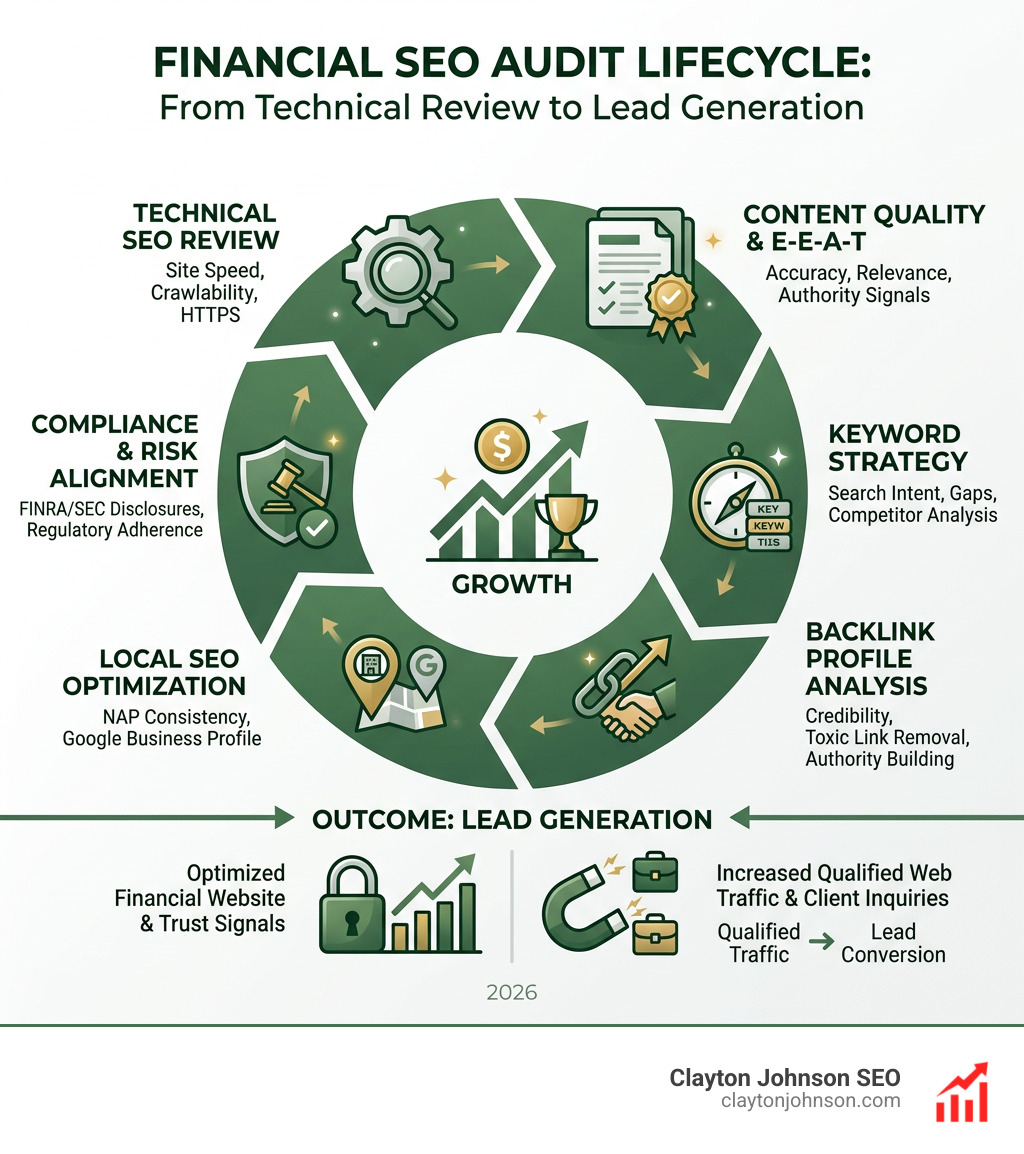
Here’s what a financial firm SEO audit covers at a glance:
| Audit Area | What It Checks | Why It Matters |
|---|---|---|
| Technical SEO | Site speed, crawlability, HTTPS, mobile | Affects rankings and user trust |
| Content Quality | E-E-A-T signals, accuracy, relevance | Required for YMYL financial content |
| Keyword Strategy | Search intent, gaps, competitor terms | Drives qualified traffic |
| Backlink Profile | Authority, toxic links, referring domains | Builds credibility with Google |
| Local SEO | NAP consistency, Google Business Profile | Critical for advisors and banks |
| Compliance | FINRA/SEC alignment, disclosures | Protects your firm legally |
Running a financial firm means you’re already managing a lot. Client relationships. Regulatory requirements. Market volatility. The last thing you want is to also become an SEO expert.
But here’s the uncomfortable truth: if potential clients can’t find you on Google, none of the rest matters.
More than 90% of search traffic goes to page one of results — and over half of all clicks go to just the top two organic results. If your firm isn’t there, your competitors are getting those leads instead.
Financial websites face a harder challenge than most. Google classifies financial content as YMYL — “Your Money or Your Life” — meaning it holds your pages to a much stricter standard before trusting them enough to rank. On top of that, FINRA and SEC regulations shape what you can and can’t say online, making a careless SEO approach a real compliance risk.
An SEO audit is how you find the gaps — the slow pages, the weak content, the missing trust signals — and fix them before they cost you clients.
This guide walks you through every layer of a financial firm SEO audit, in plain language, without the jargon overload.
Why an SEO Audit is Non-Negotiable for Finance

In digital marketing, not all websites are created equal. If you run a blog about vintage stamps, a typo or a slow-loading page is a minor nuisance. If you run a wealth management firm or a fintech app, those same issues signal a lack of professionalism and security.
Google treats financial websites with a high degree of scrutiny because they fall under the “Your Money Or Your Life” (YMYL) category. This refers to content that can significantly impact a person’s financial stability, safety, or happiness. Because the stakes are so high, an SEO audit financial firms perform must prioritize trust above all else.
If your site doesn’t meet these heightened standards, Google simply won’t risk showing it to users. This is why many firms with beautiful designs still struggle to rank; they have the “look” but lack the underlying signals that prove they are a safe bet for a searcher’s life savings. You can learn more about the specifics of this in our beginner’s guide to wealth manager SEO.
Building Trust Through E-E-A-T Guidelines
To rank a YMYL site, you must master E-A-T (Expertise, Authoritativeness, and Trustworthiness). Recently, Google added a second “E” for “Experience.”
- Experience: Does the content show first-hand involvement? (e.g., “Our advisors have managed portfolios through three market crashes.”)
- Expertise: Is the author a qualified professional? This is where detailed author bios with credentials (CFA, CFP) are essential.
- Authoritativeness: Does the industry recognize you? This is measured through mentions on reputable finance news sites and high-quality backlinks.
- Trustworthiness: Is your site secure? Do you have clear contact information and transparent disclosures?
An audit identifies where these signals are missing. We often find that brilliant financial advisors hide their credentials in a PDF or a hard-to-find “About” page, leaving Google’s bots in the dark about their actual expertise.
Navigating Regulatory Compliance
Unlike other industries, financial SEO isn’t just about pleasing an algorithm; it’s about staying on the right side of the law. Your audit must ensure that all content aligns with FINRA and SEC requirements.
This includes:
- Ensuring mandatory disclosures are present and legible.
- Avoiding “promissory” language that guarantees returns.
- Keeping records of website changes as required by state and federal rules.
- Protecting user data to meet GDPR or CCPA standards.
A professional SEO audit financial firms undergo should act as a double-check for your compliance team, identifying pages that might have been published without the necessary legal footers.
The Technical Foundation: Speed, Security, and Performance
Think of technical SEO as the plumbing of your website. If the pipes are leaking, it doesn’t matter how expensive the wallpaper is. For financial firms, technical performance is a direct proxy for reliability. If a bank’s website is slow or buggy, a customer might wonder if their money is safe there.
Key elements of a technical audit include Core Web Vitals, which are specific metrics Google uses to measure user experience, such as how fast the largest image loads and how stable the page layout is. Security is also paramount; an HTTPS certificate is the bare minimum.
For firms looking to scale, we often recommend implementing automated SEO audits to catch technical regressions before they impact your bottom line.
Addressing Common Technical SEO Issues
During an SEO audit financial firms often discover “ghost” issues that have been draining their rankings for years.
- Crawl Errors: If Google’s bots can’t “read” your site, you won’t rank. This often happens with complex client portals or interactive calculators that aren’t configured correctly.
- Broken Links: These are frustrating for users and signal a neglected site to search engines.
- Duplicate Content: Many firms use syndicated articles from financial news wires. If five hundred other advisors post the same “Market Update,” Google won’t know which one to rank. An audit helps you customize this content to make it unique.
- XML Sitemaps and Robots.txt: These files tell Google which pages to prioritize and which to ignore.
Mobile Optimization and User Experience
Research shows that more than 70% of users access financial content on mobile devices. If your retirement calculator is impossible to use on an iPhone, or your lead form has tiny buttons that are hard to tap, you are losing business.
Your audit should check for:
- Responsive Design: Does the site scale perfectly to any screen?
- Touch Navigation: Are buttons spaced far enough apart?
- Load Times: Does the site load in under three seconds on a mobile network?
Content Strategy and Keyword Intent
Content is where you prove your value. However, many financial firms fall into the trap of “content for content’s sake.” They post generic articles that don’t answer the specific questions their clients are asking.
A thorough audit looks at your existing library to identify content decay—pages that used to get traffic but are now outdated. It also examines your internal linking structure. Are your high-traffic blog posts actually pointing readers toward your “Contact Us” page? If not, you’re leaving money on the table. For a deeper dive into your site’s current health, you can use AI SEO diagnostics to find hidden opportunities.
Mastering Keyword Research in an SEO Audit for Financial Firms
Keyword research for finance is a balancing act. You want volume, but you also want intent.
- Short-tail keywords: Broad terms like “wealth management” are highly competitive and often too vague.
- Long-tail keywords: Phrases like “fee-only financial advisor for tech executives in San Francisco” have lower search volume but much higher conversion rates.
- Transactional Intent: Keywords like “open a Roth IRA” or “apply for mortgage” indicate someone is ready to take action.
- Informational Queries: “How does a bridge loan work?” identifies a user in the research phase.
Your audit should ensure you have content mapped to every stage of the client’s journey.
Adapting to Generative Search and AI Overviews
The search landscape is changing. With the rise of AI summaries and generative search, Google is increasingly answering questions directly on the results page.
To stay visible, your SEO audit financial firms must address:
- Structured Data (Schema Markup): This is code that helps search engines understand the “entities” on your page (e.g., that “John Doe” is a person with a “CFA” credential).
- Answer Engine Optimization: Structuring your content with clear H2 and H3 headings so AI tools can easily pull your answers into their summaries.
- Entity Signals: Ensuring your firm’s name, address, and phone number are consistent across the web to build a strong “brand entity.”
Authority Building and Local Visibility
Google views links from other websites as “votes” of confidence. In finance, the quality of the vote matters far more than the quantity. One link from the Wall Street Journal is worth more than a thousand links from random, unrelated blogs.
Local SEO Audit for Financial Firms and Multi-Branch Banks
For financial advisors and banks with physical locations, local SEO is the fastest way to generate leads. When someone searches for an “advisor near me,” Google uses a specific set of rules to decide who shows up in the “Map Pack.”
Your audit must verify:
- Google Business Profile: Is your profile claimed and fully optimized?
- NAP Consistency: Are your Name, Address, and Phone number identical across your website, Yelp, LinkedIn, and local directories?
- Review Management: Are you actively encouraging and responding to client reviews? (While staying within compliance guidelines for testimonials!)
- Geo-targeted Content: Do you have pages dedicated to the specific cities or neighborhoods you serve?
High-Quality Backlink Auditing
A “toxic” link from a spammy site can actually hurt your rankings. Part of an SEO audit financial firms require is a “backlink cleanup.” We look for:
- Domain Authority: Are the sites linking to you reputable?
- Niche Relevance: Do the links come from other finance, business, or local community sites?
- Earned Media: Identifying opportunities to get your experts quoted in industry publications to earn high-value links naturally.
Measuring Success: Metrics, Integration, and Self-Auditing
How do you know if your audit was successful? You have to look past vanity metrics like “total impressions” and focus on what actually drives your business.
| Feature | DIY Self-Audit | Professional Agency Audit |
|---|---|---|
| Depth | Surface level (obvious errors) | Deep dive (technical & architectural) |
| Tools | Free versions of common tools | Enterprise-grade stacks & custom AI |
| Compliance | High risk of missing nuances | Integrated legal/regulatory review |
| Action Plan | Generic “to-do” list | Prioritized roadmap tied to ROI |
| Time Investment | 10-20 hours of your time | 0 hours of your time |
Integrating SEO with Broader Digital Strategies
SEO doesn’t live in a vacuum. It should work in harmony with your other marketing efforts.
- PPC Synergy: Use your high-performing paid search keywords to inform your organic content strategy.
- Content Marketing: Turn your SEO-driven blog posts into social media snippets or email newsletter topics.
- Web Design: Ensure that any new design updates don’t break the SEO structure you’ve worked hard to build.
- CRM Integration: Track your organic leads all the way through your sales funnel to calculate your true ROI.
Performing a Basic SEO Self-Audit
Before hiring a professional, you can do a “health check” yourself:
- Google Search Console: Check for “Index Coverage” errors to see if Google is having trouble reading your pages.
- Google Analytics: Look for pages with high “Bounce Rates”—this usually means the content isn’t what the user expected.
- Site Speed: Use Google PageSpeed Insights to see how your site performs on mobile.
- Competitor Benchmarking: Search for your primary services. If you aren’t in the top 3, look at who is. What are they doing that you aren’t?
Frequently Asked Questions about SEO Audit Financial Firms
How long does a thorough SEO audit take for a financial firm?
A comprehensive audit typically takes between 1 to 3 weeks. This allows time for deep technical crawling, content gap analysis, and a review of the competitive landscape. Simple “health checks” can be done in a few days, but they won’t provide the deep strategic roadmap needed for significant growth.
What is the typical cost of a professional financial SEO audit?
Pricing varies based on the size of the firm and the complexity of the site. A basic audit for a solo advisor might start around $1,500, while enterprise-level audits for multi-branch banks or national fintech brands can exceed $7,000. The investment pays for itself by identifying “leaks” in your conversion funnel that are costing you much more in lost leads.
How do SEO audits address FINRA and SEC compliance?
A specialized audit includes a “compliance overlay.” This means the SEO team works within the guardrails provided by your legal team. We focus on optimizing the technical structure and the way information is presented (like ensuring disclosures are crawlable) rather than just changing words for the sake of keywords.
Conclusion
Auditing your financial firm’s SEO isn’t just about rankings; it’s about building a durable system for growth. At Clayton Johnson SEO, we don’t just hand you a list of errors. We provide a structured strategy framework that turns search intent into measurable pipeline and revenue.
Our philosophy is simple: Clarity → Structure → Leverage → Compounding Growth. We build the systems that operationalize your expertise, ensuring that when a potential client is looking for financial guidance, your firm is the one they find and trust.
Ready to turn your website into a lead-generating engine? Book your growth session with us today.