How to Build SEO Driven B2B Funnels That Actually Work

Why a Demand Gen Strategy Matters More Than Ever
A demand gen strategy is a systematic approach to building awareness and trust with your entire addressable market—not just the 5% actively buying today. Here’s what an effective strategy includes:
- Define your Ideal Customer Profile (ICP) using the 80/20 rule—focus on the 20% of customers who generate 80% of revenue
- Map the buying journey across the 5 Stages of Awareness (Unaware → Problem Aware → Solution Aware → Product Aware → Most Aware)
- Create demand, don’t just capture it—build trust with the 95% of buyers not yet in-market through educational content and thought leadership
- Orchestrate multi-channel distribution—combine events, search, social, and intent data to reach buying committees where they research
- Measure impact metrics—track pipeline velocity, Sales Qualified Opportunities (SQOs), and marketing-sourced revenue, not just MQLs
Most B2B marketing teams are stuck chasing the same 5% of in-market buyers. The result? Sky-high customer acquisition costs, unpredictable pipeline, and fierce competition for a tiny slice of available demand.
The problem isn’t effort—it’s approach. Research shows that 80-90% of buyers have a set of vendors in mind before they do any research, and 90% ultimately choose from that initial list. If your brand isn’t already familiar and trusted, you’re fighting for scraps.
Modern demand generation flips this equation. Instead of racing to the bottom competing for active buyers, you build sustained interest and trust with future buyers before they enter the market. You become the obvious choice long before a prospect fills out a contact form.
This requires a fundamental shift from lead capture to demand creation—from gated PDFs and aggressive retargeting to educational content, product-led experiences, and signal-based engagement. It means aligning marketing, sales, and product around shared revenue goals, not just lead volume.
The data backs this up: 68% of B2B marketers agree that demand generation delivers higher-quality prospects than traditional methods, and marketing teams implementing a specific demand generation strategy can generate 70% of pipeline for the business.
But building an effective demand gen strategy isn’t about copying tactics from high-growth companies. It’s about understanding your unique context—your product, your buyers, your company stage—and systematically addressing the gaps between awareness and revenue.
I’m Clayton Johnson, and I’ve spent years building scalable traffic systems and structured growth frameworks that turn fragmented marketing into coherent demand gen engines. My approach to demand gen strategy combines technical SEO depth, strategic positioning, and AI-assisted workflows to create measurable, compounding growth.
Defining the Modern Demand Gen Strategy
To build a funnel that actually works, we first need to agree on what we’re building. In the past, “demand gen” was often used as a fancy synonym for lead generation. Today, it represents a holistic marketing philosophy that covers the entire customer journey, from the moment someone realizes they have a problem to long after they’ve signed a contract.
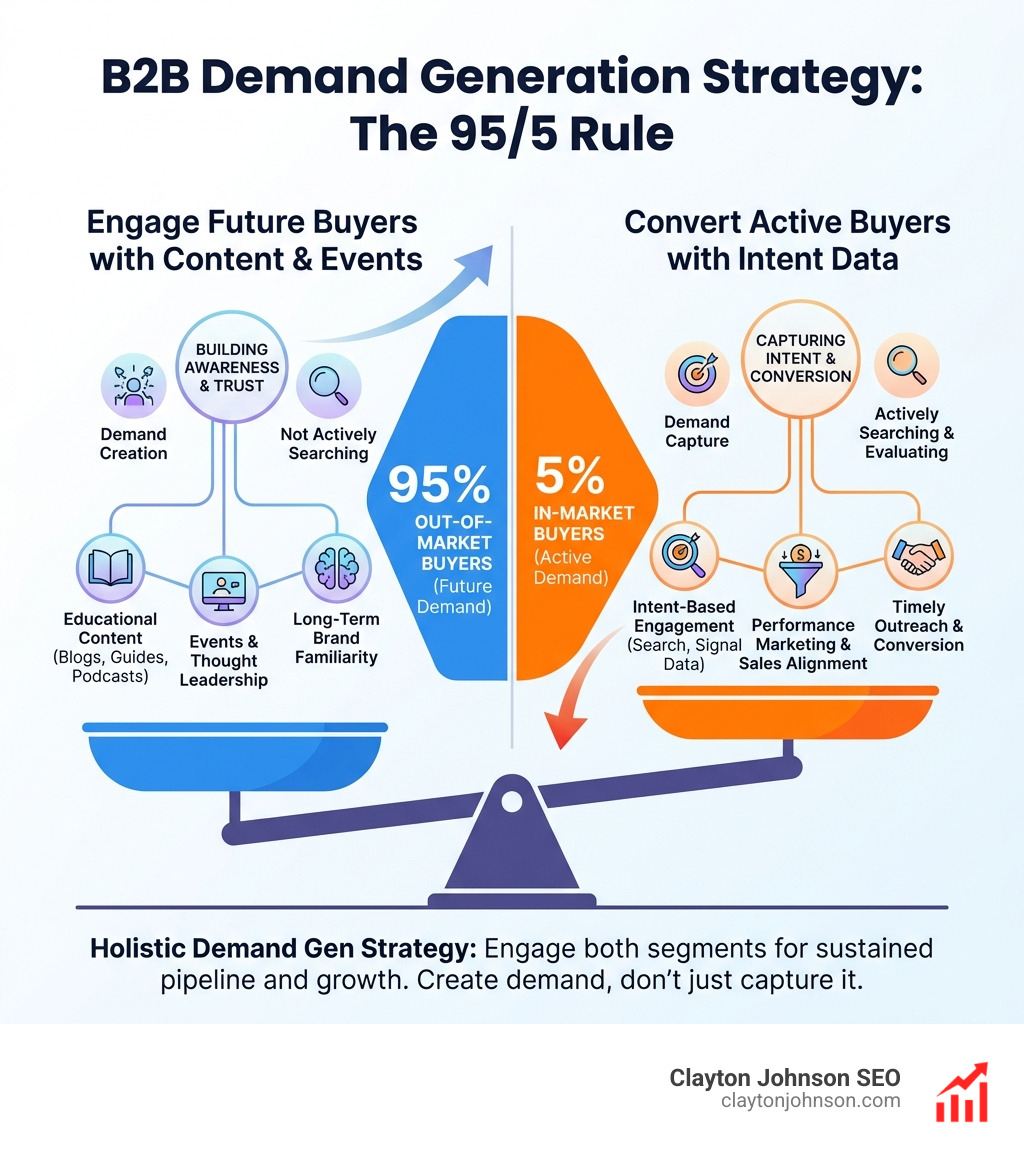
A successful demand gen strategy balances two distinct motions: demand creation and demand capture.
- Demand Creation: This is about educating the 95% of the market that isn’t looking to buy right now. We do this by highlighting problems they didn’t know they had and providing value without asking for a credit card.
- Demand Capture: This is about being there when the 5% are ready to buy. We use SEO, paid search, and intent data to ensure we are the vendor they choose.
According to research from Marketo (2023), 68% of B2B marketers agree that demand generation delivers higher-quality prospects than traditional acquisition methods. These prospects are better informed and move through the sales cycle with less friction.
Distinguishing Function from Method
It’s easy to get lost in marketing jargon. We like to think of demand generation as the function (the “what” and “why”) and inbound marketing as the method (the “how”).
While we are big proponents of digital marketing pillars, we recognize that a modern strategy isn’t purely inbound. It often includes outbound tactics—like account-based marketing (ABM) or targeted social ads—to spark brand awareness within specific high-value accounts. The goal is to build a self-perpetuating cycle where your content draws people in, and your success stories draw even more.
| Feature | Demand Generation | Lead Generation | Inbound Marketing |
|---|---|---|---|
| Primary Goal | Build long-term interest & revenue | Capture contact information | Draw customers via content |
| Focus | Full Funnel (Awareness to Retention) | Top/Middle Funnel | Content & Organic Growth |
| Content Type | Educational & Thought Leadership | Gated & Conversion-focused | SEO, Social, & Blogs |
| Success Metric | Pipeline Velocity & Revenue | MQL Volume & CPL | Traffic & Engagement |
The Shift from Lead Capture to Demand Creation
For years, B2B marketing was a “lead capture” game. We gated every PDF and optimized for the lowest Cost Per Lead (CPL). But this created a “lead gen treadmill” that produced low-intent Marketing Qualified Leads (MQLs) that sales teams hated.
The reality of modern B2B buying is that 70% or more of the buyer’s journey occurs before a prospect ever speaks to a sales representative. If you only focus on capturing leads at the very end of that journey, you’ve already lost the chance to influence their decision-making criteria. By the time they fill out your form, they’ve likely already decided who their top three vendors are.
Foundational Steps: ICP and Audience Research
You cannot generate demand if you don’t know who you’re generating it for. Every high-performing demand gen strategy is pinned to a rock-solid Ideal Customer Profile (ICP).
We recommend applying the 80/20 rule: identify the 20% of your current customers who generate 80% of your revenue. What do they have in common? Are they in a specific industry? Do they use specific software? These are the accounts you want to replicate.
This is critical because 80-90% of buyers have a set of vendors in mind before research even begins. If you aren’t targeting the right people early, you won’t be on that “day one” list. For a deeper dive into this, check out our guide on customer strategy.
Understanding Your Audience for a Better Demand Gen Strategy
To move beyond basic firmographics (company size, location), you need to understand the “Jobs-to-be-Done” (JTBD). Why does a customer actually “hire” your product?
- Customer Interviews: Don’t rely on sales notes. Talk to your customers directly to uncover their real motivations and objections.
- Smallest Viable Audience: Don’t try to appeal to everyone. Narrow your focus to a segment that is most likely to prioritize the specific pain you solve. This allows your messaging to resonate much more deeply.
Mapping the Buying Journey
In B2B, the purchase cycle now averages over eleven months. During this time, buyers move through the 5 Stages of Awareness:
- Unaware: They don’t know they have a problem.
- Problem Aware: They feel the pain but don’t know the solution.
- Solution Aware: They know what kind of solution they need but haven’t picked a vendor.
- Product Aware: They are looking at your specific product.
- Most Aware: They are ready to buy.
Mapping your content to these stages is vital because 73% of buyers expect to start their research on one channel and continue on another without repeating steps. Your demand gen strategy must provide a seamless, omnichannel experience that answers their questions at every stage.
Building Trust Through Content and Engagement
In the B2B world, trust is the ultimate currency. The majority of buyers place trust at the center of their decision making process. You don’t build trust by pitching; you build it by being consistently helpful.
Content Tactics for a Modern Demand Gen Strategy
We believe in building a “content engine” that leverages internal expertise. Your sales and product teams have the knowledge; marketing’s job is to package it.
- Expert Interviews: Schedule 30-minute interviews with your internal subject matter experts.
- Tools for Repurposing: Use Riverside to record high-quality video and Descript to quickly edit soundbites. One interview can become a blog post, a dozen social clips, and a newsletter.
- Educational Content: Focus on “product-led” content. Show how your product solves a specific problem rather than just listing features.
For more on how to structure these campaigns, see our traffic strategy frameworks.
Engaging the 95% of Out-of-Market Buyers
Since only 5% of your market is “in-market” at any time, your demand gen strategy must focus on building brand familiarity with the other 95%.
- Problem-led POV: Lead with a strong point of view on industry challenges.
- Dark Social: Understand that much of the buying journey happens in private communities, Slack groups, and direct messages where tracking pixels can’t reach.
81% of marketers believe demand generation is critical for brand awareness. By the time that 95% enters a buying cycle, your brand should be the first one they think of.
Executing the Strategy: Channels and Automation
Execution is where the strategy meets the market. A multi-channel ecosystem ensures you are present wherever your buyers spend their time.
Leveraging CRM and Marketing Automation
Your tech stack is the engine of your demand gen strategy. Tools like Salesforce, HubSpot, and Marketo allow you to manage prospect information and automate nurturing.
- Email Marketing: It remains a top data source for optimization. We use it to deliver email marketing tracks that are personalized and relatable.
- Lead Scoring: Don’t just score based on clicks. Score based on “high-intent” actions like viewing a pricing page or attending a webinar.
Using Intent Data to Find In-Market Clients
Intent data allows you to spot “buying signals” before a prospect ever visits your site. This is no longer a niche tactic: 99% of large companies are using intent data, and 70% of businesses plan to increase their spend on it.
Platforms like 6sense or Demandbase provide account intelligence, telling you which companies are researching topics related to your solution. This allows your sales team to reach out with “why now” relevance rather than cold interruption.
Event Marketing: The Trust Accelerator
70% of marketers say that live events are crucial when it comes to marketing success. Whether it’s a massive industry conference or an intimate executive dinner in Minneapolis, events provide the face-to-face interaction that builds deep credibility. For digital-first companies, paid advertising can be used to drive the right personas to these high-value events.
Measuring Success and Overcoming Challenges
If you measure the wrong things, you will optimize for the wrong outcomes. Modern demand generation requires moving away from “vanity metrics” like clicks and towards “impact metrics” that the C-suite actually cares about.
Moving from Vanity Metrics to Revenue Impact
To prove the value of your demand gen strategy, focus on:
- Sales Qualified Opportunities (SQOs): Are you generating real conversations for sales?
- Win Rates: Are marketing-sourced deals closing at a higher rate?
- Pipeline Velocity: How fast are deals moving through the funnel?
- Customer Acquisition Cost (CAC): Is your growth sustainable?
For a deeper look at aligning these metrics, check out our resources on sales strategy and analytics and data.
Overcoming Sales and Marketing Alignment Issues
The biggest killer of a demand gen strategy is friction between teams. More than 55% of organizations are investing in marketing operations to enhance efficiency.
- Service Level Agreements (SLAs): Define exactly what a “qualified” account looks like and how fast sales should follow up.
- Feedback Loops: Hold weekly “Growth Council” meetings to review lead quality and adjust messaging. If leads aren’t closing, you might need to revisit your conversion optimization strategy.
Frequently Asked Questions about Demand Generation
What is the difference between demand generation and lead generation?
Lead generation is a tactical subset of demand generation. Lead gen focuses on the “catch”—getting contact info through gated content. Demand generation is the entire “ecosystem”—building awareness, trust, and genuine interest long before the lead is captured.
How long does it take to see results from a demand gen program?
While you may see early signals (like increased engagement) within 90 days, a significant lift in marketing-sourced pipeline and closed deals typically takes 6 to 12 months. This is a long-term play for sustainable growth.
What are the most essential tools for a modern demand gen strategy?
A modern stack typically includes a CRM (HubSpot or Salesforce), a Marketing Automation platform (Marketo or Pardot), an Account Intelligence tool (6sense), and a Sales Engagement platform (Outreach or Salesloft).
Conclusion
Building a demand gen strategy that actually works isn’t about chasing the latest shiny object. It’s about a relentless focus on your ideal customer and a commitment to providing value at every stage of their journey.
At Clayton Johnson SEO, we help founders and marketing leaders move beyond the lead gen treadmill. We build Demandflow systems that combine high-intent SEO with strategic content to drive measurable revenue. Whether you are in Minneapolis or scaling globally, your growth depends on your ability to create demand, not just capture it.
Ready to transform your funnel? Explore our SEO content marketing services and let’s start building your engine for compounding growth.