Mastering the Lean Startup Model Canvas for New Ventures

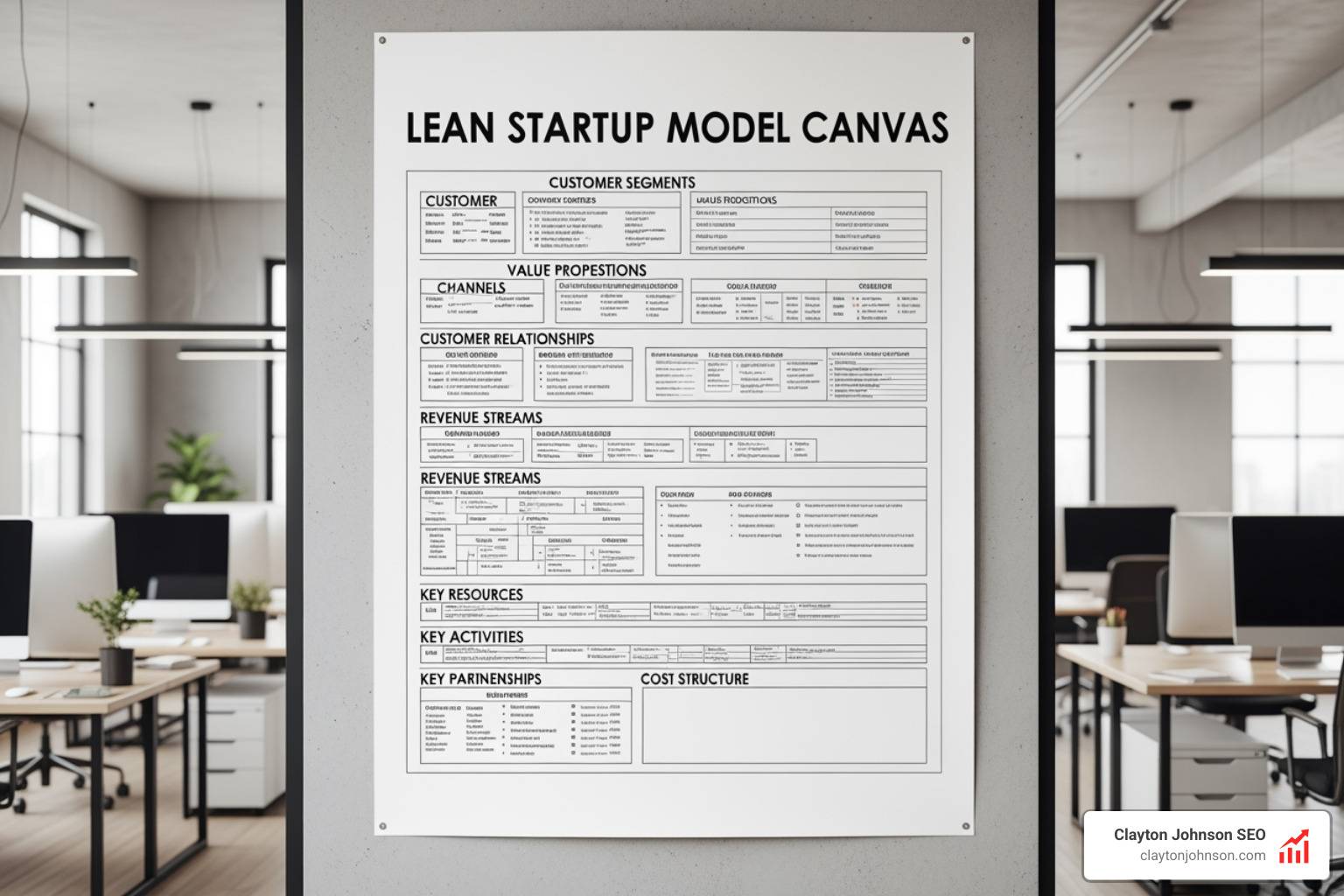
Why the Lean Startup Model Canvas is Essential for Validating New Ideas
The Lean Startup Model Canvas is a one-page strategic planning tool designed to help entrepreneurs quickly map out, test, and iterate their business ideas under conditions of extreme uncertainty. Created by Ash Maurya as an adaptation of Alex Osterwalder’s Business Model Canvas, it replaces traditional multi-page business plans with a concise framework that prioritizes speed of learning over lengthy documentation.
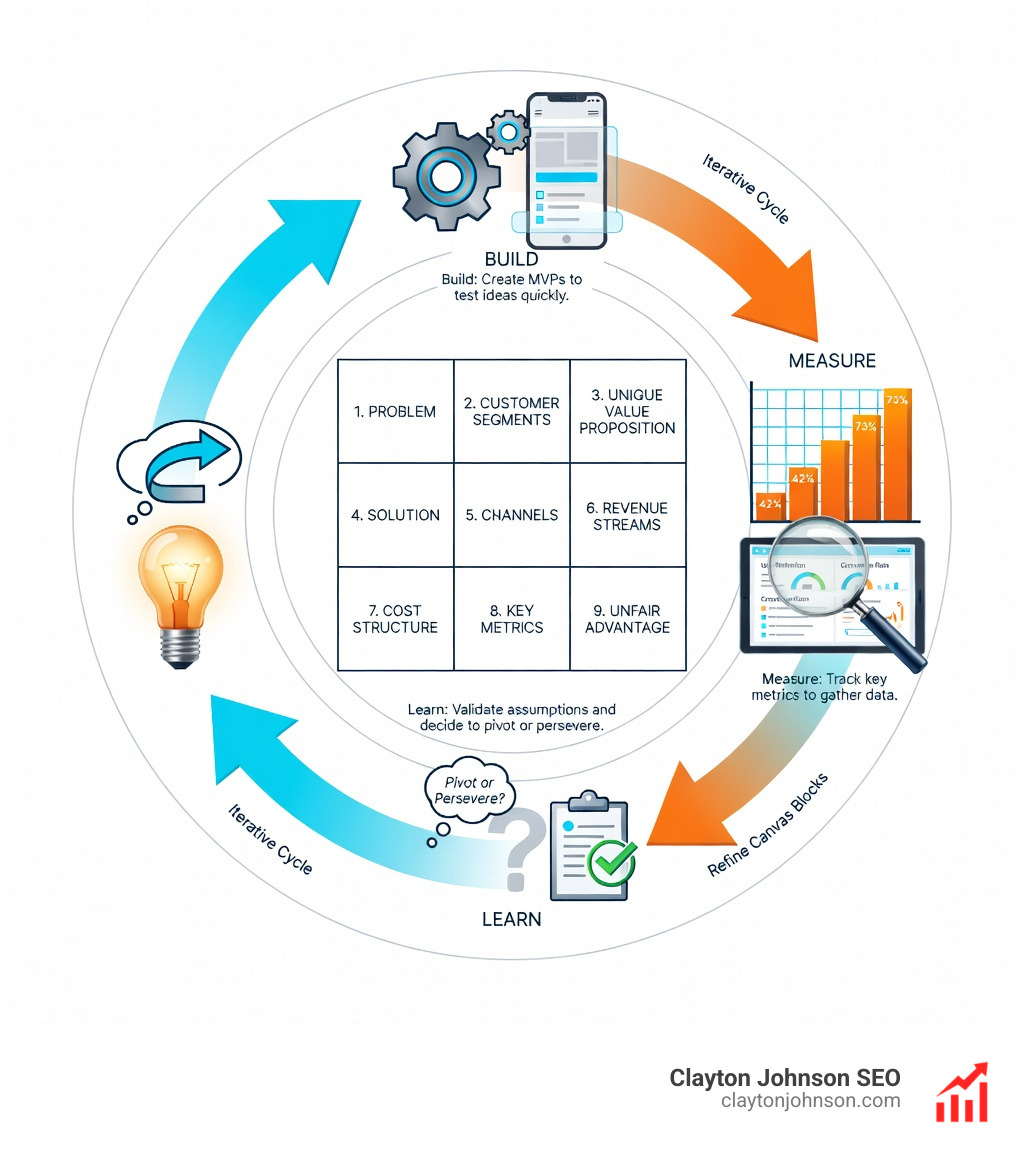
Key Components of the Lean Startup Model Canvas:
- Problem – The top 1-3 high-priority problems your customers face
- Customer Segments – Who specifically has these problems (focus on early adopters)
- Unique Value Proposition – Why you’re different and worth buying from
- Solution – Your product’s top 3 features addressing each problem
- Channels – How you’ll reach your customers
- Revenue Streams – How you’ll make money
- Cost Structure – Your key operational costs
- Key Metrics – The 1-2 numbers that truly measure your progress
- Unfair Advantage – What you have that can’t be easily copied or bought
Why It Matters: Research shows that 42% of startups fail due to “no market need” and 73% of founders build the wrong thing. The Lean Canvas addresses this by forcing you to systematically test your riskiest assumptions before investing months in development.
Unlike traditional business plans that take weeks to write and are rarely updated, you can sketch your first Lean Canvas in under 20 minutes. More importantly, it’s designed as a living document that evolves through rapid iteration following the Build-Measure-Learn cycle central to Lean Startup methodology.
The framework shifts focus from company-centric thinking to a problem-customer-solution paradigm, helping you validate whether real people will actually pay for what you’re building. Instead of planning in isolation, you’re encouraged to “Get Out The Building” and gather evidence from real customer conversations.
I’m Clayton Johnson, and I’ve helped founders and marketing leaders build structured validation systems that combine Lean Canvas modeling with SEO-driven content strategies to test market demand before heavy investment. Throughout this guide, I’ll show you how to use the Lean Startup Model Canvas to systematically reduce uncertainty and build what customers actually want.
Learn more about Lean startup model canvas:
What is the Lean Startup Model Canvas?
The Lean Startup Model Canvas is a revamped version of the Business Model Canvas (BMC). While the original BMC was designed with mature businesses in mind—focusing on infrastructure, partnerships, and customer relationships—Ash Maurya realized that startups face a different set of challenges. Startups aren’t just smaller versions of large companies; they are organizations designed to search for a repeatable and scalable business model.
Maurya’s adaptation focuses heavily on the “Problem-Solution” fit. In the early stages of a venture, you don’t need to worry about who your key partners are if you haven’t yet proven that anyone actually has the problem you’re trying to solve. By swapping out blocks like “Key Partners” and “Key Resources” for “Problem” and “Solution,” the canvas becomes an actionable tool for entrepreneurs dealing with high levels of risk and uncertainty.
To understand how to use this tool effectively, it’s helpful to see how it fits into the broader ecosystem of business planning. For those moving from an established base, learning how to blend Lean Startup and BMC for success can provide a bridge between innovation and operational excellence. You can also read more about Ash Maurya’s reasons to adapt the Business Model Canvas here.
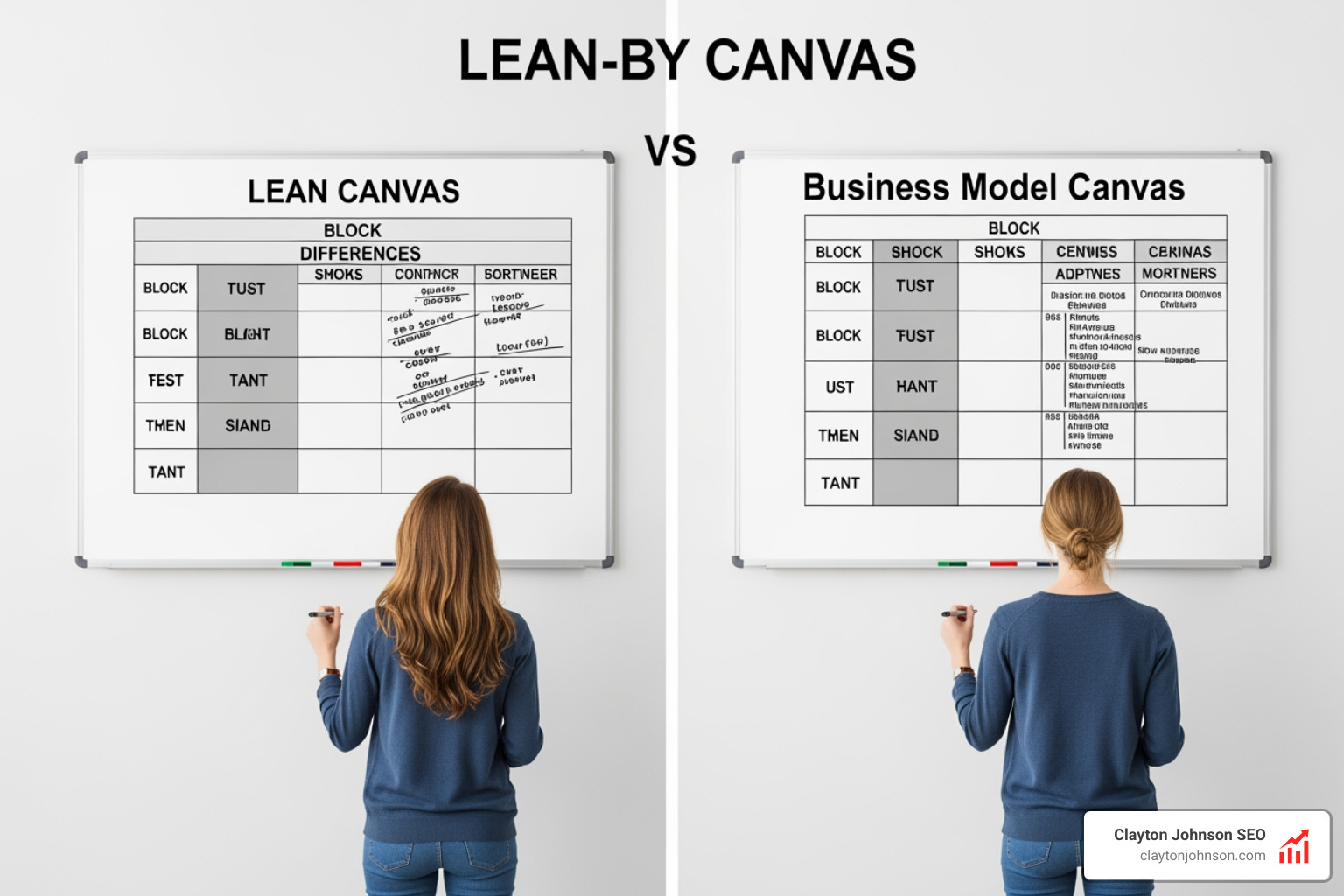
The Core Differences from the Business Model Canvas
The primary difference lies in the target audience. The Business Model Canvas, created by Alex Osterwalder at Strategyzer.com, is excellent for mature businesses that need to optimize their existing value chain. It is “company-centric.”
In contrast, the Lean Startup Model Canvas is “entrepreneur-centric.” It acknowledges that in a startup, the most expensive thing you can do is build something nobody wants. Therefore, it prioritizes:
- Problem vs. Key Partners: Startups usually don’t have partners yet; they have problems to solve.
- Solution vs. Key Activities: Instead of listing every operational task, you focus on the core features of your MVP.
- Key Metrics vs. Key Resources: Rather than listing physical assets, you track the “Pirate Metrics” (ARRRR) that show if your business is actually growing.
- Unfair Advantage vs. Customer Relationships: Instead of broad relationship categories, you identify what makes you impossible to copy.
Why Speed of Learning is the New Unfair Advantage
In the modern business landscape, the traditional 40-page business plan is effectively dead. Why? Because the human brain processes visuals 60,000 times faster than text, and a static document cannot keep up with a fast-moving market. Statistics show that 42% of startups fail because there is no market need. If you spend six months writing a plan only to find out nobody wants your product, you’ve wasted your most valuable resource: time.
The Lean Startup Model Canvas allows you to “pivot” quickly. A pivot is a structured course correction designed to test a new fundamental hypothesis about the product, strategy, and engine of growth. By using the definitive tech startup template, founders can achieve revenue much faster—often within 90 days compared to the 8-month average for those following traditional paths.
Deconstructing the 9 Essential Blocks
To master the Lean startup model canvas, we need to look at each block as a hypothesis that needs validation. We don’t just fill these in and walk away; we treat them as “Plan A” that we intend to “beat the crappiness out of” through customer testing.
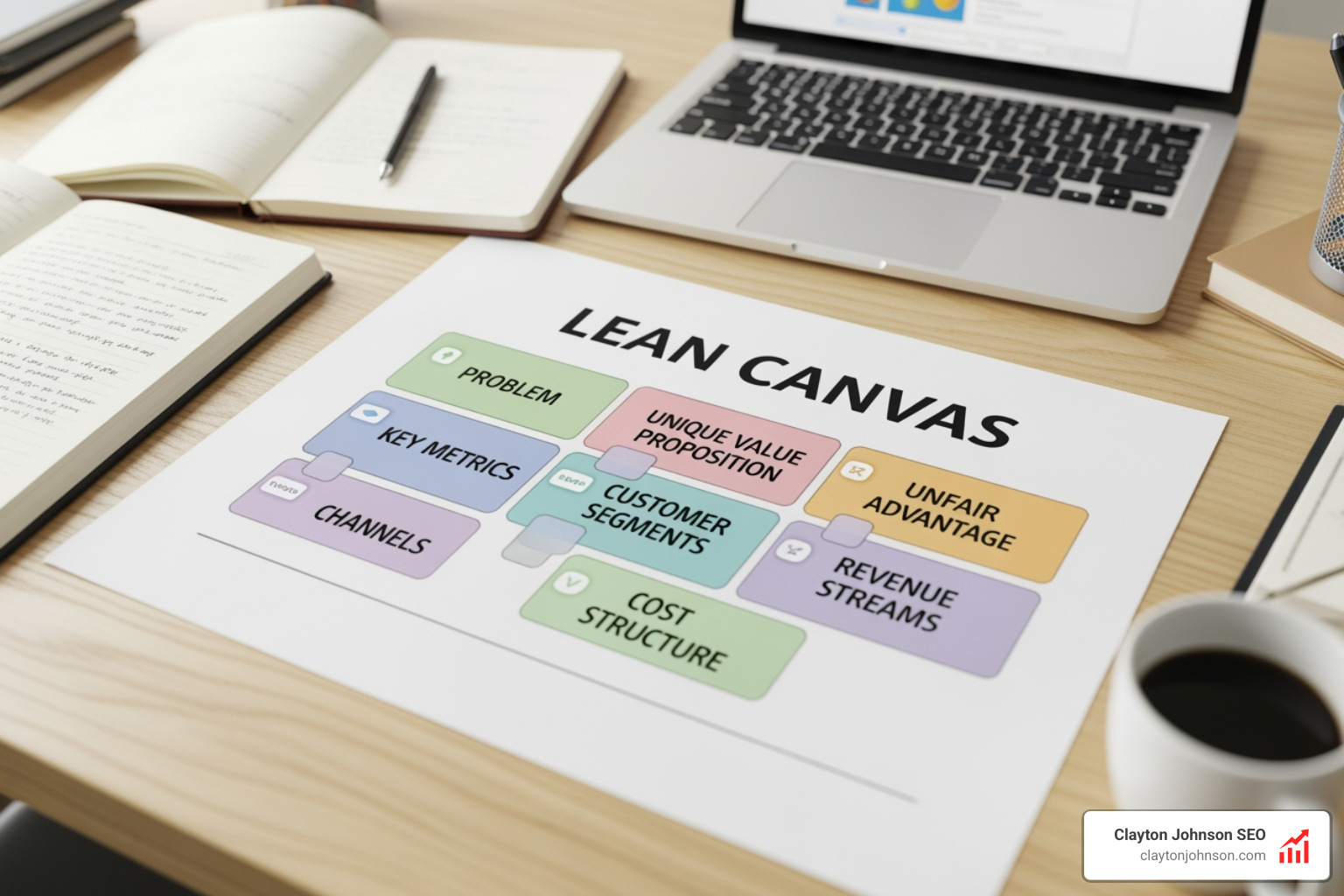
Deconstructing the Lean Startup Model Canvas Blocks
- Problem: List the top 1-3 problems your target customers are currently struggling with. If there is no problem, there is no product. You should also list Existing Alternatives—how are they solving this today? (Even if it’s just a messy Excel sheet).
- Customer Segments: Identify your target audience. Be specific. If you say “everyone,” you’re targeting no one. Focus on Early Adopters—the people who need your solution so badly they’re willing to use a buggy, unfinished version of it.
- Unique Value Proposition (UVP): This is a promise of value to be delivered. It’s the primary reason a prospect should buy from you. A great UVP answers what you do and who you do it for. For further inspiration, check out these Useful Value Proposition Examples.
- Solution: Once the problem is defined, what are the top 3 features that solve it? Don’t get carried away here; keep it tied to the MVP.
- Channels: How will you reach your customers? In the beginning, focus on learning over scale. Direct sales, cold emails, or niche communities are often better than expensive TV ads.
- Revenue Streams: How will you price your product? Pricing is a part of the product, not an afterthought. It’s a key part of validation—getting someone to sign up for free is easy; getting them to pay is the real test.
- Cost Structure: List your fixed and variable costs. What is your burn rate? What will it cost to conduct customer interviews? For more detail, see our deep dive into cost structure and expense management.
- Key Metrics: What are the numbers that tell you the business is healthy? Focus on actionable metrics rather than “vanity metrics” like total registered users.
- Unfair Advantage: This is the hardest block to fill. It’s something that cannot be easily copied or bought.
Identifying Early Adopters and Customer Segments
We often see founders try to target the “middle” of the market to capture more users. This is a mistake. Targeting the mainstream waters down your message. You want to find the “prototypical user”—the person whose hair is on fire.
In our essential guide to customer discovery, we emphasize that you need to define your early adopters by their behaviors and pain levels, not just demographics. For example, instead of “moms,” try “first-time moms with kids under three who are worried about digital privacy.” This specificity allows you to craft a UVP that resonates deeply.
How to Fill Out and Iterate Your Canvas
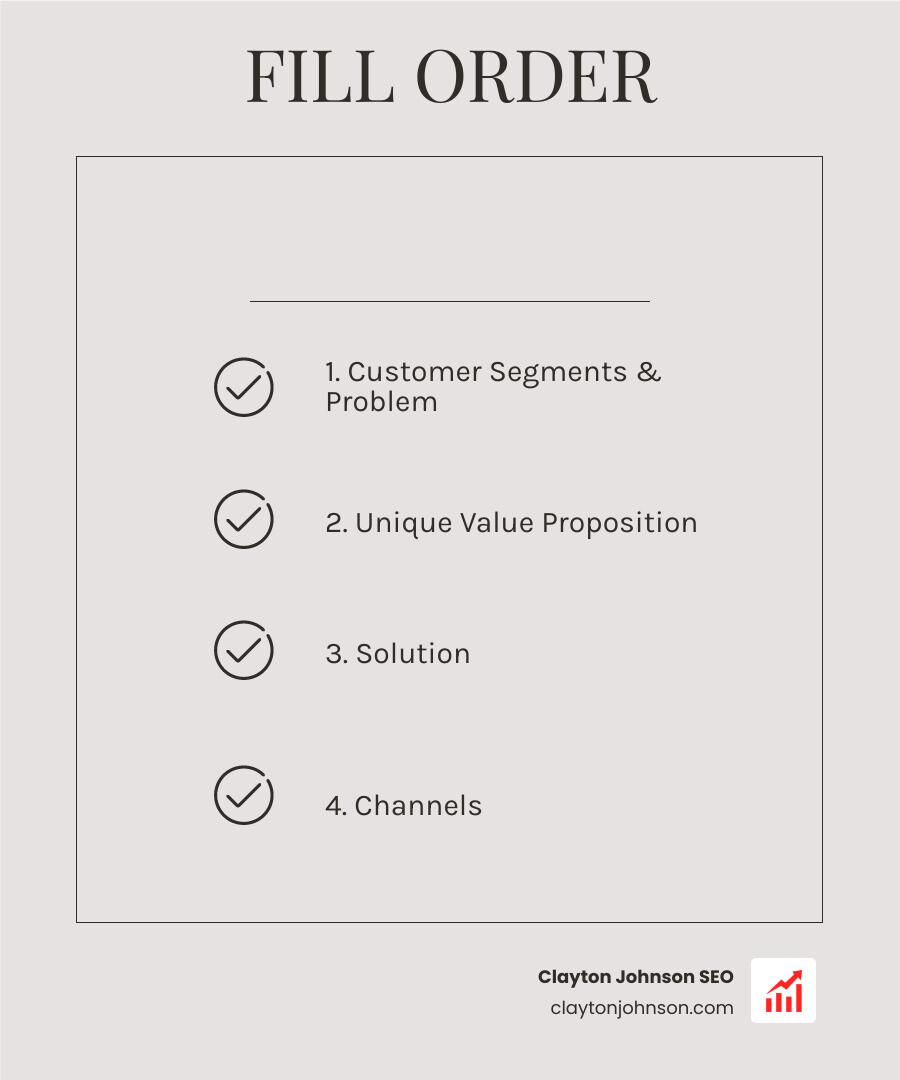
The order in which you fill out the Lean startup model canvas matters. We recommend a “Customer-Centric” approach. You can’t define a solution until you understand the problem, and you can’t understand the problem until you know who has it.
Recommended Filling Order:
- Customer Segment & Problem: These two drive the rest of the canvas.
- Unique Value Proposition: Distill the essence of your solution.
- Solution: Sketch the features that deliver the UVP.
- Channels: Determine how to reach those early adopters.
- Revenue & Cost: Work out the basic math of the business.
- Key Metrics & Unfair Advantage: Identify how you’ll measure success and protect your territory.
One of the most important steps in this process is to “Get Out The Building.” This phrase, coined by Steve Blank, means that the answers aren’t in your office—they are in the streets (or on Zoom calls with real people). You can find more on this philosophy here. Once you have your channels identified, you can begin mastering channels and relationships to drive growth.
Validating the Lean Startup Model Canvas with Metrics
How do you know if you’re actually making progress? You use Pirate Metrics (ARRRR), popularized by Dave McClure. These track the customer journey:
- Acquisition: How do users find you?
- Activation: Do they have a great first experience?
- Retention: Do they come back?
- Revenue: Do they pay?
- Referral: Do they tell others?
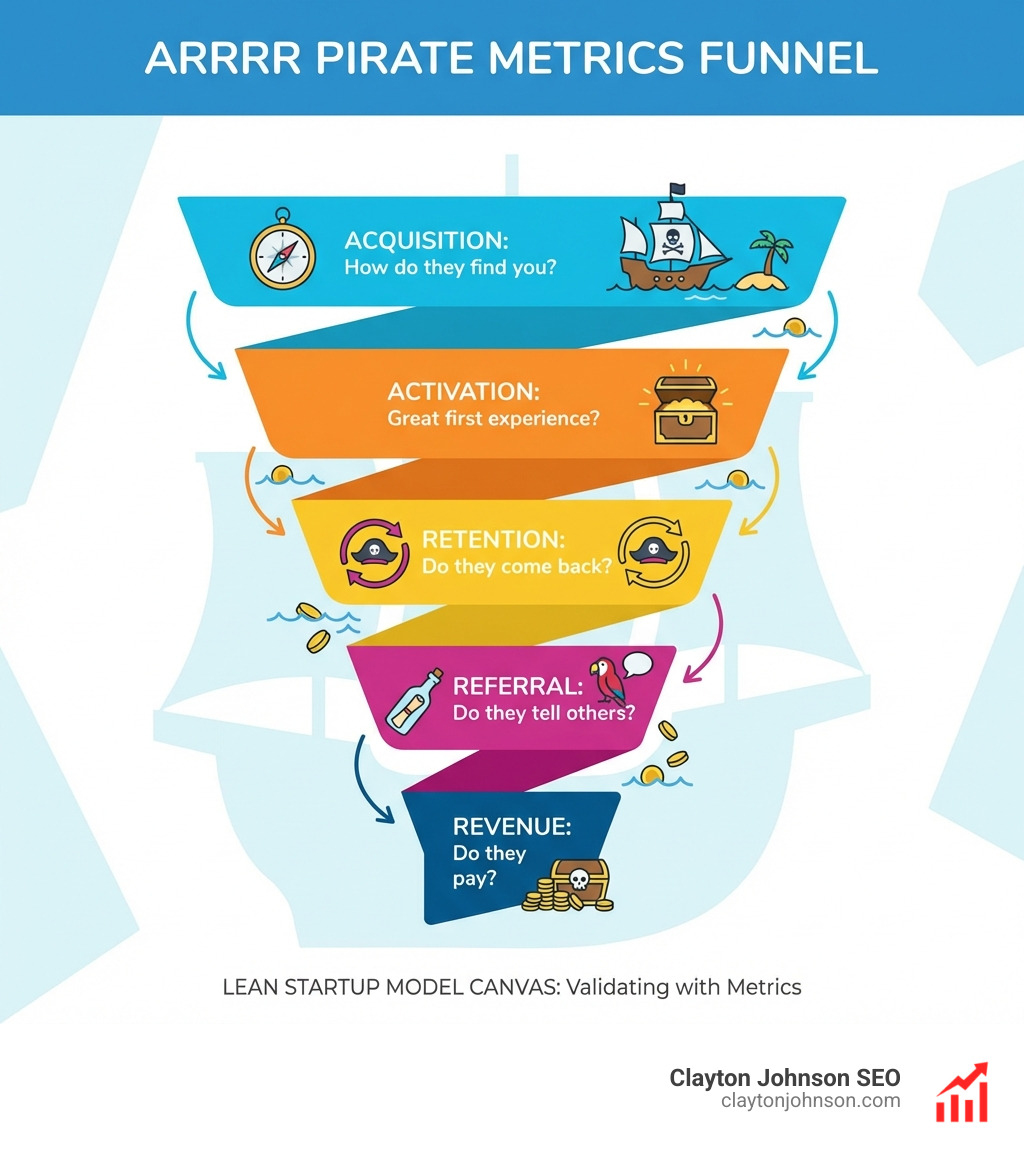
By tracking these, you move from “guessing” to “validated learning.” You can read the long version of Startup Metrics for Pirates or dive into the core Build-Measure-Learn principles to see how this fits into the lean cycle.
Pricing Strategies and Revenue Streams
Pricing is one of the riskiest parts of your business model. Many startups offer their product for free to gain traction, but this often delays validation. If your business model requires users to pay, you should test that as early as possible.
We believe that Freemium is often more of a marketing tactic than a business model. It can lead to a low signal-to-noise ratio where you’re listening to feedback from people who will never pay you. A better approach is often a Free Trial, which time-boxes the decision to pay and forces a conversion. For more on this, check out these simple pricing strategies for startups.
Real-World Examples and Best Practices
To see the power of the Lean startup model canvas, we can look at how it might have been applied to tech giants in their early days.
- Google: Their early “Problem” was that search results were irrelevant. Their “Unfair Advantage” was the PageRank algorithm.
- Facebook: They started by targeting a very specific “Customer Segment”—Harvard students. This allowed them to build a “remarkable” product for a small group before scaling.
- Airbnb: Their “Early Adopters” were attendees of a design conference in San Francisco when all hotels were booked. They validated the “Problem” (no affordable housing) by selling themed cereal to stay afloat.
These stories show that even billion-dollar companies started with a simple focus on a specific problem and a specific group of people. For more on modern applications, see our guide on digital innovation via the business model canvas.
Defining a True Unfair Advantage
Most founders list “passion” or “commitment” as an unfair advantage. Sorry to burst the bubble, but those don’t count. A true unfair advantage is something that cannot be easily copied or bought.
Examples of True Unfair Advantages:
- Insider Information: Deep industry knowledge that others don’t have.
- The Right “Dream Team”: A group of experts with a track record of success.
- Expert Endorsements: Having a key industry leader publicly back you.
- Existing Customers: A pre-existing community or user base.
- SEO Authority: Dominating search results for your core keywords.
You can find a great definition of unfair advantage that helps you distinguish between a feature and a moat.
Best Practices for Rapid Iteration
- Keep it Simple: Don’t write a novel in each block. Use bullet points.
- Make it a Living Document: If a customer interview proves an assumption wrong, update the canvas immediately.
- Collaborate: Don’t fill this out alone in a dark room. Get your team involved.
- Use Evidence: Don’t rely on “I think.” Rely on “The data shows.”
Integrating your canvas with other tools, such as a SWOT analysis, can also provide a more holistic view. Check out the ultimate guide to BMC SWOT integration for more.
Frequently Asked Questions about Lean Modeling
When should I create multiple Lean Canvases?
You should create a separate canvas for every distinct customer segment. If you are building a marketplace (like Uber or Airbnb), you need one canvas for the “Drivers” and one for the “Riders.” Their problems, UVPs, and channels are completely different.
What are the main drawbacks of the Lean Canvas?
The Lean Canvas is built for speed, which means it can sometimes lead to oversimplification. It doesn’t provide a detailed execution roadmap or a deep analysis of market dynamics. It’s an excellent “Plan A,” but it’s not a substitute for a mature strategy once you start scaling.
How do I prioritize which business model to pursue first?
When you have multiple canvases, prioritize based on:
- Customer Pain: Who has the biggest, most urgent problem?
- Ease of Reach: Which segment can you talk to tomorrow?
- Price Potential: Which segment is most likely to pay a premium?
- Learning Speed: Which model allows you to validate your assumptions the fastest?
Conclusion
The Lean startup model canvas is more than just a template; it’s a mindset. It’s about moving from “building in a vacuum” to “validating in the real world.” By focusing on the problem-customer-solution fit and iterating based on evidence, you significantly increase your chances of joining the 27% of startups that actually succeed.
At Clayton Johnson SEO, we help founders turn these canvases into growth engines. Once you’ve validated your business model, the next step is building the systems to reach your customers at scale. Whether you’re in Minneapolis or working remotely, we can help you execute with measurable results.
Ready to scale your validated idea? Explore our SEO Content Marketing Services to start building your path to customers today.