How to Enhance Your Coding Skills in the Age of AI


Why AI Skills Enhancement Is Critical for Every Developer Today
AI skills enhancement is no longer optional for developers—it’s the defining factor between stagnating in your career and positioning yourself for the future of work. Here’s what you need to know:
Quick Answer: Essential AI Skills for Developers
| Skill Category | Key Competencies | Why It Matters |
|---|---|---|
| Technical Skills | Generative AI, Machine Learning, NLP, Prompt Engineering | Automate tasks, build smarter applications, increase productivity by up to 80% |
| Power Skills | Critical thinking, ethical judgment, adaptability | Validate AI outputs, avoid cognitive offloading, maintain long-term mastery |
| Training Methods | Microlearning, certifications (Google AI Essentials), project-based learning | Scale skills quickly without disrupting workflow |
The numbers tell a stark story. 72% of organizations have already adopted AI in at least one business function, while job postings mentioning AI technologies have increased 21 times. At the same time, 85 million jobs will be displaced by automation in the coming years, and nearly 25% of workers worry their jobs could become obsolete because of AI.
But here’s the paradox: while AI can speed up tasks by 80%, research shows developers using AI assistance scored 17% lower on coding mastery tests compared to those who hand-coded. The AI group averaged 50% on quizzes versus 67% for the control group—a statistically significant gap that raises a critical question: Are we trading short-term productivity for long-term capability?
The answer isn’t to avoid AI tools. It’s to use them strategically while building genuine expertise. That means understanding the difference between technical AI skills (like Generative AI, Machine Learning, and prompt engineering) and power skills (like critical thinking, ethical judgment, and adaptability). Both are essential. Technical skills let you harness AI’s productivity gains. Power skills ensure you can validate outputs, spot hallucinations, and solve problems AI can’t.
I’m Clayton Johnson, and I’ve spent years building SEO and growth systems that integrate AI-assisted workflows for marketing and operations. Throughout this guide, I’ll show you exactly how to approach AI skills enhancement in a way that compounds your capabilities rather than replacing them.
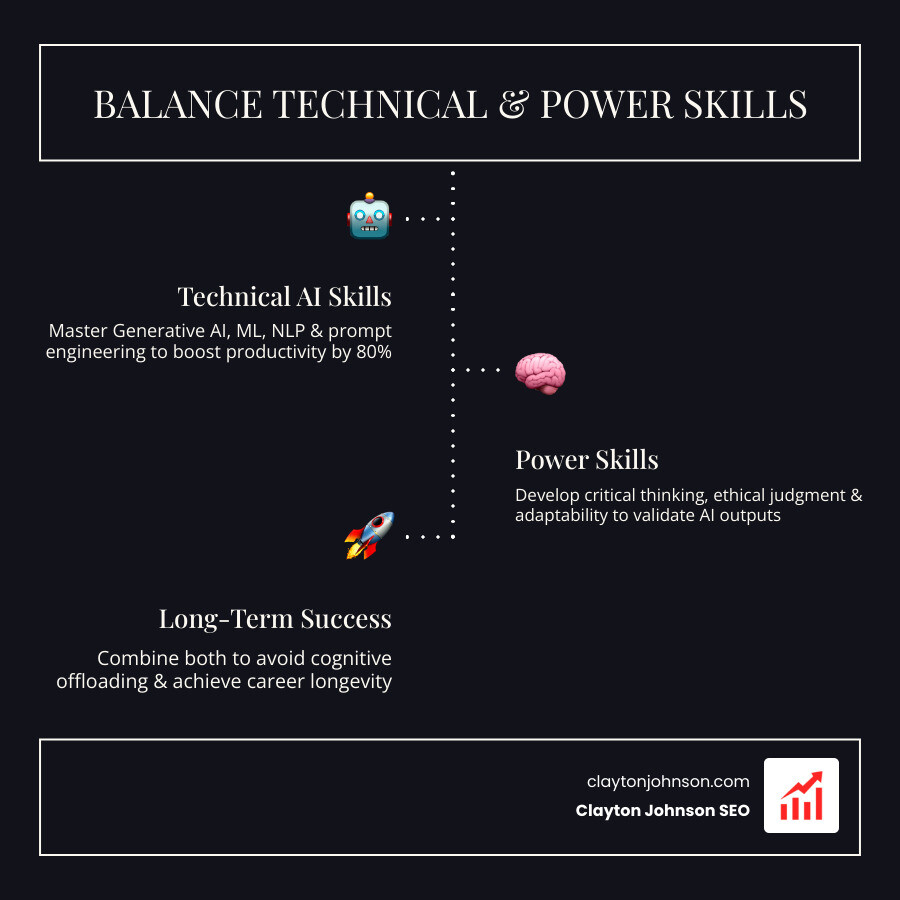
AI skills enhancement terms explained:
The Strategic Importance of AI Skills Enhancement
In the current economic landscape, AI is no longer a “nice-to-have” on a resume; it is a fundamental driver of global economic value. According to a PwC report, AI could contribute up to $15.7 trillion to the global economy by 2030. For us as developers, this represents a massive shift in how we create value.
The Future of Jobs Report 2023 by the World Economic Forum highlights that while automation is a threat to some roles, it is also a catalyst for the evolution of others. We are seeing a shift where 40% of core skills for workers are expected to change in the coming years. Career longevity now depends on our ability to integrate these tools into our daily workflows.
Navigating Job Displacement and Emerging Opportunities
It is true that automation risks are real—estimates suggest that 85 million jobs may be displaced by 2025. However, this displacement is often misunderstood. It isn’t always about a robot taking a seat; it’s about tasks being automated so that humans can focus on higher-level strategy.
We are seeing a 21x increase in job postings that mention AI technologies, signaling that the “displacement” is actually a “replacement” of old methods with new, AI-augmented ones. To stay ahead, you need to understand why your brand needs an AI growth strategy right now to ensure you are building the skills that the market is actually hiring for.
Why Every Developer Needs AI Tools for Programming
Productivity is the most immediate benefit of AI skills enhancement. Observational studies have found that AI can speed up certain tasks by as much as 80%. Whether it’s boilerplate generation, unit testing, or refactoring, the time saved allows us to move from being “code monkeys” to “architects.”
However, using these tools isn’t just about typing a prompt and hitting enter. It’s about knowing why every developer needs AI tools for programming in 2025 to maintain a competitive edge. If you aren’t using these tools, you are effectively working with one hand tied behind your back while your peers are sprinting ahead.
Core Technical Competencies for Modern Developers
To effectively participate in AI skills enhancement, we need to break down the technical landscape. It isn’t just “AI”—it’s a collection of specific disciplines that serve different purposes.
| Technology | Developer Application | Business Impact |
|---|---|---|
| Generative AI | Code generation, documentation, synthetic data | Faster development cycles |
| Machine Learning | Predictive analytics, recommendation engines | Enhanced user personalization |
| NLP | Sentiment analysis, chatbots, voice interfaces | Improved customer experience |
Beyond these, data fluency is critical. AI is only as good as the data it is trained on. Developers must understand how data is collected, organized, and interpreted to ensure the models they build or use are actually providing value. This is why finding the best AI for coding and debugging is a foundational step in your upskilling journey.
Mastering Generative AI and LLMs for AI skills enhancement
Generative AI and Large Language Models (LLMs) have lowered the barrier to entry for complex coding tasks. Because these models use natural language, you don’t need to be a PhD in mathematics to leverage them. However, you do need to understand LLM architecture—at least at a high level—to know their limitations, such as “hallucinations” or context window constraints.
For those of us looking to specialize, mastering specific ecosystems is key. For example, learning the complete Claude skill pack for modern developers can give you a specific edge in creative coding and long-form reasoning that other models might struggle with.
Advanced Prompt Engineering and Flow Prompting
Prompt engineering is often dismissed as “just talking to a computer,” but it is actually the art of precise instruction. Advanced techniques like “flow prompting”—where you consider the entire data flowchart triggered by a prompt—are becoming essential.
We must move beyond simple one-off questions and start building “chains” of thought. This involves context understanding and rigorous output validation. If you want to dive deep into this, check out our guide on mastering the Claude AI code generator for faster development.
Balancing Productivity with Long-Term Mastery
This is where things get tricky. While AI makes us faster, there is a documented risk of cognitive offloading. This happens when we rely so heavily on the tool that we stop “thinking” through the problem ourselves.
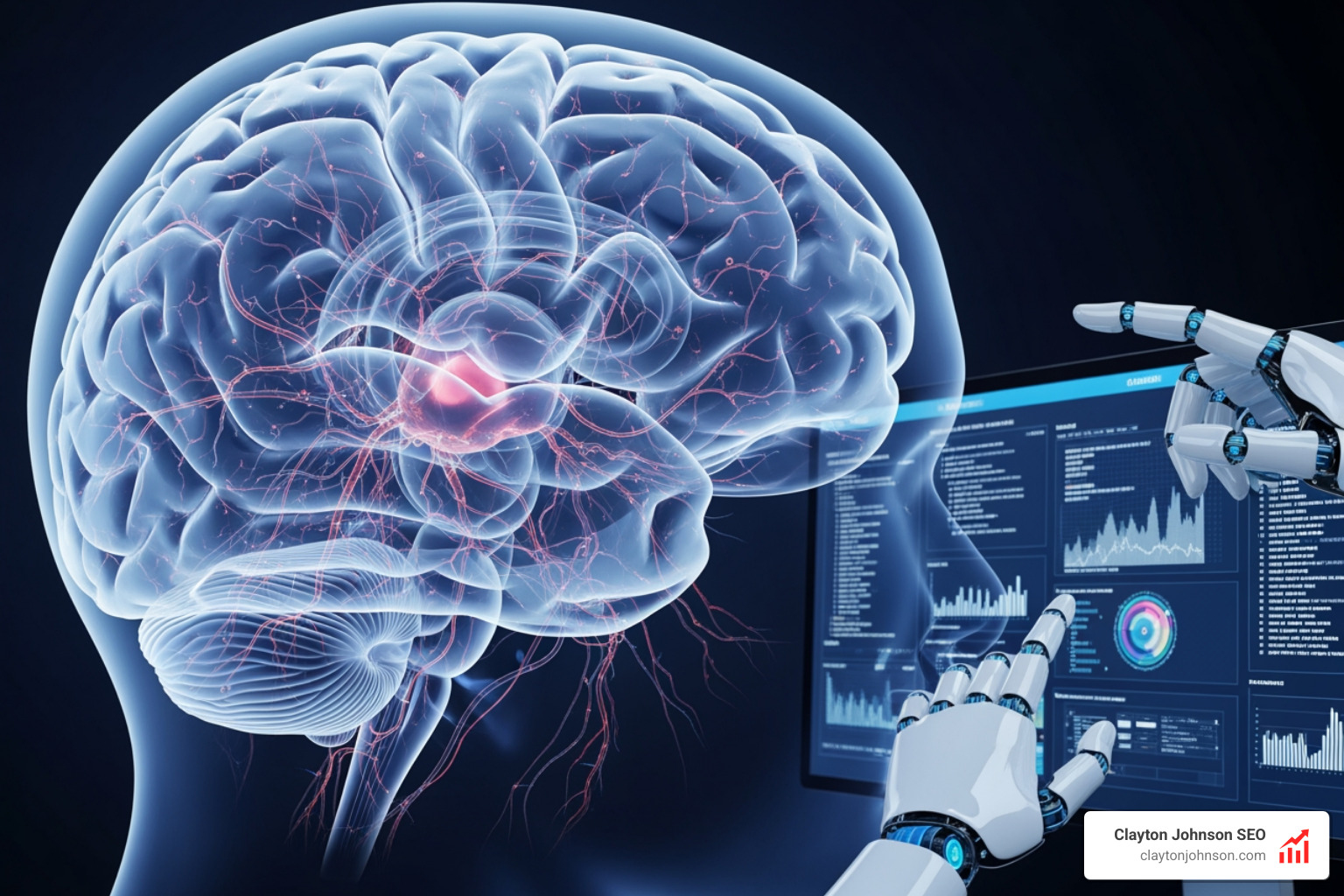
According to scientific research on AI’s impact on skill formation, developers who used AI assistance actually scored 17% lower on quizzes testing their mastery of coding concepts. They finished the tasks slightly faster, but they didn’t learn the material as well as the group that hand-coded.
Avoiding the Pitfalls of Cognitive Offloading
The danger of reduced mastery is that you eventually lose the ability to validate what the AI is giving you. If you can’t debug the code the AI wrote, you aren’t a developer; you’re an editor of a language you don’t speak.
Research from Microsoft on AI and critical thinking suggests that “getting stuck” is actually a vital part of the learning process. When AI solves every problem instantly, we miss the cognitive effort required to build long-term memory and deep understanding.
Intentional Skill Development with AI Tools
To combat this, we recommend a “hybrid” approach. Instead of asking the AI to “write this function,” ask it to “explain the logic behind this function” or “critique my current implementation.” This fosters iterative debugging and conceptual inquiry.
By using AI as a tutor rather than a ghostwriter, you ensure that your personal growth keeps pace with your productivity. This is the real truth about coding AI growth: the most successful developers will be those who use AI to learn faster, not just work faster.
Power Skills: The Human Edge in AI Adoption
As technical tasks become increasingly automated, “power skills” (often called soft skills) become our primary competitive advantage. A report by McKinsey indicates that up to 375 million workers may need to transition occupational categories, and those who succeed will be those who lean into human-centric capabilities.
Ethical AI Competency and Regulatory Awareness
As developers, we are the gatekeepers of responsible AI. This includes bias mitigation, ensuring data privacy, and staying aware of evolving regulations. We need to be able to ask: “Is this model fair? Is this data secure?”
Building these competencies is part of a broader AI skills enhancement strategy. For instance, learning how to extend Claude with custom agent skills allows you to build tools that are tailored to your specific ethical and operational standards.
Adaptability and Complex Problem Solving
A 2024 Gallup poll found that nearly 25% of workers worry their jobs will become obsolete. The antidote to this fear is adaptability. We must embrace lifelong learning as a core part of our professional identity.
AI can generate code, but it often struggles with strategic vision—the “why” behind a project. Complex problem solving remains a uniquely human domain. By focusing on the big picture, we ensure that we remain indispensable even as the underlying tech evolves.
Proven Training Methods for AI Skills Enhancement
How do we actually learn these skills without spending four years in a new degree program? The answer lies in modern, flexible training methods.
- Microlearning: Short, focused bursts of learning (under 10 minutes) that fit into a busy workday.
- Blended Training: Combining self-paced online courses with hands-on projects or peer discussions.
- Project-Based Learning: Building a real tool (like a custom chatbot) to apply theoretical knowledge.
A great starting point for many is Google AI Essentials, which provides a solid foundation in under 15 hours of study.
Leveraging Certifications and Skill Badges
Certifications act as a “proof of work” in a rapidly changing market. Whether it’s a Google Career Certificate or exploring the OpenAI Academy, these credentials validate your expertise to employers.
If you are a specialist, you might look for niche training. For example, there are essential AI skills every marketer needs to survive that overlap heavily with developer roles in the growth space.
Scalable Upskilling Strategies for Organizations
For those of us in leadership or HR roles, upskilling isn’t just an individual task—it’s an organizational one. CHROs (Chief Human Resources Officers) should lead the charge by conducting skill gap audits and providing resources for their teams.
Organizations that proactively train their staff in AI will lead in innovation and retention. Using AI competitive insights to outsmart your rivals is a key strategy for any business looking to survive the next decade.
Frequently Asked Questions about AI Skills
Why are AI skills essential for the future workforce?
AI is fundamentally remaking corporate strategy. With 72% of organizations already using AI, these skills are required to stay productive, innovate, and remain employable as roles evolve.
What are the best free resources for AI training?
Google offers several no-charge resources through “Grow with Google” and “Google Skills.” OpenAI Academy also provides free enrollment for community-driven learning and expert tutorials.
How does AI impact the job market for developers?
While it automates routine tasks, it creates a massive demand for developers who can oversee AI, validate its output, and integrate it into complex business systems. The “21x increase” in AI-related job postings proves the opportunity is there for those who upskill.
Conclusion
At Clayton Johnson SEO, we believe that AI skills enhancement is the most important investment you can make in your career today. Whether you are a solo developer or leading a large team, the ability to balance technical proficiency with human critical thinking will be your greatest asset.
If you’re looking to build a content system that leverages these advanced workflows, explore our SEO content marketing services to see how we can help you execute with measurable results. The future is AI-assisted, but it will always be human-led. Let’s get to work.