Why Most Change Initiatives Fail Before They Even Start
Change Management is the structured process of guiding people, teams, and organizations through transition — from where they are now to where they need to be.
Here’s the quick answer if you need it fast:
| What | Why It Matters |
|---|---|
| What it is | A structured approach to leading people through organizational change |
| Why it fails | 70% of change programs fail due to employee resistance and lack of leadership support |
| Key benefit | Organizations with a change strategy have 7x lower failure rates |
| Core focus | People first — not process, not technology |
| Top frameworks | Prosci ADKAR, Kotter’s 8-Step, Lewin’s 3-Step |
Now here’s the uncomfortable truth: only 34% of changes are ever considered a clear success.
That’s not a technology problem. It’s not a strategy problem. It’s a people problem — and most organizations skip right past it.
Whether you’re rolling out a new platform, restructuring a team, or navigating a full digital transformation, the way you manage the human side of change determines whether it sticks or collapses.
This guide walks you through exactly how to do it right — without the chaos.
I’m Clayton Johnson, an SEO and growth strategist who specializes in building structured systems that scale, including the kind of organizational change frameworks that turn fragmented execution into compounding results. My work in Change Management sits at the intersection of strategic clarity, structured architecture, and measurable outcomes — the same principles that drive durable organizational growth.
What is Change Management and Why Does It Matter?
At its core, Change Management is about moving people effectively through the transition from the status quo to a desired future state. We often see leaders focus entirely on the “technical” side of a project—the software install, the new org chart, or the office move—while completely ignoring the psychological journey their employees have to take.
According to Gartner, 34 per cent of changes are considered a “clear success.” That is a staggering statistic. It means two-thirds of the time, we are pouring resources into initiatives that don’t actually cross the finish line.
Why does this happen? The research is clear: 70% of change programs fail to achieve their goals, largely due to employee resistance and a lack of management support.
Organizational Resilience and Risk Mitigation
In a world of constant disruption—from AI to shifting market demands—being static is a death sentence. We use Change Management as a risk mitigation strategy. It allows a company to adapt to and capitalize on new business realities. Without it, the “inertia” of a multi-business firm can lead to total stagnation.
When we implement change correctly, we aren’t just “fixing” a problem; we are building organizational resilience. This involves:
- Lowering Uncertainty: Giving people a roadmap so they don’t fill the silence with rumors.
- Aligning Efforts: Ensuring every department is moving toward the same North Star.
- Gaining Competitive Advantage: Organizations that react rather than adopt a formal strategy have a seven times greater failure rate.
Human-Centered Design
Modern Change Management has evolved to include Human-Centered Design (HCD). This means we don’t just push change from the top down; we co-create it with the people who will actually be doing the work. By focusing on empathy and the human factor, we can turn a “mandate” into a “movement.”
Proven Frameworks: ADKAR, Kotter, and Lewin
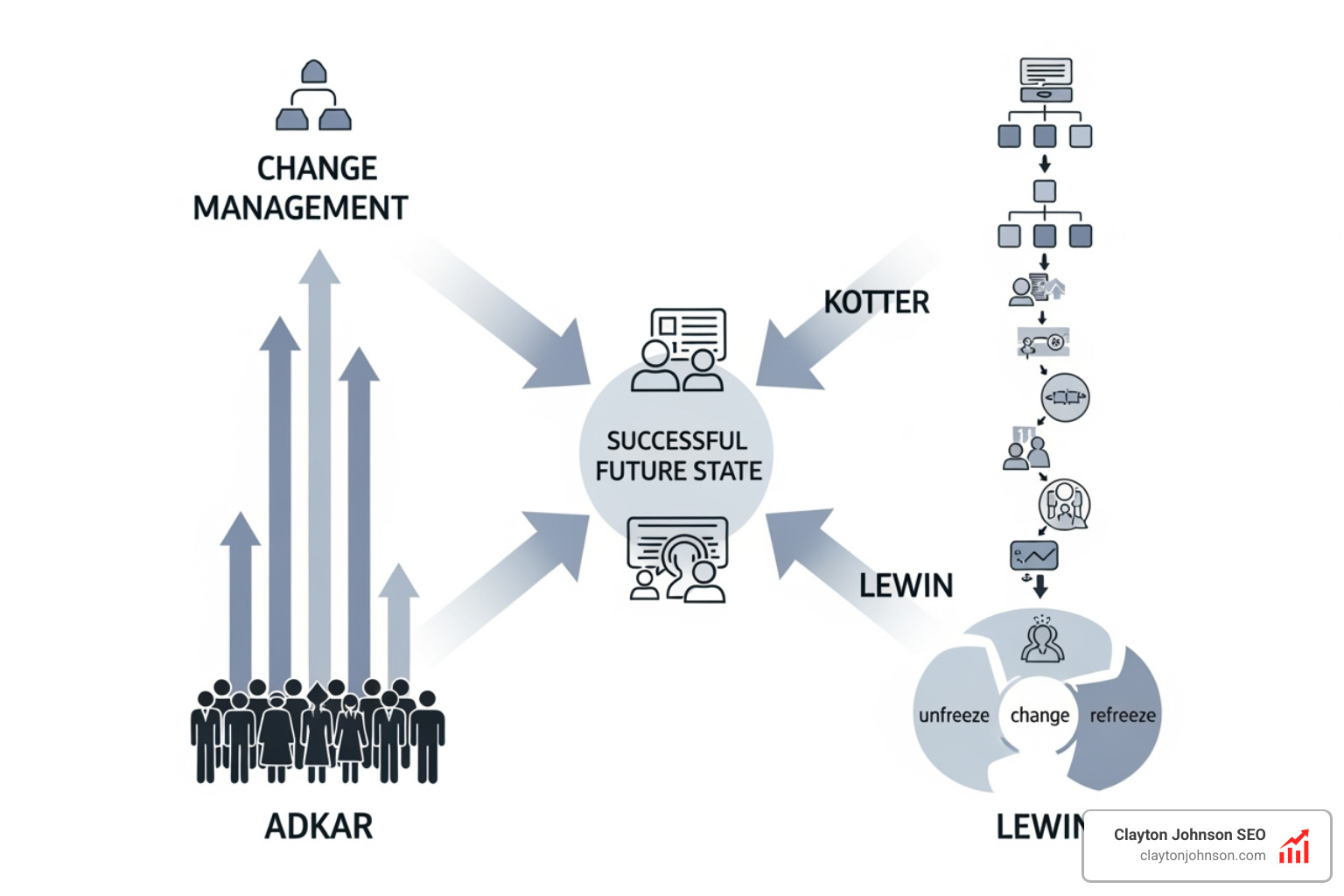
We don’t have to reinvent the wheel every time we want to change something. There are several research-based models that provide a best-practices approach to navigating these waters.
Prosci ADKAR Model
The ADKAR model is one of the most widely used individual change management frameworks in the world. It focuses on the five outcomes an individual must achieve for change to be successful:
- Awareness: Of the need for change.
- Desire: To support and participate in the change.
- Knowledge: Of how to change.
- Ability: To implement required skills and behaviors.
- Reinforcement: To sustain the change.
Prosci has certified more than 100,000 practitioners worldwide, grounding this methodology in over 25 years of research.
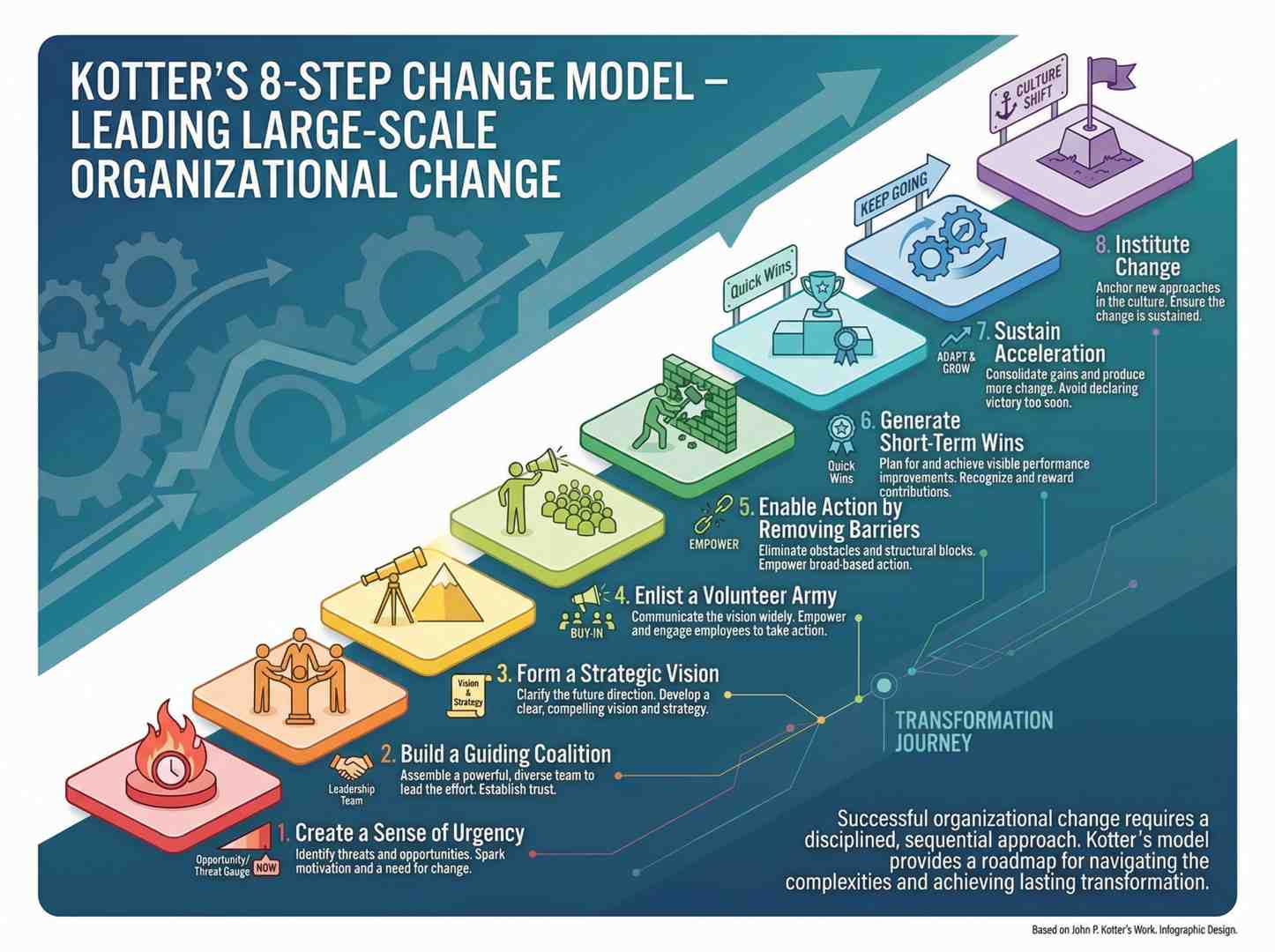
Kotter’s 8-Step Process
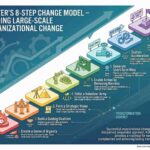
John Kotter’s model is a heavy hitter for organizational-level transformation. It’s a sequence designed to build momentum:
- Create a sense of urgency.
- Build a guiding coalition.
- Form a strategic vision.
- Enlist a volunteer army.
- Enable action by removing barriers.
- Generate short-term wins.
- Sustain acceleration.
- Institute change into the culture.
Lewin’s 3-Step Model
Kurt Lewin’s model is the “grandfather” of change frameworks. While simple, The Origins of Lewin’s Three-Step Model of Change remain foundational to how we understand human behavior:
- Unfreeze: Destabilize the current equilibrium (the status quo).
- Change: Move to the new state through collaboration.
- Refreeze: Stabilize the new norms so they stick.
Comparing the Frameworks
| Model | Focus | Best For |
|---|---|---|
| ADKAR | The Individual | Ensuring every single person is on board. |
| Kotter | The Organization | Large-scale, top-down strategic shifts. |
| Lewin | The Psychology | Understanding the fundamental shift from old to new. |
The 5-Step Process for Successful Implementation
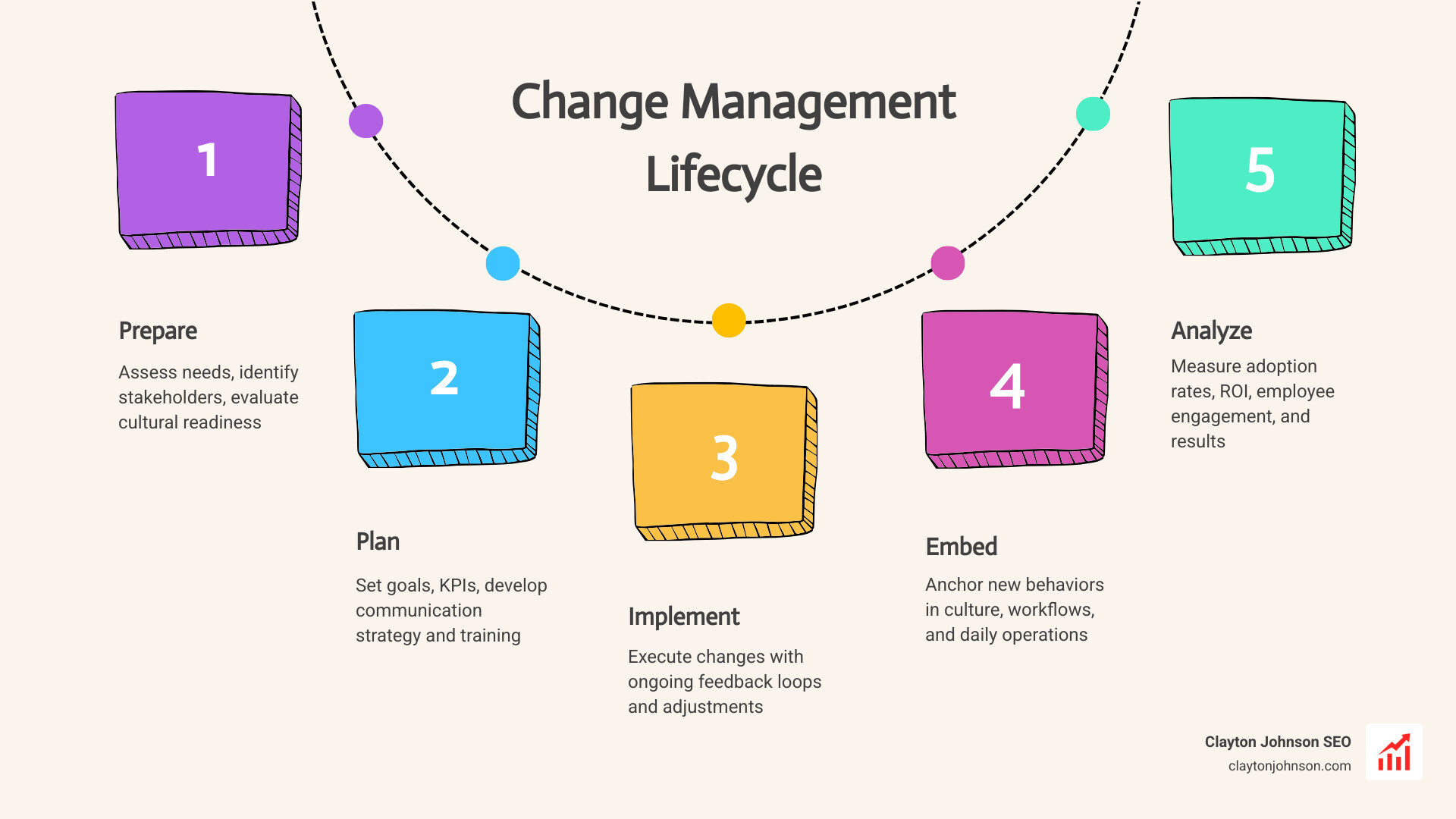
Successful Change Management doesn’t happen by accident. We follow a structured 5-step process to ensure the transition is smooth. This applies whether you are dealing with individual change, organizational change, or enterprise-wide shifts. You can find more info about strategic frameworks to help guide your specific path.
1. Preparing for Change Management
Before you announce anything, you need to do your homework.
- Stakeholder Identification: Who is affected? Who has the power to block this?
- Need Assessment: Why are we doing this? (Hint: “Because I said so” is not a business case).
- Cultural Readiness: Is your team already burnt out? If so, you need a different approach.
- Goal Setting: What does success look like in measurable terms?
2. Planning and Implementing Change Management
This is where the rubber meets the road.
- Communication Strategy: We recommend the “7×7” rule—communicate the message in seven different ways, seven different times.
- Roadmap Development: Create a timeline that accounts for the “dip” in productivity that usually happens during a transition.
- Training Programs: Don’t just give them a manual. Give them the skills they need to succeed.
- Roadblock Solutions: Anticipate where the “office riot” might start and have a plan to address those concerns early.

3. Reinforcing and Analyzing Results
Most people stop once the new system is “live.” That’s a mistake.
- Immersion: Embed the changes into daily workflows and reward systems.
- Feedback Loops: Keep listening. The “post-implementation” phase is where you find the bugs in your process.
- Success Metrics: Did you hit your KPIs? If not, why?
- Sustaining Momentum: Assign a permanent manager to ensure the organization doesn’t slide back into old habits.
Overcoming Resistance and the Role of Leadership
Resistance is a natural human reaction to change. It’s not necessarily “bad”—it’s often a sign that people care about their work and are afraid of losing their competence.
Psychological Safety and Change Fatigue
If your employees don’t feel safe to speak up, they will resist in silence (which is much harder to fix). We must build psychological safety so that concerns can be addressed openly. We also need to watch out for “transformation saturation” or change fatigue. If you try to change too much at once, the organization will simply stop responding.
The Role of Leadership
Leadership is the single most important factor in successful Change Management.
- Executive Sponsorship: If the CEO isn’t visibly using the new system, why should the interns?
- Transparency: Be honest about the “burning platform.” Why is staying the same more dangerous than changing?
- Empathy: Acknowledge that change is hard.
- Influencing Without Authority: Middle managers need the skills to lead teams through changes they didn’t personally design.

Modern Evolution: AI, Agile, and Digital Transformation
The game has changed in the 2020s. We are no longer dealing with one-off changes; we are in a state of continuous transformation.
Digital Resilience and AI
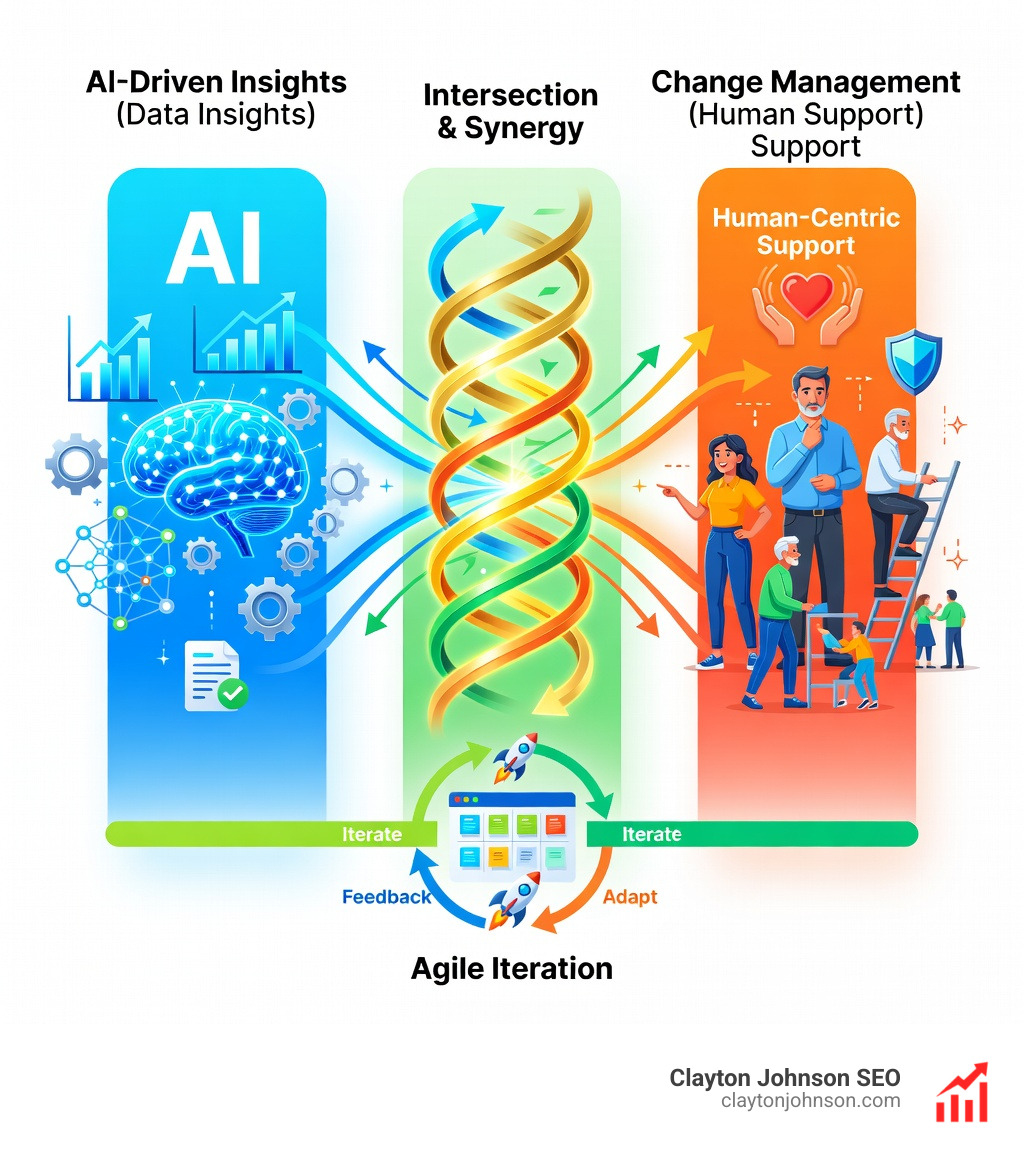
Digital transformation isn’t just about buying new tools; it’s about building “digital resilience.” We are seeing a massive shift toward Introduction to AI in Change Management. AI can help us analyze employee sentiment, automate training, and even predict which departments might struggle with a transition. You can explore more info about AI tools to see how these can be integrated into your growth architecture.
Agile and Remote Work
The rise of remote and hybrid work models has forced Change Management to become more participatory and less top-down. We use “Agile” methodologies—implementing small, iterative changes rather than one giant “big bang” rollout. This allows us to course-correct in real-time based on data-driven decision-making.
Frequently Asked Questions about Change Management
How does change management differ from project management?
This is a common point of confusion. Think of it this way:
- Project Management focuses on the technical side of the house—the tasks, timelines, and budgets required to deliver a specific output.
- Change Management focuses on the people side—ensuring that once the output is delivered, people actually use it and the business realizes the intended value.
If you have a perfect project plan but no one adopts the new tool, your project has failed.
What certifications are available for professionals?
If you want to make this a career, there are several paths:
- Prosci Certification: The gold standard for many, focusing on the ADKAR model.
- ACMP Standard: The Association of Change Management Professionals provides a globally recognized standard and the CMF (Certified Change Management Professional) exam.
- Dalhousie Certificate: A comprehensive program that covers the human side of change, project management essentials, and even AI applications.
How do you measure the success of a change initiative?
We look at three main areas:
- Adoption Metrics: How many people are actually using the new system?
- Employee Engagement: Are people feeling supported, or are they checking out?
- ROI and Performance KPIs: Did the change actually improve the bottom line or increase efficiency?
Conclusion
At the end of the day, Change Management is about leverage. It’s the difference between a project that peters out and a transformation that creates compounding growth.
Most companies don’t lack the tactics to change; they lack the structured growth architecture to make those changes stick. That is why we built Demandflow.ai. We combine actionable strategic frameworks with AI-augmented marketing workflows to solve the core problem: a lack of structure.
By applying these principles, you can move from clarity to structure, and finally to the kind of leverage that drives long-term success.
If you’re ready to stop the office riots and start seeing real results, it’s time to master your growth strategy and build a system that works for your people, not against them.