Pillar Pages and Topic Clusters Explained for Mere Mortals


Why Smart Marketers Are Building Content Around Pillars and Clusters
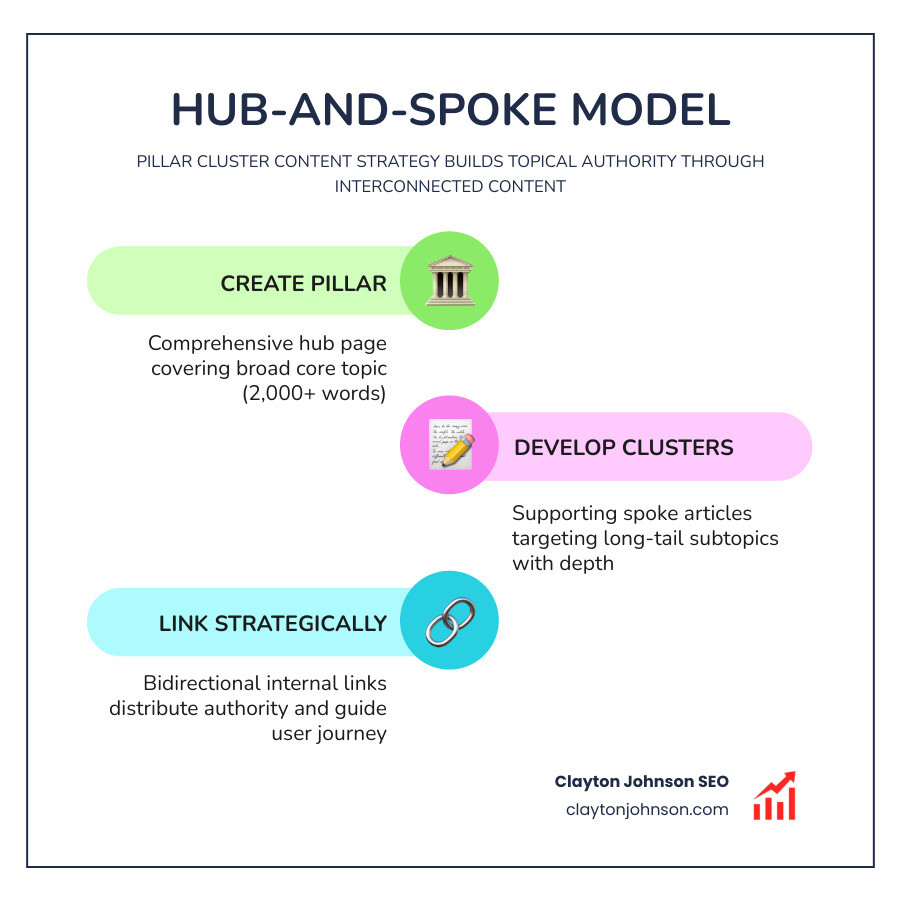
Pillar cluster content strategy is a structured approach to organizing content around core topics (pillars) supported by interconnected subtopic pages (clusters), all linked together to signal topical authority to search engines and guide users through related information.
Quick Answer:
- Pillar page = comprehensive hub covering a broad topic (2,000+ words)
- Cluster content = supporting articles exploring specific subtopics
- Internal links = connect clusters to the pillar and to each other
- Result = stronger rankings, better user experience, compounding organic growth
If you’ve noticed your content performing inconsistently—some pages rank, others disappear into the void—you’re likely dealing with a structure problem, not a content quality problem.
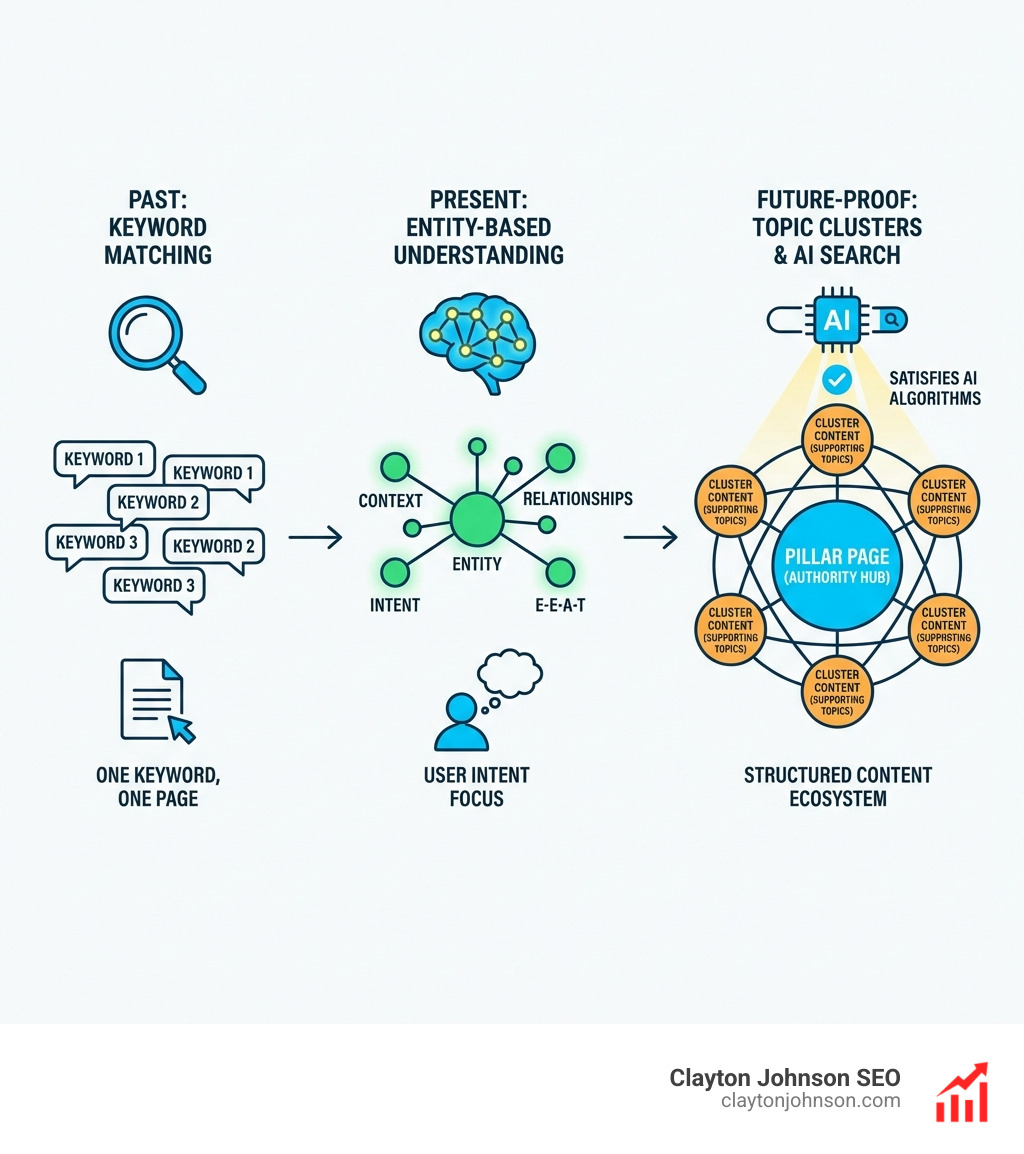
Search engines have evolved beyond matching keywords. They now evaluate whether your site demonstrates genuine expertise on a subject. That evaluation happens through topical authority—your ability to cover a topic comprehensively and connect the pieces logically.
A pillar cluster content strategy solves this by replacing scattered blog posts with an intentional architecture. Instead of publishing isolated articles, you build content ecosystems where each piece reinforces the others.
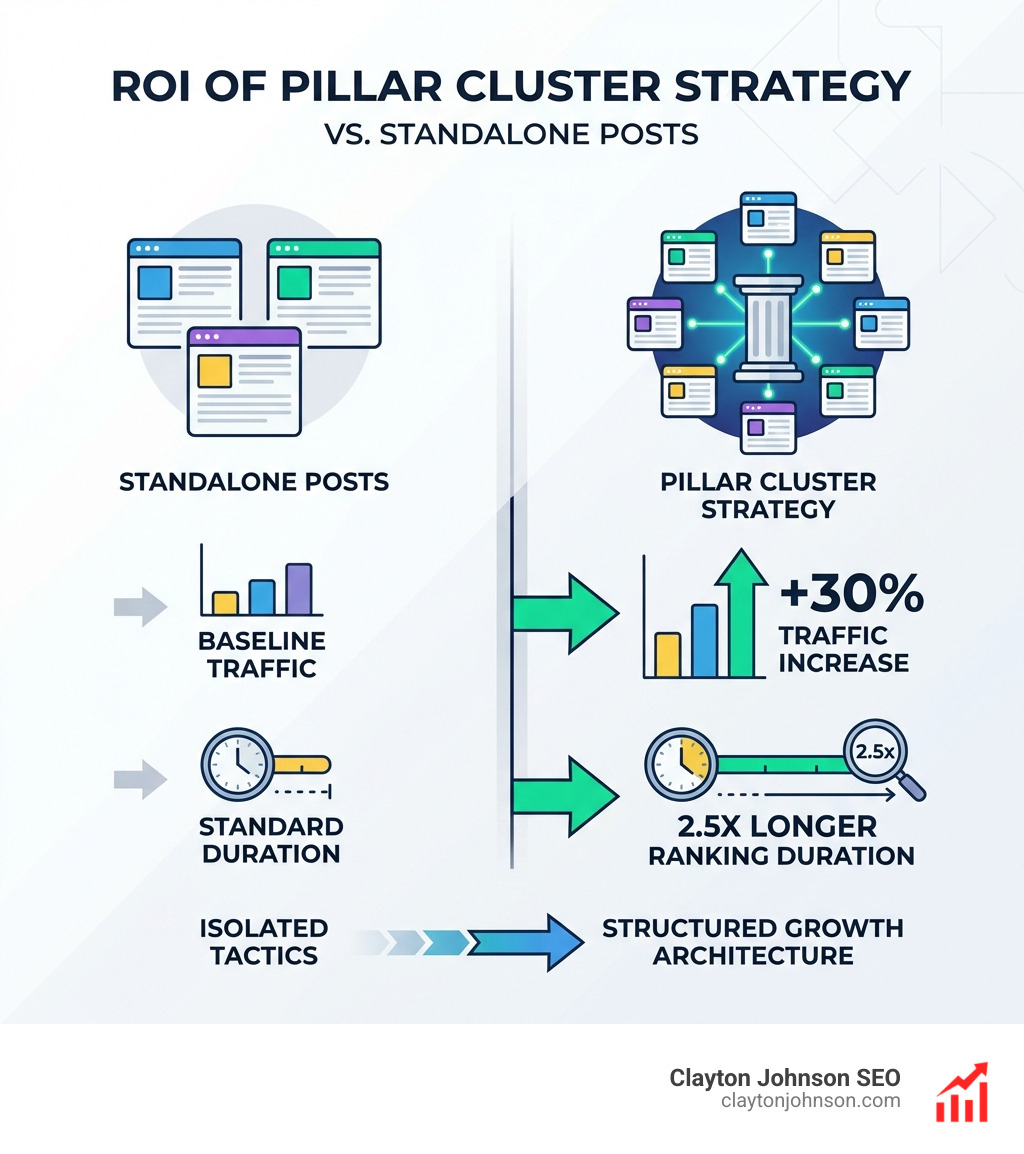
The benefits are measurable. Companies using this model report traffic increases of 30% or more, longer-lasting rankings, and lower bounce rates because visitors can navigate naturally from overview to detail. One tax software provider boosted top-10 rankings by 400% after organizing content into high-performing clusters tied to audience pain points.
But the real advantage isn’t just traffic—it’s clarity. When you organize content around pillars, you’re forced to think strategically about what topics you actually own, what your audience needs at each stage, and how to guide them through your expertise.
I’m Clayton Johnson, and I’ve spent years building taxonomy-driven SEO systems and pillar cluster content strategy frameworks for companies trying to move from reactive content production to structured growth architecture. The shift from random publishing to intentional clusters consistently delivers compounding results when executed correctly.
What is a Pillar Cluster Content Strategy?
The joy (or nightmare) of SEO terminology is that it is always in flux. You might hear people talk about “cornerstone content,” “hubs,” or “skyscraper pages.” At Clayton Johnson SEO, we prefer to call it a pillar cluster content strategy because it describes exactly how the machine works: you have a central support (the pillar) and a group of related assets (the cluster).
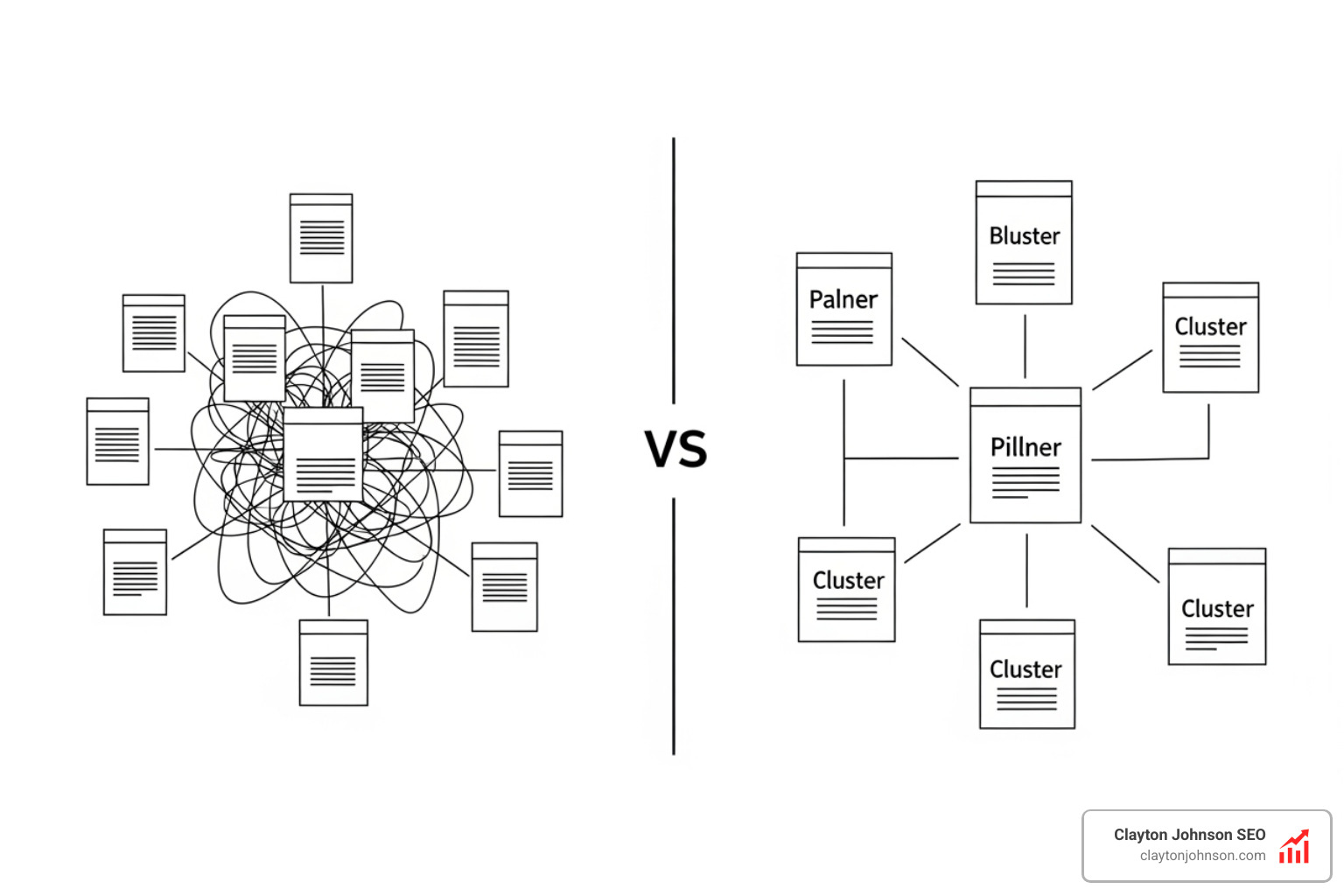
In simple terms, this strategy is an approach to content marketing that organizes your website around central topics rather than individual keywords. Instead of writing fifty different blog posts that all compete with each other, we create a structured system where one authoritative “hub” page links to multiple “spoke” articles.
This architecture signals to search engines that your site isn’t just a collection of random thoughts—it’s a library of expertise. According to Google Search Central: Site Structure, a clear hierarchy helps crawlers understand which pages are the most important and how they relate to one another. You can see how we organize our own insights by visiting the Clayton Johnson SEO Blog Pillar Page Example.
Defining the Pillar Page
A pillar page is the foundation of your topic cluster. It is a comprehensive, standalone resource that covers a broad topic in-depth. Think of it as the “Ultimate Guide” to a subject.
While a standard blog post might focus on a specific long-tail keyword like “how to grip a baseball bat,” a pillar page would cover the entire subject of “Baseball Fundamentals.” It provides a high-level overview of everything a reader needs to know, then links out to more detailed articles for the “nitty-gritty” specifics.
Key characteristics of a pillar page include:
- Comprehensive Coverage: It answers the big questions and provides the “big picture.”
- Evergreen Nature: It stays relevant over time, though it requires regular updates.
- Length: Most successful pillar pages are 2,000+ words, though depth matters more than word count.
- Internal Links: It serves as a directory, linking to all the supporting cluster pages.
Defining Topic Clusters
If the pillar page is the “hub,” the topic clusters are the “spokes.” Cluster content consists of focused articles that dive deep into specific subtopics mentioned on the pillar page.
For our “Baseball Fundamentals” pillar, cluster pages might include:
- A guide on pitching mechanics.
- An article on the best outfield drills.
- A breakdown of the different types of baseball gloves.
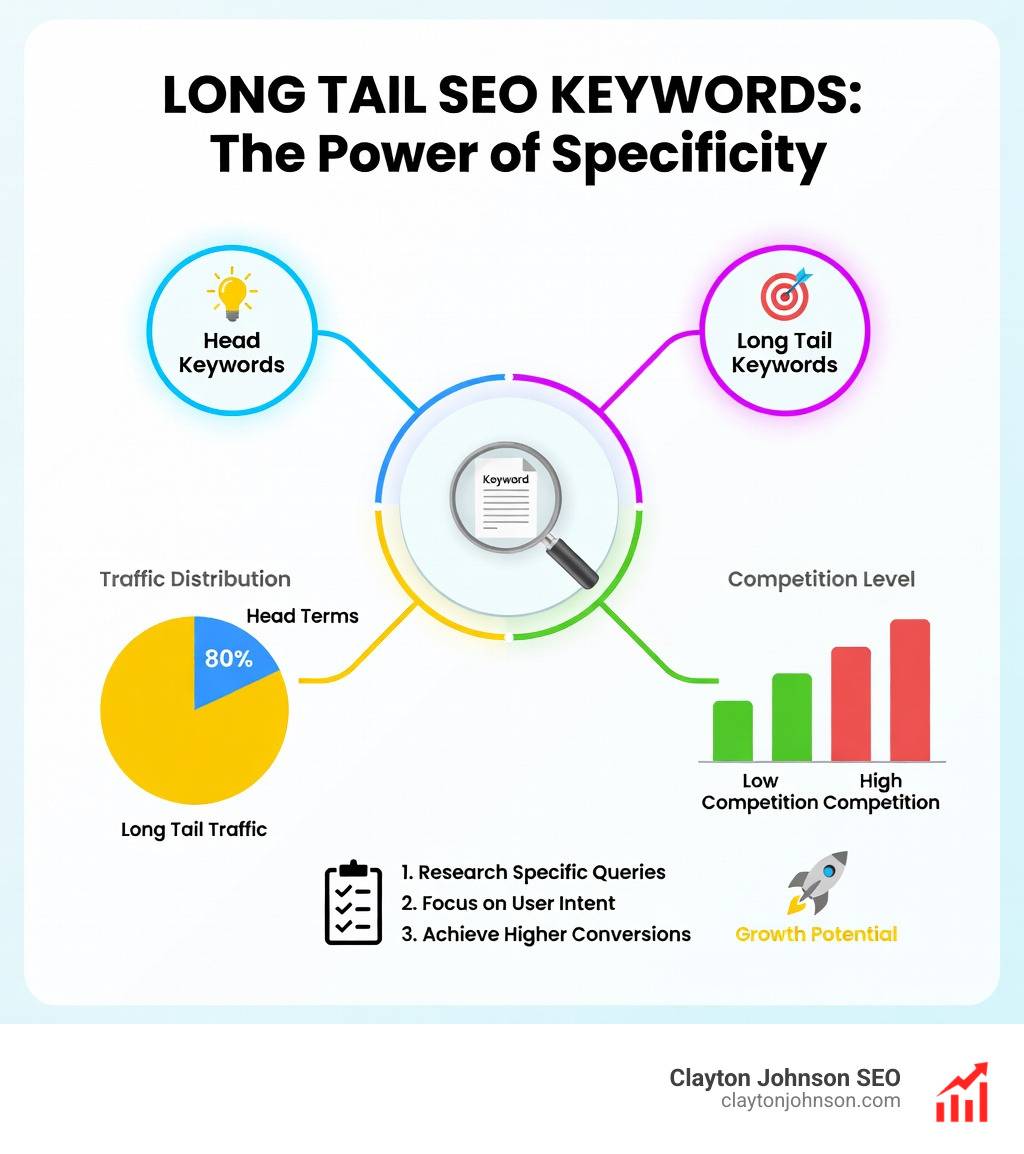
Each of these cluster pages targets a specific long-tail keyword with lower search volume but higher intent. By covering these subtopics in detail, we prove to search engines that we haven’t just skimmed the surface—we’ve explored every corner of the entity. This semantic relevance is what builds the topical authority needed to rank for competitive head terms.
[TABLE] comparing Hub-and-Spoke vs. Topic Clusters
While these terms are often used interchangeably, there are subtle differences in how marketers apply them.
| Feature | Hub-and-Spoke Model | Topic Cluster Model |
|---|---|---|
| Primary Object | Navigational Hub Page | Authoritative Pillar Page |
| Linking Pattern | Hub → Spoke (One way often) | Bi-directional (Pillar ↔ Cluster) |
| Semantic Emphasis | Categorization & Organization | Depth & Entity Relationships |
| Outcome | Improved Site Navigation | Increased Topical Authority |
| User Journey | Directory/Search style | Educational/Guided path |
Why This Strategy Wins in Modern Search
The days of “one keyword, one page” are over. Modern search algorithms, especially with recent core updates, have moved toward understanding entities and intent. Google doesn’t just look for words on a page; it looks for evidence that the website is a credible source of information.
This is where E-E-A-T (Experience, Expertise, Authoritativeness, and Trustworthiness) comes into play. A pillar cluster content strategy is the most effective way to demonstrate these qualities. When you have ten high-quality articles all pointing to one central pillar, you are telling Google, “We are an authority on this subject.”
The SEO Benefits of a Pillar Cluster Content Strategy
The results of implementing a structured architecture are often dramatic. We’ve seen sites reduce their bounce rate by up to 45% simply because users have a clear path to discover more related content.
Other benefits include:
- Ranking Lift: When one page in a cluster performs well, it passes “link equity” to the other pages in the group, helping the entire cluster rise in the SERPs.
- Increased Organic Traffic: By targeting both broad head terms and specific long-tail queries, you capture users at every stage of the funnel.
- Crawlability: A clean internal linking structure makes it easier for search engine bots to find and index your new content.
- Compounding Growth: Unlike one-off posts that fade away, clusters build a “moat” around your topics that is harder for competitors to disrupt.
For those looking to scale these results, you can explore More info about SEO content marketing services to see how we build these systems for our clients. You can also view our Clayton Johnson Resource Center Example to see this in action.
Adapting to Semantic Search and AI
We are currently in an era of AI Overviews and zero-click results. Search engines are increasingly using AI to summarize the “best” answer directly on the results page.
If your content is scattered, an AI model might struggle to see you as the primary source. However, if you have a tightly knit cluster of content, AI systems can more easily identify your site as the definitive authority on the entity. This increases the likelihood of your brand being cited in AI-generated answers, which is crucial for brand recall in a world where users may not always click through to a website.
How to Build Your Content Architecture
Building a content ecosystem isn’t just about writing; it’s about engineering. Most companies don’t lack tactics—they lack structured growth architecture. At Demandflow.ai, we focus on the taxonomy-driven systems that make this possible.
The process begins with three pillars: Keyword Research, a Content Audit, and Buyer Personas. You need to know who you are talking to, what you already have, and where the gaps are.
Choosing the Right Core Topic for Your Pillar Cluster Content Strategy
Not every topic deserves a pillar page. If you pick a topic that is too narrow, you’ll run out of things to say. If it’s too broad, you’ll never rank. We call this the “Goldilocks” problem.
To find the right core topic, ask yourself:
- Business Intent: Does this topic relate to a problem our product or service solves?
- Search Volume: Is there enough demand to justify a 3,000-word guide?
- Win-ability: Do we have the expertise to write something better than what’s currently on page one?
- Subtopic Potential: Can we realistically come up with 10-15 subtopics (spokes) for this pillar?
Mapping Your Cluster Spokes
Once you have your pillar, it’s time to map the spokes. This is where you look for long-tail queries and intent depth. Use tools like Semrush or Ahrefs to find the questions people are asking.
Common spoke categories include:
- “How-to” guides for specific tasks.
- Comparison articles (e.g., “Software A vs. Software B”).
- Case studies showing your strategy in action.
- FAQ pages addressing common objections.
While mapping, pay close attention to canonicalization. You want to ensure that each page has a unique purpose and doesn’t compete with another. For more on this, check out our Guide to canonical URLs. For a deeper dive into finding the right subtopics, read our Long-tail keywords explained article.
Structuring High-Performing Pillar Pages and Clusters
A pillar page shouldn’t just be a wall of text. It needs to be a high-functioning user interface. If a user lands on your pillar page and can’t find what they need in ten seconds, they’re gone.
Effective Pillar Page Types
Different intents require different structures. Here are the four most common types we use:
- The 10x Guide: A massive, definitive resource that is ten times better than anything else on the web.
- The Resource Hub: A directory-style page that focuses on curating the best links and tools for a topic.
- The “What-is” Pillar: Designed for beginners, this page defines a complex industry term and explains why it matters. A great example is our page on What is a CMDB?.
- The “How-to” Pillar: A step-by-step framework for achieving a specific result (e.g., “How to Build a Digital Banking Strategy”).
Regardless of the type, every pillar should have a hyperlinked table of contents, clear H2 and H3 hierarchies, and visual cues like bullet points and call-out boxes.
Strategic Internal Linking for Your Pillar Cluster Content Strategy
Internal linking is the “connective tissue” of your strategy. Without it, you just have a bunch of separate blog posts.
To maximize the power of your cluster, follow these rules:
- The Golden Rule: Every cluster page must link back to the pillar page.
- Descriptive Anchor Text: Don’t use “click here.” Use descriptive phrases like “internal linking strategy” or “content taxonomy.”
- Deep Linking: Link between “sibling” cluster pages when it makes sense for the user.
- Authority Distribution: Place your most important links high up in the content where they are more likely to be clicked.
For a full breakdown of how to master this, see our Internal linking best practices.
Frequently Asked Questions
How long should a pillar page be?
There is no “magic” number, but data shows that successful pillar pages are around 2,000 to 3,500 words. However, quality always beats length. If you can cover a topic comprehensively in 1,800 words, don’t add fluff just to hit a target. Focus on depth of information and user experience. If the page is long, use jump links to help people navigate.
Are pillar pages still effective with AI search?
Absolutely. In fact, they are more important. AI Overviews and LLMs rely on understanding relationships between concepts. A well-structured pillar cluster provides the “semantic map” these systems need to cite your brand. By providing information gain (original insights or data), you give AI systems a reason to prioritize your content over generic competitors.
How many cluster articles does each pillar need?
A good rule of thumb is to start with 8 to 15 cluster articles. This provides enough breadth to signal authority without overwhelming your production team. For very competitive “head terms,” you may eventually need 20-40 spokes. The goal is to cover the entire “surface area” of the topic.
Conclusion: Clarity → Structure → Leverage
Most companies are stuck on a content treadmill—running fast but going nowhere. They publish post after post, hoping something “sticks.”
The pillar cluster content strategy is the antidote to that chaos. It moves you from a collection of tactics to a structured growth architecture. By organizing your expertise into logical, interconnected ecosystems, you create a site that search engines trust and users love.
At Clayton Johnson SEO, we believe that Clarity leads to Structure, which provides Leverage, eventually resulting in Compounding Growth. Whether you are an enterprise or a growing startup, building your topical authority is the most durable way to win in the modern search landscape.
If you’re ready to stop guessing and start building a high-performing content system, we can help. Explore our More info about SEO consultant services to see how we can implement these systems for your business. Let’s build something that lasts.