How to position your brand so competitors cry


Why Brand Positioning Competitive Strategy Determines Who Wins the Market
Brand positioning competitive strategy is the deliberate process of staking out a unique place in your customers’ minds so they choose you over every alternative — consistently.
Here is what it covers at a glance:
- What it is: How your brand is perceived relative to competitors in your target market
- Why it matters: Brands with clear positioning build trust faster, justify premium pricing, and reduce customer acquisition costs
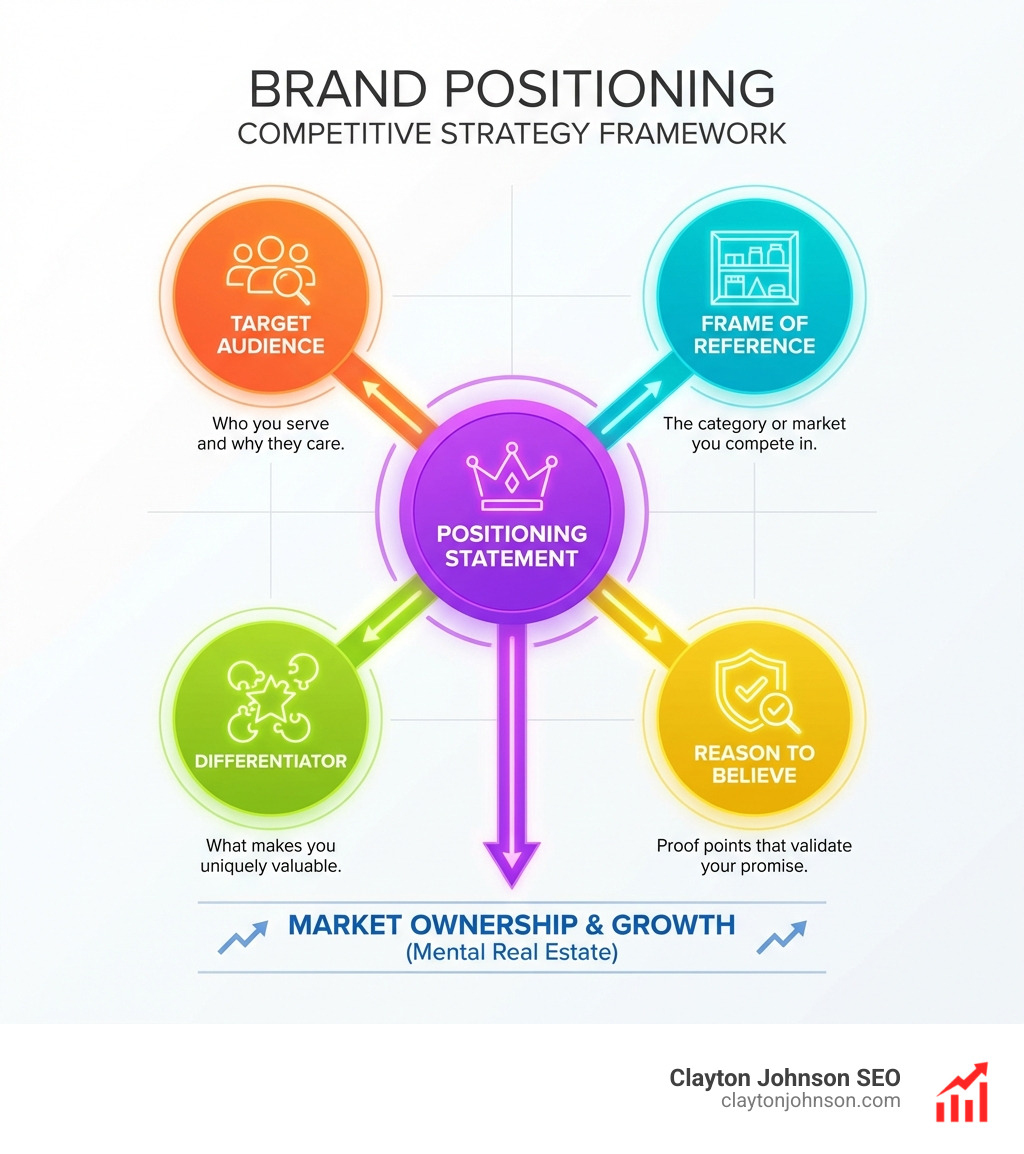
- Core components: Target audience, frame of reference, unique differentiator, and reason to believe
- How to execute it: Research → define your UVP → craft a positioning statement → test → reinforce across every touchpoint
- How to measure it: Track brand awareness, market share, Net Promoter Score, and customer acquisition rates
Most founders think positioning is a tagline. It is not. It is the strategic infrastructure that determines whether your marketing compounds or collapses.
When brands skip this step, the numbers show it. A case study on Kaunas District Public Library found that total visitor numbers dropped 23% over a three-year period — a decline directly linked to the absence of a clear brand positioning strategy. The same pattern plays out across industries: without a defined position, you are invisible in a crowded market.
The human mind has limited space for brands in any category. You either own a clear association — like Volvo owning safety or Apple owning innovation — or you blend into the noise.
I’m Clayton Johnson, an SEO strategist and growth operator who has built competitive positioning frameworks across 50+ business models, aligning brand positioning competitive strategy with SEO architecture and measurable growth systems. Let’s build yours.
The Foundation of Brand Positioning Competitive Strategy

At its core, a brand positioning competitive strategy is about “mental real estate.” Every consumer has a limited number of slots in their brain for any given category. When you think of “electric cars,” you likely think of Tesla. When you think of “overnight delivery,” you think of FedEx. These brands don’t just sell products; they own a specific meaning.
To build this foundation, we must look at the Five Competitive Forces That Shape Strategy. Understanding these forces—like the bargaining power of buyers and the threat of new entrants—allows us to master the 5 forces of competition and find where we can actually win.
We view brands as “meaning-makers.” In a world of commoditized products, positioning is what makes consumption significant. Without it, you are just another row on a spreadsheet. With it, you create a differentiated customer value proposition that drives sustainable growth.
Why Positioning is Essential for Survival
In a crowded marketplace, “market noise” is the default. If you aren’t shouting something unique, you aren’t being heard. Effective positioning simplifies the buying decision for the customer. It builds trust by promising a specific outcome and consistently delivering it.
Scientific research on brand positioning for competitive advantage suggests that well-positioned brands enjoy lower price sensitivity. When customers believe you are the only one who can solve their specific problem in a specific way, they stop haggling over pennies. This builds brand equity—the intangible value that allows a company like Apple to charge a premium while others struggle to maintain margins.
Crafting the North Star: The Brand Positioning Statement

A brand positioning statement is your internal North Star. It is not a slogan for a billboard; it is a document that ensures every marketing decision, SEO campaign, and product update aligns with your core identity. It answers the question: “Who are we, for whom, and why do we matter?”
To how to Craft the Perfect Brand Positioning Statement, you must first think about competitive pressure. You aren’t positioning in a vacuum; you are positioning against a sea of rivals. Your statement must define your unique place relative to those alternatives.
Components of a Winning Statement
A robust positioning statement typically follows a specific template: For [Target Market], [Brand] is the [Category] that [Unique Value Claim] because [Reason to Believe].
- Target Audience: Not “everyone,” but a specific group with a specific need.
- Competitive Set: The category you play in (e.g., “premium skincare” vs. “medical dermatological solutions”).
- Unique Value Claim: The one thing you do better than anyone else.
- Reason to Believe: The proof. Why should they trust you? Is it your patented technology? Your 20 years of experience? Your 5-star reviews?
For a deeper dive into the language of growth, check out this Marketing Terms Cheat Sheet. Understanding these brand personality and proof points is essential for building a strategy that sticks.
6 Steps to Execute a Brand Positioning Competitive Strategy

Execution is where most companies fail. They have a nice slide deck but no traction. We follow a structured 6-step process to ensure your brand positioning competitive strategy actually moves the needle.
- Assess Current Positioning: How do people perceive you right now? Use surveys and social listening.
- Reacquaint with Core Values: What do you actually stand for?
- Conduct Competitive Analysis 101: Identify your rivals’ strengths and weaknesses.
- Identify Unique Markers: Formulate an unfair advantage strategy by finding what you have that they can’t easily copy.
- Draft the Statement: Use the components we discussed above.
- Test and Refine: Run A/B tests on your messaging to see what resonates.
Defining Your Brand Positioning Competitive Strategy
To win, you must go beyond demographics (age, location) and into psychographics (values, fears, desires). Using A Better Way to Map Brand Strategy, we can identify “whitespace”—areas of the market that are currently underserved.
Visualizing your competitive edge with a strategy canvas helps you see where you are over-investing in things customers don’t care about and under-investing in things that would make you stand out.
Leveraging UVPs and Perceptual Maps
A Unique Value Proposition (UVP) is the heart of your differentiation. It’s the “so what?” of your business. To visualize this, we use perceptual maps. These are charts where you plot your brand and your competitors along two axes (e.g., Price vs. Quality, or Innovation vs. Reliability).
As you can watch Professor Avery discuss brand portfolio strategy, seeing where brands sit relative to one another is key to making strategic trade-offs. You cannot be the cheapest and the highest quality. You must choose a side.
Strategic Frameworks: Choosing Your Competitive Angle
Choosing an angle is about deciding how you will fight. Different markets require different weapons.
| Strategy Type | Focus | Example |
|---|---|---|
| Price-Based | Being the most affordable | Walmart |
| Quality-Based | Being the best performing | Rolex |
| Convenience-Based | Being the easiest to use | Amazon |
| Innovation-Based | Being the first with new tech | Tesla |
Whether you are aiming for category leadership or positioning yourself “against the leader” (like Avis famously did with “We try harder”), you need a model. The ultimate guide to market positioning models can help you select the right framework for your specific industry.
Real-World Examples of Market Dominance
- Apple: Positions on innovation and design, making the product a lifestyle statement rather than just hardware.
- Nike: Focuses on athletic performance and inspiration, aligning the brand with the “inner athlete” in everyone.
- Voss: In the commoditized world of water, Voss positions on luxury and purity, using a distinct bottle design to command a higher price.
- Coca-Cola: Uses emotional branding to link their product to happiness and togetherness.
- Ethos Water: Positions on social consciousness, donating a portion of every sale to clean water programs.
Scientific research on brand positioning and business growth shows that these strategies aren’t just for show; they drive real revenue by creating deep emotional bonds with consumers.
Measuring Impact and Avoiding Strategic Pitfalls
If you can’t measure it, you can’t manage it. We track several key performance indicators (KPIs) to see if our brand positioning competitive strategy is actually working:
- Market Share: Are we taking a bigger piece of the pie?
- Brand Awareness: Do people know we exist?
- Net Promoter Score (NPS): Do our customers actually like us?
- Customer Acquisition Cost (CAC): Is it getting cheaper to find new customers because our brand does the heavy lifting?
To truly understand your standing, you must stop guessing and start positioning with competitive intelligence.
Common Mistakes to Avoid
The most common mistake is trying to be everything to everyone. When you stand for everything, you stand for nothing. Other pitfalls include:
- Copying Competitors: If you look like them, customers will choose based on price alone.
- Weak Differentiators: Claiming “quality” or “service” isn’t enough—everyone says that.
- Ignoring Market Shifts: The world changes. If you don’t beat the competition with AI analysis and modern tools, you’ll be left behind.
Evolving Your Brand Positioning Competitive Strategy
Positioning is not a “set it and forget it” task. You must continuously monitor market feedback and trends. Sometimes, a brand refresh is enough; other times, full repositioning is required.
Using AI competitive insights to outsmart your rivals allows us to stay agile. We can see shifts in consumer sentiment in real-time and adapt our messaging before the competition even realizes what happened.
Frequently Asked Questions about Brand Positioning
What is the difference between a value proposition and a positioning statement?
A value proposition is a broad statement of the functional and emotional benefits your product provides. A positioning statement is more specific—it defines those benefits in relation to your competitors and for a specific target audience.
How often should a company audit its competitive positioning?
We recommend a deep-dive audit at least once a year, or whenever a major new competitor enters the market. However, continuous monitoring of KPIs should happen monthly.
Can a small business compete with global brands using positioning?
Absolutely. In fact, small businesses must use positioning to survive. While a global brand has the budget to be everywhere, a small business can win by being the “only” solution for a very specific niche.
Conclusion
At the end of the day, marketing isn’t about who has the loudest voice; it’s about who has the clearest message. We don’t believe in random acts of marketing. We believe in structured growth architecture.
Through Demandflow.ai and our work at Clayton Johnson SEO, we help founders move from tactical chaos to compounding growth. By combining actionable strategic frameworks with AI-enhanced execution, we ensure your brand positioning competitive strategy isn’t just a document—it’s a weapon.
Ready to stop guessing? It’s time to start building your SEO content marketing infrastructure and claim the mental real estate your brand deserves.