How to Win the Search Engine Game with Enterprise AI SEO

Why Enterprise Search Visibility Demands a Smarter Approach
AI SEO tools for enterprises are no longer optional — they’re the engine behind scalable search visibility, high-quality lead generation, and sustainable competitive advantage.
Here are the top AI SEO tools built for enterprise-scale operations:
| Tool | Best For | Starting Price |
|---|---|---|
| Conductor | AEO/GEO + AI search visibility | Custom (enterprise) |
| Semrush | All-in-one SEO + competitor data | $199/month |
| Clearscope | Content intelligence + NLP scoring | $170/month |
| Surfer SEO | AI content optimization | $99/month |
| MarketMuse | Content strategy at scale | $149/month |
| Ahrefs | Backlink analysis + research | Custom |
| Screaming Frog + AI | Technical SEO audits | £199/year |
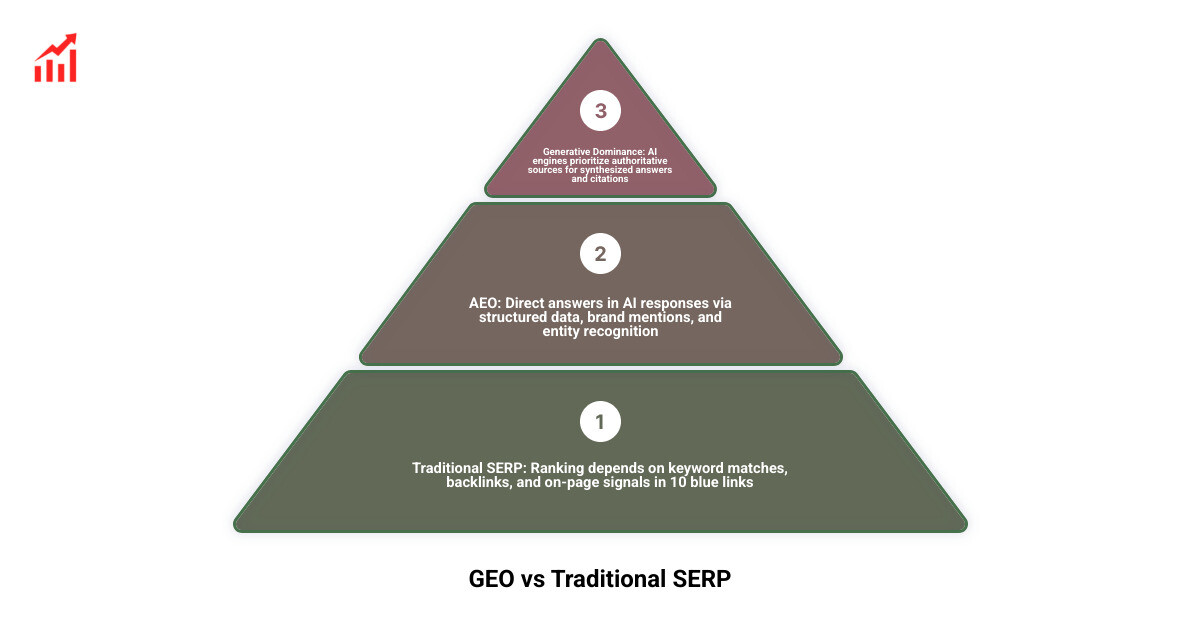
The search landscape has fundamentally shifted. Your customers aren’t just typing into Google — they’re asking ChatGPT, Perplexity, and Gemini for answers. If your brand isn’t showing up in those AI-generated responses, you’re invisible to a growing segment of buyers.
Traditional SEO still matters. But enterprises now need to compete across two landscapes simultaneously: classic search engine results and AI-powered answer engines.
The gap between companies that get this right and those that don’t is widening fast. One ecommerce brand, for example, achieved a 385% increase in AI overview visibility after shifting its strategy to optimize for generative search engines — while outpacing its nearest competitor by 146%.
That kind of result doesn’t happen by accident. It takes the right tools, the right stack, and a systems-level strategy.
I’m Clayton Johnson — an SEO strategist with nearly two decades of experience building scalable search frameworks for ambitious companies, and the creator of DemandFlow.ai, a demand generation platform built around integrating AI SEO tools for enterprises into unified growth systems. In this guide, I’ll walk you through exactly how to build a winning enterprise AI SEO stack that drives real, measurable results.
The Best ai seo tools for enterprises to Scale Search Visibility
When we talk about ai seo tools for enterprises, we aren’t just looking for a better way to find keywords. We are looking for systems that can handle tens of thousands of pages, coordinate between global marketing teams, and integrate seamlessly with existing martech stacks.
Enterprise tools differ from freelancer-grade software in three key ways: scalability, security, and sophistication. While a small business might be happy with a simple AI writer, a large organization needs a robust enterprise AI strategy that accounts for brand governance and multi-channel attribution.
Choosing the Right Platform for Your Scale
The choice between all-in-one platforms and specialized tools is a common debate in boardroom meetings. All-in-one platforms like Semrush and Conductor offer a “single source of truth,” which is vital for multi-team collaboration. On the other hand, specialized tools like Clearscope or Rankscale.ai provide deeper, more granular insights into specific areas like content intelligence or AEO/GEO services.
For most large organizations, the goal is to build a stack that balances these two. You need the “command center” for reporting and technical health, layered with specialized AI engines for content creation and generative engine optimization. This holistic approach is the foundation of successful enterprise AI.
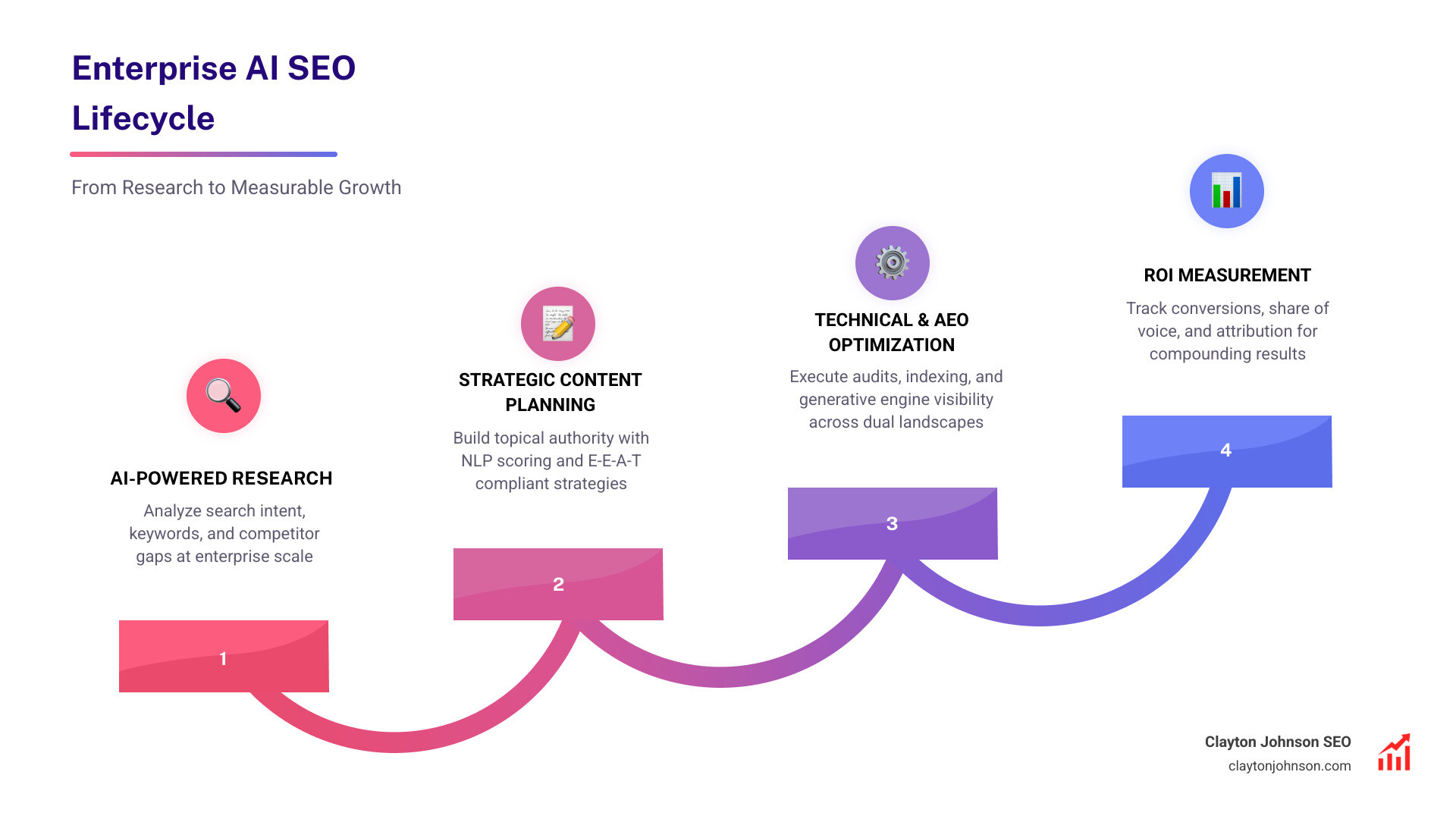
Strategic Content Planning with ai seo tools for enterprises
In an enterprise environment, content isn’t just about “writing more.” It’s about building topical authority across thousands of URLs. Tools like Clearscope and MarketMuse use Natural Language Processing (NLP) to analyze the top-performing content in any niche, providing a data-driven “recipe” for what your content needs to cover to rank.
This is where building a robust AI content strategy becomes critical. Instead of guessing which topics matter, these tools identify “content gaps” where your competitors are winning and you aren’t.
- Koala AI: For teams needing to move fast, Koala AI allows for bulk article generation and deep research. It can even convert YouTube videos into structured blog posts in under 60 seconds, which is a massive win for repurposing enterprise video assets.
- Surfer SEO: We often recommend Surfer SEO for on-page optimization. Its real-time Content Score ensures that every piece of content meets the structural requirements of modern search engines before it ever hits the CMS.
By focusing on E-E-A-T (Experience, Expertise, Authoritativeness, and Trustworthiness), these tools ensure that AI-assisted content doesn’t just look like “fluff” but actually provides value to the end user.
Technical Excellence and AI SEO Tools for Enterprises
Technical SEO at enterprise scale is a different beast. When you have a million URLs, a single crawl issue can turn into a very expensive problem fast. This is where AI SEO tools for enterprises like Semrush and Ahrefs earn their keep, using automated audits to surface problems and help you prioritize fixes by likely traffic and business impact.
We are also seeing a rise in specialized technical AI tools:
- Indexly: Offers automated indexing for Google and Bing, ensuring your new content is discovered instantly.
- Screaming Frog + AI: By integrating AI APIs with Screaming Frog, technical teams can now group issues and generate schema markup for thousands of pages simultaneously.
- Predictive Modeling: Advanced tools now use AI to predict how much traffic a new page will likely get before you even publish it, allowing for better resource allocation.
Conducting AI-driven SEO audits regularly allows enterprise teams to maintain a “clean” site architecture, which is essential for both traditional bots and the new wave of AI crawlers. These diagnostic environments are the “safety nets” of a modern SEO strategy.
Optimizing for AEO and Generative Search
The most significant shift in the search game is the move toward Answer Engine Optimization (AEO) and Generative Engine Optimization (GEO). Your audience is increasingly looking for direct answers within platforms like ChatGPT and Perplexity.
Conductor has positioned itself as a leader here, offering purpose-built AI for AEO. Their platform tracks your brand’s “share of voice” within AI-generated responses. If a user asks ChatGPT for the “best enterprise cloud provider,” Conductor helps you understand if your brand is being cited and why.
To win in this new landscape, you need AI-driven SEO systems that focus on brand authority. AI engines prioritize trust signals. This means your off-site reputation, mentions in reputable journals, and structured data are more important than ever. Specialized tools like Rankscale.ai provide granular tracking for these generative engines, showing you exactly how your citations are trending over time.
Data Security and Compliance in Enterprise AI
For an enterprise, “free” AI tools are often the most expensive ones because of the data risks they carry. When adopting tools for enterprises, security must be a top priority.
Large organizations should look for tools that meet the following standards:
- ISO 42001: The global standard for responsible AI management.
- SOC 2 Type 2: Ensuring your proprietary data isn’t used to train public AI models.
- Multi-team Permissions: Essential for mastering enterprise AI governance and ensuring that only the right people have access to sensitive SEO data.
Before rolling out any tool, we recommend creating an AI implementation roadmap that includes a thorough vetting by your IT and legal departments. This ensures that while you are scaling your search visibility, you aren’t creating a compliance nightmare.
Measuring ROI and Business Impact
At the end of the day, SEO isn’t about rankings; it’s about revenue. In an enterprise environment, you need to connect your SEO efforts directly to the bottom line. This requires sophisticated attribution modeling that accounts for the long buyer journeys typical in B2B and high-value B2C sectors.
A modern SEO strategy for enterprises uses AI to analyze massive datasets from Google Analytics, CRMs like Salesforce, and SEO tools to find the “golden path” to conversion.
Key metrics to track include:
- Share of Voice (SoV): How often your brand appears in both SERPs and AI answers compared to competitors.
- Attribution Modeling: Understanding how an initial touchpoint in a ChatGPT response eventually leads to a demo request.
- Content Efficiency: Measuring the ROI of AI-generated vs. human-written content to optimize production costs.
This data-driven approach is why enterprise AI is the secret sauce for modern marketing success. It moves SEO from a “guessed” expense to a predictable growth engine.
Conclusion: Implementing a Systems-Driven AI SEO Strategy
Winning the search game at the enterprise level requires more than just buying a few subscriptions. It requires a fundamental shift in how we think about search. We are moving away from chasing individual keywords and toward building durable, automated systems that capture intent wherever it happens.
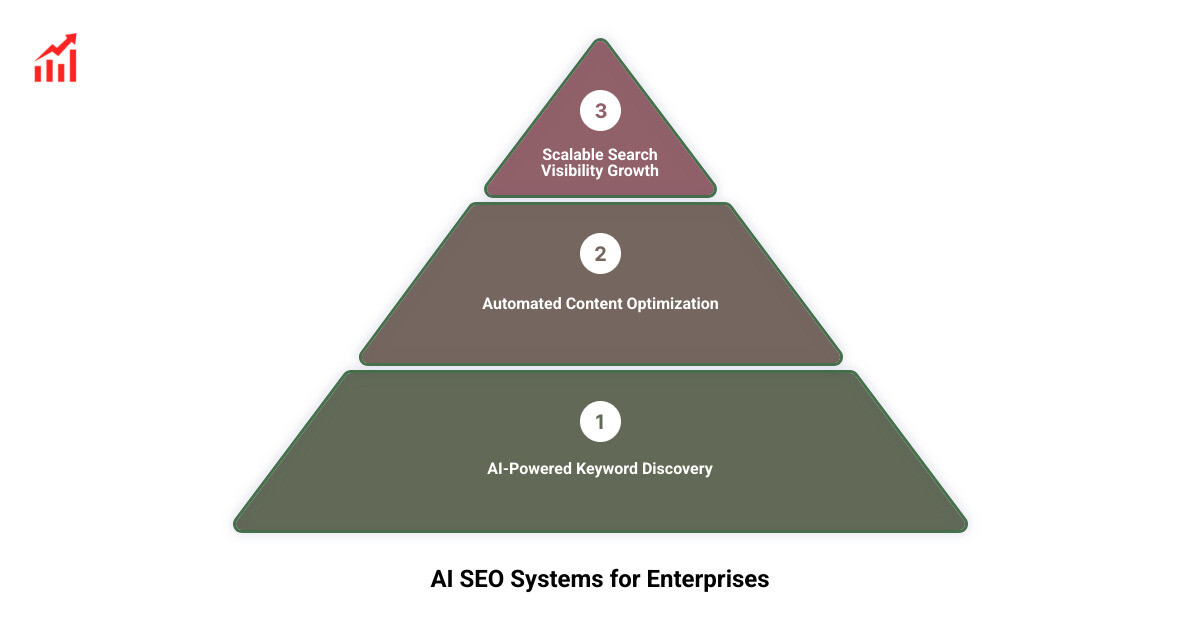
Our approach at Clayton Johnson SEO is built on the philosophy of Clarity -> Structure -> Leverage -> Compounding Growth. By using the right ai seo tools for enterprises, you create the leverage needed to turn fragmented marketing efforts into a coherent growth engine.
Whether you are looking to audit your existing technical stack, build a content powerhouse, or dominate the new world of AEO and GEO, the key is systems-level thinking. Don’t just implement tools; build the architecture that allows those tools to drive measurable business impact.
Ready to turn your SEO strategy into a scalable growth system? Contact us for a strategy consultation and let’s build your enterprise AI roadmap together.