Ignite Your Business with These Joint Venture Growth Engines


Why Brand Joint Venture Strategies Are a Growth Engine You Can’t Ignore
Brand joint venture strategies are one of the most powerful ways to grow faster, enter new markets, and build competitive advantages — without going through a full merger or acquisition.
Here is a quick overview of how to execute them:
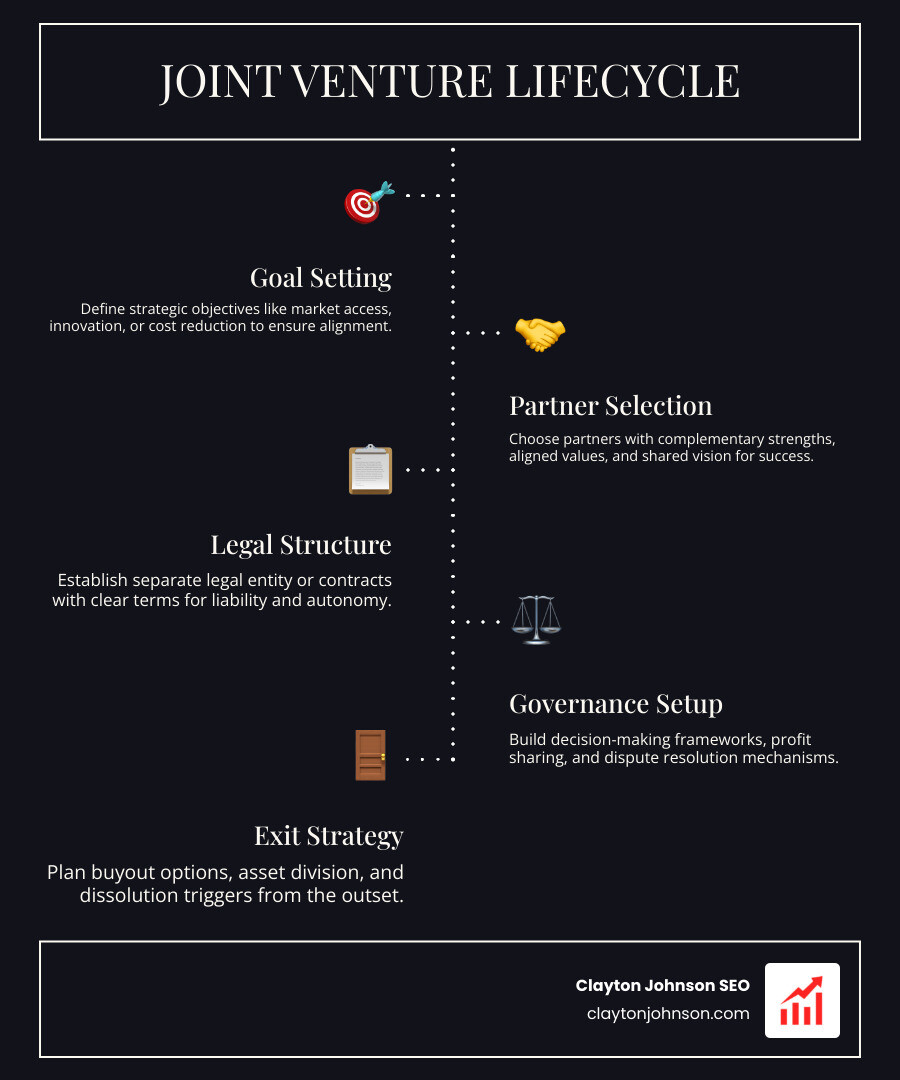
- Define your strategic goal — market access, capability sharing, cost reduction, or innovation
- Choose the right JV model — Test & Nudge, Learn & Absorb, or Innovate & Attack
- Align brand values — mismatched values lead to consumer confusion and reputational damage
- Structure the legal entity — form a separate LLC or contractual agreement with clear governance
- Build a governance framework — define decision-making authority, profit sharing, and dispute resolution
- Plan your exit — agree on buyout terms, asset handling, and dissolution triggers upfront
The numbers tell the story clearly. Companies operating inside collaborative ecosystems are 2.3 times more likely to be highly innovative than peers working alone. Yet roughly 80% of joint ventures outlive their usefulness simply because partners never clearly defined their goals or governance at the start.
That gap between potential and outcome is exactly where most brands lose.
A well-designed joint venture does not just pool resources. It creates value that neither partner could build alone — faster market entry, shared risk, and access to capabilities that would take years to develop internally.
But get the strategy wrong — misaligned brand values, vague agreements, poor governance — and the venture becomes a liability instead of a launchpad.
I’m Clayton Johnson, an SEO strategist and demand generation expert who has helped hundreds of businesses build scalable growth systems, including advising on the digital visibility and positioning components of brand joint venture strategies. In the sections ahead, I’ll walk you through exactly how to structure, execute, and future-proof a joint venture that actually delivers.
Mastering brand joint venture strategies for Market Dominance
When we talk about brand joint venture strategies, we aren’t just talking about a simple “shout-out” on social media. A true joint venture (JV) is a strategic marriage where two or more independent entities pool resources to achieve a specific objective while remaining separate businesses. Think of it as a “commercial marriage” where both parties bring their best assets to the table to create a third, specialized entity or project.

The primary motivations for entering a JV usually fall into four buckets:
- Market Access: Using a partner’s local knowledge or distribution network to break into a new geography.
- Resource Pooling: Combining capital, equipment, or intellectual property to lower individual costs.
- Competitive Advantage: Merging specialized skills (like a tech firm and a car manufacturer) to create a product neither could build alone.
- Risk Distribution: Sharing the financial and reputational “downside” of an ambitious new project.
Statistics show that companies in these ecosystems are 1.7 times more likely to be faster to market and 1.2 times more likely to be flexible than their solo-flying peers. However, it is vital to understand how JVs differ from other models like M&A or licensing.
Comparing Collaboration Models
| Feature | Joint Venture | Strategic Alliance | Mergers & Acquisitions | Licensing |
|---|---|---|---|---|
| Legal Entity | Usually a new, separate entity | Contractual only | Full integration | Contractual permission |
| Autonomy | High (for parents) | High | Low (target is absorbed) | Very High |
| Risk Sharing | Shared 50/50 or by equity | Limited | Acquirer takes all risk | Licensee takes most risk |
| Complexity | High (Governance needed) | Moderate | Very High | Low |
While M&A involves one company swallowing another, a JV allows you to keep your identity. It’s often more resilient during economic downturns—in fact, 60% of executives view JVs as more resilient than M&A during tough times.
Core Frameworks for brand joint venture strategies
Choosing the right approach depends on your risk tolerance and what you’re trying to learn. We often look at three primary strategic archetypes:
- Test & Nudge: This is for companies with limited experience in a specific niche. You start with small-scale pilot projects to test a concept. If it works, you scale; if it doesn’t, you pivot without having bet the entire farm.
- Learn & Absorb: Here, the JV acts as an external “innovation lab.” One partner might have the technology while the other has the market reach. Over time, the parents “absorb” the new knowledge into their core operations.
- Innovate & Attack: This is the high-stakes version. Partners combine heavy-hitting capabilities to disrupt an entire industry or create a new ecosystem (like electric vehicle charging networks).
When building these, you can often steal these business models legally by looking at successful frameworks in other industries and adapting them to your partnership.
Designing Governance and Decision-Making Systems
The “handshake deal” is the death of many partnerships. Research from Water Street Partners shows that 80% of JVs outlive their utility because governance wasn’t defined. Even worse, 60% face operational complications due to misaligned objectives.
To prevent stalemates, your governance must address:
- Voting Rights: Is it a 50/50 split, or does one “prime” partner have the final say on specific operational issues?
- The Board: Who sits on the management board? For cross-border deals, including local representatives is non-negotiable.
- Dispute Resolution: What happens when you disagree? Successful ventures often use a hybrid model—majority rules for daily tasks, but unanimous consent for “big” moves like debt or market expansion.
For more on how to maximize these structures, see the latest on Capturing and Optimizing Joint Venture Value | BCG.
Operationalizing brand joint venture strategies through Legal Entities
One of the biggest advantages of a JV is the “legal fortress” it builds. By creating a separate legal entity (like an LLC), you create a cushion of limited liability. If the JV fails, the parent companies are generally protected from direct exposure.
This autonomy allows the JV to act like a startup—agile, fast, and focused—without being bogged down by the parent companies’ bureaucracy. When setting this up, you must choose the right key partners in BMC (Business Model Canvas) to ensure that the resources being contributed (IP, staff, capital) are quantified accurately.

Executing and Future-Proofing Your Collaborative Engine
Once the ink is dry on the legal papers, the real work begins. Execution is where most brand joint venture strategies succeed or fail. It isn’t just about the numbers; it’s about the “commercial marriage” surviving the honeymoon phase.

The most successful partnerships—those that are 35% more likely to achieve their goals—are the ones that agreed on a risk management framework upfront. This includes managing cultural misalignment and unequal contributions. If one partner feels they are doing 80% of the work for 50% of the profit, the venture won’t last.
Essential Exit Strategy Components
Don’t wait for a crisis to talk about the end. A robust agreement includes:
- Buyout Provisions: Clear valuation formulas for when one partner wants to buy the other out.
- Asset Allocation: Who keeps the IP, the customer list, and the equipment?
- Termination Triggers: Specific milestones or “failure to perform” clauses that allow for a clean break.
- Confidentiality: Ensuring that once the “marriage” ends, your secrets don’t walk out the door.
Aligning Brand Values and Creative Marketing
In co-branding, “brand fit” is everything. If a luxury brand partners with a budget-friendly brand, they risk “cognitive dissonance.” Consumers get confused, and both brands lose equity.
Success requires Value Congruence. You need to ask: What problems do we solve that nobody else can? and How do we talk about this value in one voice?
Marketing integration should follow a “One Voice” policy. This prevents your sales teams from giving conflicting guidance—like one partner pitching “innovation” while the other pitches “cost savings.” For a deep dive into this, check out our positioning strategy guide.
Navigating Cross-Border Complexities and Risk
When JVs cross borders, the complexity doubles. You aren’t just dealing with different laws; you’re dealing with different “clocks.” Some cultures value long-term relationship building, while others want immediate ROI.
Cultural Intelligence (CQ) is a critical skill here. You must navigate:
- Legal Compliance: Understanding local labor laws and tax implications.
- Market Regulations: Navigating antitrust laws and government requirements for local partnerships.
- Reputational Risk: A cultural faux pas in one country can cause a global backlash.
Experience matters here. “Serial dealmakers”—companies that do JVs regularly—outperform first-timers by a median of 0.4 percentage points in total shareholder return. They’ve learned the hard way that you can’t just “copy-paste” a domestic strategy into a foreign market.
Sustaining Innovation and Long-Term Scalability
The world moves fast. A JV that was a great idea three years ago might be obsolete today. To future-proof your alliance, you must foster a culture of continuous knowledge sharing.
This means:
- Periodic Strategic Refreshes: Re-evaluating the JV’s goals every 12-18 months.
- Talent Integration: Moving top talent between the parents and the JV to keep ideas fresh.
- Agile Leadership: Empowering the JV management to make decisions without waiting for two corporate headquarters to sign off.
At Clayton Johnson SEO, we help brands navigate these complexities by building the digital systems that support growth. Whether it’s through SEO services that increase the visibility of a new joint entity or strategic frameworks that align marketing teams, we focus on clarity and leverage.
Final Thoughts on Joint Venture Success
Brand joint venture strategies are not a “set it and forget it” tactic. They are living, breathing growth engines. By focusing on upfront alignment, nimble governance, and a clear exit strategy, you can unlock innovation that is impossible to achieve alone.
Remember:
- Trust is the currency of a JV.
- Structure is the skeleton that supports it.
- Adaptability is the fuel that keeps it running.
If you’re ready to turn your collaborative ideas into a scalable growth engine, start with the framework. Build the system, align the brands, and watch the compounding growth take over.