The Ultimate Guide to Keyword Strategy


Unlocking Growth: Your Ultimate Guide to Keyword Strategy 🚀
A Keyword Strategy is crucial for your business’s online success. It’s more than just finding popular words. It’s a precise plan for how you’ll connect with your customers through search engines.
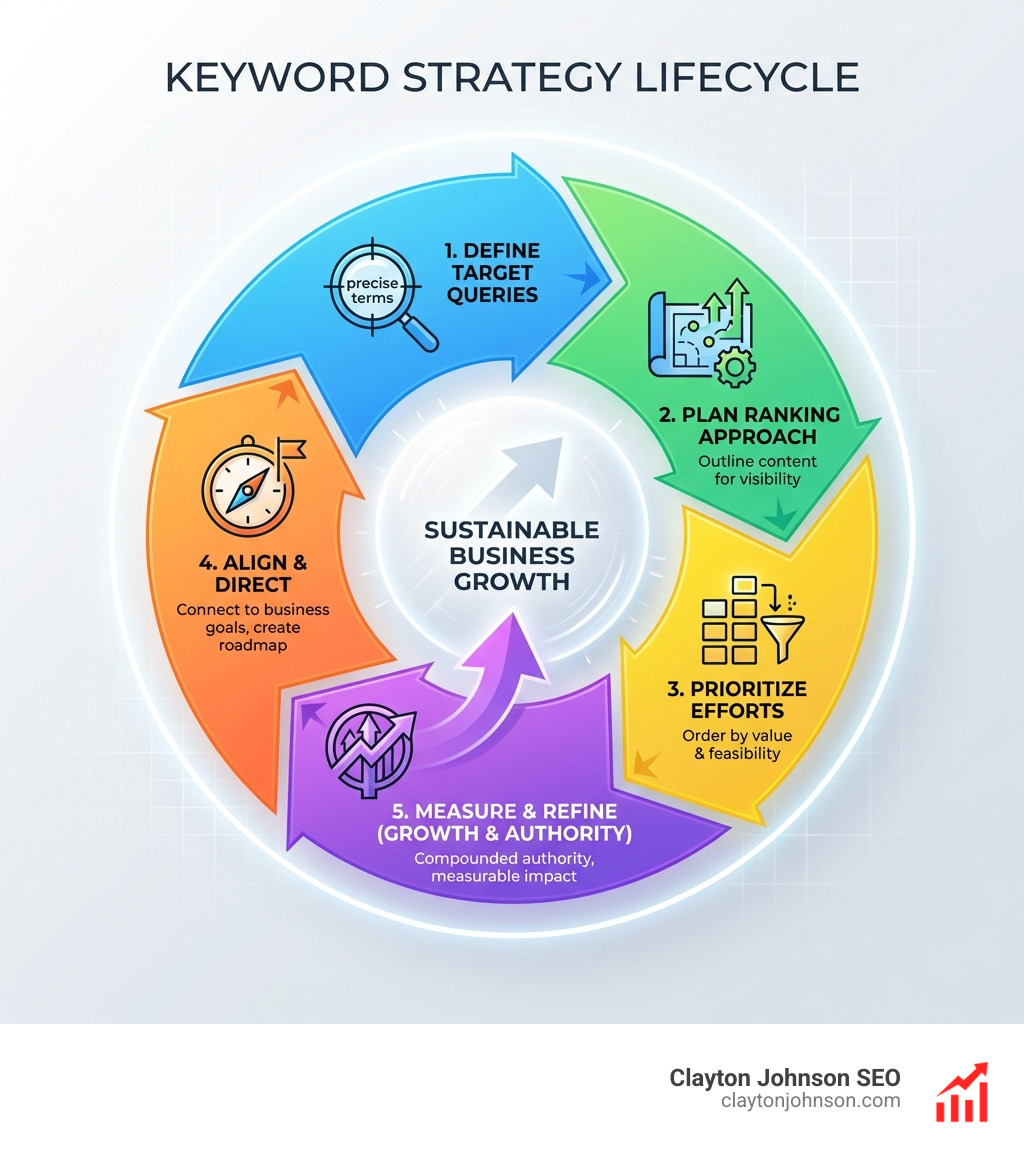
Here’s a quick overview of what a Keyword Strategy involves:
- Defining Target Queries: Deciding exactly which search terms your business wants to rank for.
- Planning Ranking Approach: Outlining how your content will achieve visibility for those terms.
- Prioritizing Efforts: Determining the order in which keywords will be tackled based on their value and feasibility.
- Aligning with Goals: Ensuring all search efforts directly support your wider business objectives.
- Giving Direction: Transforming raw keyword data into an actionable roadmap for growth.
The Keyword Strategy is your business’s blueprint for winning in search. It’s not just a list of words; it’s a strategic plan that defines exactly which search terms you want to rank for, how you’ll achieve those rankings, and in what order of importance. While keyword research gathers data, a keyword strategy gives that data meaning and direction.
Why is this so crucial? Because organic traffic drives significant business growth, often outperforming referral traffic by 2–4x. A strong strategy ensures your content reaches the right customers, builds topical authority, and aligns directly with your overall business objectives, turning search visibility into measurable outcomes. Without it, even the best keyword data won’t move the needle.
As Clayton Johnson, an SEO strategist and growth operator, I’ve spent years engineering scalable traffic systems and building structured strategic frameworks. My work transforms fragmented marketing efforts into cohesive growth engines, always rooted in a robust Keyword Strategy that compounds authority and drives measurable business impact.
Easy Keyword Strategy glossary:
Why a Structured Keyword Strategy is Essential for Growth
Most businesses treat SEO like a game of “whack-a-mole.” They find a keyword, write a blog post, and hope for the best. This ad-hoc approach is why many marketing budgets disappear into the void without a trace of ROI. At Demandflow, we believe that most companies don’t lack tactics—they lack structured growth architecture.
A structured Keyword Strategy acts as the foundation of this architecture. It ensures that every piece of content you produce serves a specific purpose, whether it’s building brand awareness or driving immediate sales. Without a plan, you risk targeting “vanity metrics”—keywords with high volume but zero business value. For example, a luxury watch brand targeting “cheap watches” might get traffic, but they won’t get customers.

Ad-Hoc Research vs. Structured Strategy
| Feature | Ad-Hoc Keyword Research | Structured Keyword Strategy |
|---|---|---|
| Focus | Individual keywords | Topic clusters and authority |
| Goal | High search volume | Business value and conversions |
| Execution | Reactive (done on the fly) | Proactive (mapped to business goals) |
| Growth | Linear and inconsistent | Compounding and scalable |
| Alignment | Isolated from marketing | Integrated with brand messaging |
When we align your search efforts with your wider marketing goals, we create a unified front. This is especially vital for businesses in competitive markets like Minneapolis. By signing in to Google Search Console (GSC), you can see exactly how your current pages are performing and where the gaps lie.
A strategic approach allows for better resource allocation. Instead of wasting time on keywords that are impossible to rank for, we focus on “must-wins” that move the needle. This is the essence of SEO content marketing: creating an authority-building ecosystem where your content doesn’t just sit on a page—it builds trust and generates compounding inbound demand.
The 4-Step Framework to Identify and Evaluate Keywords
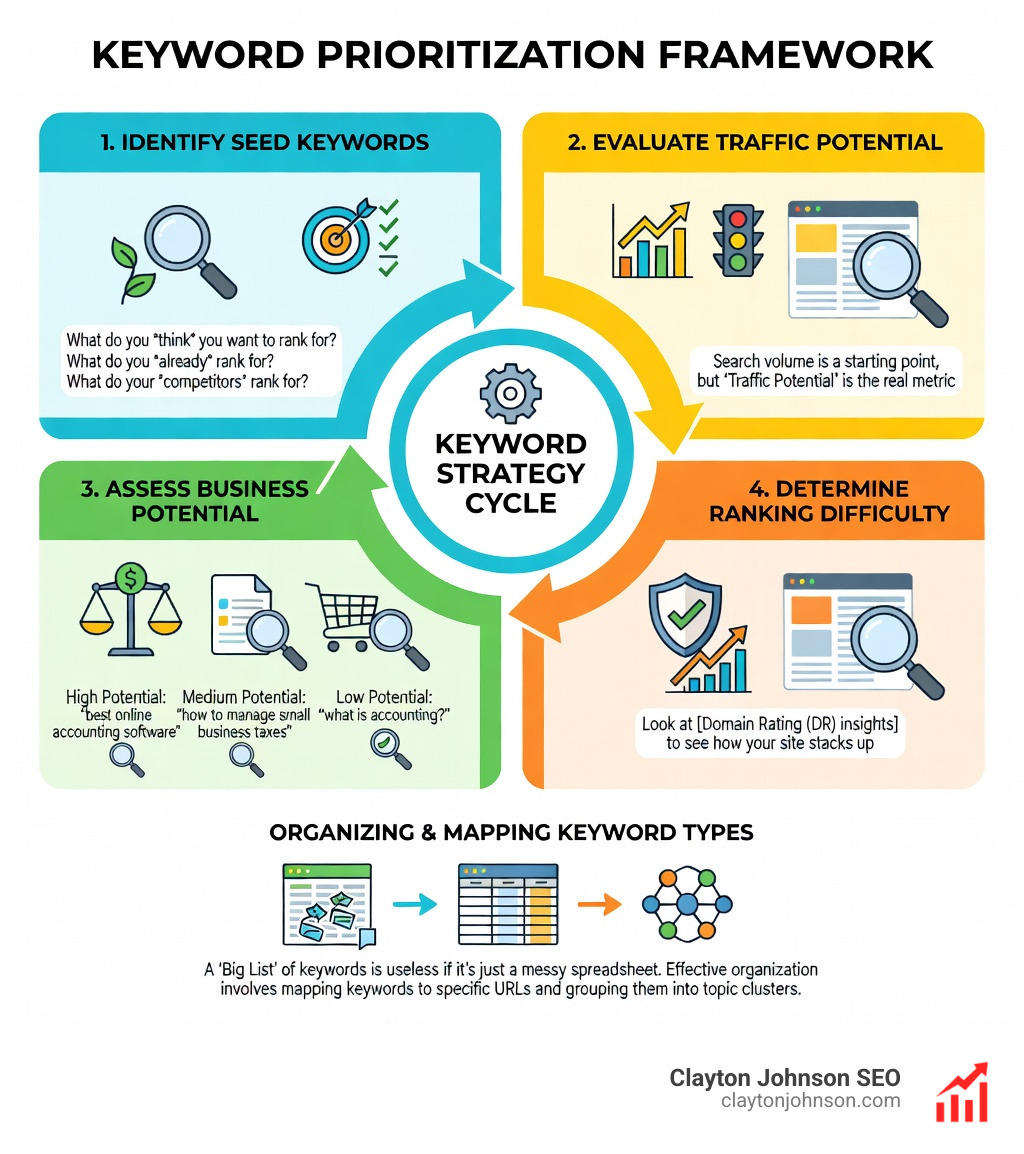
To build a growth engine, you need a repeatable process. We break down the development of a Keyword Strategy into four distinct phases. This framework ensures you aren’t just guessing what people want; you’re using data to drive decisions.

1. Identify Seed Keywords
Everything grows from a seed. To find yours, we ask three simple questions:
- What do you think you want to rank for?
- What do you already rank for?
- What do your competitors rank for?
We then validate these seeds using tools like the Use Keyword Planner page. For instance, if you sell wholesale wine glasses, your seeds might include “bulk wine glasses” or “cheap wine glasses.”
2. Evaluate Traffic Potential
Search volume is a starting point, but “Traffic Potential” is the real metric. Traffic potential looks at how much total traffic the top-ranking page for a keyword gets from all the related terms it ranks for. A keyword might have 500 searches, but the top page might get 5,000 visits because it ranks for hundreds of variations.
3. Assess Business Potential
Not all traffic is created equal. We score keywords based on how close the searcher is to making a purchase:
- High Potential: The searcher is looking for exactly what you sell (e.g., “best online accounting software”).
- Medium Potential: The searcher has a problem your product solves (e.g., “how to manage small business taxes”).
- Low Potential: The searcher is looking for general information (e.g., “what is accounting?”).
4. Determine Ranking Difficulty
Can you actually win? We look at Domain Rating (DR) insights to see how your site stacks up against the competition. If the first page of Google is filled with giants like Amazon or Wikipedia, and your DR is low, we might pivot to long-tail keywords where you have a better chance of dominance.
Organizing, Mapping, and Categorizing Keyword Types
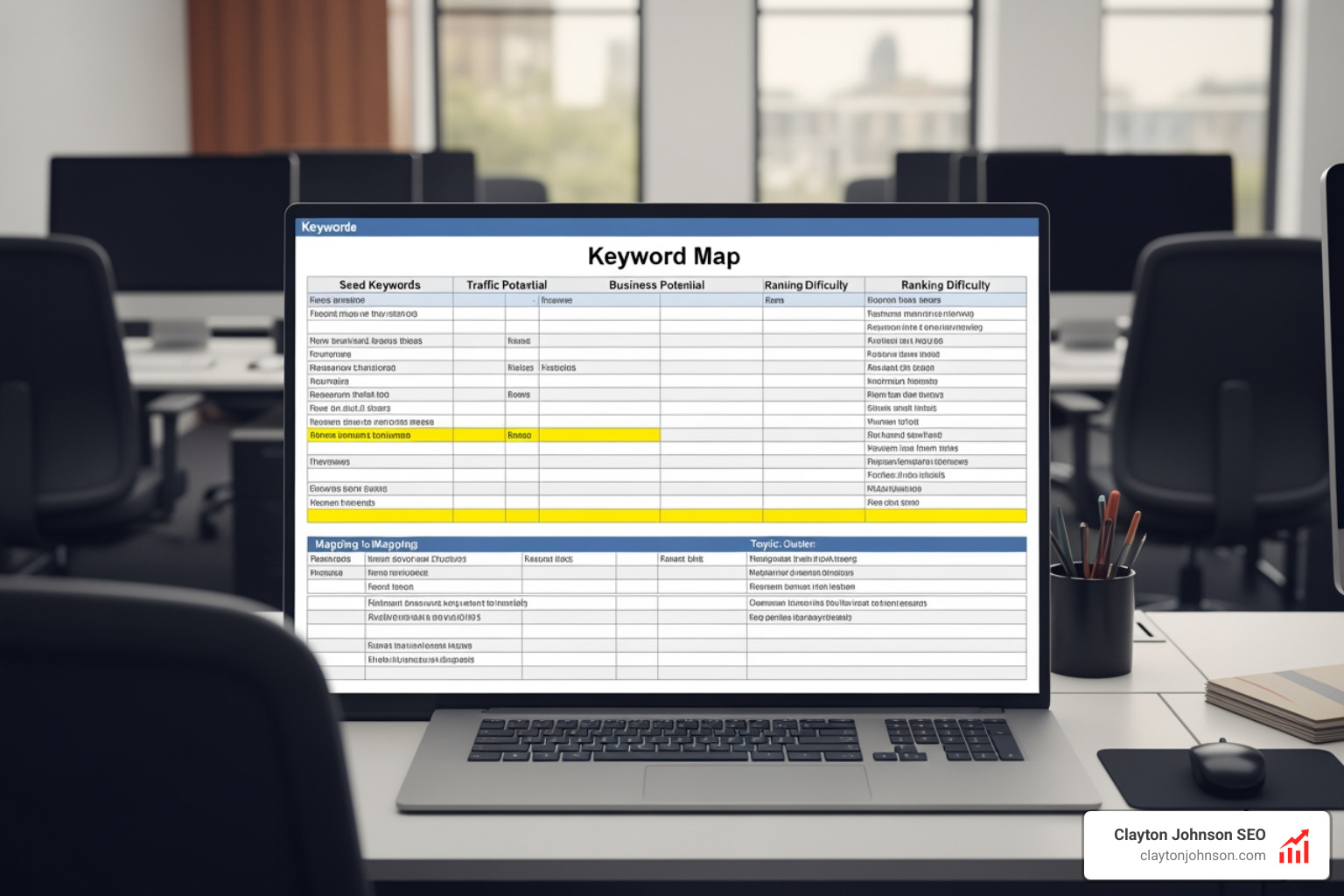
Once you have your list, you need to organize it. A “Big List” of keywords is useless if it’s just a messy spreadsheet. Effective organization involves mapping keywords to specific URLs and grouping them into topic clusters.
Topic Clusters and Pillar Pages
We use “Pillar Pages” to cover broad topics and “Sub-pages” to dive into specifics. This structure tells search engines that you are an expert in your field, building “Topical Authority.” For example, a pillar page about “Digital Marketing” would link to sub-pages about “SEO,” “PPC,” and “Email Marketing.”
Keyword Categories for Your Strategy
- Branded Keywords: Searches for your specific company name (e.g., “Clayton Johnson SEO”). These are essential for reputation management.
- Non-Branded Keywords: Searches for products or services without a brand name (e.g., “Minneapolis SEO agency”). These drive new customer acquisition.
- Competitor Keywords: Targeting terms your competitors rank for to identify gaps in your own content.
- Long-Tail Keywords: Highly specific phrases with lower volume but higher conversion rates (e.g., “organic beard oil for sensitive skin”).
- Must-Win Keywords: The 5-10 terms that are absolutely critical to your business’s bottom line.
To get started with your own mapping, you can use our free keyword strategy template. This helps you visualize your content architecture and ensures you aren’t creating multiple pages that compete for the same keyword (keyword cannibalization).
Frequently Asked Questions
How does keyword research differ from a Keyword Strategy?
Keyword research is the act of gathering data—it’s the “what.” A Keyword Strategy is the “how” and “why.” Research gives you a list of 500 words; strategy tells you to prioritize #12 because it has the highest business value, and to group #45-50 into a single pillar page to build authority. Strategy gives the data meaningful direction and turns it into an actionable framework.
How do you measure the success of a Keyword Strategy?
Success isn’t just about ranking #1. We look at:
- Organic Visibility: Is your overall “Share of Voice” in the market increasing?
- Conversion Rates: Is the traffic we’re bringing in actually buying something?
- Ranking Progress: Are we moving up for our “must-win” keywords?
- ROI Modeling: Does the cost of creating the content and building authority result in a profitable return?
What are the best tools for keyword planning?
While there are many tools, our favorites for a robust Keyword Strategy include:
- Google Ads Keyword Planner: Great for finding volume and bid estimates.
- Semrush: Excellent for keyword gap analysis and tracking rankings.
- Ahrefs: The gold standard for analyzing competitor backlinks and traffic potential.
- Moz Pro: Helpful for assessing keyword difficulty and page authority.
- Google Search Console: The best tool for seeing what you already rank for and finding “quick win” opportunities.
Turn Keywords into Compounding Growth 🚀
Today’s search landscape doesn’t guarantee any visibility. Between Google’s AI Overviews and the rise of generative search engines like ChatGPT and Perplexity, your business needs more than a few blog posts. You need a structured growth architecture.
A Keyword Strategy is the blueprint for that architecture. It provides the clarity and structure needed to create leverage, leading to the compounding growth that every founder and marketing leader dreams of. Whether you are looking for local dominance in Minneapolis or national expansion, the path to success begins with a plan.
At Clayton Johnson SEO, we don’t just “do SEO.” We build systems. From our Scalable Authority Retainers to our taxonomy-driven SEO systems, we provide the infrastructure your brand needs to remain competitive in an AI-driven world.
Ready to stop guessing and start growing? Check out SEO content marketing and lets build a keyword strategy that compounds traffic, leads, and revenue.