Keyword Strategy: Examples and Templates for SEO Success


Why Most Keyword Lists Fail (And What a Real Strategy Looks Like)
Keyword strategy examples are one of the most searched topics in SEO — and for good reason. Most business owners have a list of keywords somewhere. Very few have a strategy.
Here’s the core difference at a glance:
| Keyword List | Keyword Strategy | |
|---|---|---|
| What it is | A collection of search terms | A plan for how and when to target them |
| Tied to goals? | Rarely | Always |
| Includes intent? | No | Yes |
| Guides content? | No | Yes |
| Measurable? | No | Yes |
The most common keyword strategy examples by business type:
- E-commerce – Target branded exact-match terms + long-tail product queries
- Service businesses – Focus on local, high-intent transactional keywords
- Affiliate sites – Prioritize commercial investigation and comparison keywords
- Content/blog sites – Build topical authority with informational keyword clusters
- B2B SaaS – Target bottom-funnel pain-point queries + competitor comparison terms
Here’s the hard truth: organic search drives more trackable web traffic than paid, social, and display combined. Yet most business owners still treat keywords as an afterthought — stuffing a few terms into a page and hoping for the best.
A real keyword strategy answers three questions: which terms to target, how to rank for them, and in what order to prioritize. Without that framework, even great content stays invisible.
This guide gives you the frameworks, real-world examples, and templates to build a keyword strategy that actually drives leads.
What is a Keyword Strategy and Why is it Essential?
A keyword strategy is the master plan that defines which search queries you want to rank for, how you’ll achieve those rankings, and the priority in which you’ll tackle them. While keyword research is the act of gathering data, the strategy is the decision-making process that turns that data into a growth engine.
Why does this matter? Because organic search remains the dominant source of trackable web traffic. It outperforms paid search, organic social, and display traffic. If you don’t have a plan to capture this traffic, you are essentially leaving your most valuable leads on the table.
For both SEO and PPC, a solid strategy ensures you aren’t just “spraying and praying.” In SEO, it helps you build topical authority so search engines trust you as a source of information. In PPC, it prevents wasted ad spend by ensuring your bids align with keywords that actually convert.
By identifying your unit’s strengths and aligning them with what your target audience is actually typing into that search bar, you move from “guessing” to “operating.” We’ve seen businesses increase leads by as much as 78% simply by revising their approach to the-ultimate-guide-to-keyword-strategy. It’s about ROI metrics—not just vanity numbers like “impressions.”
The Three Phases of Building a Keyword Strategy
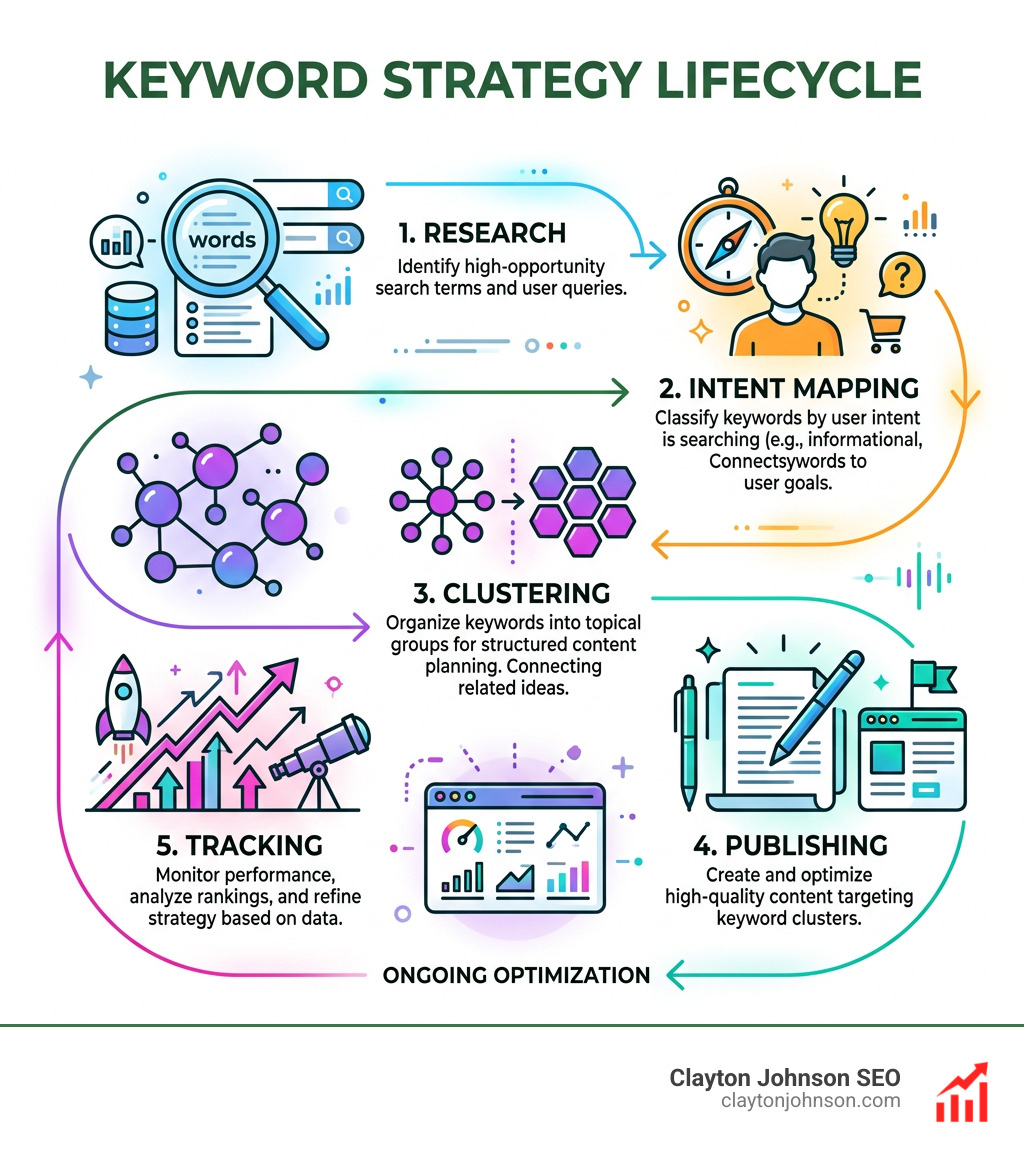
Building a strategy isn’t a one-and-done task; it’s a structured process. We like to break it down into three distinct phases: Brainstorm, Research, and Refine/Organize.

Phase 1: Brainstorming and Seed Keyword Discovery
Before you touch a tool, you need to look at your business. What do you do better than anyone else? What should you be known for?
Start by listing “seed keywords”—broad terms related to your product or service. If you’re an academic unit, this might be “teacher education” or “MBA programs.” From there, think like your audience. What questions are they asking? Tools like Answer Socrates are fantastic for this because they show you the real-world questions people ask around a topic.
For example, a prospective student isn’t just searching for “college.” They are searching for “best teacher education programs” or “how to get financial aid for Michigan State.” These questions form the basis of your search queries.
Phase 2: Researching with Keyword Strategy Examples
Once you have your seeds, it’s time to add data. This is where you use the Google Keyword Planner or paid powerhouses like Semrush and Ahrefs.
In this phase, you are looking for three main metrics:
- Search Volume: How many people are actually looking for this?
- Competition Level: How many other sites are trying to rank for this?
- Keyword Difficulty (KD): A score (usually 0-100) that tells you how hard it will be to crack the first page.
A great tip for beginners is to look for “low-hanging fruit.” These are often long-tail keywords—phrases with 3+ words that have lower volume but much higher intent. You can learn how-to-find-untapped-keywords-like-a-search-engine-ninja by focusing on these specific niches where the big players aren’t looking.
Phase 3: Refining and Organizing into Topic Clusters
Now that you have a massive list, you need to organize it. This is where most people stop, but it’s where the magic happens. You want to group your keywords into “topic clusters.”
A topic cluster consists of:
- Pillar Pages: A comprehensive “hub” page that covers a broad topic (e.g., “The Ultimate Guide to Coffee”).
- Subpages (Cluster Content): Smaller, more specific articles that dive deep into sub-topics (e.g., “Best French Press Coffee Makers” or “How to Roast Coffee Beans at Home”).
This structure builds “topical authority.” When you link these pages together, search engines see that you aren’t just writing one-off articles; you are building a winning-the-ai-search-era-with-intent-based-keyword-research ecosystem. Internal linking is the glue that holds this strategy together.
Mapping Search Intent to Your Keyword Strategy Examples
Search intent is the “why” behind a search. If you target a keyword but your content doesn’t match the reason the person searched for it, you will never rank.
There are 4 types of search intent that we use to shape our keyword strategy examples:
Informational and Navigational Intent
- Informational: The user wants to learn something. (e.g., “what is a keyword strategy?”)
- Navigational: The user is looking for a specific website. (e.g., “Clayton Johnson SEO login”)
These keywords sit at the top of the funnel. This is the awareness stage. You should create educational content, blog posts, and “how-to” guides here. If you’re wondering what-is-informational-intent-anyway, it’s your opportunity to introduce your brand to a user before they are ready to buy.
Commercial and Transactional Keyword Strategy Examples
- Commercial Investigation: The user is comparing options. (e.g., “Semrush vs Ahrefs”)
- Transactional: The user is ready to buy or take action now. (e.g., “buy Dior perfume online” or “hire SEO strategist”)
This is the decision stage. These keywords are often more competitive and expensive in PPC, but they drive the most direct sales leads. Even if a keyword has low volume, if it has high transactional intent, it can be incredibly profitable. We often teach clients how-to-target-low-volume-keywords-for-high-volume-profits by focusing on these “bottom-of-funnel” gems.
Advanced Tactics: Competitor Gaps and AI-Driven Optimization
One of the fastest ways to find new opportunities is to look at what your competitors are doing—and what they aren’t doing. A “Keyword Gap” analysis shows you the terms your competitors rank for that you don’t.
In Google Ads, we also have to decide between different ad group structures. This is a common debate in our keyword strategy examples:
| Strategy | Definition | Best For |
|---|---|---|
| SKAGs (Single Keyword Ad Groups) | One keyword per ad group. | Precise control over ad copy and bids. |
| STAGs (Single Theme Ad Groups) | A group of related keywords per ad group. | Leveraging Google’s AI and machine learning. |
Most modern strategies are moving toward STAGs because they allow you to automate-your-success-using-ai-driven-keyword-optimization. By grouping by theme, you give Google’s AI more data to find the best-performing users.
Furthermore, don’t ignore automated campaign types like Performance Max or Smart Shopping. These can complement a traditional keyword strategy by using your product feed and audience signals to find customers across YouTube, Gmail, and Display, even when they aren’t searching for your specific keywords.
Frequently Asked Questions about Keyword Strategy
How often should I update my keyword strategy?
We recommend a deep dive every 3 to 6 months. Search trends change, new competitors enter the market, and Google’s algorithms are constantly evolving. If you notice a page’s rankings dropping, it might be time to re-evaluate the search intent or check for new keyword gaps.
What are the most common keyword strategy mistakes?
The “Big Two” are keyword stuffing and ignoring the long-tail.
- Keyword Stuffing: Writing for bots instead of humans. If your text sounds like a robot wrote it, users will bounce, and Google will penalize you.
- Ignoring Long-Tail: Everyone wants to rank for “shoes,” but you’ll have much better luck ranking for “red waterproof running shoes for flat feet.” Specificity wins.
How do I measure the success of my keywords?
Don’t just look at rankings. Use Google Search Console to track impressions and click-through rates (CTR). Use Google Analytics to see if those keyword visits are actually turning into conversions or sales. If you have 10,000 visitors but zero leads, your strategy is targeting the wrong intent.
Conclusion
Building a successful keyword strategy is about more than just finding words; it’s about building a system. At Clayton Johnson SEO, we focus on creating scalable traffic systems and growth frameworks that turn fragmented marketing efforts into coherent engines.
Whether you are an e-commerce brand trying to dominate the perfume market or a service business looking for local leads, the principles remain the same: Clarity, Structure, and Leverage. By aligning your content with search intent and organizing it into logical clusters, you create a durable asset that grows in value over time.
Ready to stop chasing tactics and start building a system? Explore our SEO Services to see how we can help you build a keyword strategy that delivers measurable business impact.